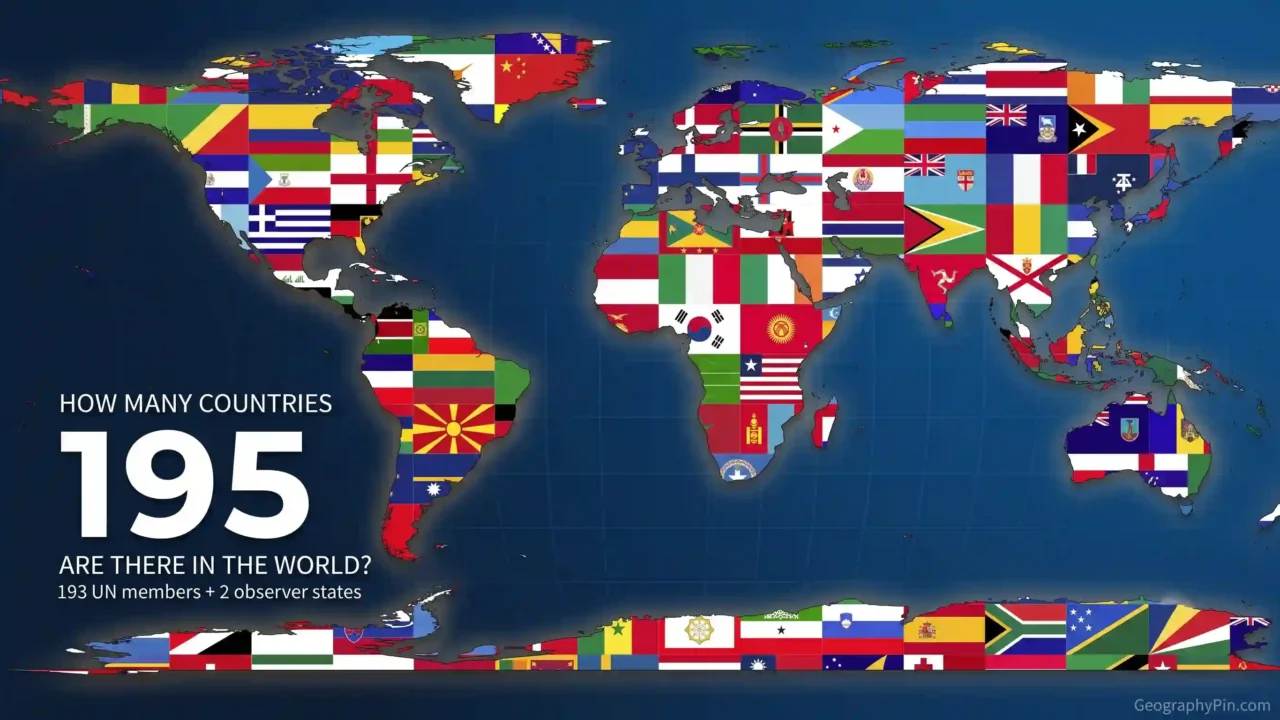
There are 195 countries in the most widely used general-reference count: 193 United Nations member states plus the Holy See and the State of Palestine, the UN’s two non-member observer states. If a question asks only for UN members, the answer is 193, not 195.
How to use this article: Start with the 195-country calculation, see why totals vary, check what qualifies as a country, or choose the right number for your purpose.
The Short Answer: 195 Countries
For ordinary geography questions, schoolwork, and general world references, 195 countries is the clearest answer. It is a defined counting convention, not a claim that every government agrees about every sovereignty dispute.
The 195-country calculation
The calculation is straightforward:
- 193 UN member states: These are full members of the United Nations, with representation and voting rights in the General Assembly.
- 2 UN non-member observer states: The Holy See and the State of Palestine can participate in much of the UN’s work but are not full voting members.
South Sudan became the UN’s 193rd member in July 2011. As of July 2026, no additional state has been admitted, so the formal membership total remains 193 (United Nations, 2026).
The Holy See requires a small naming clarification. It is the sovereign entity that conducts international diplomacy, while Vatican City State provides its territorial base. General country lists may label this single entry “Holy See” or “Vatican City,” but they should not count them as two separate countries.
If you need the names and capitals rather than just the total, GeographyPin’s complete country-and-capital list follows the same 195-entry scope.
Why Country Counts Do Not Always Match
A country total is only meaningful when the counting method is clear. A UN membership list, an Olympic delegation list, a football association directory, and a computer database are designed for different purposes.
The main totals compared
| List or system | Total or scope | What it actually counts |
|---|---|---|
| United Nations membership | 193 | Full UN member states (United Nations, 2026) |
| Common geography reference | 195 | UN members plus its two non-member observer states |
| Olympic Movement | 206 | Recognized National Olympic Committees (International Olympic Committee, 2026) |
| FIFA | 211 | National and territorial football associations (FIFA, 2026) |
| ISO 3166-1 | Not a sovereign-state total | Countries, dependencies, and other areas of geopolitical interest (ISO, 2026) |
The Olympic and FIFA totals do not prove that the world has 206 or 211 sovereign countries. Some territories and constituent nations compete separately even though they are not independent UN members. England, Scotland, Wales, and Northern Ireland, for example, have separate FIFA associations while belonging to one UN member state: the United Kingdom.
Database totals can also be misleading. An international code may be assigned because banks, websites, postal systems, or statistical agencies need to identify an area separately. A code is useful for administration, but it does not automatically settle sovereignty.
What Counts as a Country?
There is no single global authority with the power to settle every claim to statehood. The UN admits members, individual governments decide which states they recognize, and international courts address specific legal questions rather than maintaining one universal country list.
The commonly cited statehood criteria
The 1933 Montevideo Convention describes four characteristics commonly used when discussing statehood:
- A permanent population
- A defined territory
- A government
- The capacity to enter into relations with other states
These characteristics are important, but they do not function like an automatic approval checklist. Effective control, recognition by other states, treaty relations, unresolved territorial claims, and admission to international organizations all affect how an entity is treated in practice.
Country, state, nation, and territory are different ideas
- Sovereign state: A political and legal entity with authority over its affairs and territory.
- Country: The everyday geographic term usually used for a sovereign state, although it is sometimes applied more loosely.
- Nation: A community linked by identity, culture, language, history, or political aspirations. A nation does not necessarily have its own state.
- Territory: A geographic area that may be dependent, autonomous, administered by another state, or disputed.
- Constituent country: A country forming part of a larger sovereign state, such as the countries within the United Kingdom.
This is why a place can be widely called a country in cultural or sporting contexts without appearing as a separate member of the United Nations.
How the 195 Countries Are Distributed
The following breakdown assigns every entry in the 195-country convention to one continent. It uses UN regional placement as its base, divides the Americas into North and South America, and treats Oceania as the wider region containing Australia and the Pacific island states (United Nations Statistics Division, 2026).
| Continent or region | Countries | Counting note |
|---|---|---|
| Africa | 54 | UN-member-state scope |
| Asia | 48 | Includes the State of Palestine |
| Europe | 44 | Includes the Holy See |
| North America | 23 | Includes Central America and the sovereign Caribbean states |
| South America | 12 | Sovereign-state count |
| Oceania | 14 | Does not count every dependent Pacific territory |
| Antarctica | 0 | No sovereign country is counted there |
| Total | 195 | One placement per country |
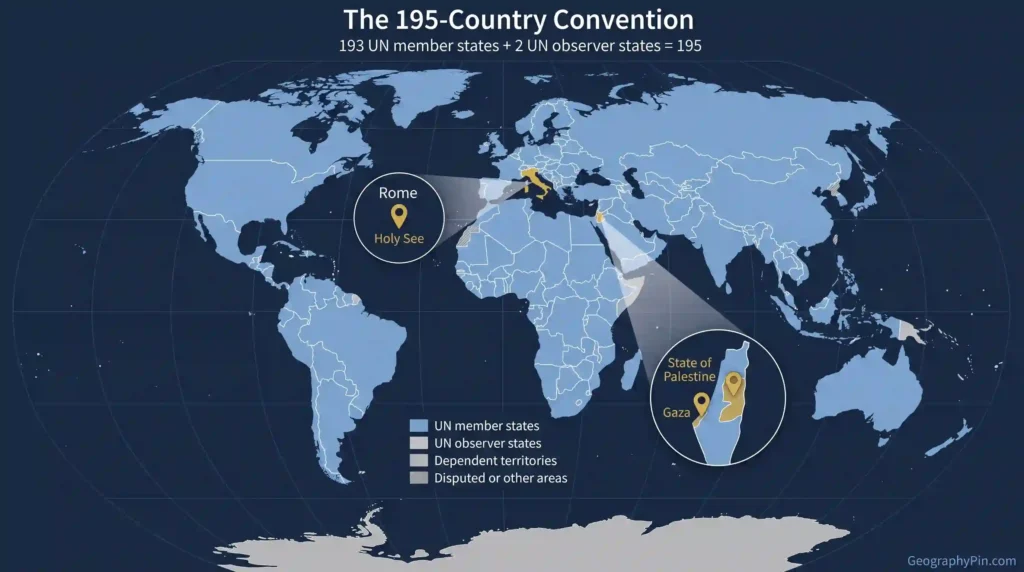
Table downloads (2)
- Why major country-like lists produce different totals (6 × 3)View tableDownload CSV
- Countries by continent under the 195-country convention (9 × 3)View tableDownload CSV
Continental totals can change when a source classifies transcontinental countries differently or treats North and South America as one continent. GeographyPin’s continents explainer compares the major seven-, six-, and five-continent models.
The Political Cases Behind Alternative Counts
Most disagreement is concentrated in a small number of places where effective self-government, international recognition, territorial claims, and organizational membership do not all point in the same direction.
Three cases that change some lists
Taiwan: Taiwan is self-governing and is treated separately in many trade, travel, and statistical contexts, but it is not a UN member. The People’s Republic of China claims sovereignty over it, and its international status remains contested. Standard 195-country lists do not add Taiwan as a separate entry.
Kosovo: Kosovo declared independence from Serbia in 2008 and is recognized by many, but not all, UN member states. It is not a UN member. In 2010, the International Court of Justice concluded that Kosovo’s declaration of independence did not violate international law, but the opinion did not require other governments to recognize Kosovo or settle its status for every organization.
Western Sahara: The UN treats Western Sahara as a Non-Self-Governing Territory whose final status remains unresolved. The Sahrawi Arab Democratic Republic is nevertheless a member of the African Union, which has 55 member states. UN-based world lists normally give Africa 54 sovereign countries because they do not add Western Sahara as a separate country.
When a source gives a total of 197 countries, it commonly starts with the usual 195 and then adds Kosovo and Taiwan. That is a chosen reference convention, not the UN’s total; UN membership remains 193.
No recognition threshold solves every case. Requiring recognition from one government would be arbitrary, while requiring recognition from every government would exclude states involved in diplomatic disputes. Reliable lists therefore state their inclusion rules instead of presenting one politically neutral “official” total that does not exist.
Which Number Should You Use?
The best answer depends on the wording of the question and what the resulting list will be used for.
A practical rule for quizzes, maps, and data
- General geography question: Answer 195 countries.
- Question asking for UN members: Answer 193 member states.
- School assignment: Use the convention requested by the textbook or teacher. If none is specified, write “195: 193 UN members plus two observer states.”
- Map or spreadsheet: Add a scope note explaining how observer states, disputed entities, and dependent territories are handled.
- Sports question: Use the organization’s own membership list, not the general country total.
- Legal or geopolitical analysis: Name the entities included and explain the recognition standard instead of relying on one number.
If you are preparing a presentation or article, GeographyPin’s free world map maker can highlight pasted country lists. The scope note should remain visible whenever the selection involves disputed or dependent territories.
FAQ
Are there 193, 195, or 197 countries?
All three figures can appear, but they use different rules. There are 193 UN members. Adding the Holy See and State of Palestine produces the common total of 195. A 197-country list usually adds Kosovo and Taiwan as well, although that is not a universally accepted official total.
Why do the Olympics have 206 national committees?
The International Olympic Committee recognizes 206 National Olympic Committees, including committees representing some territories that are not separate UN member states. Olympic membership and sovereign statehood are different classifications.
Is Vatican City counted as a country?
Yes, it occupies one place in the common 195-country total. The precise UN observer is the Holy See, while Vatican City State is its territorial base. General references often use “Vatican City” as the familiar country label.
Is the State of Palestine included in the 195 countries?
Yes. The State of Palestine is one of the UN’s two non-member observer states and is included alongside the 193 full members in the common 195-country convention.
Is Taiwan included in the 195 countries?
No. Taiwan is treated separately in many practical datasets and operates its own governing institutions, but it is not a UN member or observer state. Some broader lists add it, which is one reason totals above 195 appear.
Are Greenland and Puerto Rico countries?
They may appear separately in travel, sports, or statistical material, but they are not sovereign UN member states. Greenland is an autonomous territory within the Kingdom of Denmark, while Puerto Rico is a United States territory.
Can the number of countries change?
Yes. The total can change when a new state forms, existing states unite or dissolve, or an applicant gains UN membership. Recognition decisions can also change how individual governments and organizations construct their own lists.
What Did We Learn Today?
The clearest general answer is 195 countries: 193 UN members plus two non-member observer states. Use 193 when the question specifically asks about UN membership. Higher totals usually add partially recognized states or use organizations with separate membership rules, so a careful answer should always identify its counting method.
Sources & Data Notes
This article was prepared with AI assistance and editorial review, using standard reference material from the United Nations and its Statistics Division, the Organization of American States, the International Court of Justice, the African Union, the International Olympic Committee, FIFA, and ISO. Membership figures are presented as current to July 2026; broader figures may be rounded where appropriate, and newer releases, recognition decisions, or membership changes may alter some details.