The trick is that borders don’t stop at the edge of a continent. Once you count overseas territories and remote islands, a different country jumps to the top of the list.
This article explains which countries have the most time zones, how we’re counting them, and why France quietly beats everyone else.
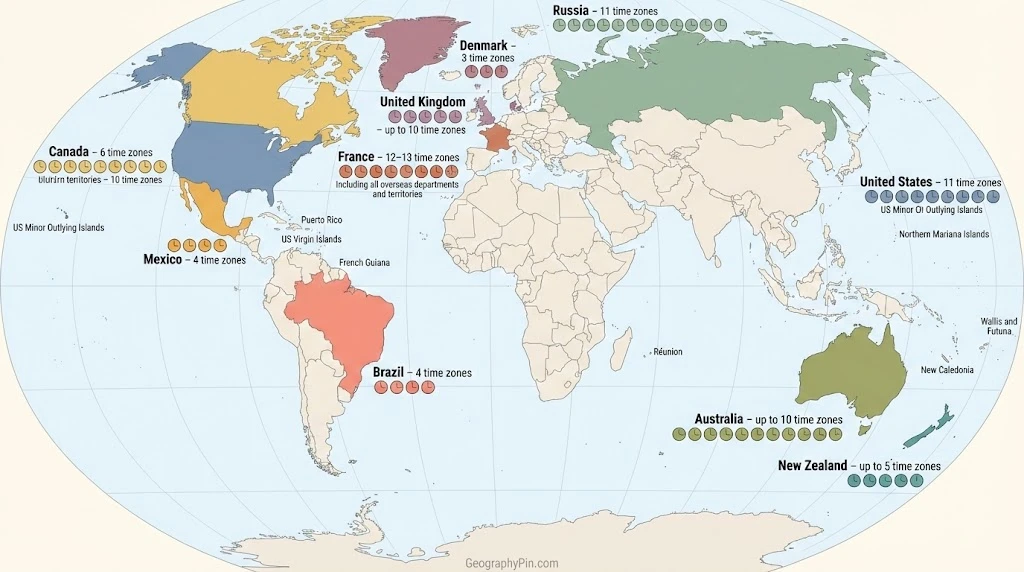
France is commonly listed as the country with the most time zones: 12 across its mainland and overseas territories, or 13 in sources that also count its Antarctic claim. The United States and Russia usually come next with 11 each once you include remote islands and territories.
Key facts at a glance
- France: 12 time zones, or 13 if an Antarctic claim is counted in the list you’re using.
- United States & Russia: 11 time zones each in many rankings once territories and outlying islands are included.
- United Kingdom & Australia: about 9 time zones each when overseas territories and Antarctic stations are counted.
- Global picture: there are about 38 distinct UTC offsets in use worldwide as standard times (counts vary slightly by definition).
How to use this article
- Need the quick quiz answer? Start with the ranked list.
- Want the logic behind the numbers? Go to how time zones work.
- Here for the stories and weird cases? Jump to case studies and the FAQ.
Which Country Has the Most Time Zones in the World?
France uses 12 official civil time zones worldwide, or 13 in some lists that include an uninhabited Antarctic claim. The United States and Russia each have 11 time zones in many rankings once you include their island territories and remote possessions. The difference between 12, 13, and 11 comes down to how a list treats overseas territories, tiny outlying islands, and Antarctica.
Those headline numbers come from the way time-keeping references group official civil time by country, using legal definitions and widely used datasets such as the IANA time zone database. Authors then decide whether to include overseas territories, uninhabited islands, or Antarctic claims.
This means “the country with the most time zones” isn’t just about the mainland map you see in school. France’s European core uses one time zone. What lifts it is the worldwide spread of French territories. Russia’s 11 zones sit mostly on one huge landmass, while the United States mixes a continental core with scattered islands.
Countries With the Most Time Zones (Ranked List)
Here is a ranked list of countries with the most time zones, counting standard civil time and including overseas territories and remote islands where they are commonly listed with the country.
| Country | Approx. number of time zones (incl. territories) | Example UTC offsets | Key notes |
|---|---|---|---|
| France | 12–13 | UTC−10 to UTC+12 (plus fractional offsets) | Single zone in Europe; wide spread of overseas regions in the Pacific, Atlantic, Indian and Southern Oceans; some lists add a 13th zone for an Antarctic claim. |
| United States | 11 | UTC−12 to UTC+12 | Four main continental zones plus Alaska and Hawaii; US law defines 9 standard zones for the USA and its dependencies, while many references add 2 more for uninhabited islands (often bringing the total to 11). |
| Russia | 11 | UTC+02 to UTC+12 | Continuous chain of time zones across Eurasia, with up to 10 hours between western and eastern borders. |
| United Kingdom | 9 | UTC−8 to UTC+6 | Mainland UK on UTC/UTC+1 seasonally; overseas territories from the Caribbean to the Indian Ocean and Pacific. |
| Australia | 9 | UTC+05 to UTC+11 (plus fractional offsets) | Several mainland zones, plus islands like Lord Howe and Norfolk, and Antarctic stations that use different local times. |
| Canada | 6 | UTC−08 to UTC−03:30 | Six primary time zones from the Pacific coast to Newfoundland’s half-hour zone. |
| Denmark | 5 | UTC−04 to UTC+01 | Kingdom includes Greenland and the Faroe Islands; some references differ on whether Greenland’s sub-zones are grouped as five or six distinct time zones. |
| New Zealand | 5 | UTC−11 to UTC+13 | New Zealand, the Chatham Islands and parts of the wider Realm of New Zealand near the International Date Line; different sources group these slightly differently but usually reach about five zones. |
| Brazil | 4 | UTC−05 to UTC−02 | Wide east–west spread across South America, with several official zones. |
| Mexico | 4 | UTC−08 to UTC−05 | Multiple zones across Baja California and the Mexican mainland. |
Most modern rankings follow this same pattern: France in first place with 12 time zones (or 13 including Antarctica), the United States and Russia tied in second with 11 each, then the United Kingdom and Australia on roughly nine, with Canada just behind on six. The exact totals can shift by one depending on the rules, but the order at the top is usually very stable.
Which country has the most time zones without overseas territories?
If you ignore overseas territories and look only at the main landmass, Russia is the clear winner. It spans 11 time zones from UTC+2 in Kaliningrad to UTC+12 in the far east, and 10 of those form a nearly continuous band across northern Eurasia.
To understand why different lists sometimes disagree on the headline numbers, we need to look at how time zones are defined and counted.
How Time Zones Work (and How We Count Them in This Article)
Time zones exist because the Earth rotates. When the Sun is high in the sky over one place, it is still dark thousands of kilometres away. To keep railways, flights, and global trade running, countries define standard times based on UTC offsets (differences from Coordinated Universal Time, for example UTC−5 or UTC+3), not on every town’s local solar noon.
In a simple textbook model, the world would have 24 time zones, each covering 15 degrees of longitude and separated by one exact hour.
In reality, things are messier. Political borders, national decisions, and the International Date Line bend the grid, and many places use half-hour or even 45-minute offsets. Counting all of these, there are about 38 distinct UTC offsets used as standard time in the world today (depending on how a source groups edge cases).
That is why different sources can disagree about a “list of time zones by country.” Some lists only count whole-hour offsets. Others group territories that share the same legal time. And some fold uninhabited Antarctic claims into the total, while others ignore them. There is no single worldwide authority that enforces one way of counting, so writers have to explain their method.
Standard time, legal time and daylight saving time
To keep things clear, it helps to separate three ideas.
- Standard time zone: the UTC offset that defines “normal” time for a region, such as UTC+01:00.
- Legal time / clock time: what national law says clocks must show, which can differ from ideal solar time for political or economic reasons.
- Daylight saving time (DST): a seasonal one-hour (sometimes 30-minute) shift used by many countries in summer.
In this article we are counting standard time zones used for civil time, not treating summer time as a separate zone. When we say France has “12 time zones,” that means 12 distinct base offsets used as normal legal time somewhere in French territory during the year. Some sources raise that to 13 by counting an Antarctic claim or territory in their total.
Here is how we count “time zones by country” for the rankings above.
- We include overseas departments and territories that are under the country’s sovereignty or full administration.
- We include half-hour and 45-minute offsets as separate zones.
- We exclude purely military time zones and historic zones no longer in use.
- We do not count daylight saving time shifts as extra zones; we only care about the base offset.
Sources & method: These counts follow the IANA time zone database, national laws on legal time and widely used “time zones by country” tables from specialist references such as timeanddate and global atlases.
With those rules, the ranking “France > United States = Russia > United Kingdom = Australia > Canada” matches the main specialist references used by quiz writers, exam sites, and atlas publishers.
Case Studies and Oddities: How Countries Ended Up With So Many (or So Few) Time Zones
To understand why some countries have many time zones and others stick to one, it helps to look at a few stories. Geography matters, but so do empires, politics, and decisions about national unity.
Below are short case studies for the main multi-zone countries, followed by the one-zone giants like China and India and the quirks of half-hour offsets.
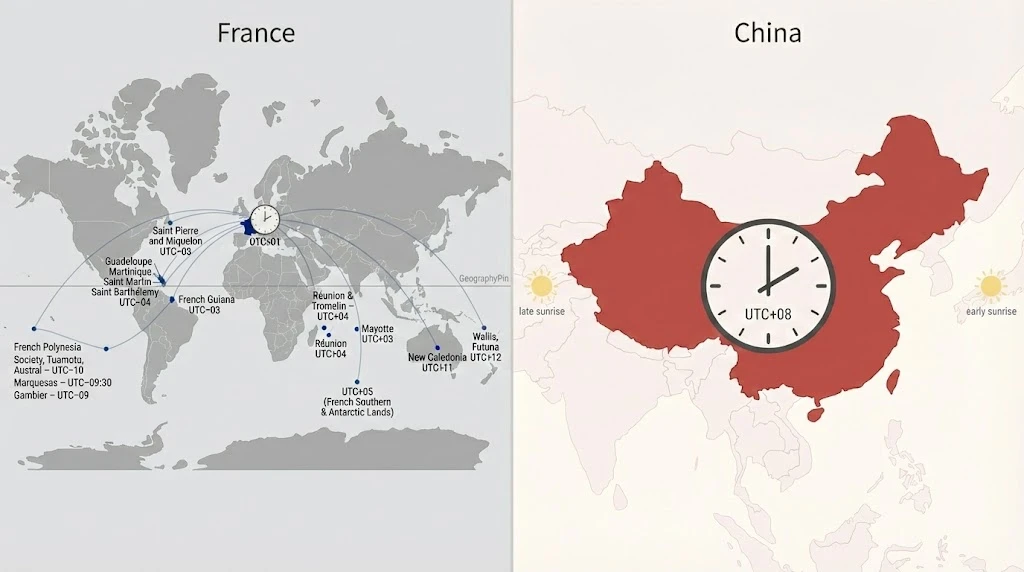
France: a global time-zone arc from Pacific to Antarctic
Metropolitan France in Europe is simple. It uses Central European Time (UTC+01:00 in winter, UTC+02:00 in summer). The picture changes completely once you add Overseas France.
French Polynesia in the Pacific uses UTC−10, UTC−9:30, and UTC−9. In the Atlantic, parts of the Caribbean and French Guiana use time zones around UTC−4 and UTC−3. In the Indian Ocean, Réunion and Mayotte sit on UTC+4 and UTC+3. At the far end, Wallis and Futuna is on UTC+12.
This chain of islands and distant regions is why France shows up at the top of almost every “countries with the most time zones” list. Some writers add a thirteenth time zone for a French Antarctic claim, which is why you will see both “12” and “13” in different quizzes and blog posts.
United States: continental spread plus scattered islands
The United States is usually taught with four main time zones in the contiguous states: Eastern, Central, Mountain, and Pacific. Add Alaska and Hawaii and you reach six primary zones that cover the 50 states.
US federal law recognises nine standard time zones once you include the major territories (like American Samoa and Guam). Many time-keeping references reach a total of 11 when they also add two extra zones for uninhabited islands such as Baker and Howland (often listed at UTC−12) and Wake Island (often listed at UTC+12).
In everyday life, this means a “national” live TV event can start at one local time on the East Coast, another in California, and a completely different time again for Guam or American Samoa. Airlines, sports leagues, and the federal government rely heavily on UTC and clear time-zone labels to keep schedules in sync.
Russia: 11 zones across Eurasia
Russia stretches across northern Eurasia with an east–west time difference of up to ten hours. At the western edge, Kaliningrad uses UTC+2, while at the eastern edge, regions such as Kamchatka use UTC+12. In between, a chain of 11 standard time zones steps across the country.
Over the past few decades, the Russian government has experimented with reducing and re-expanding the number of time zones and with changing seasonal clock rules. (Time policies can shift, which is one reason different references sometimes disagree on older totals.)
Railway timetables used to run on Moscow time. Now they mostly follow local time to reduce confusion. The geography is simple: a broad band across the map. The politics of keeping people happy with their clocks has been much more complex.
United Kingdom: a small core with global leftovers
The United Kingdom itself uses Greenwich Mean Time (UTC+0) in winter and British Summer Time (UTC+1) in summer. The variety comes from the network of British Overseas Territories.
Bermuda, the Falkland Islands, Gibraltar, Saint Helena, the British Indian Ocean Territory, and a cluster of Caribbean islands all observe different local times, pushing the UK’s total to about nine time zones in many modern rankings.
This is also where the history of time zones became formal. Greenwich, near London, became the world’s reference meridian in the late 19th century, and GMT was the original standard from which modern UTC grew. The twist is that the “home of time” now shares its time-zone crown with former colonial rivals.
Australia and Canada: big land, scattered communities
Australia has a surprisingly rich mix of time zones. The mainland is split into Western, Central, and Eastern time, with Central using a half-hour offset (UTC+9:30) in places such as South Australia. Add in Lord Howe Island, Norfolk Island, and several Antarctic stations, and some lists reach a total of around nine zones for Australia.
Canada runs from the Pacific coast to the Atlantic and beyond, with six main civil time zones. The most famous quirk is Newfoundland Time at UTC−3:30, sitting half an hour ahead of neighbouring Atlantic Time. This half-hour step is part of Canada’s identity. It often shows up in jokes, travel stories, and airline warnings.
One-zone giants: China and India
China is almost as wide as the contiguous United States, stretching across roughly five “ideal” time zones and about 3,250 miles (around 5,200 kilometres) from east to west. Yet the entire country officially uses a single time zone: China Standard Time (Beijing Time) at UTC+08:00.
This creates very late sunrises and sunsets in the far west but keeps the country on one legal clock, which the government treats as a symbol of unity. In some western regions, people quietly follow an unofficial local time for daily life while still using Beijing Time for trains and official business.
India is another large country that uses just one official time zone: Indian Standard Time (IST), UTC+05:30. The half-hour offset began as a compromise, and modern policy keeps IST as the single national reference to avoid confusion in government, business, and digital systems.
Half-hour and 45-minute offsets: why some clocks sit in between
Several countries choose time zones that are offset by 30 or 45 minutes, not a full hour.
- India at UTC+5:30, using a half-hour compromise across the country.
- Nepal at UTC+5:45, with a 45-minute offset that sits between neighbours.
- Parts of Australia at UTC+9:30 or UTC+10:30, including central and island regions.
- Newfoundland in Canada at UTC−3:30, half an hour ahead of Atlantic Time.
These in-between zones usually line up better with the position of a country’s main population or political centre than a neat whole-hour offset would.
From a technical point of view, they are just extra UTC offsets in the global list. But they can easily catch travellers and planners off guard if they forget that not every time zone shifts in one-hour steps.
These examples raise some common questions about how many time zones countries have, so let us answer them directly.
FAQ
Does France really have more time zones than Russia and the United States?
Yes. When you include its overseas departments and territories, France is commonly listed with 12 civil time zones, or 13 if a source also counts an Antarctic claim. The United States and Russia are each linked to 11 time zones in many modern rankings once you include remote islands and territories, so France stays in first place.
How many time zones does the US have?
If you only look at the 50 states, the United States uses six main time zones: Eastern, Central, Mountain, Pacific, Alaska, and Hawaii. By law, the USA and its dependencies are assigned nine standard time zones. Many references reach 11 when they also include uninhabited islands that sit on extra offsets (often listed at UTC−12 and UTC+12).
How many time zones does Russia have?
Modern Russia spans 11 standard time zones, from UTC+2 in Kaliningrad to UTC+12 in the far east. The government has experimented with changing the number of zones and seasonal clock rules at different times, which is why older sources sometimes show different totals.
How many time zones does China use, and why only one?
China officially uses just one time zone, China Standard Time (UTC+08:00), often called Beijing Time. Geographically, the country covers about five ideal time zones, but the government keeps a single legal time to underline national unity and simplify administration. In far-western regions, people sometimes use an informal local time alongside Beijing Time.
How many time zones should a country have?
There is no fixed rule. In theory, a country should add a new time zone roughly every 15 degrees of longitude. In practice, governments balance geography against politics and convenience. Some large countries choose many zones to keep solar time sensible. Others, like China and India, accept odd sunrise and sunset times in some regions in exchange for a single, simple national time.
What is the maximum possible number of time zones in the world?
If we only used whole hours, we would have 24 time zones from UTC−12 to UTC+12. Because of half-hour and 45-minute offsets, plus the way the International Date Line bends, the real world uses about 38 distinct UTC offsets as standard times. In theory, governments could define even more fractional offsets, but 38 already feels complicated enough.
Which country has the most time zones without counting overseas territories?
Russia has the most time zones without overseas territories, with 11 standard zones from UTC+2 to UTC+12 across its main landmass.
Why do some lists say the US or Russia have more time zones than France?
Different lists use different rules. Some ignore Antarctic claims, some exclude uninhabited islands, and some group certain territories differently. Lists that drop France’s Antarctic claim (or group a few territories in another way) can make France look equal to, or behind, the United States or Russia. When you count standard civil time zones for each country in a consistent way, France usually comes out ahead.
What Did We Learn Today?
Here is the short version if you skimmed the article.
- France, thanks to its overseas territories, tops the list of countries with the most time zones, ahead of both Russia and the United States.
- Most rankings count time zones including overseas territories, and small islands and Antarctic claims can change the exact totals by one.
- There are about 38 distinct UTC offsets in use worldwide, far more than the simple textbook picture of 24 neat zones.
- Large countries like China and India deliberately use a single national time, trading geographic accuracy for political and practical simplicity.
- Half-hour and 45-minute offsets, such as those in India, Newfoundland and parts of Australia, show how flexible time zones become when countries fine-tune them for local needs.
Time zones are a reminder that geography, history, and politics all meet on your wristwatch. The next time you see France sitting above Russia and the United States in a “country with the most time zones” quiz, you will know it is not a trick question, just a story of empires, islands, and a lot of different clocks.
If you enjoyed this explainer, you might also like reading about why some countries have more than one capital city or how the International Date Line shapes our calendar and time zones.