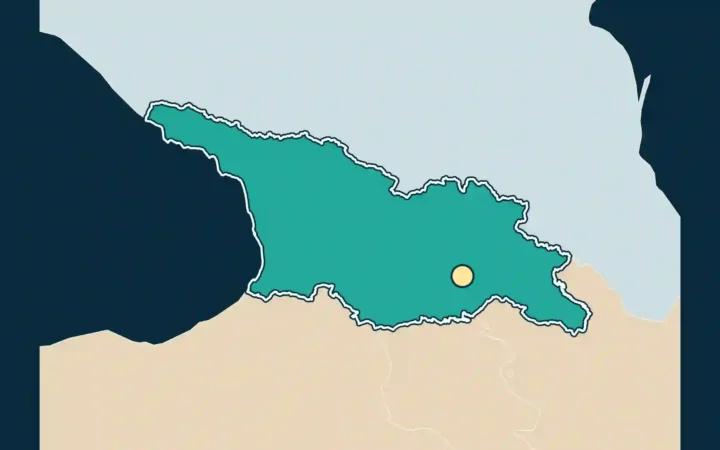
Most countries touch several others, but a small group has exactly one land neighbor. These “single-border” states can be tiny enclaves inside one country, narrow peninsulas connected by one land bridge, or nations sharing a single island border. Using standard sovereign-state land-border counting, the commonly cited core list is 15 countries.
How to use this page: If you want the list fast, start with the quick list or the table. If you’re unsure what counts as a “neighbor,” begin with the definition. If you’ve seen lists that disagree (especially around Denmark), go straight to edge cases.
A “single-border nation” is a sovereign country that shares exactly one land border with another sovereign state. Using standard land-border counting (not sea borders, not territories), the core set is 15 countries—including Portugal (Spain), the United Kingdom (Ireland), Qatar (Saudi Arabia), The Gambia (Senegal), Lesotho (South Africa), and microstates like Vatican City and San Marino (Italy).
- Brunei — Malaysia
- Dominican Republic — Haiti
- The Gambia — Senegal
- Haiti — Dominican Republic
- Ireland — United Kingdom
- Lesotho — South Africa
- Monaco — France
- Papua New Guinea — Indonesia
- Portugal — Spain
- Qatar — Saudi Arabia
- San Marino — Italy
- South Korea — North Korea
- Timor-Leste — Indonesia
- United Kingdom — Ireland
- Vatican City — Italy
You may also see Denmark in older lists; it’s now best treated as an edge case because of a tiny Denmark–Canada land border on Hans Island/Tartupaluk.
What “only one land neighbor” means (and what it doesn’t)
In geography, “neighbor” usually means a country you share a land border with—an on-the-ground boundary that people could, in theory, cross without taking a boat or plane. Coastlines and maritime boundaries don’t add “neighbors,” even if two countries sit close across a narrow sea.
The rule we use on this page:
- A country qualifies if it shares land borders with exactly one sovereign state.
- The border can be short or long, and it can be split into separate segments (as long as every segment touches the same sovereign neighbor).
- We do not count sea borders, ferries, or general “close across water” situations.
- We do not count dependent territories as separate neighbors (e.g., Gibraltar isn’t a sovereign state).
For Ireland, we treat the United Kingdom as the one land neighbor via Northern Ireland, because the border is on the island of Ireland even though Northern Ireland is not a sovereign country.
A quick note on “neighbors” vs. territories
Some borders involve overseas territories or special regions (think Gibraltar, Ceuta/Melilla, or military base areas). Those situations can confuse “neighbor counts,” but they don’t change the core idea here: we’re counting only land borders between sovereign states.

The full list of single-border countries
Below is the practical, reader-first list. Most examples fall into repeating patterns: microstates enclosed by one country (like Vatican City), peninsulas connected by one land border (like Portugal), and shared-island borders (like Haiti and the Dominican Republic). A few are “near-enclaves” (like Monaco) where the country has a coastline but only one land border.
| Country | Only land neighbor | “Type” (why it has one neighbor) | Quick note |
|---|---|---|---|
| Brunei | Malaysia | Separated border segments | Two separated parts touch the same neighbor (Malaysia). |
| Dominican Republic | Haiti | Island border | Shares Hispaniola; one land neighbor. |
| The Gambia | Senegal | River corridor / near-enclave | A narrow state wrapped by Senegal, opening to the Atlantic. |
| Haiti | Dominican Republic | Island border | Shares Hispaniola; one land neighbor. |
| Ireland | United Kingdom | Island border | Land border is with Northern Ireland (UK) only. |
| Lesotho | South Africa | Enclave (surrounded) | Fully enclosed by one country (a classic enclave case). |
| Monaco | France | Microstate (near-enclave) | Land border only with France; coastline on the Mediterranean. |
| Papua New Guinea | Indonesia | Island border | Shares the island of New Guinea; one land border only. |
| Portugal | Spain | Peninsula edge | Iberian Peninsula; one land route out, extensive maritime access. |
| Qatar | Saudi Arabia | Peninsula connection | A single land link; strong reliance on sea/air routes too. |
| San Marino | Italy | Microstate enclave | Completely surrounded by Italy. |
| South Korea | North Korea | Divided peninsula | The DMZ runs about 155 miles (250 km) across the peninsula as a buffer zone. |
| Timor-Leste | Indonesia | Island border | Shares the island of Timor; the rest is coastline. |
| United Kingdom | Ireland | Island border | Its only land border is on the island of Ireland (Northern Ireland–Ireland). |
| Vatican City | Italy | Microstate enclave | Tiny land border entirely within Rome. |
If you ever see totals that differ, the difference almost always comes from definitions (sovereign states vs. territories) or special edge cases like Denmark/Canada (Hans Island). The “core” idea stays the same: one land neighbor means one sovereign-state land border relationship.
Types of single-border geography (why this happens)
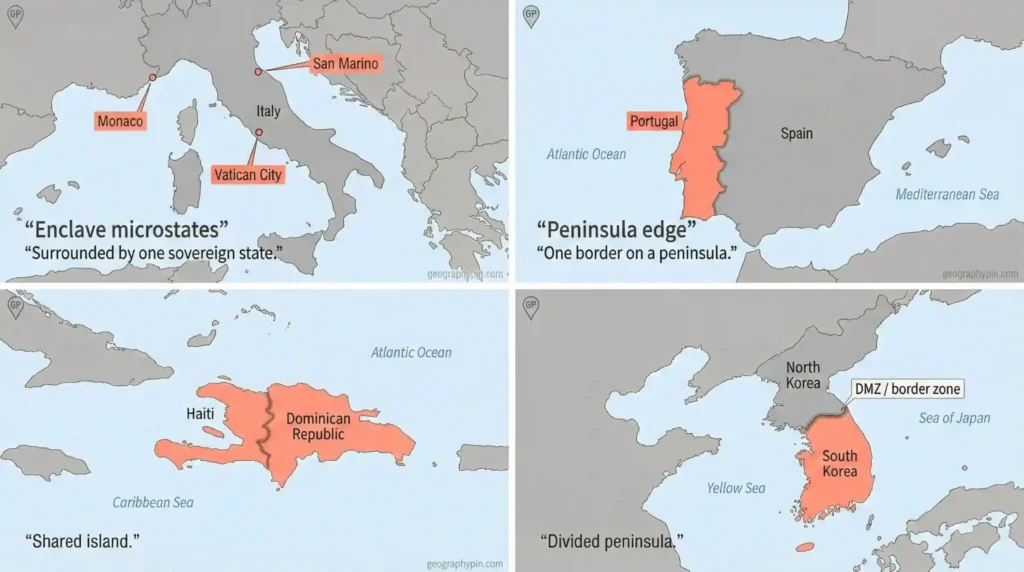
Single-border countries follow a few repeatable map patterns. Once you know the patterns, you can predict them quickly: the country is either wrapped inside one neighbor, connected by a single land bridge, or sharing an island with just one other state.
At a glance (types → examples):
- Enclaves/near-enclaves: Vatican City, San Marino, Lesotho, Monaco
- Peninsula edge/connection: Portugal, Qatar
- Shared-island borders: Haiti–Dominican Republic, Ireland–United Kingdom, Timor-Leste–Indonesia, Papua New Guinea–Indonesia
- Split territory, same neighbor: Brunei
1) Enclaves and near-enclaves (one country surrounds you)
Microstates like Vatican City and San Marino are the classic examples: the surrounding country controls every land approach, so there’s no second border to count. Lesotho is the larger-scale version—an entire mountainous country fully surrounded by South Africa. Monaco is not fully surrounded (it has coastline), but its only land border is still with France, which keeps it in the single-border category.
2) Peninsula edge states (one land bridge to the rest of the continent)
Portugal sits on the western edge of Iberia, so Spain is the only country it touches by land. Qatar fits the same “peninsula connection” shape: one land border to Saudi Arabia, with the rest being coastline. In these cases, the sea acts like a hard limit—so there’s only one land boundary to count.
3) Shared-island borders (one neighbor on the same island)
Some countries have one neighbor because they share an island with just one other state. Haiti and the Dominican Republic split Hispaniola. Ireland shares a land border with the United Kingdom via Northern Ireland. Timor-Leste shares Timor with Indonesia. Papua New Guinea shares the island of New Guinea with Indonesia.
4) “Two borders, same neighbor” (separated segments)
Brunei is the clean reminder that “only one land neighbor” doesn’t always mean “only one border line.” Brunei has separated territories on Borneo, but every land border segment is still with Malaysia—so the neighbor count remains one. That’s why the definition focuses on the sovereign state across the border, not on how many separate boundary pieces exist.
Why having one neighbor matters (trade, security, and daily life)
Having only one land neighbor is not automatically “good” or “bad,” but it does shape a country’s options. One border can simplify routines (one main overland route, fewer crossing points to manage), but it can also concentrate dependency and risk.
In practice, one land neighbor often means:
- Trade chokepoints: disruptions hit harder if the main land corridor is blocked.
- Resilience planning: ports and airports become strategic backups.
- Diplomatic focus: the “one neighbor relationship” can dominate crisis planning.
- Border management pressure: one line carries outsized attention and symbolism.
Economic dependence and supply routes
Enclaves and surrounded states feel this most. Lesotho’s road-and-rail reality is tied to South Africa’s networks. For small European enclaves, integration can be smooth and stable, but everyday movement (commuting, deliveries, emergency access) is still linked to the surrounding country’s rules. Peninsula edge states like Portugal reduce that risk by leaning heavily on seaports, which can balance the “one land gate” issue.
Security, leverage, and border politics
When there’s only one land neighbor, that border can become extremely sensitive. South Korea’s only land border sits across a heavily fortified buffer zone, which is a very different reality than, say, Monaco’s quiet land boundary with France. In general, one border can concentrate both risk and leverage because there isn’t an alternative land route to diversify pressure.
| Area | What often changes |
|---|---|
| Trade & transport | Overland routes concentrate at fewer crossings; ports/air routes become strategic backups. |
| Diplomacy | The “one neighbor relationship” can dominate foreign policy and crisis planning. |
| Borders & identity | Border regions may carry outsized cultural/economic importance. |
| Resilience | Disruptions hit harder unless the country can pivot to sea/air supply quickly. |
The simple takeaway: one land neighbor usually means fewer land options, so the country compensates—either through strong agreements with that neighbor, or by building capacity in sea and air connections.
Edge cases & common confusions
Lists like this can get messy when people mix up land borders with sea proximity, count territories as separate “neighbors,” or rely on older datasets that pre-date recent boundary changes. Here are the most common reasons lists differ.
- Territories vs. sovereign states: dependent territories are not counted as separate neighbors.
- Fixed links (causeways/bridges): these are connections, but they’re not typically treated as “natural land borders.”
- Boundary changes: rare, but real—see the Denmark/Canada case below.
Denmark & Canada: Hans Island (Tartupaluk) changed the count
Older “single-border” lists often included Denmark because Denmark proper has one land border (with Germany). But in 2022, Canada and the Kingdom of Denmark (together with Greenland) resolved the Hans Island/Tartupaluk dispute by creating a tiny international land boundary on the island. That means the Kingdom of Denmark now has a second land-border neighbor (Canada), even though Denmark proper still borders only Germany.
Countries with zero land neighbors (often confused with “one neighbor”)
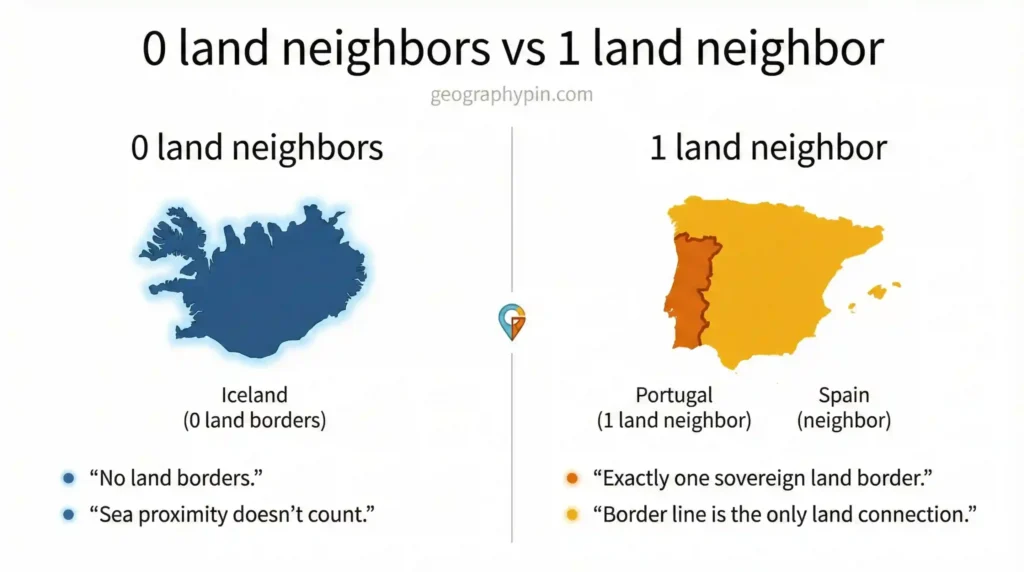
Island states like Iceland, Japan, New Zealand, Madagascar, Sri Lanka, and many Caribbean nations have no land borders at all. They may have close maritime neighbors and strong links across water—but in the strict “land neighbor” sense, they’re a different category than Portugal or Qatar.
A quick “near-miss” table: commonly miscounted cases
| Often confused case | What people assume | What’s actually going on |
|---|---|---|
| Denmark | “It borders only Germany, so it’s always single-border.” | Denmark proper borders Germany, but the Kingdom of Denmark has a tiny land border with Canada via Greenland at Hans Island/Tartupaluk. |
| Brunei | “Two neighbors because it’s split.” | Two border segments, but both touch the same neighbor: Malaysia. |
| Ireland | “No land neighbors because it’s an island.” | It has one land border on the island: with the UK via Northern Ireland. |
| Microstates (Monaco, Vatican, San Marino) | “They don’t count.” | They are sovereign states with one land neighbor; size doesn’t change the definition. |
Table downloads (3)
- Countries with exactly one land neighbor (sovereign-state border count) (16 × 4)View tableDownload CSV
- Common “real-world” effects of a single land neighbor (varies by country) (5 × 2)View tableDownload CSV
- Examples of common neighbor-count confusions (5 × 3)View tableDownload CSV
If you find a list that looks different from the one above, check (1) whether it’s counting territories, and (2) whether it was written before boundary updates like Hans Island/Tartupaluk.
FAQ
How many countries have only one land neighbor?
Using the standard “sovereign-state land border” definition, the commonly cited core list is 15. Lists can differ at the margins if they treat edge cases differently (especially Denmark/Canada after the Hans Island/Tartupaluk agreement) or mix in territories.
Does “only one neighbor” include sea borders?
No. This is about land neighbors only. A country can have one land neighbor and still face multiple countries across the sea or have major shipping links.
Is Denmark really a single-border country?
It depends on what you mean by “Denmark.” Denmark proper has one land border (Germany). But the Kingdom of Denmark (via Greenland) also has a tiny land border with Canada on Hans Island/Tartupaluk, so many newer references treat Denmark as an edge case rather than a clean “one land neighbor” example.
Why are Haiti and the Dominican Republic both on the list?
They share the island of Hispaniola and have exactly one land border with each other. Each country’s only land neighbor is the other one.
Are there countries completely surrounded by one neighbor?
Yes. Lesotho is fully surrounded by South Africa, while Vatican City and San Marino are fully surrounded by Italy. These are the clearest “one neighbor” cases because every land approach runs through the same surrounding country.
What Did We Learn Today?
- “Only one neighbor” usually means one land neighbor, not “one nearby country across water.”
- The global list is small—commonly 15 countries—and it follows repeating map patterns.
- Enclaves (Vatican City, San Marino, Lesotho) are the most obvious single-border cases.
- Shared-island borders (Haiti–DR, Ireland–UK, Timor-Leste–Indonesia, PNG–Indonesia) create “one neighbor” naturally.
- Edge cases exist (especially Denmark) when borders change or definitions mix “states” with “territories.”
Single-border countries are a good reminder that geography quietly shapes politics, trade, and daily routines. One line on the map can concentrate opportunity, risk, and relationships—especially when there’s only one line to cross.
Sources & Data Notes
For border-count topics like this, the most reliable approach is to use standard, widely cited datasets and country border summaries, and apply one consistent rule (sovereign-state land borders only).
- CIA World Factbook (land boundaries field) for country-by-country border listings.
- Correlates of War (COW) Direct Contiguity datasets for consistent “contiguity” definitions used in research.
- Government statements for rare boundary updates (e.g., the Hans Island/Tartupaluk agreement creating a Canada–Kingdom of Denmark land boundary).
When sources disagree, it’s usually because of definitions (sovereign states vs territories), fixed links/causeways, or how they treat unusual micro-borders. Border measurements can also vary by surveying method, so any lengths are best treated as approximate.