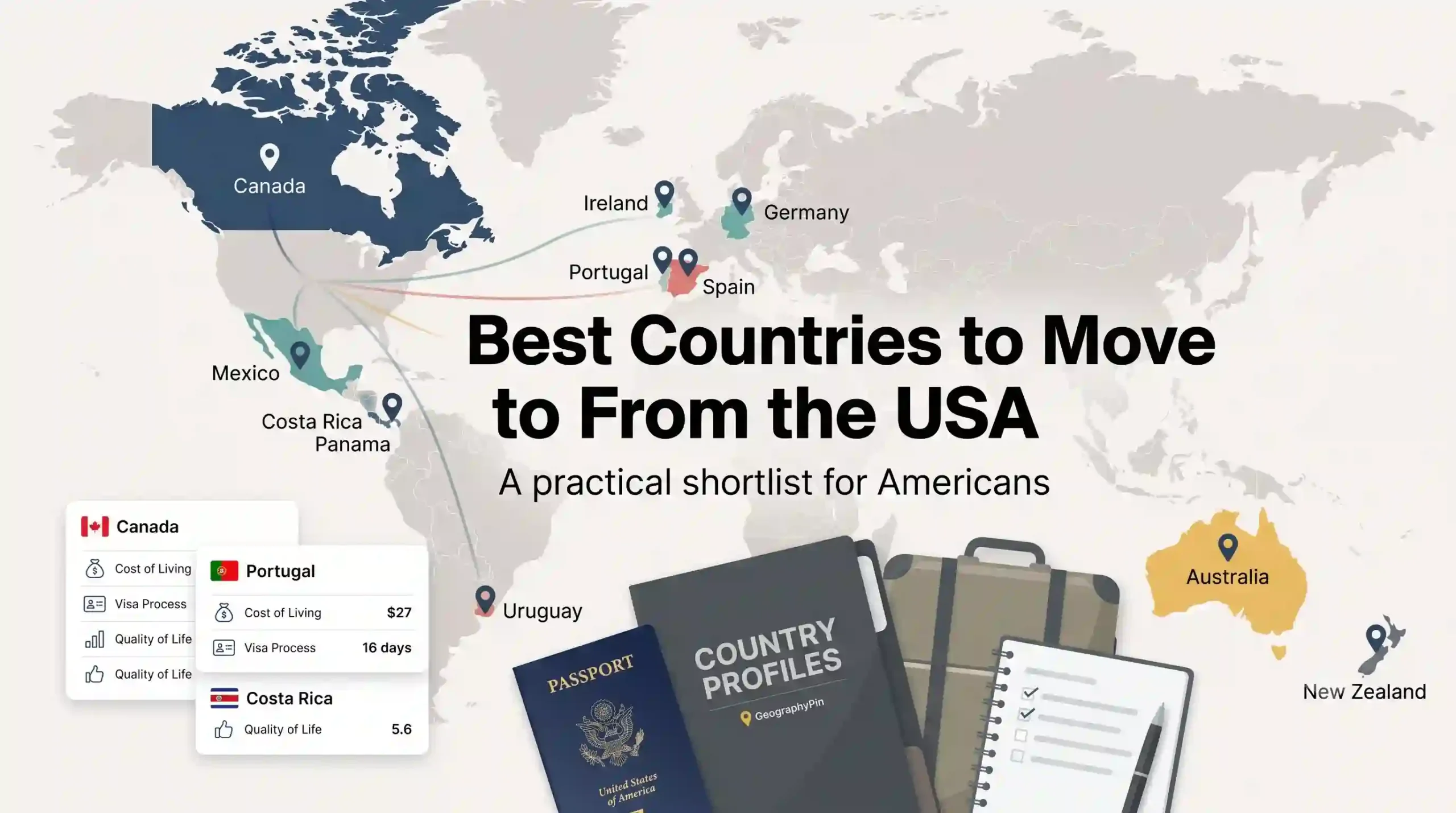
For Americans, a serious shortlist often includes Canada, Mexico, Portugal, Spain, Ireland, Germany, Australia, New Zealand, Costa Rica, Panama, and Uruguay. The right choice depends on why you are leaving and what kind of life you are trying to build next.
The best countries to move to from the USA include Canada for proximity, Mexico for access and lifestyle, Portugal and Spain for European living, Germany and Ireland for skilled work, Australia and New Zealand for English-speaking life, and Costa Rica, Panama, or Uruguay for retirement planning.
How to use this article: Start with the quick picks by life goal, compare your options in the shortlist table, check the visa reality before choosing a destination, and avoid the mistakes that derail otherwise good moves.
The Best Country Is the One That Fits Your Actual Life
Many Americans search this topic after becoming tired of high costs, political tension, healthcare stress, work pressure, or the feeling that life has become harder than it should be. Those are understandable reasons to consider a change, but moving abroad does not automatically repair a weak plan.
A country can look perfect in a video and still be wrong for you. The visa may be difficult, local salaries may be too low, or healthcare may be strong nationally but limited in the town you like. A destination may also seem cheap only because the examples online exclude international schools, private insurance, imported products, frequent flights home, and other costs that matter to your actual life.
How this shortlist was built
This is an editorial shortlist, not a universal ranking. The countries were compared through seven practical questions:
- Legal route: Is there a realistic way for an American to obtain residence?
- Income and work: Can the country support the reader’s job, pension, business, or remote income?
- Cost: Does the destination remain affordable after housing, insurance, taxes, transport, and normal lifestyle costs?
- Healthcare: Can the reader obtain suitable care in the city where they would actually live?
- Taxes: How complicated could the combination of U.S. and local tax rules become?
- Language and integration: Can the reader manage daily life and eventually build a life beyond an expat community?
- Distance: How difficult and expensive will it be to maintain family, business, and medical connections in the United States?
A country does not need to win every category to belong on the list. It needs to offer a credible solution for a common type of American mover.
Quick picks by life goal
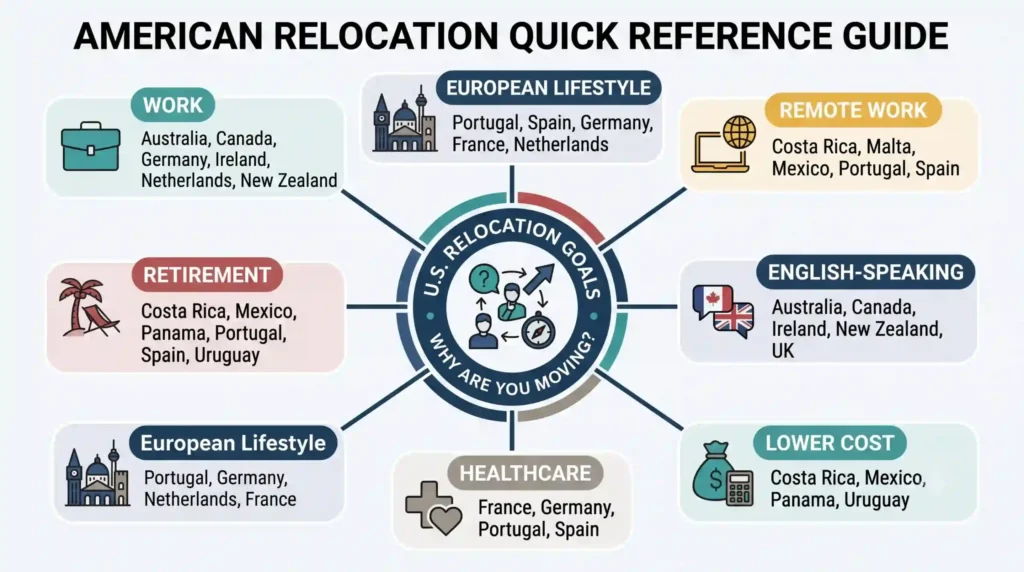
Best for English-speaking daily life: Canada, Ireland, the United Kingdom, Australia, and New Zealand. The language transition is easier, but immigration and housing may not be.
Best for lower-cost living near the USA: Mexico, Costa Rica, and Panama. Their proximity also makes them easier to test before committing.
Best for skilled work: Canada, Germany, Ireland, the Netherlands, Australia, and New Zealand. These countries make the most sense when an applicant’s occupation, qualifications, salary, or employer can support a legal route.
Best for retirement-style planning: Mexico, Costa Rica, Panama, Portugal, Spain, and Uruguay. Healthcare access, residence permission, taxes, and long-term comfort matter more than finding the lowest advertised rent.
Best Countries to Move to From the USA by Goal
A single ranking would be easy to produce, but it would not be very useful. The better approach is to match the destination to the reason you are moving.
If you want career growth, Germany may fit better than Costa Rica. If you are retiring, Mexico may be more practical than the Netherlands. Ireland may feel easier if you only speak English, while Portugal or Spain may make more sense if climate and European life matter more.
Shortlist comparison table
| Relocation goal | Countries to compare first | Why they make sense | What to check carefully |
|---|---|---|---|
| Easier cultural transition | Canada, Ireland, United Kingdom, Australia, New Zealand | English-speaking daily life and relatively familiar institutions | Strict visa rules, housing costs, and distance from family |
| Lower-cost living near the USA | Mexico, Costa Rica, Panama | Regional access, warmer climates, and established American communities | Security, healthcare, local paperwork, and city-by-city cost differences |
| European lifestyle | Portugal, Spain, France, Germany, Netherlands | Public transport, urban life, healthcare systems, and regional travel | Taxes, housing pressure, bureaucracy, and language |
| Skilled work | Canada, Germany, Ireland, Netherlands, Australia, New Zealand | Established skilled-worker, employer-sponsored, and work-linked routes | Credentials, salary rules, employer sponsorship, and occupation requirements |
| Retirement | Mexico, Costa Rica, Panama, Portugal, Spain, Uruguay | Climate, healthcare options, foreign-resident communities, and slower daily life | Insurance, tax residence, income rules, and long-term medical care |
| Remote work | Portugal, Spain, Costa Rica, Mexico, Malta | Possible routes based on foreign income or work performed for overseas employers and clients | Immigration status, employer permission, local taxes, U.S. filing, and insurance |
This table does not declare one country universally better than another. It shows where a reader’s research should begin. That is more useful than forcing every destination into the same ranking.
Best Overall Shortlist for Americans
The following countries deserve particular attention because they can solve more than one relocation problem at the same time. Some offer proximity, some reduce the language barrier, and others stand out for work, retirement, or remote income. None should be treated as an automatic choice.
Canada
Canada is an obvious first comparison for many Americans. It is close, culturally familiar, and English-speaking in most daily settings outside Quebec. It can make sense for skilled workers, students, family-linked applicants, and people whose experience fits the Canadian job market.
Canada is familiar, but it is not an open-door move. Express Entry is the online system used to manage applications through the Canadian Experience Class, Federal Skilled Worker Program, and Federal Skilled Trades Program. Applicants still need to qualify and compete within the system. Housing in major Canadian markets should also be researched at the city level rather than assumed to be cheaper than comparable U.S. cities.
Mexico
Mexico is one of the most practical countries for Americans to test before making a permanent decision. It is easier to visit repeatedly, compare different regions, and return to the United States when family, medical, or business needs arise.
Mexico can fit retirees, remote earners, Spanish learners, and people seeking lower living costs without crossing the Atlantic or Pacific. Long-term residence still requires the correct legal status, and financial requirements or procedures can vary under current rules and consular practice. Mexico City, Mérida, Lake Chapala, San Miguel de Allende, Baja California, and the major beach regions also differ sharply in climate, cost, healthcare, security, and social life.
Portugal
Portugal remains a major European option for Americans because it combines climate, coastline, urban life, and several recognizable residence categories. English is commonly encountered in some international and tourism-heavy areas, although Portuguese becomes increasingly important outside those settings.
Portugal’s official national-visa portal lists residence and temporary-stay categories for professional activity performed remotely, along with routes connected to employment, independent work, study, and other purposes. Lisbon, Porto, and popular coastal communities should no longer be approached as universally inexpensive destinations. Housing, taxes, and the speed of administrative procedures need to be checked before moving.
Spain
Spain is strong for Americans who want European city life, public transport, warm regions, and a Spanish-speaking environment. It can fit retirees, remote workers, students, and people with stable income from outside Spain.
Spain’s telework visa is designed for eligible foreigners who want to live in Spain while working remotely for a company outside the country. Official consular guidance requires supporting evidence such as professional history, employment or business documentation, permission to work remotely, financial means, and insurance or social-security coverage. Spain can offer an attractive daily life, but taxes and bureaucracy deserve as much attention as climate and housing.
Ireland
Ireland reduces one of the largest barriers Americans face in Europe: daily language. It is also connected to major technology, pharmaceutical, finance, medical-device, and professional-services employers.
The tradeoff is cost, particularly housing in and around Dublin. Ireland makes the most sense for Americans with a genuine employment path, family connection, study route, or reliable income. It is less convincing as a plan based only on the belief that moving to Europe will reduce expenses.
Germany
Germany is one of the strongest European choices for skilled employment. It can fit engineers, healthcare workers, IT professionals, researchers, technicians, manufacturing specialists, and other applicants whose qualifications match a recognized work route.
As of July 2026, Germany’s official EU Blue Card guidance lists a regular minimum annual gross salary of €50,700. A lower threshold of €45,934.20 applies in qualifying shortage occupations and to certain recent graduates, subject to the relevant conditions. A concrete job offer or employment contract is required. Germany is not always the simplest lifestyle move, but it can be one of the more credible long-term career moves.
Australia and New Zealand
Australia and New Zealand appeal to Americans who want English-speaking daily life, outdoor culture, established institutions, and distance from U.S. political pressure. Both can suit families and skilled professionals whose occupations match current migration needs.
The difficulties are distance, expense, and immigration selectivity. Australia relies heavily on skilled, employer-sponsored, family, and other qualifying visa categories. New Zealand’s Skilled Migrant Category considers factors connected to skilled employment, qualifications or occupational registration, income, English, health, and character. Additional Skilled Migrant Category changes are scheduled to take effect on August 24, 2026, so anyone applying around that date should compare the old and new requirements directly with Immigration New Zealand.
Costa Rica, Panama, and Uruguay
Costa Rica, Panama, and Uruguay are not always the first choices for local career growth, but they are important for retirement, remote income, and long-term living in Latin America.
Costa Rica has a formal remote-worker stay category. As of July 2026, official guidance lists a stable net foreign income requirement of at least $3,000 per month for an individual or $5,000 per month for a family, together with medical-insurance requirements. Panama is frequently considered for retirement and international business, but older online summaries of its residence programs should not be treated as current without verification. Uruguay appeals to people seeking a smaller South American country, but housing, taxes, healthcare, and residence procedures still need to be assessed personally.
Visa Paths Americans Should Check First
A country can be beautiful and still be useless for your plan if you cannot legally remain there. Tourist access is not immigration. A remote job is not automatically a residence permit, and owning property does not necessarily provide the right to live or work in a country.
Visa reality before choosing a destination
Before choosing a country, ask one boring but decisive question: What legal route allows me to live there? If the answer remains vague, the plan is not ready.
Americans commonly compare skilled-worker programs, employer sponsorship, remote-work visas, retirement or passive-income residence, student visas, family routes, ancestry-based citizenship, and investment-based options. Each can have different income rules, paperwork, insurance requirements, renewals, work rights, and routes to permanent status.
Work and skilled-worker routes
A work route is most realistic when you have a clear professional advantage. That may be a degree, licensed profession, shortage occupation, high-demand technical skill, qualifying salary, job offer, or employer willing and authorized to sponsor foreign workers.
Canada, Germany, Ireland, the Netherlands, Australia, and New Zealand are especially relevant in this category. The process may be selective, but a successful work-based move can provide a more stable foundation than repeatedly extending temporary stays.
Remote-work routes
Remote-work visas can be useful when income comes from an employer or clients outside the destination country. Portugal, Spain, Costa Rica, and Malta are among the routes Americans often compare. Mexico is also popular with remote workers, although the correct residence category should be checked through current official or consular guidance.
Remote work does not remove immigration, tax, or employment rules. Applicants may still need residence permission, health insurance, employer approval, minimum income, and evidence that the work is genuinely performed for foreign businesses or clients. Local tax residence and U.S. filing obligations must also be considered.
Retirement and passive-income routes
Retirees commonly compare Mexico, Costa Rica, Panama, Portugal, Spain, and Uruguay because these countries offer combinations of climate, healthcare, established foreign communities, and residence categories connected to pensions or outside income.
The word “retirement” covers very different situations. A healthy couple with two pensions has a different plan from a single retiree with chronic medical needs. A person who wants a quiet beach community also has different requirements from someone who needs a major hospital, international airport, and English-speaking specialists nearby.
Family, ancestry, and citizenship routes
Some Americans may qualify for citizenship or residence through parents, grandparents, marriage, or other family relationships. Ireland, Italy, Germany, Poland, and several other European countries have their own rules, but eligibility depends on specific legal and documentary conditions.
An ancestry route can be extremely valuable when the documents support it. It can also become complicated when birth records, name changes, marriage records, or an ancestor’s naturalization date do not meet the country’s legal standard.
Cost, Healthcare, Taxes, and Language
The real cost of moving abroad is not only rent. It includes healthcare, insurance, taxes, transport, food habits, paperwork, school needs, emergency flights home, and the cost of learning how a new system works.
Cheap country, expensive lifestyle
A country can be cheaper than the United States and still feel expensive if you live as though you never left. Imported food, international schools, private doctors, expat neighborhoods, short-term rentals, air conditioning, taxis, and frequent restaurant meals can erase the expected savings.
This matters in Mexico, Portugal, Spain, Costa Rica, Panama, Thailand, and other destinations often promoted through low-budget examples. The better question is not “How cheaply could I survive?” It is “What would my real life cost there?”
Healthcare should help decide the city
Healthcare is one reason many Americans consider leaving, but a national reputation does not answer every practical question. A country may have excellent hospitals in its capital and limited specialist access in smaller towns. A beautiful coastal community may feel less suitable when you need frequent treatment or emergency care.
Retirees, families, and people with chronic conditions should evaluate hospitals, specialists, prescriptions, emergency services, insurance rules, waiting times, language access, and private-care options in the specific city they are considering.
U.S. tax rules do not disappear
U.S. citizens abroad remain subject to U.S. tax rules on worldwide income. Whether a return is required depends on filing thresholds and individual circumstances, but claiming benefits such as the foreign earned income exclusion or foreign tax credit generally requires filing a U.S. return.
This does not automatically mean paying tax twice. It does mean planning before the move. Foreign bank accounts, self-employment, pensions, investments, rental property, capital gains, business ownership, and local tax residence can create reporting or tax consequences that are easy to miss when the original decision was based mainly on rent and weather.
Language is not a small detail
English-speaking countries are easier at first, but they are often more expensive or selective about immigration. A non-English-speaking country may offer a better lifestyle or legal route, but language eventually becomes part of every ordinary task.
It is possible to survive in international communities in Portugal, Spain, Mexico, Costa Rica, Panama, Germany, France, Japan, or Uruguay. Surviving, however, is not the same as belonging. Doctors, landlords, mechanics, schools, neighbors, tax offices, and government forms eventually pull most residents beyond the expat bubble.
Countries That Look Easy but Need More Caution
Some destinations look effortless online because most content focuses on food, weather, beaches, rent, or street life. Those details matter, but they do not explain residence status, income stability, healthcare, taxes, work rights, or long-term integration.
Thailand
Thailand can offer an attractive lifestyle, strong food culture, warm weather, and large international communities in Bangkok, Chiang Mai, Phuket, and other popular areas. It can work well for temporary stays, some retirees, and people who clearly qualify for a suitable long-term route.
The important issue is legal status. Visa conditions, reporting duties, insurance, work restrictions, and renewal rules need to be understood before treating Thailand as a permanent low-cost base. A tourist-friendly country is not automatically an easy country in which to settle permanently.
United Arab Emirates
Dubai and Abu Dhabi attract professionals, entrepreneurs, and internationally mobile workers through modern infrastructure, air connections, business networks, and a large foreign-resident population. The UAE can work particularly well for people with strong salaries or a clear business reason to live there.
It is not usually a low-cost escape. Housing, private schooling, insurance, transport, and lifestyle expenses can be substantial. Residence also normally depends on employment, business, investment, property, family sponsorship, or another qualifying category.
Japan
Japan attracts Americans through public transport, food, culture, urban order, and a strong reputation for personal safety. For people with employment, study, family, or another recognized route, it can become a serious long-term option.
The adjustment can be demanding. Japanese language, workplace expectations, housing practices, and administration may be difficult for newcomers. Japan can be deeply rewarding, but it is rarely the simplest first move for someone who wants minimal paperwork and immediate social comfort.
France and Italy
France and Italy remain dream destinations for many Americans because of their cities, food, landscapes, history, architecture, and regional variety. Both can work for retirees, students, dual citizens, workers with a qualifying route, and people with stable outside income.
The move may involve more bureaucracy, tax planning, local-language dependence, and administrative waiting than a vacation reveals. These countries can provide an excellent life, but they should not be presented as effortless destinations.
How to Test a Country Before Moving
A serious move should be tested before it becomes permanent. Vacation is not a test. Vacation shows restaurants, hotels, attractive streets, and your best mood. Living exposes bills, noise, doctors, bureaucracy, loneliness, internet problems, and normal Tuesday life.
Try the normal-life test
Spend time in the neighborhood you could realistically afford. Cook at home, use public transport, visit a clinic, work from the apartment, check the supermarket, and walk through the area outside tourist hours. If you have children, investigate schools and daily family logistics rather than judging the city from its central attractions.
Some places become more attractive during this test. Others stop looking magical. Both results are useful.
Compare cities before countries
Mexico City and Mérida are not the same move. Lisbon and a smaller Portuguese city are not the same move. Toronto and Atlantic Canada are not the same move. Berlin and a smaller German city are not the same move.
City choice affects rent, healthcare, employment, schools, transport, climate, security, language exposure, and social life. Many relocation mistakes happen because someone chooses a country from online content without choosing the right city inside it.
Use a simple scorecard
Score each destination on legal route, cost, healthcare, taxes, language, work, schools, security, distance from family, long-term residence, and daily comfort. Use the same criteria for every country so that an exciting destination does not receive points simply because it photographs well.
The right country may not be the most dramatic choice. It may be the place where the paperwork works, the city fits your budget, healthcare is accessible, and daily life still feels stable after the first month of excitement has passed.
Common Mistakes Americans Make Abroad
Most unsuccessful moves abroad do not fail because the entire country is terrible. They fail because the person arrived with half a plan.
Mistakes that derail good moves
- Confusing tourist entry with residence: Permission to visit does not automatically include permission to live or work.
- Choosing only by rent: Cheap housing does not solve healthcare, tax, school, security, or visa problems.
- Ignoring U.S. tax rules: Moving abroad does not automatically end U.S. filing and reporting responsibilities.
- Assuming a remote job solves immigration: Employment performed online can still require residence permission, employer approval, and local tax planning.
- Remaining permanently inside an expat bubble: It can make the first months easier, but it may limit language learning and local integration.
- Buying property too early: Renting first provides time to understand neighborhoods, ownership rules, taxes, and resale conditions.
- Forgetting city-level healthcare: A good national system does not guarantee the right specialist or hospital near your home.
- Assuming lower cost means easier life: Some less expensive destinations require more language ability, patience, paperwork, and flexibility.
- Moving only to escape the United States: Leaving a problem is not the same as building a workable life somewhere else.
The safest relocation plans are boring in the right places: legal status, realistic budgets, healthcare access, tax planning, and a city tested outside vacation conditions.
FAQ
What is the easiest country for Americans to move to?
Mexico is often one of the easiest serious destinations for Americans to test because it is close, frequently visited, and home to established American communities. Long-term residence still depends on current immigration rules, documentation, financial eligibility, and the office handling the application.
What is the best country in Europe for Americans to move to?
Portugal and Spain are strong lifestyle comparisons for retirees, remote workers, and people with outside income. Ireland reduces the language barrier, while Germany and the Netherlands are stronger for many skilled workers. The final choice depends on legal eligibility, housing, taxes, work, and language.
What country is best for American retirees?
Mexico, Costa Rica, Panama, Portugal, Spain, and Uruguay are common retirement comparisons. Mexico is practical because of proximity, while Costa Rica and Panama appeal to many people considering Central America. Portugal and Spain suit retirees who want Europe, and Uruguay offers a smaller South American alternative.
Can Americans move abroad and keep working remotely?
Sometimes, but it is not automatic. Remote workers still need an appropriate legal stay, employer or client documentation, tax planning, and usually health insurance. Some countries offer dedicated remote-work categories, while others may not permit long-term remote work under tourist status.
Do Americans still pay U.S. taxes after moving abroad?
Americans abroad remain subject to U.S. tax rules on worldwide income. Whether tax is owed depends on individual circumstances, while filing requirements depend on applicable thresholds and reporting rules. Foreign earned income exclusions, foreign tax credits, and tax treaties may reduce or change the result.
Is Canada easy for Americans to move to?
Canada is culturally familiar, but immigration is not automatic. Americans still need a valid route through skilled immigration, employment, study, family sponsorship, or another qualifying status. Housing costs in the chosen Canadian city should also be part of the decision.
Should I move abroad permanently or test the country first?
Test it first whenever possible. A trial stay reveals daily life more honestly than a vacation. Rent before buying, use local services, test transport and healthcare access, check internet reliability, and experience the neighborhood outside tourist routines.
What Did We Learn Today?
The best countries to move to from the USA depend on the reason for moving. Canada, Ireland, Australia, and New Zealand reduce the language barrier, but immigration and housing can be difficult. Mexico, Costa Rica, and Panama are strong for proximity, lifestyle, and retirement planning. Portugal and Spain are major European choices for remote workers, retirees, and people with outside income, while Germany, Ireland, the Netherlands, Canada, Australia, and New Zealand deserve attention from skilled workers. The smart move is not choosing the country praised most often online; it is choosing a legal route, city, budget, healthcare system, and daily life that can still work after the excitement of moving has faded.
Sources & Data Notes
Visa and residence information was checked in July 2026 against Immigration, Refugees and Citizenship Canada, Mexico’s consular and immigration guidance, Portugal’s national-visa portal, Spanish consular services, Germany’s federal Make it in Germany portal, Immigration New Zealand, the Australian Department of Home Affairs, the Costa Rica Tourism Board, other national migration authorities, and IRS guidance for Americans abroad. Immigration categories, income requirements, salary thresholds, healthcare access, and tax treatment can change, while eligibility may depend on employment, income, family status, nationality, and the office handling an application. Country comparisons are editorial summaries intended to help readers build a shortlist, not individualized immigration or tax advice. AI tools assisted with structure and language, while source checking and final editorial judgment remained with the author.