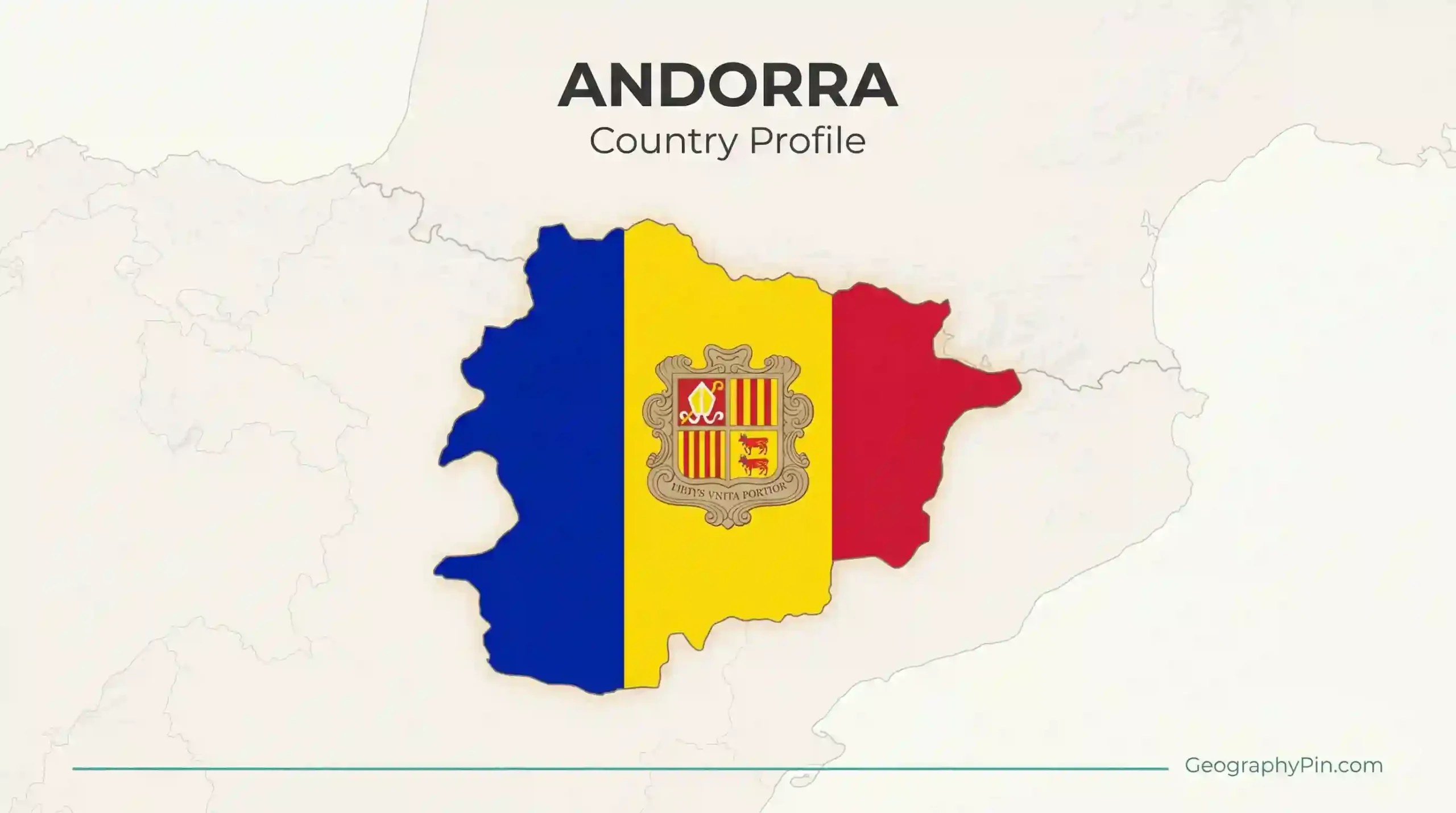
Andorra is an independent country in the eastern Pyrenees between Spain and France. It is a parliamentary co-principality with Catalan as its official language, uses the euro, and is closely tied to Europe without being a member of the European Union or the Schengen Area.
How to use this article: Start with where Andorra sits and what it is for the essentials, jump to capital, language, and parishes for the social basics, use the tax and economy section for the money question, and check the border basics note if your real concern is entry, EU ties, or travel practicality.
Where Andorra sits on the map
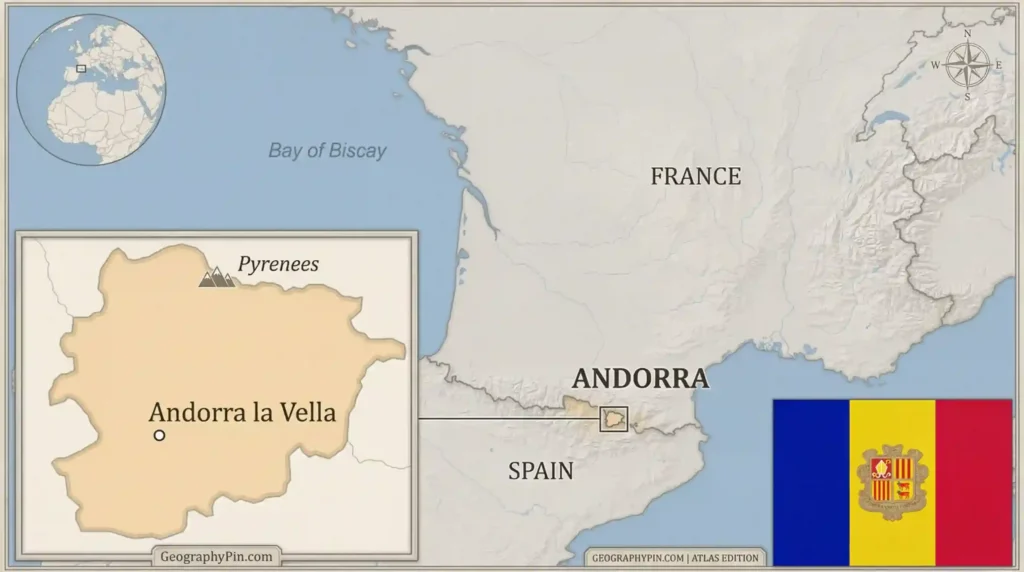
Andorra is a landlocked European state in the eastern Pyrenees, between Spain and France. Standard reference works give its area as 181 square miles (468 square kilometers), which helps explain why people often mistake it for a province or border district rather than a sovereign country in its own right.
The fast location check
Andorra is not part of Spain, not part of France, and not a dependency of either state. It is the Principality of Andorra, an independent country with its own institutions, its own parliament, and its own constitutional order.
| Topic | Andorra |
|---|---|
| Political status | Independent parliamentary co-principality |
| Capital | Andorra la Vella |
| Area | 181 sq mi (468 sq km) |
| Official language | Catalan |
| Currency | Euro (€) |
| EU membership | Not an EU member |
| Schengen membership | Not in the Schengen Area |
| Administrative divisions | Seven parishes |
Population figures vary slightly by date and source. The safest plain summary is that Andorra has a little over eighty thousand residents, with totals shifting modestly depending on whether a source is using census data or a yearly statistical estimate.
Landscape, altitude, and climate
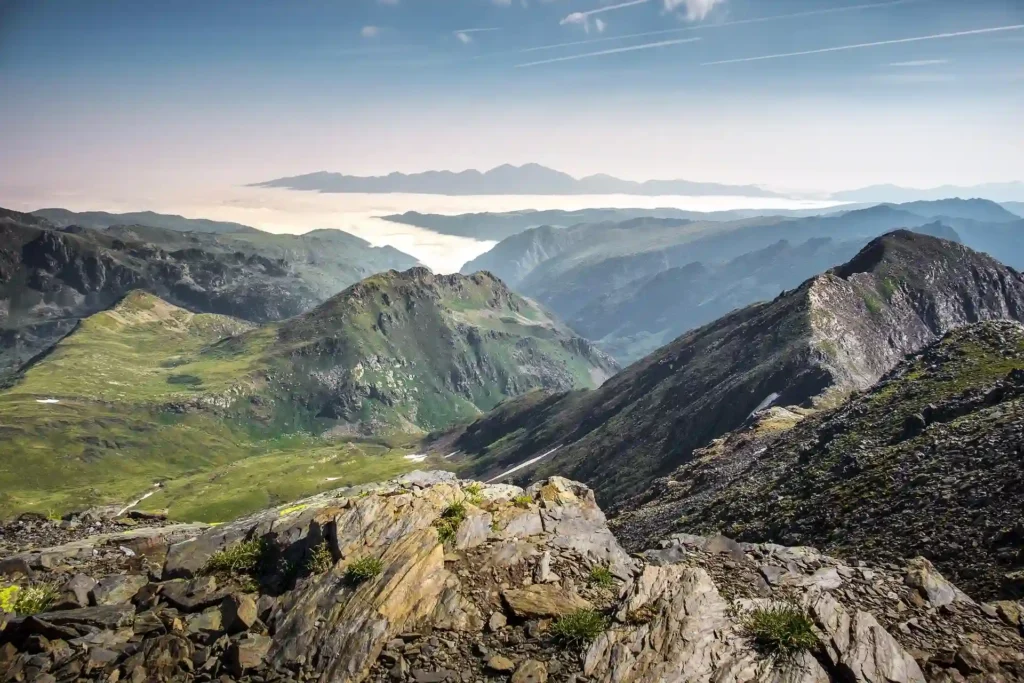
Andorra is a mountain country first. Official tourism material says about 90% of its territory is natural land, and one of its best-known physical reference points is Pic del Comapedrosa, the country’s highest peak at 9,652 feet (2,942 meters).
Why the terrain matters
The shape of the land explains much of Andorra’s profile. High valleys, narrow corridors, and steep uplands limit agriculture, concentrate settlement on valley floors, and make outdoor recreation central to the country’s identity and economy.
A mountain climate with Mediterranean influence
Official visitor material describes Andorra as having a high-mountain climate with Mediterranean influence: warm summers, cold winters, frequent snowfall, and rainfall concentrated mainly between May and October. The same material gives an average minimum temperature of 28°F (-2°C) and an average maximum of 75°F (24°C).
One landscape stands out even within that mountain setting: the Madriu-Perafita-Claror Valley, Andorra’s UNESCO World Heritage Site. UNESCO treats it as a cultural landscape shaped by long-term mountain land use, pastoralism, and communal management, which makes it important not only for scenery but also for understanding Andorran history and identity.
A short historical frame
Andorra’s political structure is old, but the modern state is relatively recent in legal terms. Official material says the country has existed as a parliamentary co-principality for centuries, while the current constitution entered into force in 1993 and gave the state its modern democratic framework.
The useful way to read that history is simple: Andorra preserved a medieval power-sharing arrangement long enough to modernize it instead of replacing it. That helps explain why the country still has co-princes, yet also functions through a constitution, an elected parliament, and a government responsible for ordinary administration.
Government, institutions, and world position
Andorra’s heads of state are two co-princes: the Bishop of Urgell and the President of the French Republic. The constitution describes them as joint and indivisible heads of state, but Andorra is not run as a personal monarchy in the usual sense; day-to-day political life is handled through constitutional institutions.
How the parliament works
The General Council is Andorra’s parliament. Official institutional material says it has 28 members elected for four years, with half chosen nationally and half chosen by the seven parishes. That arrangement helps explain why local territorial identity still matters politically in such a small country.
Not in the EU, but closely tied to Europe
One of the most common confusions is EU status. Andorra is not a member of the European Union and is not part of the Schengen Area, but it uses the euro and maintains close links with European institutions. That puts it in a position that is closely connected yet still legally distinct.
Andorra is also a member of the Council of Europe, which matters because it places the country clearly inside Europe’s wider legal and democratic framework even though it remains outside the EU and Schengen systems.
People, language, and everyday culture
Capital, language, and parishes
Catalan is the official language of Andorra. At the same time, Spanish, French, and Portuguese are widely heard in daily life because of the country’s cross-border setting and diverse resident population.
The capital is Andorra la Vella, and the country is divided into seven parishes:
- Canillo
- Encamp
- Ordino
- La Massana
- Andorra la Vella
- Sant Julià de Lòria
- Escaldes-Engordany
Everyday Andorran culture reflects both mountain geography and cross-border contact. Romanesque churches remain one visible layer of the older cultural landscape, while the UNESCO-protected Madriu-Perafita-Claror Valley preserves evidence of pastoral life, terraces, stone paths, and communal land use that shaped the country long before modern tourism became dominant.
That mix produces a country that feels culturally compact but not culturally isolated. Catalan gives Andorra a distinct public identity, yet its location between France and Spain and its multilingual daily life make it more outward-facing than many readers expect from such a small state.
Economy, tourism, and the tax question
World Bank data place Andorra’s economy in the low-billions of US dollars and its income per person at a comparatively high level for such a small state. The key point is not the exact number alone; it is that Andorra is economically substantial relative to its size.
Why taxes come up so often
Andorra is widely associated with low taxes and shopping, and that reputation has a real basis. Standard reference works have long noted the role of light taxation and customs advantages in the country’s retail importance, while official tourism material presents retail and tourism as central parts of national income.
Still, reducing Andorra to a tax label misses the larger picture. Tourism, retail, finance, and other service activity all matter, and the country’s mountain setting helps explain why these sectors became more important than large-scale farming or heavy industry.
Terrain also limits what the economy can be. Only a small share of Andorra’s land is suitable for cultivation, so the country developed around commerce, mountain tourism, services, and cross-border movement rather than broad agricultural production.
Getting there, borders, and travel basics
The border rule most visitors miss
The practical point many visitors miss is that Andorra is not a member of the Schengen Area, and access is normally through Spain or France. For many non-EU travelers, the real legal question is often the entry requirement of the transit country rather than Andorra alone.
Official visitor information also notes that EU citizens can enter with a valid passport or national identity card, and that tourist stays are commonly treated within a 90-day framework. Because all normal road access passes through Spain or France, travelers should read Andorra’s own rules together with the border requirements of the neighboring state they will use.
That is the clearest practical summary: Andorra is easy to understand on a map, but border procedure is never only about the map. Its position outside Schengen and its physical access through neighboring states make travel questions more technical than readers often expect from a small European destination.
FAQ
Is Andorra part of Spain or France?
No. Andorra is an independent state between Spain and France. Its constitutional order and institutions are its own, even though one co-prince is linked to Spain and the other to France.
Is Andorra in the European Union?
No. Andorra is not an EU member. It is, however, closely tied to Europe and uses the euro, which is one reason many readers assume it belongs to the EU when it does not.
What language do people speak in Andorra?
Catalan is the official language. Spanish, French, and Portuguese are also common in daily life because of migration, work patterns, and Andorra’s position between two larger neighbors.
Why does Andorra have two princes?
Because its political system preserves a historic co-princely arrangement that survived into the modern constitutional era. The country modernized that structure rather than abolishing it.
Is Andorra in the Schengen Area?
No. That matters mainly for border procedure, because entry normally happens through Spain or France even though Andorra itself is a separate sovereign state.
What is Andorra best known for?
Most commonly: mountain scenery, winter sports, shopping, and its low-tax reputation. It is also known for its unusual constitutional setup and strong mountain identity.
What Did We Learn Today?
- Andorra is a sovereign state in the eastern Pyrenees between Spain and France, not a province of either neighbor.
- It is a parliamentary co-principality with two heads of state and a parliament shaped by both national and parish representation.
- Catalan is the official language, but daily life is multilingual.
- Its mountain terrain shapes settlement, climate, tourism, and the wider economy.
- Andorra is outside both the EU and Schengen, yet remains closely tied to Europe and uses the euro.
Sources & Data Notes
This profile was checked against standard reference material, including official Andorran institutions, international organizations, and established general-reference sources. A few figures are rounded for readability, and some details such as population, travel rules, or economic data may change as newer official releases appear. AI tools were used only in a limited supporting role for cleanup and presentation, with the article itself reviewed and shaped editorially.