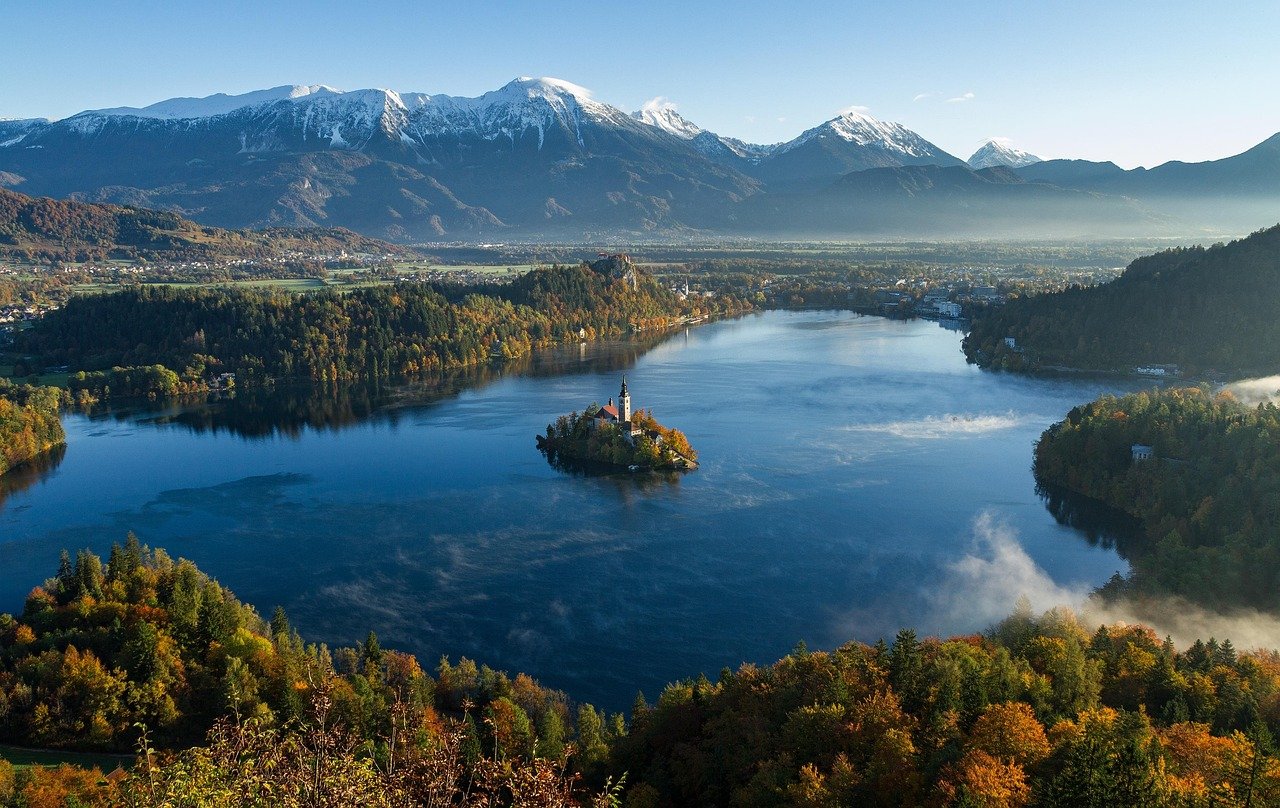
A lake is an inland body of standing or relatively slow-moving water that occupies a basin and is surrounded by land. It may be fresh or salty, natural or human-made, permanent or seasonal. “Standing” distinguishes it from a river, but lake water still moves through waves, currents, inflows, outflows, and vertical mixing.
How to use this article: Start with the three-level definition, see how the water balance works, compare lakes with similar water bodies, or jump to the main formation types.
What Makes a Lake a Lake?
The everyday answer
In ordinary language, a lake is a body of water collected inland in a depression and surrounded by land. Unlike a river or stream, its identity comes mainly from the basin it occupies rather than from continuous channelized flow.
A lake does not have to be completely cut off from the ocean. Many lakes have river outlets whose water eventually reaches a sea, so “inland and surrounded by land” is more useful than simply calling every lake landlocked.
The geographic working definition
For geography, a practical definition is standing or relatively slow-moving water occupying an inland basin. Standing does not mean motionless. Wind generates waves and currents, rivers may pass through the basin, temperature differences move water vertically, and storms can make the whole surface oscillate.
The lake is therefore more than the visible water. It is a physical system made from three connected parts: the basin that holds the water, the watershed that delivers water and material to it, and the balance between inputs and losses.
The real-world edge cases
There is no worldwide size or depth at which every pond becomes a lake. The U.S. Geological Survey notes that generic geographic terms such as lake and pond have no official definitions in its national names framework, and scientific, legal, mapping, and local usage can apply different rules.
That is why a named “pond” may be larger than a nearby “lake,” a reservoir may carry a lake name, and a shallow lake may grade into wetland. The best definition identifies the normal case without pretending those boundaries are exact everywhere.
How a Lake Works
The basin holds it; the watershed feeds it
A lake basin is the low area occupied by the water. Its depth, shape, geology, and outlet height help determine how much water the lake can hold, how long water remains there, and how easily wind can mix it.
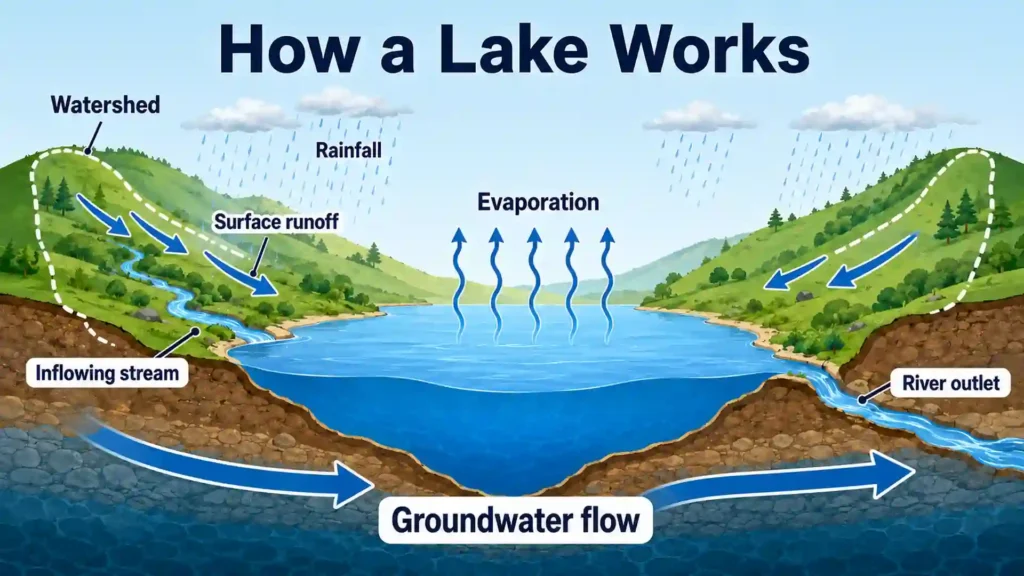
The watershed, also called the drainage basin or catchment, is the surrounding land from which water drains toward the lake. Rain or melting snow may fall directly on the surface, flow over land as runoff, arrive in streams, or enter through groundwater. Sediment, nutrients, salts, and pollutants can follow those same routes.
The water balance controls the level
The basic relationship is simple: change in lake storage equals water entering minus water leaving. Inputs include precipitation, stream and river inflow, surface runoff, and groundwater. Losses include evaporation, river outflow, groundwater seepage, and human withdrawals.
A lake rises when inputs exceed losses and falls when losses exceed inputs. The shoreline, area, depth, and salinity can all change with that balance. The USGS overview of lakes and reservoirs describes lakes in the same water-cycle terms: water accumulates where runoff and groundwater enter a low area faster than it can escape.
Open-drainage and closed-basin lakes
An open-drainage lake has a surface outlet, normally a river. Water and dissolved material can leave through that outlet, even if the river takes a long route before reaching the ocean.
A closed-basin or endorheic lake has no surface outlet to another drainage system or the ocean. Water mainly leaves through evaporation or seepage. Evaporation removes water but leaves most dissolved minerals behind, so salts can accumulate when inflow, rock chemistry, climate, and time favor concentration. The Dead Sea is an endorheic hypersaline lake and a clear example of that process.
Lake vs. Pond, Reservoir, Wetland, Lagoon, and Inland Sea
The categories below are useful working distinctions, not a single global legal code. A water body can sit near more than one boundary, and its established name may not match the category a scientist uses for a particular study.
A practical comparison
| Water body | Usual working distinction | Where the boundary blurs |
|---|---|---|
| Lake | Inland standing or slow-moving water occupying a basin and surrounded by land | No universal minimum area or depth |
| Pond | Usually smaller and shallower, often with light reaching much or all of the bottom | Size, depth, ecology, and local names do not produce one worldwide cutoff |
| Reservoir | Water deliberately impounded or stored, commonly behind a dam | It functions like a lake and may officially or locally be called one |
| Wetland | Defined by persistent or recurring saturation, wet soils, and water-adapted ecology | Shallow open water and vegetated lake margins can be classified as wetland |
| Lagoon | Usually shallow water partly separated from a sea or larger lake by a barrier | Its connection to the parent water body may be narrow, intermittent, or altered |
| Inland sea | A historical or geographic label often used for a very large enclosed or nearly enclosed water body | Names and legal treatment may differ from hydrology; the Caspian Sea is commonly treated as the largest lake by area |
The lake–pond distinction is the least rigid of these comparisons. Area and depth can help within a specific survey or regulation, but a threshold chosen for one dataset should not be presented as a universal law of geography.
How Lakes Form
A lake needs two things: a basin and enough water to maintain it, at least for part of the year. The event that creates the hollow may be completely different from the rainfall, rivers, snowmelt, or groundwater that later fill it.
Seven principal basin-forming processes
- Glacial: Moving ice erodes hollows, deepens valleys, and deposits debris that can dam drainage. Lake Geneva occupies a basin shaped substantially by Alpine glaciation.
- Tectonic: Faulting, rifting, folding, or subsidence creates depressions. Lake Baikal lies in an active rift basin and is the world’s deepest lake.
- Volcanic: Craters and calderas can fill with water, while lava flows can dam valleys.
- River or oxbow: A river cuts through the neck of a meander, leaving the former bend as a curved lake; floodplain deposition can isolate other basins.
- Karst: Water dissolves limestone, gypsum, or other soluble rock, forming sinkholes and enclosed depressions that reach groundwater or collect runoff.
- Landslide-dammed: Rock, earth, or ice blocks a valley and impounds a river. Some of these natural dams fail quickly; others persist.
- Impact: A meteorite impact excavates a crater that later collects precipitation, runoff, or groundwater.
The North American Lake Management Society’s lake-science overview describes many of these basin origins and emphasizes that basin shape and origin continue to influence water quality, mixing, and a lake’s response to its watershed.
How Lakes Are Classified
“Type of lake” can refer to several different traits. The categories are not competing answers: one lake can simultaneously be tectonic in origin, freshwater, open-drainage, permanent, nutrient-poor, and seasonally mixed.
The classifications that explain lake behavior
| Basis | Common categories | What it tells you |
|---|---|---|
| Salinity | Fresh, brackish, saline, hypersaline | The concentration of dissolved salts |
| Drainage | Open-drainage, closed or endorheic | Whether water has a surface outlet |
| Origin | Glacial, tectonic, volcanic, river-made, karst, dammed, impact, artificial | How the basin or impoundment formed |
| Permanence | Permanent, seasonal, intermittent | Whether open water persists through ordinary dry periods |
| Nutrient status | Oligotrophic, mesotrophic, eutrophic, hypereutrophic | Nutrient availability and biological productivity, often assessed with clarity, phosphorus, and chlorophyll |
| Mixing pattern | Polymictic (frequent), monomictic (once-yearly), dimictic (twice-yearly), meromictic (incomplete), amictic (absent) | How often oxygen, heat, and nutrients are redistributed vertically |
These are working systems, not labels of quality. An oligotrophic lake is generally low in nutrients and biological production; a eutrophic lake is more nutrient-rich and productive. Natural conditions can produce either state, although human nutrient inputs can drive rapid eutrophication and harmful blooms.
Parts of a Lake, Stratification, and Turnover
The main ecological zones
- Littoral zone: the shallow nearshore area where light can reach the bottom, often allowing rooted plants to grow.
- Open-water zone: the water beyond the littoral edge, also called the limnetic or pelagic zone. Its sunlit upper part supports plankton and active photosynthesis.
- Deep-water zone: the darker water below effective light penetration, often called the profundal or aphotic zone.
- Lake-bottom zone: the sediment surface, called the benthic zone. It runs beneath shallow and deep water rather than forming only one horizontal layer.
The boundaries move with depth, water clarity, season, and lake level. A shallow clear lake may have a broad littoral zone, while a steep, deep, or turbid lake may have a narrow one.
Why deeper lakes form layers and then mix
Sunlight warms the surface first. In a sufficiently deep lake, warm, less-dense surface water can sit above colder, denser deep water. Limnologists call the warm upper layer the epilimnion, the rapid temperature-transition layer the metalimnion or thermocline region, and the colder lower water the hypolimnion.
In many temperate lakes, autumn cooling reduces the density difference between layers. Wind can then mix the water column, redistributing heat, oxygen, and nutrients; this is turnover. A second mixing period may occur after ice melts in spring. Shallow lakes may mix frequently, while tropical, polar, very deep, or chemically stratified lakes can follow different patterns. Turnover is common, but it is not a twice-yearly rule for every lake.
Notable Lake Benchmarks
Lake records depend on the chosen metric and convention. Surface area is not volume, freshwater records exclude saline lakes, water levels move shorelines, and the connected Lakes Michigan and Huron may be counted separately by name or together as one hydrologic lake.
A qualified record table
| Benchmark | Lake | Rounded figure | Convention or caution |
|---|---|---|---|
| Largest lake by surface area | Caspian Sea | About 143,200 sq mi (371,000 km²) | Treated here as an inland endorheic lake; area changes with water level |
| Deepest lake and largest freshwater lake by volume | Lake Baikal | About 5,387 ft (1,642 m) deep; about 5,500 cu mi (23,000 km³) | UNESCO summary text rounds maximum depth to about 5,577 ft (1,700 m) |
| Largest freshwater lake by surface area under the conventional five-lake naming system | Lake Superior | About 31,700 sq mi (82,100 km²) | Lake Michigan–Huron is larger when the connected pair is treated as one hydrologic lake |
Table downloads (3)
- How lakes compare with related water bodies (7 × 3)View tableDownload CSV
- Common lake classifications and what each one describes (7 × 3)View tableDownload CSV
- Selected lake benchmarks and the conventions behind them (4 × 4)View tableDownload CSV
These figures are benchmarks, not permanent surveyed edges. NASA’s Caspian figure, UNESCO’s Lake Baikal profile, and the EPA’s Great Lakes table use rounded reference values; changing water levels and different measurement methods can produce other defensible totals.
Why Lakes Matter and What Threatens Them
Freshwater, habitat, settlement, and local economies
Lakes store water, support aquatic and shoreline ecosystems, provide habitat for resident and migratory species, and connect surface water with groundwater. Communities use them for drinking water, irrigation, fisheries, hydropower, transport, recreation, and tourism. Large lakes can also moderate nearby temperatures and influence local winds and snowfall.
The benefits are linked rather than separate. A change in water level can alter shoreline habitat, boat access, water supply, and tourism at the same time. Lake Sevan illustrates how freshwater storage, natural outflow, managed releases, irrigation, hydropower, and ecological recovery can become parts of one water-management question.
The main pressures on lake systems
- Nutrient pollution: Excess nitrogen and phosphorus can fuel algal growth; decomposition may then reduce oxygen in deeper water.
- Invasive species: Introduced organisms can reshape food webs, habitat, water clarity, and nutrient cycling.
- Shoreline development: Removing vegetation and wetlands can increase runoff, erosion, habitat loss, and pollution entering from the watershed.
- Diversion and withdrawal: Taking water or reducing river inflow can lower levels, shrink shallow habitat, and concentrate salts or pollutants.
- Climate-related change: Shifts in precipitation, evaporation, water temperature, ice cover, and mixing can alter both water quantity and ecology.
No single pressure produces the same response in every lake. Basin depth, watershed land use, residence time, drainage, salinity, and local climate determine whether the first visible sign is a bloom, oxygen loss, shoreline retreat, habitat change, or a different mixing season.
Frequently Asked Questions
Are all lakes freshwater, and why are some salty?
No. Lakes may be fresh, brackish, saline, or hypersaline. Salt often becomes concentrated in a closed basin because water evaporates while most dissolved minerals remain, although inflow chemistry, geology, seepage, and time also matter.
Can a river flow through a lake?
Yes. A river can enter a lake, slow and spread through its basin, then leave through an outlet. The lake remains a standing-water basin even though water continuously passes through it.
Is there a strict size that separates a lake from a pond?
No universal threshold applies worldwide. Particular agencies or studies may choose area, depth, light penetration, or vegetation criteria for their own work, while established local names may follow none of them.
Is a reservoir a lake?
A reservoir is an artificial or strongly controlled impoundment built mainly to store or regulate water. It behaves like a lake in many physical and ecological ways, and common usage often calls reservoirs lakes, but origin and management distinguish the terms.
Can a lake disappear?
Yes. Sediment and vegetation can gradually fill a basin; a natural dam can fail; an outlet can deepen; or evaporation and withdrawals can exceed inflow. Seasonal and intermittent lakes also disappear and return as part of their normal water cycle.
What Did We Learn Today?
A lake is best understood as inland water occupying a basin, but the complete picture includes the watershed, water balance, drainage, basin origin, salinity, ecological zones, and mixing pattern. Those features explain why one lake remains fresh while another turns salty, why a river can pass through a lake, and why the lake–pond boundary cannot be reduced to one global number.
Sources & Data Notes
Lake terminology varies across scientific, mapping, legal, and local naming systems, so this article uses working distinctions rather than an invented global lake–pond threshold. Benchmark figures are rounded: Caspian area changes with water level, the Lake Superior record assumes Michigan and Huron are counted separately, and published Baikal depths vary slightly with measurement and rounding.