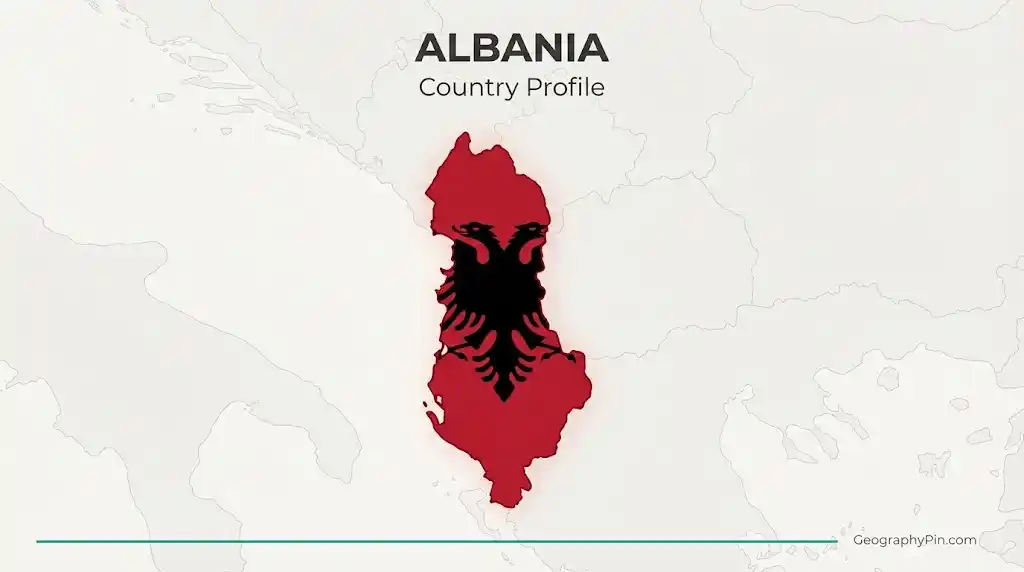
Albania is a country in southeastern Europe on the western Balkan Peninsula, between the Adriatic and Ionian Seas. Tirana is its capital, but the bigger story is the mix: rugged mountains, a strategic coastline, a distinct language, and a modern path shaped by NATO membership and a long European transition.
How to use this article: Need the basics fast? Start with the quick facts. Want the physical picture? Go to rivers and mountains. Checking where Albania stands now? Open the economy snapshot. Planning movement? See transport.
Quick Facts & Key Numbers
At a glance
On the main country-profile indicators, Albania is small by area, modest by population, and strongly centered on Tirana as its political and economic core. The 2023 census counted 2,402,113 residents. Albania is generally classified as an upper-middle-income country, and recent human development reporting places it in the very high human development category.
| Metric | Value |
|---|---|
| Capital city | Tirana |
| Largest city | Tirana |
| Population | 2,402,113 residents (2023 census) |
| Area | 11,100 sq mi (28,748 km²) |
| Highest point | Mount Korab, about 9,068 ft (2,764 m) |
| Official language | Albanian |
| Currency | Albanian lek (ALL) |
| Government type | Unitary parliamentary republic |
| NATO status | Member since 2009 |
| EU status | Candidate country; accession negotiations underway |
| Time zone | Central European Time / Central European Summer Time |
Area, language, and relief facts are stable reference points. Population, income, and development indicators move over time, so the headline values here are rounded where that makes the profile cleaner and safer.
Where Is Albania Located?
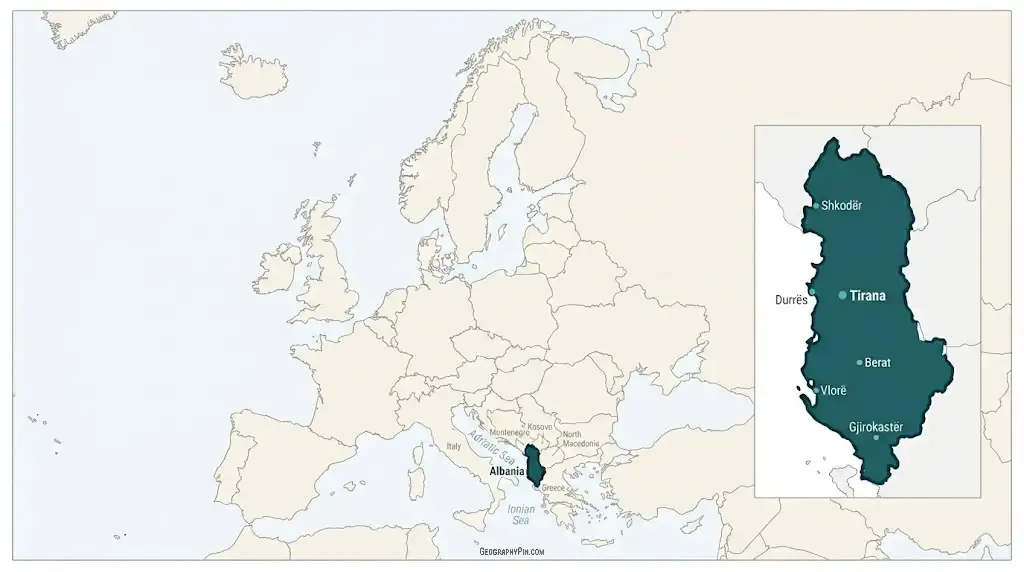
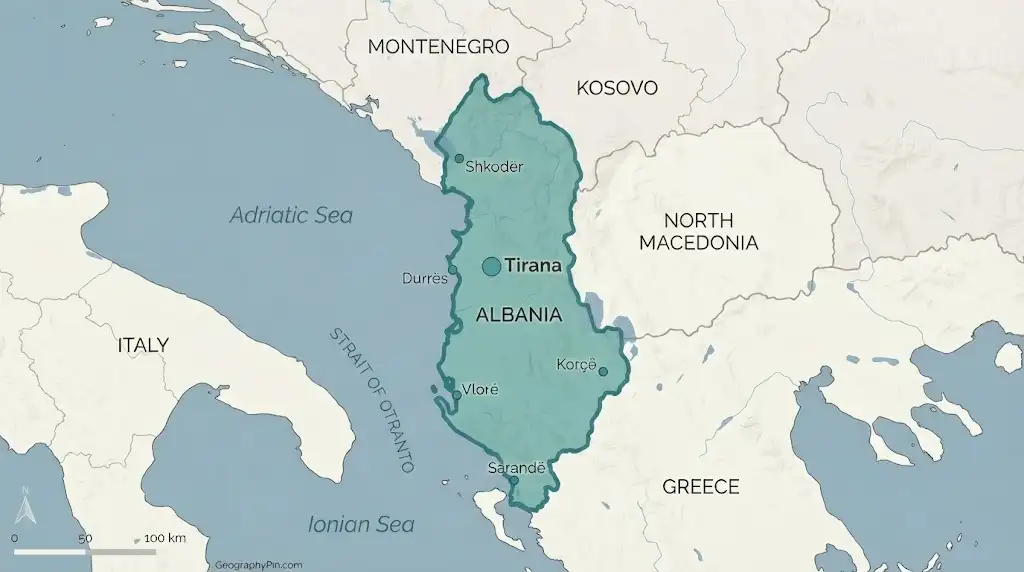
Albania lies in southeastern Europe on the western side of the Balkan Peninsula. It faces the Adriatic Sea to the west and northwest and the Ionian Sea to the southwest, while bordering Montenegro, Kosovo, North Macedonia, and Greece on land.
That position gives Albania a useful bridge-like geography. It sits close to southern Italy across the Adriatic, but also connects physically and historically to the interior Balkans. Tirana is set in the central-western part of the country, while Durrës anchors the main port zone on the coast.
Albania’s Landscapes, Climate & Nature
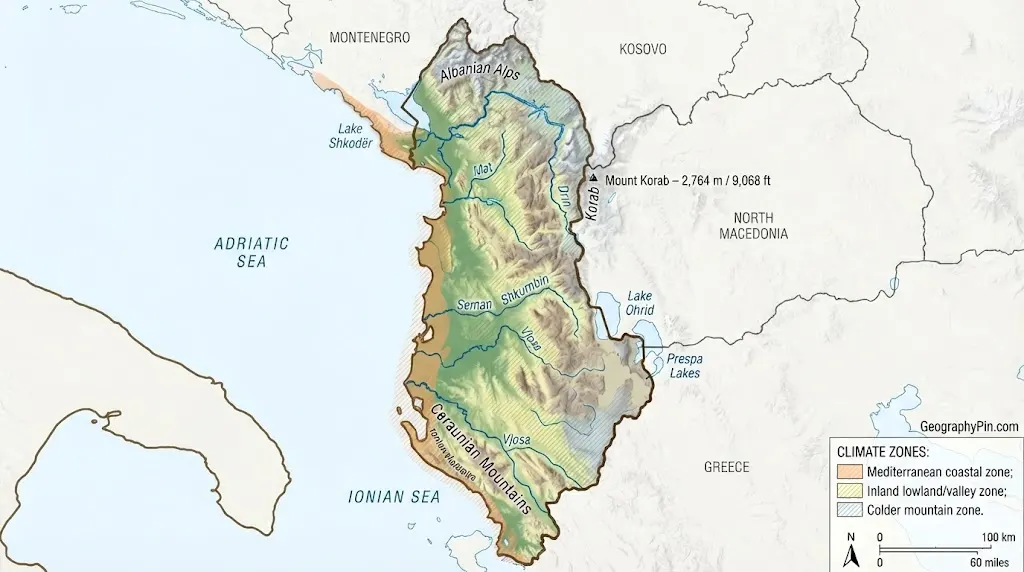
Most of Albania is hilly or mountainous rather than flat. The country’s relief rises sharply away from the coast, and the coastal lowlands form only a relatively narrow western belt compared with the rugged interior.
The contrast between sea and mountain is one of Albania’s defining geographic traits. The Adriatic side is generally lower and more open, while the Ionian side becomes steeper and more dramatic, with rocky slopes and narrow coastal strips backed by higher ground.
The climate is broadly Mediterranean along the coast, with hotter, drier summers and milder, wetter winters, but inland basins and uplands shift toward colder winter conditions and stronger seasonal contrast. Albania also stands out for the ecological value of places such as the Vjosa river system, which has become one of the country’s best-known conservation landmarks.
Major rivers, mountains & natural regions
The Drin is Albania’s main river system, and Mount Korab is the country’s highest summit. Northern mountain landscapes such as Theth and Valbonë, the central and southern river corridors, and the wetlands of the western plain show how much physical variety is compressed into a relatively small national territory.
People, Languages & Albanian Culture
Population & settlement
Albania’s 2023 census recorded 2,402,113 residents, confirming a substantial decline from the previous census era and reinforcing the role of emigration and lower birth rates in shaping the country’s demography. At the same time, settlement has become more concentrated in and around Tirana, Durrës, and other urban centers.
Language & identity
Albanian is the official language and one of Europe’s clearest linguistic markers of national distinctiveness, because it forms its own branch within the Indo-European family. The two major dialect groupings usually identified are Gheg in the north and Tosk in the south, while the standard written language is based mainly on Tosk.
Religion & society
Albania is a secular state with Muslim, Catholic, and Orthodox traditions, but public identity is often framed more strongly in civic and national terms than in strict confessional ones. That mix is one reason Albania is frequently described as a place where religious coexistence has remained relatively visible in daily life.
Culture, music & food
Albanian culture blends Balkan, Mediterranean, and Ottoman-era influences. One of its best-known cultural markers is Albanian folk iso-polyphony, while the country’s urban heritage is strongly reflected in places such as Berat and Gjirokastër. Everyday food culture leans Mediterranean, with pastries, yoghurt-based dishes, grilled meat, vegetables, seafood along the coast, and a dense café culture in towns and cities.
Government, Politics & International Role
Albania is a unitary parliamentary republic. The president serves as head of state, while executive authority is centered more directly on the prime minister and cabinet. Tirana remains the core institutional seat for parliament, ministries, and the main national offices.
Internationally, Albania is firmly tied to Euro-Atlantic structures. It joined NATO in 2009, became an EU candidate in 2014, began formal accession talks in 2022, and by the end of 2025 had opened all negotiating clusters and chapters, even though membership itself still requires a much longer alignment and ratification process.
Albania’s Economy & Key Industries
Economic overview & living standards
Albania’s economy is no longer the isolated system it was under communism. It is now generally classified as upper-middle-income. Recent data place GDP per capita at roughly US$10,000, while recent human development reporting places Albania in the very high human development category.
| Indicator | Recent value |
|---|---|
| GDP per capita | About US$10,000 |
| HDI | About 0.81 |
| Urban population share | About 58%–59% |
| Income group | Upper-middle-income |
Services dominate the economy, but agriculture still matters beyond the main urban corridor, and demographic change remains a real structural pressure. Tourism has become a major growth driver, while fiscal resilience and ageing trends remain central policy concerns.
Main sectors, tourism & energy
Tourism, construction, trade, and transport have become major economic drivers, while agriculture, garments, and some mineral-based industries still remain part of the national mix. Hydropower is especially important in Albania’s electricity system, but that strength also creates vulnerability in dry years, when weaker river flow can raise import needs and expose the energy system to weather shocks.
Cities, Regions, Transport & Travel Highlights
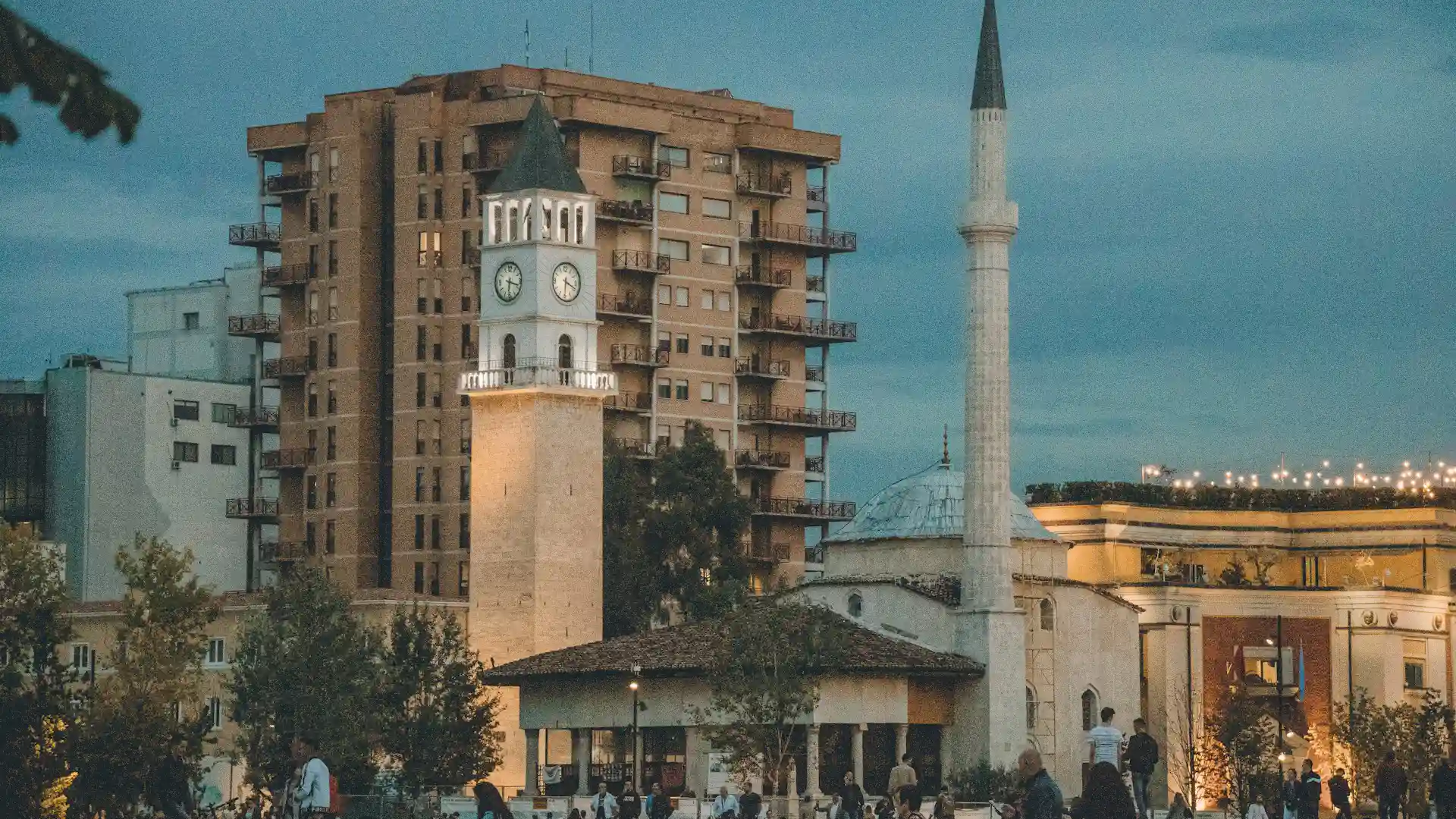
Tirana is the capital and largest city, but Albania’s regional geography is much broader than a single urban center. Durrës is the main Adriatic port, Vlorë is tied both to the southern coast and the 1912 declaration of independence, Shkodër links the north to the lake and mountain zones, and Berat and Gjirokastër remain two of the country’s strongest historic-city symbols.
| City / region | Role | Known for |
|---|---|---|
| Tirana | Capital and largest city | Government, business, universities, museums, café life |
| Durrës | Main port city | Adriatic coast, ferry links, Roman heritage |
| Vlorë and the Riviera | Southern coastal gateway | Sea views, beaches, independence-era importance |
| Shkodër | Northern hub | Lake access, mountain gateway, historic setting |
| Berat and Gjirokastër | Historic urban centers | UNESCO-listed Ottoman-era townscapes |
Transport & getting around
Most international arrivals come through Tirana International Airport. Road travel remains the main domestic mode for most people, ferry links continue to connect Durrës with Italian ports, and Albania’s railway system is still limited but under gradual upgrade.
History in Brief
The territory of present-day Albania has deep historical layers. Classical-era Illyrian populations, Roman incorporation, Byzantine rule, medieval fragmentation, and then long Ottoman control all helped shape the country’s settlement patterns, religion, political memory, and regional ties.
Modern Albanian statehood dates from the declaration of independence in Vlorë on November 28, 1912. The twentieth century then brought monarchy, occupation during the Second World War, a hardline communist period under Enver Hoxha, and finally the difficult transition to plural politics and market reform after 1990.
Since the 2000s, Albania’s broader strategic story has been one of institutional opening and international integration. NATO accession in 2009 and the later launch of EU accession negotiations are the clearest symbols of that shift.
| Period / year | Key point |
|---|---|
| Ancient and classical eras | Illyrian populations, then Roman rule |
| Late antiquity and medieval centuries | Byzantine influence, local principalities, shifting regional control |
| 15th century onward | Ottoman rule becomes dominant after the Skanderbeg era |
| 1912 | Independence declared in Vlorë |
| 1939–1944 | Italian and then German occupation during World War II |
| 1944–1990 | Communist rule and extreme political isolation |
| 1990s onward | Democratic transition, instability, then deeper Western integration |
Table downloads (4)
- Quick facts about Albania (12 × 2)View tableDownload CSV
- Albania economic snapshot (5 × 2)View tableDownload CSV
- Major Albanian urban and regional anchors (6 × 3)View tableDownload CSV
- Albania history timeline (8 × 2)View tableDownload CSV
Challenges & Future Trends
Albania’s clearest structural challenge is demographic. The 2023 census confirmed long-term population decline, and that trend feeds directly into labour supply, ageing, and regional imbalance.
Governance and rule-of-law reforms remain just as important. Judicial reform, institutional trust, public administration, and anti-corruption performance are central tests of how credible and durable Albania’s next phase of development will be.
Environment is the other major long-range pressure point. Albania has valuable rivers, mountain ecosystems, and coastal landscapes, but tourism growth, waste management, hydropower choices, and climate stress all shape how durable that natural capital will be over time.
FAQ
Is Albania in the European Union?
No. Albania is an EU candidate country, not an EU member state. Accession negotiations are underway, but full membership still depends on a much longer legal and political process.
What language is spoken in Albania?
Albanian is the official language. Its two main dialect groupings are usually identified as Gheg in the north and Tosk in the south.
What currency does Albania use?
Albania uses the Albanian lek, abbreviated ALL. Euros may appear in some tourism settings, but the national currency is the lek.
What is Albania best known for?
Albania is best known for its contrast between mountains and coast, its Adriatic and Ionian shorelines, its distinct Albanian-language identity, and historic towns such as Berat and Gjirokastër.
What is the climate like in Albania?
The coast is broadly Mediterranean, with warmer, drier summers and milder winters, while inland and upland areas are colder in winter and more seasonal overall.
Do you need a visa to visit Albania?
That depends on your nationality and length of stay. Many short-stay travelers can enter without a visa, while longer or restricted cases may require advance application.
What Did We Learn Today?
Albania is small on the map but not small in geographic or strategic weight. It combines a mountainous interior, a coastal western edge, a distinct linguistic and cultural identity, a post-communist state-building story, and an economy and foreign policy still being reshaped by migration, tourism, hydropower, NATO membership, and a still-unfinished EU path.
Sources & Data Notes
For a country profile like this, I lean mostly on Albania’s census material, broad baseline indicators from major international datasets, and institutional references where they fit the topic. Some figures are rounded on purpose, and newer releases can shift population, income, or policy details over time. I also use AI assistance for drafting support and occasional visual cleanup, but the aim here is still a grounded editorial summary rather than inflated precision.