Saudi Arabia is the world’s largest sovereign country without a permanent natural river. It covers about 830,000 square miles (2.15 million square kilometers), yet its surface drainage consists mainly of wadis that flow after rainfall rather than year-round rivers. The distinction matters because temporary watercourses are still real drainage features.
How to use this article: Start with the four-fact answer, clarify rivers versus wadis, see Saudi Arabia’s water sources, or check why country lists vary.
Saudi Arabia: the largest country without a permanent river
Using total surface area and a permanent-river criterion, Saudi Arabia is the answer. Its surface area is approximately 830,000 square miles (2,149,690 square kilometers).
Saudi Arabia has large valleys and drainage channels, but no permanent rivers or streams. This is the more precise version of the familiar statement that the country “has no rivers”.
Fast check: the answer in four facts
- Country: Saudi Arabia
- Criterion: No permanent natural river
- Surface area: About 830,000 square miles (2.15 million square kilometers)
- Surface drainage: Mainly wadis, temporary runoff, springs, reservoirs, and dammed floodwater
Libya is the closest large comparison commonly included under the same definition. Libya covers about 679,000 square miles (1,759,540 square kilometers) and has no permanent natural rivers, making Saudi Arabia approximately 151,000 square miles (390,150 square kilometers) larger.
Why Saudi wadis do not count as permanent rivers
A perennial stream normally carries water throughout the year. An intermittent stream flows during certain seasons, while an ephemeral stream flows mainly in direct response to rainfall.
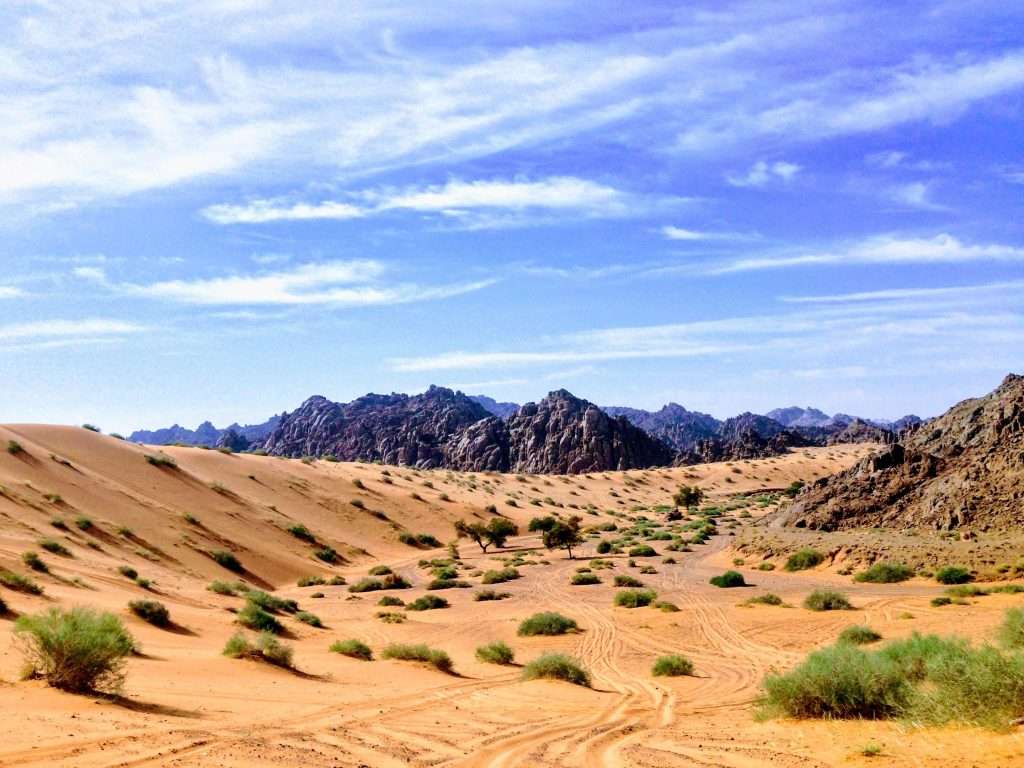
A wadi is a valley or drainage channel common in arid regions. Many Saudi wadis remain dry for long periods and then carry fast runoff after heavy rain. These flows can support groundwater recharge, fill reservoirs, and cause destructive flash floods, but they do not form a continuously flowing national river system.
Saudi Arabia is therefore not without drainage or surface water. It is specifically without a permanent natural river.
How Saudi Arabia gets water without rivers
The absence of perennial rivers does not mean the country has no usable water. Saudi Arabia has developed a water system that combines natural reserves, captured runoff, desalination, and water reuse.
Saudi Arabia’s main water sources
- Desalinated seawater: Seawater is treated at coastal plants and transported to cities, including inland population centers.
- Groundwater: Renewable and nonrenewable aquifers supply households, industry, and especially agriculture.
- Captured runoff: Dams collect some of the water that moves through wadis after rainfall.
- Treated wastewater: Reused water supports irrigation, industry, and landscaping while reducing demand for higher-quality freshwater.
Desalinated water accounted for 50% of Saudi Arabia’s distributed water supply in 2023. That figure refers to water entering the distribution system, not half of all water used nationally; agriculture continued to depend heavily on groundwater.
What the lack of rivers changes
A permanent river naturally collects water across a basin, supports ecosystems, and can provide a renewable supply when withdrawals remain sustainable. Saudi Arabia must reproduce some of those functions through dams, wells, desalination plants, treatment facilities, storage, and long-distance pipelines.
Each source has limits. Desalination requires energy and creates concentrated brine; moving water from coastal plants to inland cities adds cost; and excessive extraction from nonrenewable aquifers reduces reserves that replenish very slowly. Saudi Arabia’s National Water Strategy therefore emphasizes demand management, resource protection, wastewater reuse, and more efficient use of groundwater and surface runoff.
Riverlessness has also influenced agriculture. Farming that cannot rely on regular river flow needs irrigation from groundwater, dams, treated water, or other managed sources. This makes crop choice, irrigation efficiency, and aquifer protection central parts of national water planning.
Countries commonly listed as having no permanent rivers
Saudi Arabia is not the only sovereign state without a permanent natural river. The following examples retain the article’s original comparisons while applying the more accurate permanent-river definition.
Examples under the permanent-river definition
| Country | Natural surface drainage | Important clarification |
|---|---|---|
| Libya | Wadis and brief runoff after rainfall | The Great Man-Made River is an engineered pipeline network, not a natural river. |
| Bahrain | No perennial rivers | The arid island country has no natural river system carrying water year-round. |
| Kuwait | No permanent rivers or lakes; small wadis can form after rain | Runoff is normally brief because of the hyper-arid climate and high evaporation. |
| Malta | Small temporary streams and watercourses | Malta has no large permanent river system, but “riverless” does not mean it has no watercourses. |
| Qatar | No permanent rivers | Rainfall can create temporary runoff and contributes to limited groundwater recharge. |
| United Arab Emirates | Wadis and occasional flash flows | The country has no reliable perennial river or comparable year-round surface-water system. |
This is an illustrative comparison rather than a claim that one universally accepted global list exists. Small streams, seasonal channels, border rivers, springs, and locally used feature names can change how individual sources classify a country.
Why lists of riverless countries vary
Some lists use “no rivers” as shorthand for no permanent rivers. Others exclude short streams, count only named rivers, or classify temporary channels as rivers. A country can therefore appear riverless in one reference while another source records intermittent or locally perennial surface flow.
Oman shows why copied lists require caution. Most of its surface flow is intermittent, but an FAO country study identifies perennial surface flow along Wadi Dayqah for about 19 miles (30 kilometers). Calling Oman entirely riverless therefore depends on the definition being used.
The clearest wording is not simply “countries with no rivers.” It is countries without permanent natural rivers, followed by an explanation of how temporary streams and wadis are treated.
Frequently Asked Questions
Does Saudi Arabia have any rivers?
Saudi Arabia has no permanent natural rivers. It does have wadis and other drainage channels that may carry water seasonally or after heavy rainfall.
Can Saudi Arabia flood if it has no permanent rivers?
Yes. Intense rain can move rapidly through dry wadis and produce flash floods. A watercourse does not need to flow year-round to create serious flooding.
Is Libya’s Great Man-Made River an actual river?
No. It is a large engineered network that transports groundwater through pipes. Its name does not change Libya’s classification as a country without permanent natural rivers.
Is there an official number of countries without rivers?
There is no single count that works under every definition. Totals vary according to whether sources include temporary streams, small watercourses, border rivers, or channels that flow only after rain.
What Did We Learn Today?
Saudi Arabia is the largest sovereign country without a permanent natural river, covering about 830,000 square miles (2.15 million square kilometers). Its wadis still carry runoff, recharge groundwater, fill reservoirs, and create flood hazards, while desalination, groundwater, captured rainfall, and reused water support national demand. Any list of riverless countries should state clearly how temporary watercourses are classified.
Sources & Data Notes
Principal references consulted included World Bank World Development Indicators and Climate Risk Country Profiles, FAO AQUASTAT and country water studies, Saudi Arabia’s 2023 Water Accounts and National Water Strategy, US Environmental Protection Agency streamflow guidance, Malta’s Third River Basin Management Plan, and national communications submitted by Saudi Arabia, Bahrain, and the United Arab Emirates through the UNFCCC. Area figures are rounded, and classifications can vary according to how temporary streams and wadis are treated. This article was prepared and editorially reviewed by Z.K. Atlas, who completed the final factual checks and publication approval. AI tools may have assisted during the editorial process, including with language refinement and the creation or editing of visual materials.