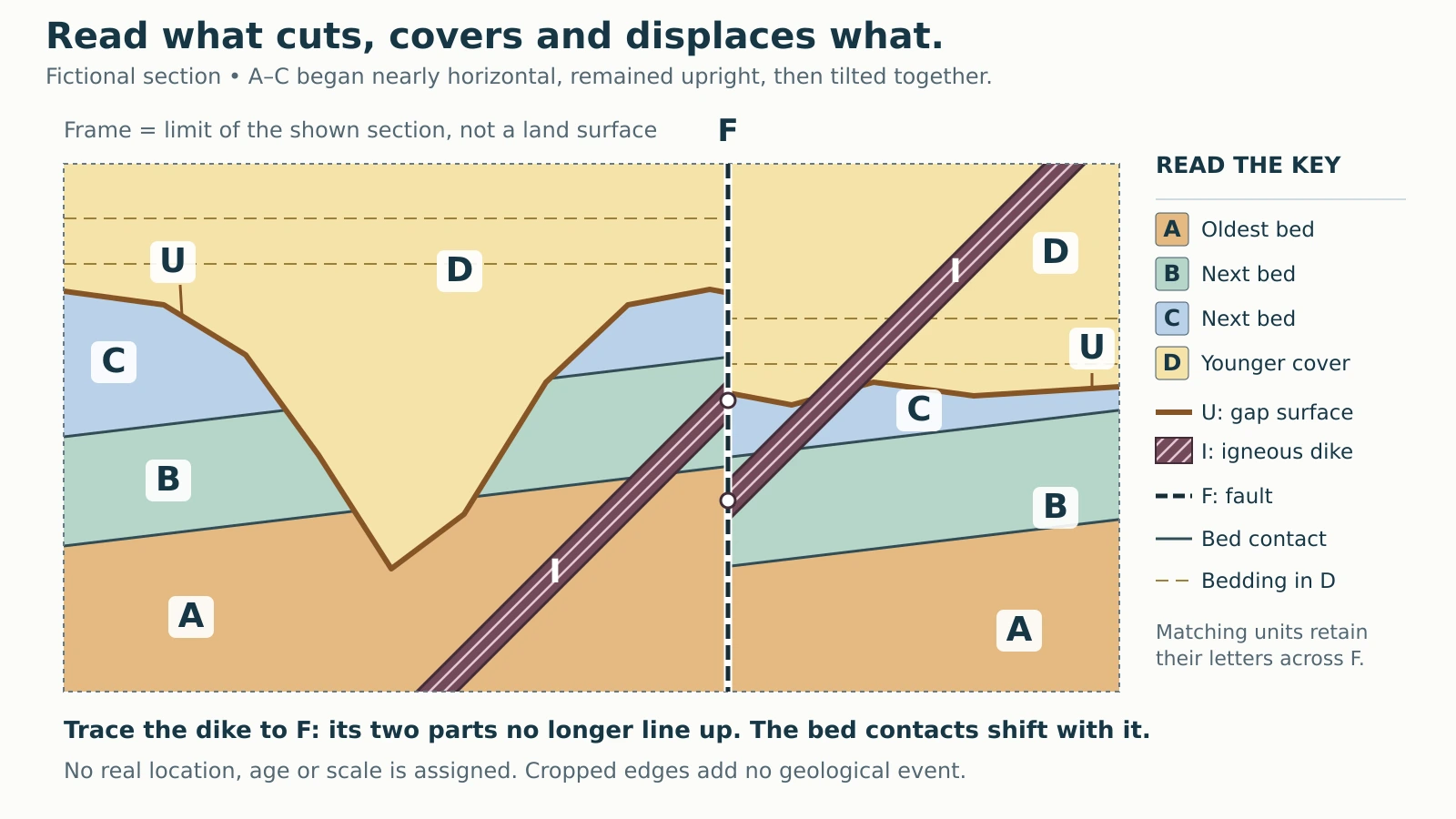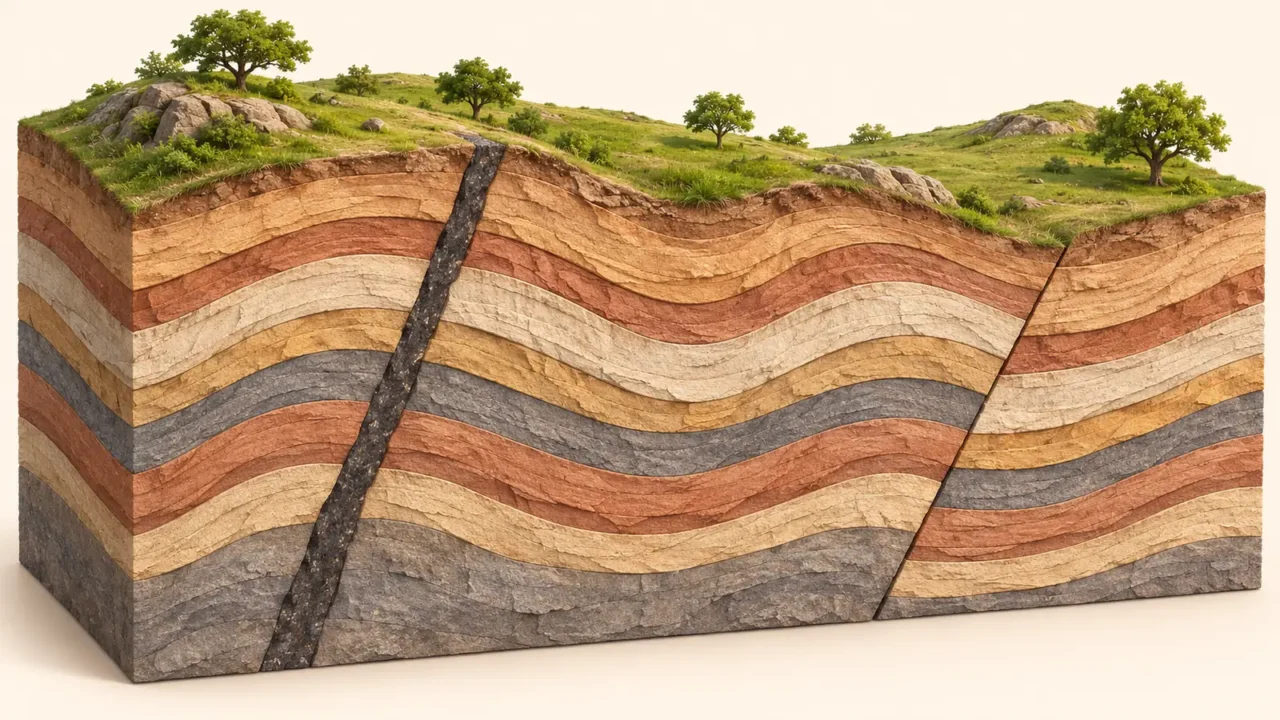
A geological cross-section shows rock bodies and structures in a side view. Reading their history means explaining the relationships between them, rather than ranking everything by its height on the page. One fictional section makes those connections visible.
To read a geological cross-section, identify the rock units, establish their original order, and trace which features cut, cover or displace others. In this upright example, deposition of A, B and C precedes tilting, erosion, deposition of D, intrusion of I and movement on F. This is a relative sequence, not a set of ages in years.
How to use this article: You can check the supplied assumptions, trace the fault offset, or try the missing-evidence case.
1. Separate Units, Contacts and Events
The letters name different kinds of evidence. A, B, C and D are sedimentary beds. A contact is a boundary between rock bodies. U is an erosional surface representing a gap in the rock record, not another sedimentary layer. I is an igneous dike: a sheet of rock that intruded across earlier layering. F marks a fault along which displacement occurred.
Start with the stated assumptions
For this exercise, A, B and C were deposited nearly horizontally, remained upright rather than overturned, and later tilted gently together. D has a different bedding orientation. The unit identities and contacts are supplied teaching evidence, not an interpretation of a real photograph.
Thin solid lines mark older bed contacts; dashed brown lines show bedding within D. Those guides do not introduce extra named beds. The thick irregular line is U, the hatched band is I, and the heavy dashed line is F.

2. Reconstruct the Beds, Tilt and Gap
Within the upright older package, A underlies B and B underlies C. That gives A deposition → B deposition → C deposition. The National Park Service explains this ordering principle as superposition. Apply it to the sedimentary sequence, not indiscriminately to every object in the picture.
All three older beds share the tilt, so their deposition preceded the supplied tilting event. The starting assumption matters: inclined sedimentary lines can also form during deposition. An inclined line alone does not establish later deformation.
Now follow U through the irregular hollow. It cuts across the tilted contacts and reaches different older units. Those beds had to exist and be tilted before erosion truncated them. D subsequently covered U. This relationship is an angular unconformity: younger sedimentary cover rests across the eroded, differently oriented older sequence.
GeographyPin’s erosion-landform guide explains removal at the surface. Here the task is narrower: place that removal between tilting and D deposition. U records missing history without telling us its duration.
3. Follow the Dike and Fault Across the Section
Trace the hatched band I across the older beds, through U and into D. The intrusion is younger than the material it cuts. Its deep-reaching lower part does not make it older than the high bed D: the cross-cutting contact supplies the ordering evidence.
Match both sides before dating the movement
At F, the two dike segments meet the fault at different heights. Corresponding bed contacts, U and the bedding guides in D shift consistently too. Match the repeated letters and follow the boundaries; do not treat the right-hand pieces as newly deposited units.
The displaced dike establishes I intrusion before F movement. A line drawn near I would not establish that order. The NPS explanation of cross-cutting relationships connects relative age to intrusion and displacement, rather than visual proximity.
F is the youngest among the eight supplied events. That does not prove nothing happened afterward, nor date every possible movement in a real fault’s history.
4. Give Every Step an Evidence Check
Read this sequence from oldest to youngest. The sequence includes tilting and erosion, which produced no new named bed.
| Order and event | Observation that supports the placement |
|---|---|
| 1. A deposition | A lies beneath B in the upright older package. |
| 2. B deposition | B overlies A and underlies C. |
| 3. C deposition | C overlies B and shares the later tilt. |
| 4. Tilting of A–C | All three initially near-horizontal beds are tilted together. |
| 5. Erosion forming U | U truncates the tilted older beds. |
| 6. D deposition | D covers U with differently oriented bedding. |
| 7. I intrusion | I cuts the older beds, crosses U and cuts D. |
| 8. F movement | F offsets I and corresponding contacts, including D. |
A useful self-check is to reverse a proposed pair. Could I have been intruded before the D it cuts existed? Could the depicted movement on F have displaced a dike not yet present? Each reversal conflicts with the supplied contact evidence.
5. Recognize When the Order Is Unresolved
A separate case with no exposed I–F relationship
Imagine a different section, described only in words: I and F both cut D, but their mutual relationship is not exposed anywhere. No displacement or truncation between I and F is supplied.
Both features postdate D. Their order relative to each other remains unresolved: I could precede F, or F could precede I. This is a separate evidence set, not the main drawing with one junction covered while other offset clues remain visible.
Even the complete main example supplies no numeric ages, deposition rates or duration for the gap. A thicker bed does not establish a longer deposition interval. The section also cannot identify the cause of tilting, an earthquake’s size or a future hazard.
For broader mechanisms, use the separate plate-tectonics explanation. The relationships here establish chronology without identifying a plate boundary. A surface-only topographic profile would not supply these subsurface contacts.
What Did We Learn Today?
Work from observations to a supported order: which bed overlies another, which surface truncates it, what crosses that surface, and what displaces the crossing feature. Keep surfaces separate from rock units and the drawing frame separate from geological events. When a necessary relationship is missing, retain the comparisons you can establish and leave the rest unresolved.
Sources & Data Notes
The section, unit labels and eight-event exercise are original fictional teaching material, with no real location or numeric age assigned. NPS supports the dating principles and terminology; the New Mexico Bureau source provides independent outcrop context. No source photograph or illustration was copied.