A river network can gain a tributary without gaining a higher Strahler order. The number depends on how upstream branches connect, so neither counting junctions nor counting headwaters is enough. A small network makes the rule and its limits easier to see.
Assign Strahler stream order from the headwaters downstream: start every link with no upstream tributary at 1. When two equal-order links join, increase the downstream order by one. When unequal orders join, retain the higher value. The result describes the branching structure of the specified input network, not a measurement of its water flow.
How to use this article: You can try the unnumbered network, recompute an omitted branch, or compare Strahler with Shreve.
1. Apply Three Rules to Stream Links
A link is a channel segment between network junctions, or between a junction and a headwater or outlet. A headwater link has no upstream tributary in the network being classified. Junction names identify places; order numbers describe the connecting links.
For the river vocabulary behind the drawing, see river parts, tributaries and confluences. Here the task is to number the channels, rather than trace their drainage-basin boundary.
- Start at 1: assign every headwater link order 1.
- Equal orders: 1 and 1 produce 2; 2 and 2 produce 3.
- Unequal orders: keep the larger number, so 3 and 1 produce 3.
These merger rules follow NSW Water’s Strahler explanation. Work downstream only after assigning both incoming links. A river name does not give every reach along that river one unchanging order.
2. Try the Five-Headwater Network
Fill the downstream links before checking
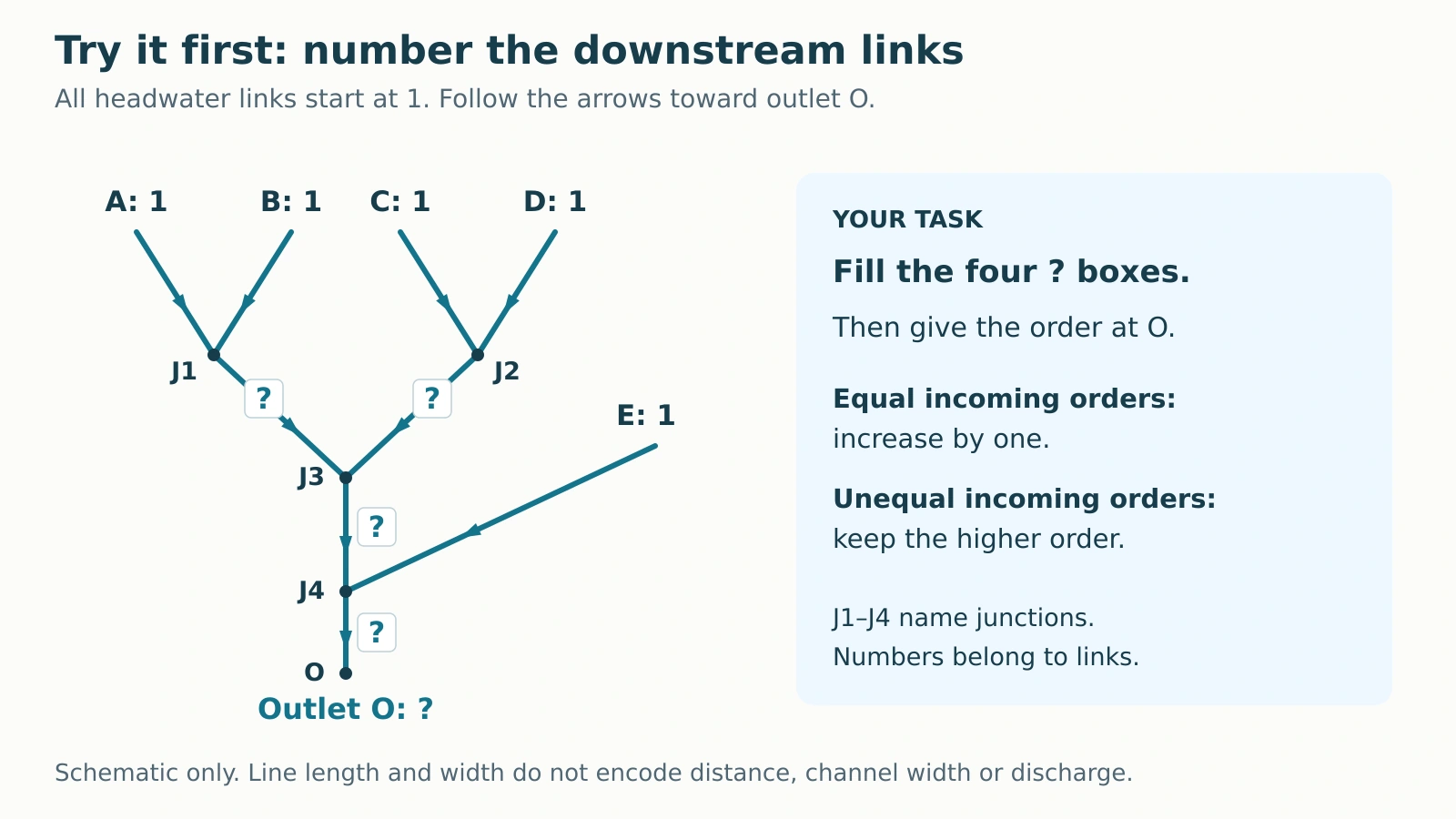
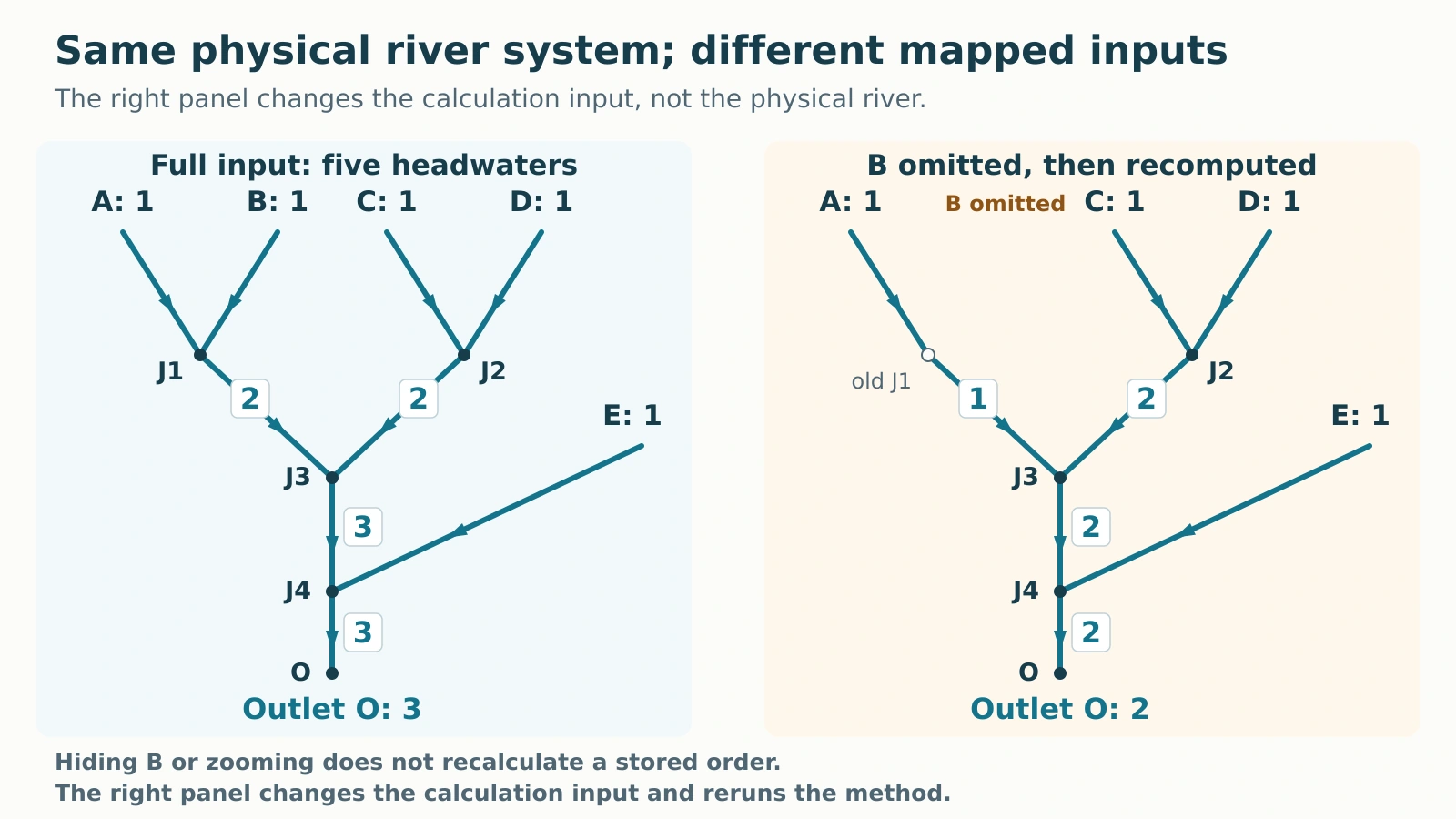
The original exercise has headwater links A, B, C, D and E, all order 1. A and B meet at J1; C and D meet at J2. Those two branches join at J3, and E enters later at J4. Outlet O is downstream of J4.
Follow the arrows and fill the four question-mark boxes. Then state the outlet order and explain whether E changes it. There are no hidden tributaries, three-way joins, splits or loops.

3. Check the Worked Solution
The first two mergers each create a second-order branch. Their meeting creates a third-order branch, which keeps its order when E joins.
| Location | Incoming orders | Downstream order | Reason |
|---|---|---|---|
| J1 | A: 1 and B: 1 | 2 | Equal: increase by one |
| J2 | C: 1 and D: 1 | 2 | Equal: increase by one |
| J3 | 2 and 2 | 3 | Equal: increase by one |
| J4 | 3 and E: 1 | 3 | Unequal: retain the higher |
Outlet O is third order. There is no further junction between J4 and O, so the final link stays at 3. E remains a contributing headwater, even though its arrival does not increase the Strahler number.
If you reached 4, check whether you added one automatically at J4. The rule requires equal incoming orders. If you reached 5 by counting headwaters, you answered a different classification question, explained below.
4. Remove One Input and Recompute
Separate a changed dataset from a changed display
Now omit B from the network used for calculation and rerun the method. This is the same physical river schematic with a deliberately simplified input dataset. It does not represent drought, channel destruction or measured water loss.

- Old J1: A continues at 1 because this input no longer has a confluence there.
- J2: C and D still join as 1 and 1, producing 2.
- J3: 1 meets 2, so the downstream link is 2.
- J4 and O: 2 meets E’s 1 and remains 2 to the outlet.
USGS documentation notes stream order’s sensitivity to cartographic scale. Map scale, channel-selection rules or extraction settings can change which branches an input contains. They do not necessarily change every order; inspect the actual network and whether the values were recomputed.
5. Compare the Branching Pattern and the Method
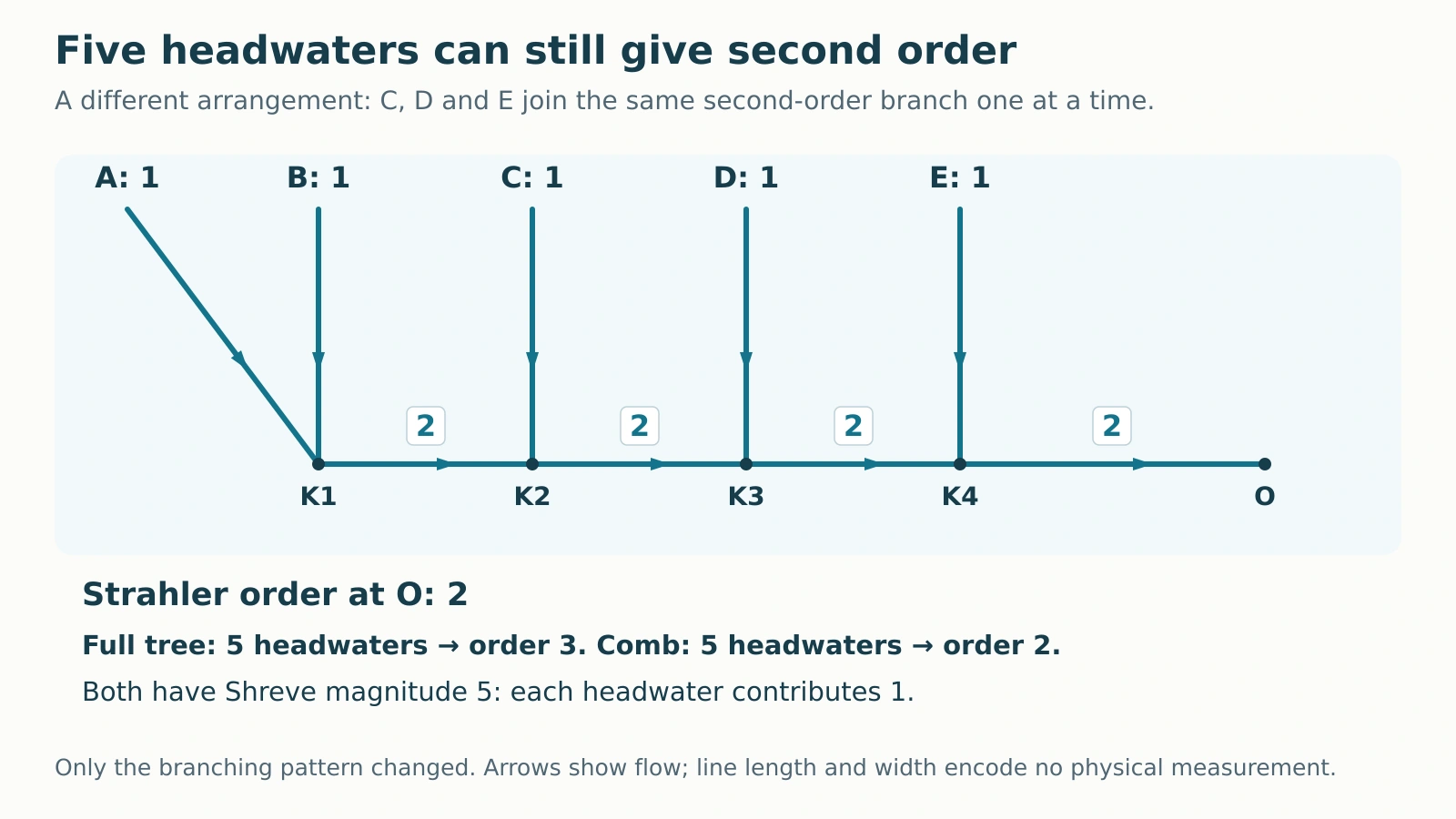
Both the original tree and the comb below have five headwater links. Why are their outlet orders different?

In the original tree, two second-order branches meet. In the comb, A and B produce the only second-order branch; C, D and E join it individually. Headwater count alone therefore cannot establish the Strahler order.
Why Strahler 3 and Shreve 5 can both be correct
Esri’s Stream Order function documentation describes another method: Shreve magnitude. Give each headwater link 1, then add incoming magnitudes at every junction.
For the full tree, Shreve magnitudes are 2 after J1, 2 after J2, 4 after J3 and 5 after J4. At O, Strahler order 3 and Shreve magnitude 5 are consistent results from different methods. Omitting B gives Shreve 4; the five-headwater comb gives Shreve 5.
In these converging trees, Shreve sums upstream headwater contributions. It does not count every interior and exterior segment together, or measure water volume. Check the method name before comparing numbers from two maps.
6. Keep Order Separate from River Conditions
The calculations use connections alone. They contain no measurements of channel width, drainage area, speed or instantaneous discharge. Stream order by itself also does not establish whether water flows year-round, how dangerous a crossing is, or the river’s biodiversity or water quality.
A first-order label does not prove that a channel is temporary, steep or fast. Higher order does not supply a local flood forecast or show that water is clean. GeographyPin’s hydrology quiz tests the separate concepts of discharge, water storage and flood probability.
Real networks can have braids, canals, split-and-rejoin channels and distributaries. Those need method-specific handling; the USGS describes a separate treatment for divergences. They are outside this converging-tree exercise.
When reporting an order, keep three things together: the method, the input network and the chosen link or outlet. Without that context, two numbers may describe different calculations rather than a disagreement about one river.
What Did We Learn Today?
Trace connections before assigning numbers. Equal-order mergers raise Strahler order; unequal mergers do not. Recomputing a changed input can change the answer, while a display change alone cannot. The five-headwater counterexample and Shreve comparison show why both the network arrangement and the method name matter.
Sources & Data Notes
These are original hypothetical topology exercises, not surveyed networks or river observations. Every directed link was checked independently by recursive calculation. The schematics exclude splits and loops; their line lengths and widths carry no physical measurements.