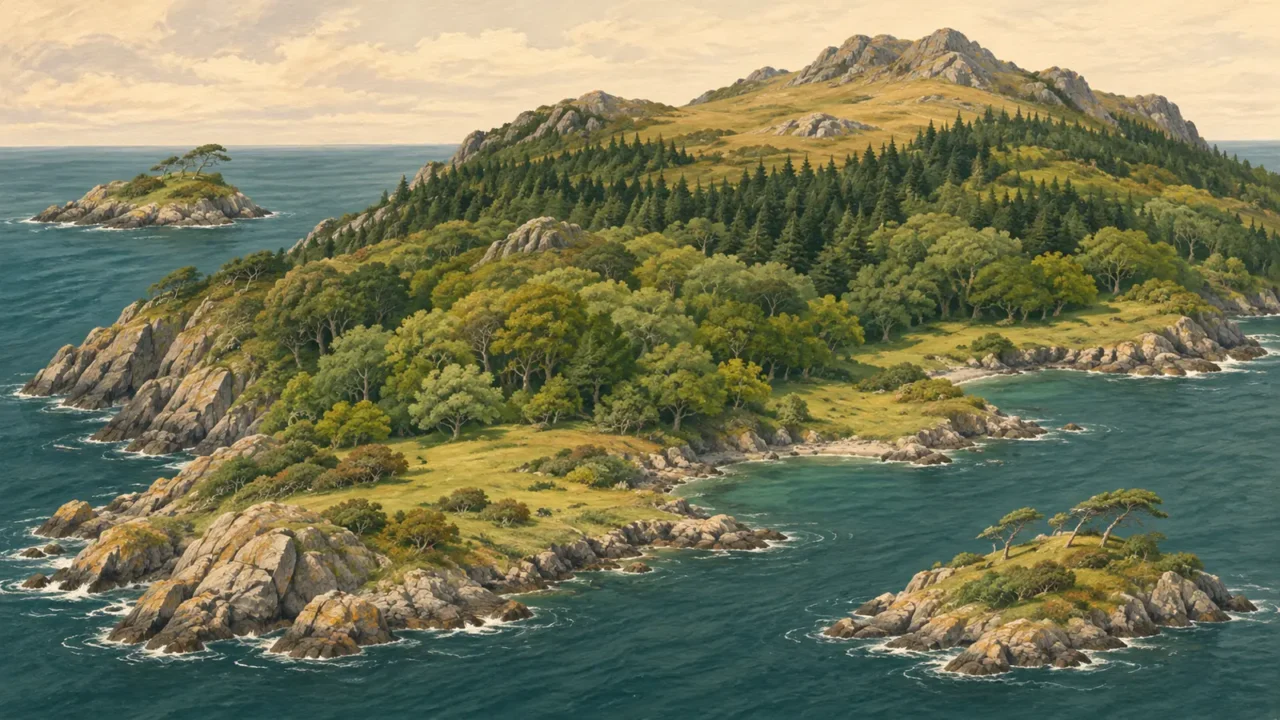
Try this biogeography quiz: 20 questions about where organisms live, how they spread and why distributions change. Apply the concepts to islands, fragmented forests, mountain slopes and evidence from the past, with an explanation after every answer.
Biogeography connects ecology and evolution with geography. This untimed practice set tests processes and interpretation rather than species records or country trivia.
Where does life occur, and why?
20 questions · No timer · One point per correct answer
Easy, Medium and Hard are relative editorial difficulty levels for general geography learners, not standardized ratings. Every correct answer earns one point.
Choose an answer, then open “Show answer” to check it yourself. Interactive scoring appears when JavaScript is available.
Choose one answer, select Check answer, then continue to the next question.
Your Biogeography quiz result
Easy
Show answer
Correct answer: Range describes where it occurs; habitat describes the places and conditions it uses.
A range describes geographic extent. Habitat concerns the conditions and resources used within that extent. Suitable habitat is not necessarily occupied, so a range is not simply a map of all potentially suitable climate.
Easy
Show answer
Correct answer: It is native there, but not endemic to Region A.
Native means naturally occurring in the area. Endemic adds geographic restriction: a species endemic to Region A occurs naturally nowhere else. Neither term tells you how abundant it is.
Medium
Show answer
Correct answer: Evidence that it negatively affects native biodiversity or ecosystems.
Introduction and establishment alone do not make an alien species invasive under this definition. Harm to native biodiversity or ecosystems is the distinguishing evidence; not all introduced species become invasive.
Easy
Show answer
Correct answer: Dispersal.
Dispersal moves organisms or their propagules, such as seeds, to another place. Here the seeds crossed an existing barrier; a new barrier did not divide the original population.
Medium
Show answer
Correct answer: A barrier’s effectiveness depends on the organism’s dispersal abilities.
Geographic isolation depends on how organisms move and survive. One stretch of water can strongly restrict one species while allowing gene flow in another.
Medium
Show answer
Correct answer: Vicariance.
Vicariance divides a formerly continuous distribution. Loss of a land bridge is one mechanism. Isolation may allow later divergence, but the separation alone does not prove that new species have formed.
Hard
Show answer
Correct answer: A large island close to the mainland.
In this model, being nearer raises immigration of new species, while larger area lowers local extinction. The large, near island therefore has the highest expected richness. Real islands also differ in history, habitats and other conditions.
Hard
Show answer
Correct answer: It is consistent with dynamic equilibrium and species turnover.
A balance between colonization and local extinction can maintain similar richness while species identities change. Equilibrium does not mean no movement, no extinctions or an unchanging community.
Easy
Show answer
Correct answer: Plot A, because it contains more species.
Species richness counts distinct species: four in A and three in B. Total individuals measure abundance instead. The question supplies complete censuses so unequal detection is not the issue.
Medium
Show answer
Correct answer: More of the remaining forest is exposed to edge conditions.
Edges can experience stronger wind and drying than forest interiors. Narrow fragments may retain trees yet lose much of the sheltered environment required by an interior specialist. Effects depend on the species and setting.
Medium
Show answer
Correct answer: To facilitate movement and potential gene flow between the populations.
A suitable corridor can help individuals move between habitat patches and breed across populations. Its value depends on whether the focal species can use it; a mapped connection alone guarantees neither movement nor persistence.
Medium
Show answer
Correct answer: Changing temperature, growing season and other site conditions filter which plants can persist.
Elevation is associated with environmental gradients, including temperature and growing-season length. Soils and exposure also matter. The pattern is not a universal altitude boundary or evidence that individual trees instantly evolve into other species.
Medium
Show answer
Correct answer: Broad vegetation structure and climatic conditions.
Biomes group broad ecological patterns, such as climate and vegetation form. Similar biomes can occur in disconnected regions with different species. A biome label is not an inventory of a local ecosystem.
Easy
Show answer
Correct answer: An ecotone.
An ecotone is a transition between ecological communities. The treeline transition can have varying width and structure, rather than being a sharp boundary exactly matching a line on a small-scale map.
Medium
Show answer
Correct answer: Secondary ecological succession.
This is secondary succession because community composition changes after a disturbance while soil and biological remnants persist. Evolutionary adaptation concerns inherited traits across generations, not the replacement of one set of species by another.
Medium
Show answer
Correct answer: Refugia.
Refugia allow populations to persist while conditions elsewhere become unfavorable. Later expansion can leave historical patterns in modern distributions. Multiple refugia can produce more complex histories than a single south-to-north recolonization.
Medium
Show answer
Correct answer: Changes in surrounding vegetation through time.
Pollen assemblages provide evidence of past vegetation. Dating supplies the time framework, but transport and preservation affect the record. Pollen is a proxy, not an exact census of plants at the core location.
Hard
Show answer
Correct answer: No; local habitat information and appropriately timed surveys are still needed.
A range map shows broad geographic extent, not continuous occupancy. Local habitat, season and data age matter. Enlarging a coarse map does not supply missing detail or replace a survey.
Hard
Show answer
Correct answer: The area may become climatically suitable, but natural colonization is not assured.
Climate suitability is not a record of occurrence or a guarantee of arrival. Dispersal distances and land use can limit range shifts, while habitat and species interactions also affect establishment.
Medium
Show answer
Correct answer: Adaptive radiation.
Adaptive radiation combines common ancestry, diversification and ecological differences among descendant species. It concerns branching evolution across generations, not a single organism changing species to meet a new need.
Read patterns, then ask about the process
Each correct answer earns one point, with no penalty for a wrong answer. At the end, select Review answers to see every question and explanation, or Try again to replay the same set. The quiz does not save your score between visits.
- Separate the terms. Native does not mean endemic, introduced does not automatically mean invasive, and species richness is not the same as abundance.
- Keep model assumptions in view. Island size and isolation help explain richness, but real distributions also reflect history, habitat, interactions and movement.
- Distinguish time and scale. Succession changes communities, evolution changes inherited traits across generations, and a broad range map does not confirm occupancy at every site.
For a broader, configurable mix of places and geography topics, try the world geography quiz.
What Did We Learn Today?
The geography of life reflects environmental conditions, movement, interactions and history. Dispersal and vicariance help explain separated populations, while refugia and fossil pollen reveal that present ranges are not the whole story. Islands and habitat fragments illustrate both the value and limits of simple models. Careful interpretation distinguishes a suitable place from an occupied one, and a broad mapped pattern from local evidence.
Sources & Data Notes
The questions use standard biogeographic concepts from government science resources, IUCN and academic references. Scenarios and numerical examples are hypothetical, not field observations. Island comparisons state their model assumptions; native and endemic status refer to the area named, and invasive status uses IUCN’s biodiversity-impact definition. Distribution maps and climate models are not treated as precise records of local occupancy. Difficulty labels are editorial, not standardized ratings.
- U.S. Geological Survey: Species Data Overview; Paleoclimate Proxies; Future of Species Range Shifts: Species range shifts, protected areas, and climate connectivity.
- British Columbia Ministry of Environment: Native/Non-Native or Endemic Status Help.
- IUCN: Invasive alien species and climate change.
- University of California, Berkeley: IB 168: Key Concepts, Plant Geography.
- OpenStax, Rice University: Biology 2e: Formation of New Species; Biology 2e: Community Ecology; Biology 2e: Terrestrial Biomes.
- USDA Forest Service: Equilibrium Theory of Island Biogeography: A Review.
- Stanford Encyclopedia of Philosophy: Conservation Biology: Island Biogeography.
- Smithsonian Libraries and Archives: Theory meets reality: How habitat fragmentation research has transcended island biogeographic theory.
- USDA Climate Hubs: Enhance landscape connectivity.
- U.S. National Park Service: Alpine Vegetation Resource Brief.
- University of Illinois: Surviving the ice: Northern refugia and postglacial colonization.