You can cross the Pacific and arrive on a date earlier than your departure date without traveling backward in time. The International Date Line changes the local calendar label. The journey still takes a positive amount of real time, and UTC provides a straightforward way to keep the arithmetic honest.
Cross the International Date Line westward and the calendar advances one day; cross eastward and it goes back one day. That is the calendar correction, not a complete travel-time calculation. For an actual journey, convert departure time to UTC, add elapsed travel time, then convert to the destination’s local time.
Start here: Learn the direction rule, compare one instant in four places, or follow the worked arrival calculation.
1. What the International Date Line changes
The International Date Line is the conventional boundary between calendar dates in the Pacific. It runs broadly near 180° longitude, but it bends to accommodate local choices about civil dates. It is not a physical wall, and crossing it does not make a person age an extra day or become younger.
Two different things change during travel: real time passes, and the local clock-and-calendar system changes. A displayed arrival date cannot tell you the trip’s duration unless you also know the departure and arrival time zones.
UTC, Coordinated Universal Time, provides the common reference. A UTC offset states how many hours to add to UTC to obtain local time. For example, UTC+13 means local time is 13 hours ahead of UTC; UTC−11 means it is 11 hours behind.
2. Eastward or westward: which day do you change?
West adds a day; east subtracts a day
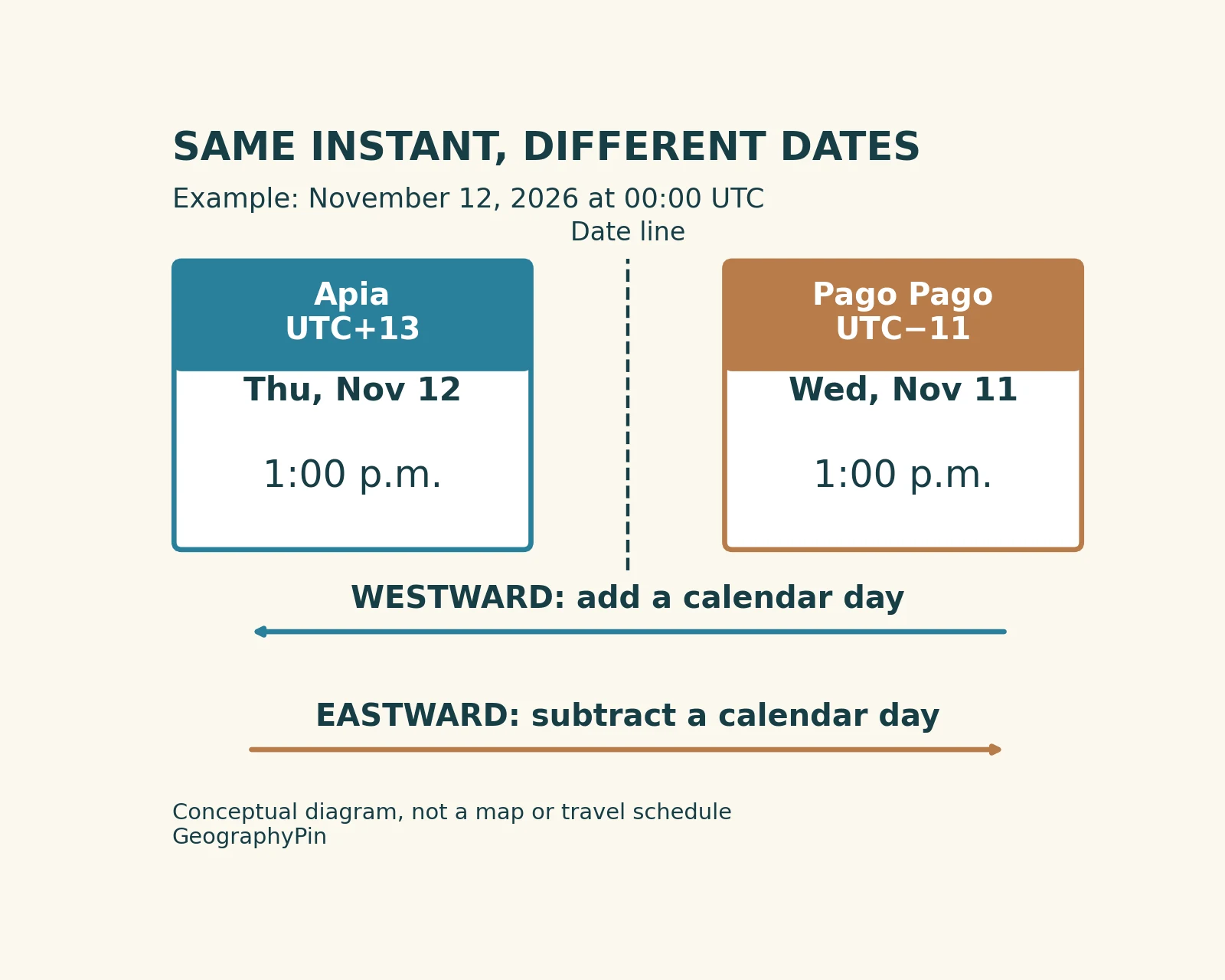
The memory rule describes the calendar adjustment at the date line. It does not mean that every eastward trip arrives yesterday or every westward trip arrives tomorrow. Your departure time, elapsed journey time and the actual local offsets determine the final date.
It also does not mean that the difference between every pair of destinations on opposite sides is exactly 24 hours. Their zones may use different hour offsets. Read the date and clock together rather than applying a day change and ignoring the rest.
3. The same instant in different calendar dates
One UTC instant, four local readings
Use November 12, 2026 at 00:00 UTC as a fixed example. The following readings describe the same instant, not four events separated by travel.
| Place | UTC offset | Local date and time |
|---|---|---|
| Apia, Samoa | UTC+13 | Thursday, November 12, 2026, 1:00 p.m. |
| Pago Pago, American Samoa | UTC−11 | Wednesday, November 11, 2026, 1:00 p.m. |
| Tarawa, Kiribati | UTC+12 | Thursday, November 12, 2026, noon |
| Honolulu, Hawaii | UTC−10 | Wednesday, November 11, 2026, 2:00 p.m. |
Apia and Pago Pago have a 24-hour difference in this example, so their clock faces match while their dates differ. Tarawa and Honolulu have a 22-hour difference, so neither their dates nor their clock readings match. The date-line rule alone is not enough to calculate the latter pair.
These are date-specific examples, not a promise that every location will keep the same offset forever. Civil-time rules can change, and some places use daylight saving time. Use a time-zone-aware calendar or converter for a real booking.
4. Calculate a crossing through UTC
A hypothetical one-hour journey
Suppose a traveler leaves Apia at 10:00 a.m. on Thursday, November 12, 2026, and reaches Pago Pago exactly one hour later. This is an arithmetic exercise, not an advertised flight or a claim about an actual route’s duration.
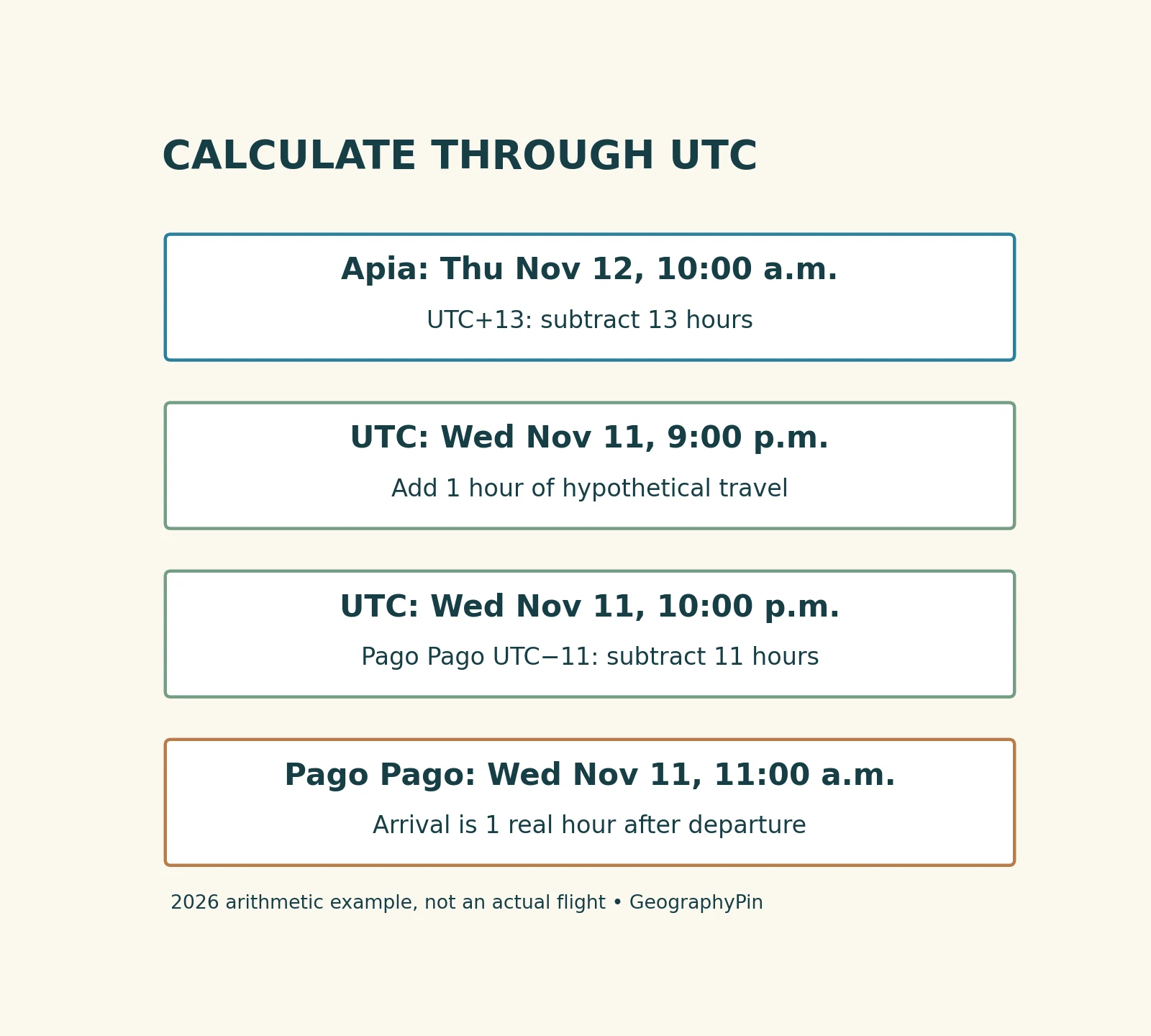
- Departure to UTC: 10:00 a.m. November 12 minus 13 hours equals 9:00 p.m. November 11 UTC.
- Add travel time: one hour later is 10:00 p.m. November 11 UTC.
- UTC to destination: subtract 11 hours for Pago Pago, giving 11:00 a.m. Wednesday, November 11.
The traveler arrives on the previous local date, but one real hour has passed. To check the result, convert both local timestamps back to UTC and subtract: 10:00 p.m. minus 9:00 p.m. is one hour.
Do not double-count the date line. Once you have converted through the correct UTC offsets, the date change is already included. Subtracting another day because the journey was eastward would make the answer wrong.
5. Why the line is not exactly 180 degrees
The 180th meridian is a geometrical line of longitude. The International Date Line reflects civil-date arrangements and therefore does not follow that meridian everywhere. NOAA notes that it has no legal international status and that countries can choose the dates they observe.
This is why simply reading 180° on a globe is not enough to determine the calendar used by a nearby island. Nor is crossing from eastern to western longitude automatically the same thing as crossing the date line. For coordinate notation, see how to read latitude and longitude.
The line’s bends are related to the broader reason time-zone boundaries do not stay straight: people organize civil time around inhabited places and political choices, not only around ideal longitude bands. This article uses conceptual diagrams instead of inventing a precise modern date-line boundary.
6. Common date-line mistakes
- Comparing clock times without dates: 1:00 p.m. in two places can refer to different local calendar dates.
- Confusing Samoa with American Samoa: Apia and Pago Pago use different civil-time rules.
- Assuming a universal 24-hour destination difference: check both UTC offsets.
- Adding the date-line correction twice: a proper UTC conversion already handles it.
- Using a current offset for a different season or historical date: select the actual travel date.
Frequently Asked Questions
Do you gain or lose a day crossing the International Date Line?
Eastward crossing moves the local calendar back a day; westward crossing moves it forward a day. “Gain” and “lose” describe calendar labels, not extra or missing real time.
Can a plane land before it took off?
Its local arrival date and time can appear earlier than its local departure reading. In a common reference such as UTC, arrival still follows departure by the elapsed journey time.
Is the International Date Line the same as 180° longitude?
No. It runs broadly near that meridian but deviates according to civil-date arrangements. Longitude is geometric; the observed date is a civil convention.
Should I add a day after using a time-zone converter?
No, not if the converter already used the correct locations and dates. The UTC-offset conversion includes the calendar change.
What Did We Learn Today?
The date line changes the local calendar, not the passage of time. Westward adds a calendar day and eastward subtracts one, but actual arrival calculations need both locations’ offsets and the elapsed journey. Convert through UTC and let that calculation handle the date change once.
Sources & Data Notes
Original GeographyPin diagrams are conceptual, not mapped date-line boundaries. The November 2026 examples were calculated with named IANA time zones and cross-checked against published local offsets. The one-hour journey is hypothetical. Future or historical journeys require the rules for their own dates.