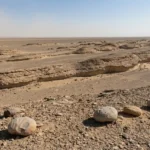
A ventifact is one of the clearest “signatures” of wind erosion: a rock face worn smooth, faceted, or pitted by airborne sand. They’re common in dry, open landscapes where strong winds can keep sand grains moving and where rocks stay exposed long enough to be shaped.
A ventifact is a rock that has been polished, pitted, and often faceted by wind-driven sand and dust—like natural sandpaper working for a long time in one prevailing direction. Many ventifacts develop sharp edges and flat faces that reflect repeated abrasion, especially in deserts and other sparsely vegetated, windy environments.
How to use this article: For quick identification, jump to the fast check; for “what it isn’t” confusion, use common confusions; to compare look-alikes, go to the comparison table; for short answers, head to FAQ.
What is a ventifact?
A ventifact is a rock shaped by aeolian abrasion—abrasion caused by wind-blown particles. In simple terms, sand grains carried close to the ground strike exposed rock surfaces again and again, gradually polishing them, carving tiny pits, and sometimes trimming the rock into flat faces (facets).
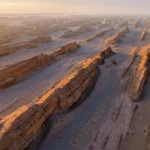
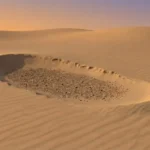
Ventifacts are usually discussed at the “hand sample” scale: individual stones, cobbles, or boulders you can walk up to and examine. That’s different from big wind-eroded landforms like yardangs (streamlined ridges) or dune fields (sand accumulations).
Many field guides use “ventifact” mainly for individual stones and boulders, but some authors also apply the term to wind-abraded bedrock or outcrops; usage varies by tradition.
Why deserts produce classic ventifacts
Deserts and other barren landscapes are ideal because they combine three ingredients: frequent winds, available sand-sized particles, and little vegetation to protect surfaces. When rocks remain exposed for long periods, the “sandblasting” effect has time to leave a visible mark.
What ventifacts look like up close
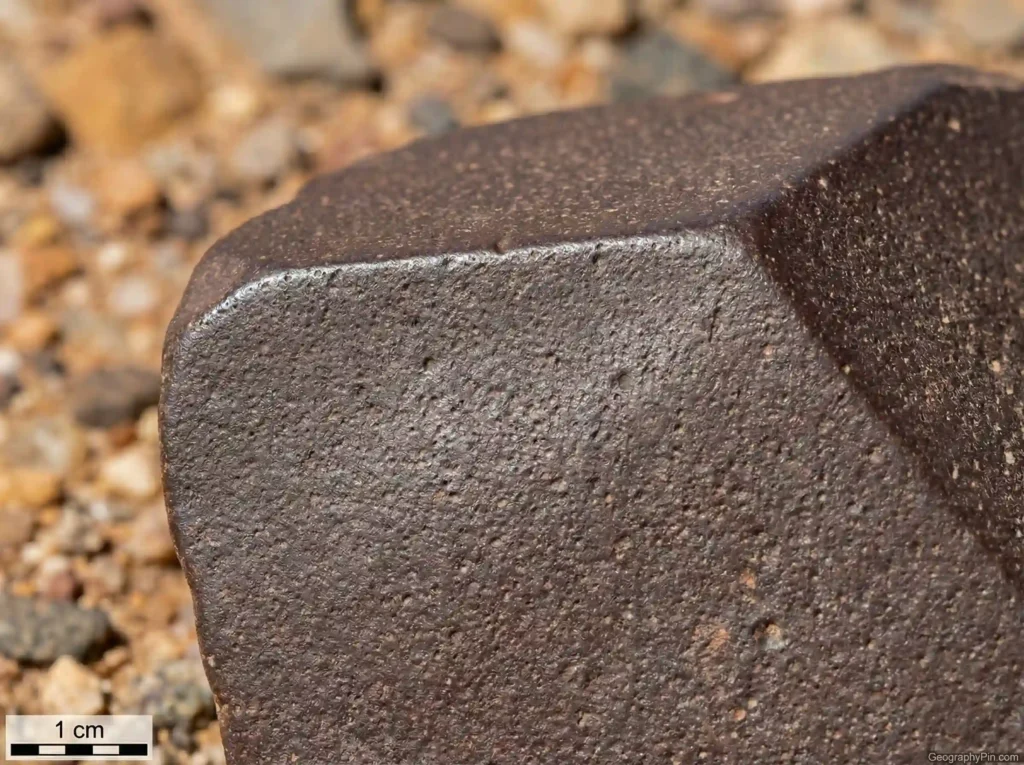
Look for a smooth, slightly glossy face, tiny impact pits, and edges that feel sharper than you’d expect from ordinary weathering. Some show multiple flat faces meeting at ridges, as if the rock has been planed down from different angles.
Fast check: how to recognize a ventifact
Ventifacts can be subtle until you know what to look for. This checklist focuses on features that are visible without tools and that don’t require guessing ages, wind speeds, or sand volumes.
Fast check in 60 seconds
- One dominant “worked” face: a smoother, cleaner surface compared with the rest of the rock.
- Facets and ridges: flat planes meeting at edges, sometimes forming a wedge-like profile.
- Pitting: tiny, closely spaced impact marks that look like peppering or stippling.
- Context: open ground, sparse plants, loose sand or grit nearby, and signs of wind action (ripples, sand drift).
Quick “touch test” and the caution that comes with it
Ventifact faces often feel smoother than surrounding surfaces, but don’t rely on smoothness alone. Water-worn cobbles, rock varnish, and even some chemical weathering can also create smooth textures. The strongest clue is the combination of polish plus pitting and planar facets.
A simple rule for “wind direction” claims
A common temptation is to treat a ventifact like a wind vane: “the facet points to the prevailing wind.” Sometimes that’s reasonable, but it’s not guaranteed. Rocks can roll, tilt, or be reworked as conditions change, and local turbulence can redirect sand flow. If you use ventifacts to infer wind direction, treat it as a clue—then confirm with landscape-scale signs like dune slipfaces, ripple orientations, or sand drift patterns.
How wind makes ventifacts
Wind alone doesn’t carve solid rock efficiently; the real work is done by particles carried by the wind. Sand grains moving close to the ground strike exposed surfaces repeatedly. Over time, those impacts abrade micro-highs, smooth irregularities, and can cut faces that become increasingly planar as abrasion “averages out” bumps and protrusions.
Abrasive delivery: why the near-ground zone matters
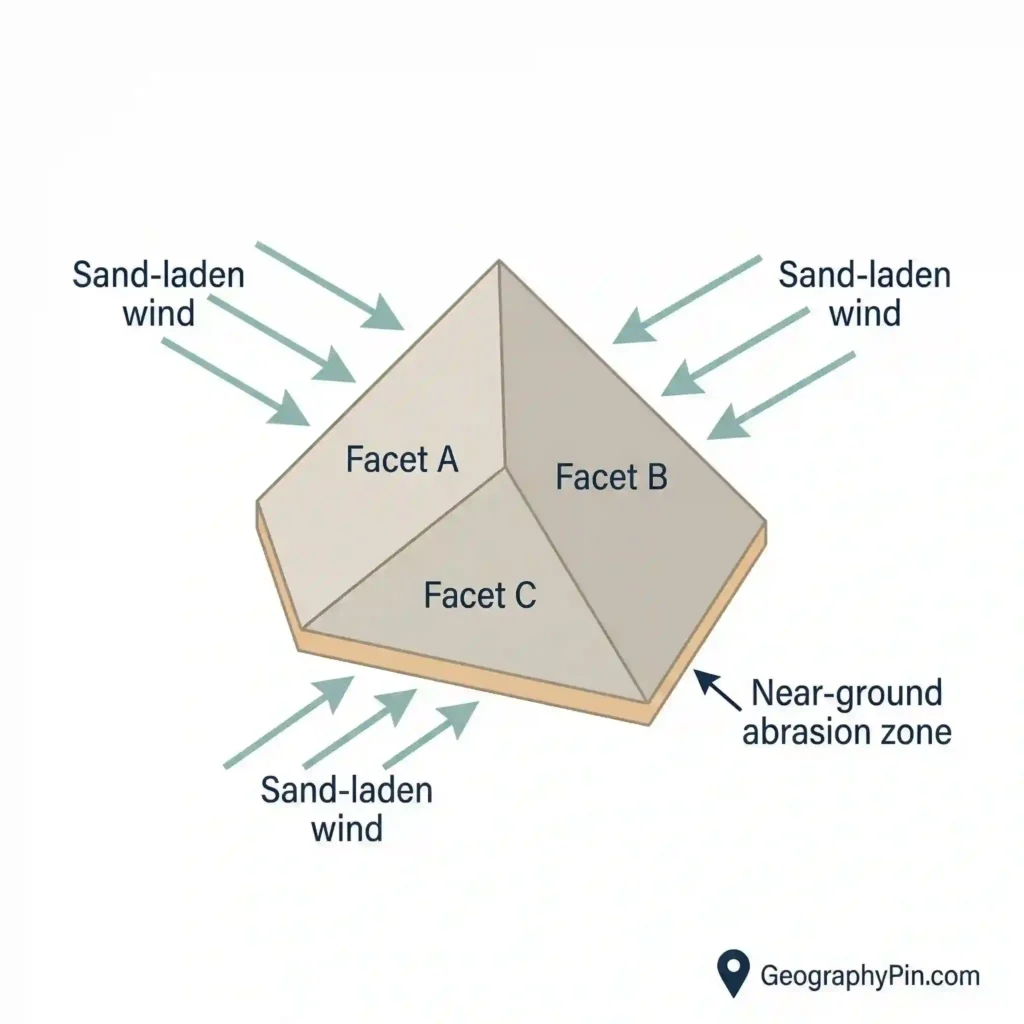
Most effective abrasion happens where sand grains travel in short hops and skims near the surface. That’s why ventifact shaping often concentrates on the lower part of a rock, especially if sand supply is steady and vegetation is minimal. The height and angle of the “worked” zone can shift with changes in sand level, seasonal winds, or how a rock sits in the ground.
Facets, edges, and the “planing” effect
Once a face begins to form, it can become self-reinforcing: a flatter surface offers a consistent target for incoming grains, and sharp edges can persist because sand impacts preferentially remove small protrusions rather than rounding everything evenly. If wind direction changes over long periods—or if a rock rotates—new facets can develop, creating a multi-faced ventifact.
Polish versus coating: two different “shines” that get confused
Wind polish is a texture created by abrasion. Desert varnish is a thin surface coating that can darken rock. A ventifact can be varnished, and a varnished rock can be slightly smoothed, but the processes are not the same. When you see crisp facets and uniform pitting, abrasion is usually the main story; when you see a dark film without clear faceting, coating processes may dominate.
Types, terms, and common confusions
Ventifact terminology can be a little messy because different field traditions emphasize different shapes. The safest approach is to focus on observable features (facets, pitting, polish) and then use the special terms as optional labels rather than as strict categories.
Common shape terms you may see
- Single-faceted: a dominant wind-worked face on one side (sometimes called an einkanter).
- Two-faceted: two main faces meeting along a ridge (sometimes called a zweikanter).
- Three-faceted “dreikanter”: three faces meeting along sharp edges, often described as a classic ventifact form in older literature.
These labels are descriptive, not a guarantee of a specific wind history. A rock can gain or lose facets as it shifts, gets buried by sand, or is re-exposed.
Common confusions: what a ventifact is not
Not a yardang: a yardang is a large ridge or streamlined hill carved by wind erosion; a ventifact is an individual rock shaped by abrasion. Not a dune: dunes are built by deposition of sand, not the sculpting of rock surfaces. Not glacial striations: glacial marks are typically linear scratches/grooves from rock dragged under ice, often aligned consistently across bedrock surfaces.
One more practical caution: some sharply edged ventifacts can resemble human-made stone tools at a glance, so context matters—especially near known archaeological areas where true artifacts may occur.
Comparison table: ventifacts versus look-alikes
| Feature | What you see | Main process | Typical setting |
|---|---|---|---|
| Ventifact | Polished or matte-smoothed facet(s), fine pitting, sharp edges | Wind-driven abrasion by sand/dust | Deserts, polar deserts, windy barren plains, exposed rocky surfaces |
| Desert varnish | Thin dark coating; can look glossy; may not show facets | Surface coating chemistry and dust accumulation over time | Arid to semi-arid regions, exposed rock faces |
| Water-worn polish | Rounded edges, overall smoothness, fewer sharp planar facets | Flowing water rolling sediment against rock | Riverbeds, beaches, channels, flood zones |
| Glacial striations | Parallel scratches or grooves, often on bedrock surfaces | Abrasion by debris at the base of moving ice | Formerly glaciated terrain, valleys, uplands |
| Yardang | Large streamlined ridge/hill aligned with wind | Wind erosion of softer layers; abrasion and deflation at landscape scale | Arid basins with exposed sedimentary or weakly cemented deposits |
Where ventifacts form and what they can tell you
Ventifacts form where sand-sized particles can be mobilized and where rock surfaces stay exposed. That usually means dry, open landscapes with persistent winds, but “dry” can include cold deserts as well as hot ones. You may also see ventifact-like abrasion features discussed in planetary geology, especially for wind-shaped rocks on Mars.
Environments that favor ventifacts
- Sand sources nearby: dunes, sandy washes, deflated basins, or loose granular surfaces.
- Exposure time: stable ground surfaces where rocks aren’t quickly buried or covered by plants.
- Wind corridors: gaps, basins, or open plains that focus wind and keep grains moving.
You’ll often spot ventifacts scattered across desert pavement—tight pebble/cobble covers left behind after wind removes finer sediment.
What a ventifact can (and can’t) reveal
Can reveal: that wind-driven abrasion has been active, and that sand-sized particles were available to do the cutting. In some settings, a consistent facet orientation can support a prevailing-wind interpretation when it matches other wind indicators in the landscape.
Can’t reliably reveal by itself: a precise wind direction history, a time span, or a wind speed. Without dating and broader context, a ventifact is best treated as qualitative evidence: “wind abrasion happened here.”
Field-friendly photo tips (useful for documentation)
For a clear record, photograph the rock from three angles: (1) the most polished facet straight-on, (2) a side view that shows the ridge between facets, and (3) a wide shot showing the ground surface and any nearby sand features. If possible, include a scale object and note whether the rock looks embedded (stable) or loose (easily moved).
FAQ
Are ventifacts only found in hot deserts?
No. They’re most associated with hot deserts because the settings are obvious and widespread, but similar wind abrasion can happen in cold, dry, sparsely vegetated regions where sand or grit is available and surfaces stay exposed.
What’s the difference between a ventifact and a yardang?
A ventifact is an individual rock shaped by wind-blown particles. A yardang is a landscape-scale ridge or hill carved and streamlined by wind erosion, often in layered or weakly cemented deposits.
Do ventifacts always have three faces?
No. Some have one dominant facet, others have two, and some develop three or more. The number of facets depends on wind direction changes, rock stability, and whether the rock has rotated or been partially buried and re-exposed.
Can you use a ventifact to tell the prevailing wind direction?
Sometimes, but cautiously. A facet can align with a dominant sand-blasting direction, yet rocks can move and local turbulence can redirect sand. Use ventifacts as supporting evidence and cross-check with dunes, ripples, or other wind-shaped features nearby.
Is a shiny rock in the desert automatically a ventifact?
Not automatically. Desert varnish can look shiny because it’s a surface coating, and water-worn stones can be smooth. For a ventifact, look for the combination of abrasion polish with pitting and planar facets.
Are ventifacts found on Mars?
They’re frequently discussed in planetary geology because wind is a major surface-shaping force on Mars. Researchers describe wind-abraded rocks and facets using ventifact terminology, though the exact conditions differ from Earth.
What Did We Learn Today?
- A ventifact is a rock shaped by wind-driven sand abrasion, often showing polish, pitting, and flat facets.
- The strongest field ID is the combination of facets plus fine pitting, in a windy, sparsely vegetated setting.
- Ventifacts are not yardangs (big ridges) and not dunes (sand deposits); they’re individual rocks with abrasion signatures.
- Classic shape labels include einkanter (one facet), zweikanter (two), and dreikanter (three), but shapes can change if rocks move.
- Facet orientation can hint at wind direction, but only when confirmed with other wind indicators in the landscape.
Sources & Data Notes
This article follows standard geomorphology explanations commonly summarized by public-education geology materials (USGS-style primers), national geological survey glossaries, and university field guides for aeolian processes, with cross-checks against broader aeolian geomorphology references for terminology. Because ventifact formation depends strongly on local sand supply, surface exposure, and wind regime, the text avoids numeric thresholds and uses cautious language where rocks can rotate or be reworked.