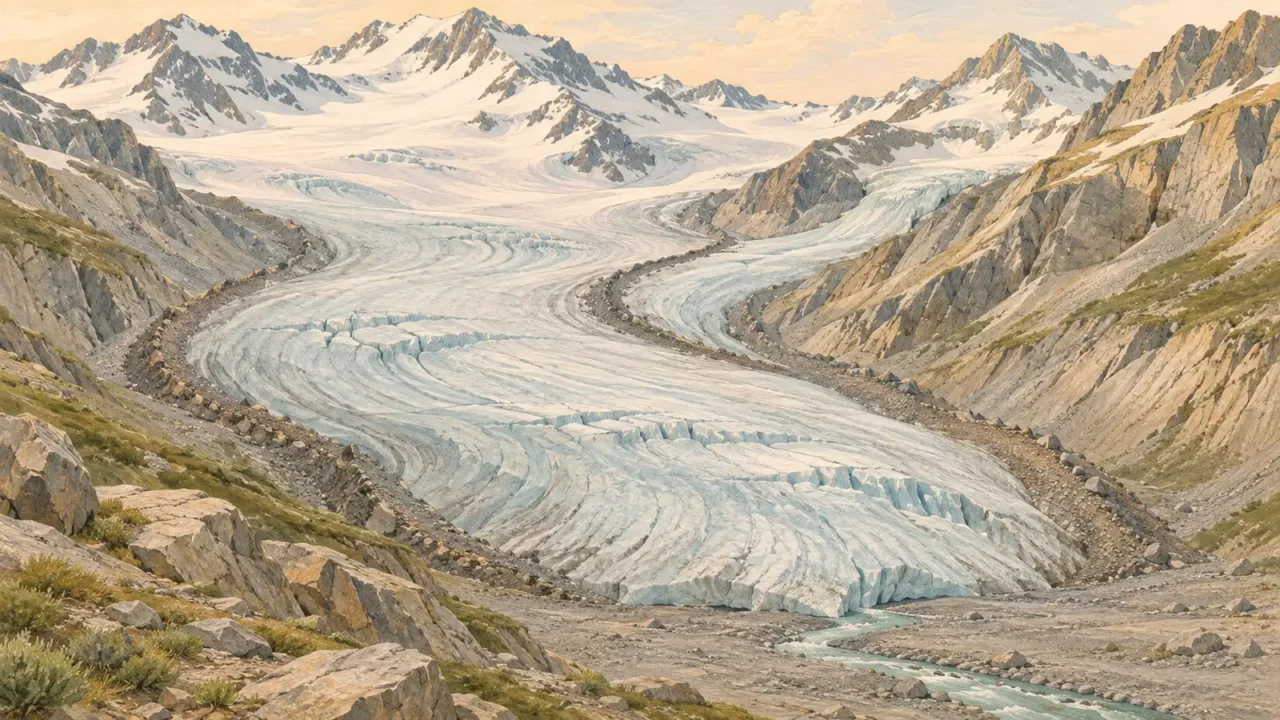
Take this glaciology quiz to test how glaciers move, how ice gains and loses mass, and what changes in snow and frozen ground can tell us. Answer 20 questions, then review the explanations to separate observations from assumptions.
Glaciology focuses on ice and glaciers; the cryosphere also includes seasonal snow, sea ice and frozen ground. This round uses invented field scenarios and small calculations rather than polar records. A moraine is a deposit of debris left by a glacier.
Follow the evidence in ice, snow and frozen ground.
20 questions · No timer · One point per correct answer
Easy, Medium and Hard are relative editorial difficulty levels for general geography learners, not standardized ratings. Every correct answer earns one point.
Choose an answer, then open “Show answer” to check it yourself. Interactive scoring appears when JavaScript is available.
Choose one answer, select Check answer, then continue to the next question.
Your Glaciology and cryosphere quiz result
Easy
Show answer
Correct answer: The ice mass deforms and flows under its own weight.
A glacier is a persistent ice body that flows under its own weight. Snow surviving summer is necessary for many glaciers to form, but persistence alone does not establish glacier flow. This question concerns an active glacier, not a detached remnant of stagnant glacier ice.
Easy
Show answer
Correct answer: An ice cap covers a smaller land area.
NSIDC uses about 19,300 square miles (50,000 square kilometers) as the conventional dividing area: ice caps are smaller and ice sheets larger. Both consist of glacier ice and can flow outward from broad domes. The distinction is not fresh versus salt water or moving versus stationary ice.
Easy
Show answer
Correct answer: Calving of glacier ice from a floating extension.
An ice shelf is a floating extension of glacier ice. When a large piece breaks away, the process is calving and the detached block is an iceberg. Floating in seawater does not make that block sea ice, which forms by freezing seawater.
Easy
Show answer
Correct answer: Yes, because permafrost is defined by ground temperature and duration.
Permafrost is ground that stays at or below 32°F (0°C) for at least two consecutive years. It may be soil, sediment or rock, and it need not contain ice. Temperature history, rather than snow cover or latitude alone, determines whether the definition is met.
Easy
Show answer
Correct answer: The active layer.
The active layer is the ground above permafrost that undergoes annual thawing and freezing. Its lower boundary can move as thaw depth changes. The seasonally thawed layer should not be confused with the ground that remains at or below freezing from year to year.
Easy
Show answer
Correct answer: Sublimation, which contributes to ablation.
Sublimation changes solid ice directly into vapor. It removes mass and therefore contributes to ablation, the collective loss of snow and ice. Ablation is broader than melting: a glacier can lose mass even when the particular loss process produces no liquid runoff.
Medium
Show answer
Correct answer: −15 inches (−38.1 cm) water equivalent.
Net balance is gain minus loss: 40 − 55 = −15 inches (−38.1 cm) water equivalent. The negative sign means net mass loss. Water equivalent puts snow and ice on a common mass-per-area basis; it is not necessarily the measured drop in the ice surface.
Medium
Show answer
Correct answer: It becomes smaller.
With the stated pattern and unchanged outline, a higher equilibrium line leaves less glacier area above the line and more below it. The line marks zero annual surface balance locally. It does not mean that the whole glacier has zero total mass balance.
Medium
Show answer
Correct answer: Internal deformation of the solid ice under stress.
Glacier ice can deform slowly under sustained stress, a process called creep. Basal sliding is another possible source of motion, but it is not required for internal deformation. Ice need not melt into liquid water before a glacier can flow.
Medium
Show answer
Correct answer: The front is retreating while the glacier ice continues to flow downhill.
The snout is a boundary, not a fixed parcel of ice. It can retreat when ice is removed at the front faster than flow supplies it, even as individual ice parcels move downhill. Terminus position and ice velocity therefore describe different aspects of glacier behavior.
Hard
Show answer
Correct answer: No; ice discharge and other non-surface losses can outweigh the surface gain.
Surface mass balance accounts for surface gains and losses, not the full glacier budget. Ice lost through calving and other non-surface exchanges must also be considered. Positive surface balance can coexist with total mass loss if those additional losses are larger.
Hard
Show answer
Correct answer: Mass increased during the last interval, but remained below the starting amount.
The cumulative value rose from −45 to −40 inches, a gain of 5 inches (12.7 cm) water equivalent during the last interval. It is still below zero, so the earlier losses have not been fully recovered. A cumulative total and an interval change answer different questions.
Medium
Show answer
Correct answer: The land ice, because it adds water mass not previously in the ocean.
Floating sea ice already displaces seawater, so its direct melt effect is much smaller than adding the same mass from land. It is not strictly zero: salinity and density differences produce a small effect. This comparison excludes indirect climate effects and changes in grounded-ice discharge.
Medium
Show answer
Correct answer: Reduced restraint can let grounded ice flow into the ocean faster.
A shelf can provide back stress, often called buttressing, that restrains the glacier feeding it. Removing that restraint can accelerate grounded-ice discharge into the ocean. The response depends on the shelf and glacier geometry; every calving event does not cause the same acceleration.
Hard
Show answer
Correct answer: 20 square miles (51.8 km²).
The 40% and 80% cells qualify, so extent is 10 + 10 = 20 square miles (51.8 km²). Weighting those cells by concentration instead gives an ice area of 12 square miles (31.1 km²). Neither extent nor area alone establishes ice thickness or volume.
Medium
Show answer
Correct answer: B yields twice the water depth: 8 inches (20.32 cm) versus A’s 4 inches (10.16 cm).
Snow water equivalent measures stored water rather than snow depth alone. Multiplying depth by the stated density ratio gives A: 20 × 0.20 = 4 inches, and B: 20 × 0.40 = 8 inches. Equal snow depths can therefore represent different water stores.
Medium
Show answer
Correct answer: More runoff may arrive early, leaving less snowmelt supply later in summer.
Dust can lower snow reflectivity and accelerate melting, shifting water release earlier. Equal starting snow-water storage does not guarantee equal seasonal availability, or even equal annual runoff after evaporation and other losses. The practical issue here is timing, not simply how deep the snow looks.
Hard
Show answer
Correct answer: The trapped air can be younger than the enclosing ice, requiring separate age estimates.
Firn is compacted snow that has not yet become fully consolidated glacier ice. Air can diffuse through its connected pores before closure traps it. The resulting gas age can be younger than the enclosing ice age, so researchers account for that offset rather than assuming simultaneous formation.
Medium
Show answer
Correct answer: Melting ground ice can leave the sediment structure to compact or collapse.
Ground ice can occupy substantial volume and support an ice-rich soil structure. When it melts, drainage and consolidation can cause settlement. This mechanism is much less relevant to nearly ice-free bedrock, although real infrastructure risk still depends on geology, drainage, foundations and other site conditions.
Medium
Show answer
Correct answer: An unstable slope could send an avalanche into the lake and overtop the dam.
An avalanche entering a lake can generate waves that overtop and erode a moraine dam, potentially releasing water rapidly. Lake growth alone does not prove that failure will occur. Assessment also needs dam properties, water volume, possible triggers and downstream exposure.
Separate ice motion, mass and consequences
Each correct answer earns one point, with no penalty for a wrong answer. At the end, select Review answers to see every question and explanation, or Try again to replay the same set. The quiz does not save your score between visits.
- Track the right quantity. A glacier’s front position is not its ice-flow direction. Surface balance is not the complete ice-sheet budget, and sea-ice extent does not reveal thickness.
- Compare like units. Water-equivalent depth expresses snow or ice as an equivalent water store. Snow depth alone misses density, and a cumulative balance differs from a single interval’s change.
- Follow the connections. A buttressing ice shelf can restrain grounded ice. Darkened snow can melt earlier and shift seasonal runoff, even where starting snow-water storage is unchanged.
- Keep local conditions in view. Permafrost is defined by temperature, while its ice content helps determine thaw-settlement risk. Lake growth warrants investigation, not a claim that flooding is inevitable.
For a broader, configurable mix of places and geography topics, try the world geography quiz.
What Did We Learn Today?
The cryosphere is a system of moving ice, seasonal snow and thermally defined frozen ground. Glacier flow and terminus retreat can occur together; surface gains do not settle the full mass budget. Land ice and floating ice have different direct sea-level effects, while shelf loss can change grounded-ice discharge. Water equivalent, sea-ice extent and ice-core ages each require their own interpretation. Consequences for water supply, roads and downstream communities depend on timing and local conditions.
Sources & Data Notes
All numerical examples and field scenarios are hypothetical. Water-equivalent figures use a common reference area; U.S. customary units appear first, with metric equivalents. The 15% sea-ice extent threshold is specified in the question. Floating-ice melt has a small direct sea-level effect, not strictly zero; grounded-ice discharge is a separate pathway. Permafrost is defined thermally and need not contain ice. Easy, Medium and Hard are relative editorial labels, not standardized ratings. Older research sources support stable methods and concepts, not claims about today’s ice conditions.
- National Snow and Ice Data Center: Glaciers: overview (Q1, Q2, Q3); Science of Glaciers (Q6, Q9); Why Glaciers Matter (Q7, Q10, Q12); Frozen Ground & Permafrost (Q4, Q19); Active layer (Q5); 2015 melt season in review (Q8, Q11); The Science of Ice Shelves (Q3, Q14); What is the difference between sea ice area and extent? (Q15); Does dusty snow mean less water in the Rockies? (Q17); Why Frozen Ground Matters (Q19).
- U.S. Geological Survey: Compiled Input Data and Glacier-Wide Mass Balances (Q7, Q12); Snow water equivalent (Q16); Glacier-related outburst floods (Q20).
- NASA: Melting Ocean Ice Affects Sea Level, Unlike Ice Cubes in a Glass (Q13).
- British Antarctic Survey: A tentative chronology for the EPICA Dome Concordia Ice Core (Q18); Chemical signals of past climate and environment from polar ice cores and firn air (Q18).