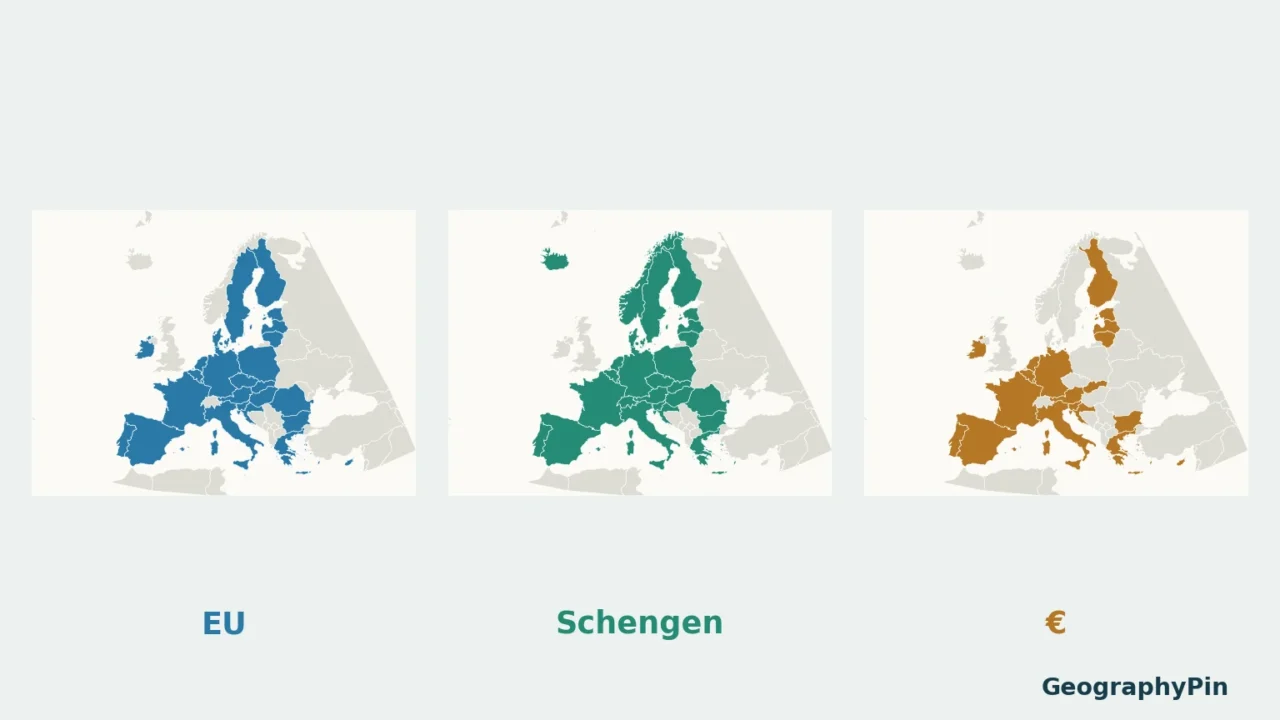
A country can be in Europe but outside the European Union. It can belong to Schengen without using the euro, or use the euro without belonging to either the EU or the eurozone. The confusion disappears once the four names are treated as answers to four different questions.
Europe is a geographic region; the European Union is a political and economic union; Schengen is an area without routine internal border checks; and the eurozone is the group of EU countries sharing the euro. Their memberships overlap, but none of those institutional borders defines the continent itself.
1. Four names, four different meanings
Start with the question, not the map color
| Name | What it describes | Useful question |
|---|---|---|
| Europe | A geographic and historical region of Eurasia | Where is this place? |
| European Union (EU) | A political and economic union of 27 member states | Is the country an EU member? |
| Schengen area | 29 countries in the area without routine internal border checks | Is this border inside the common travel area? |
| Eurozone (euro area) | 21 EU member states sharing the euro | Is the country part of the EU’s single-currency area? |
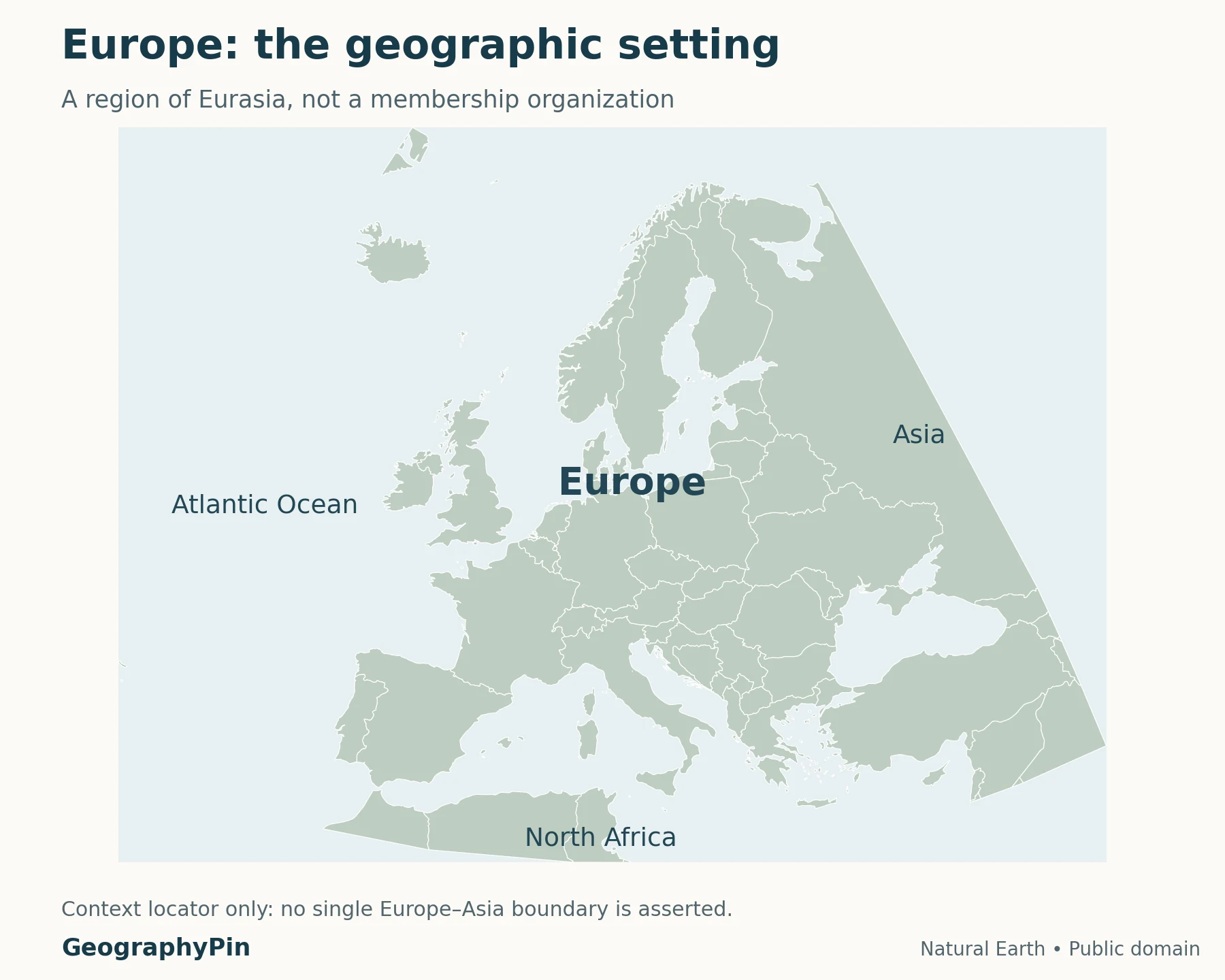
The EU has treaties, institutions and a defined membership list. Europe has no accession procedure. A country does not stop being geographically European when it leaves a political organization, and a currency decision does not move a continent’s edge.
The Europe–Asia division is itself conventional: the two regions form the continuous Eurasian landmass. Geographic, statistical and political lists can therefore include different edge cases. That is a separate problem from counting the EU’s members.
For the institutional comparison, the counts have explicit meanings. The Council’s Schengen list counts the 29-country area in which routine internal border checks have been removed. Cyprus applies parts of the Schengen rules but is not yet included in that border-free-area count. The eurozone count means EU members, not every place where euro banknotes circulate.
2. Read the maps without mixing their borders
The three membership maps use the same European view so that changes in shading are easy to compare. Gray means that a country or area is not included in that particular grouping. It does not mean that the place is outside geographic Europe.
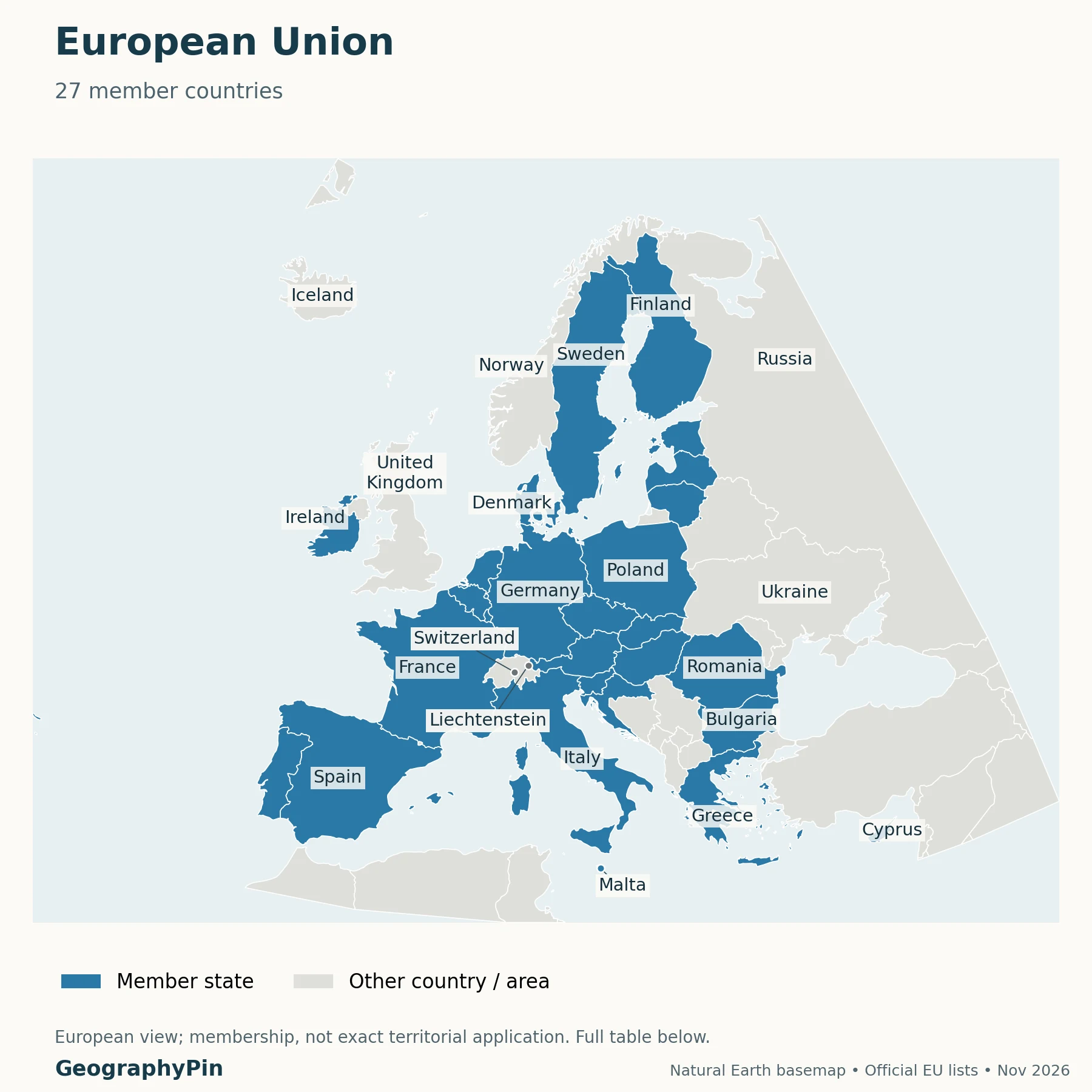
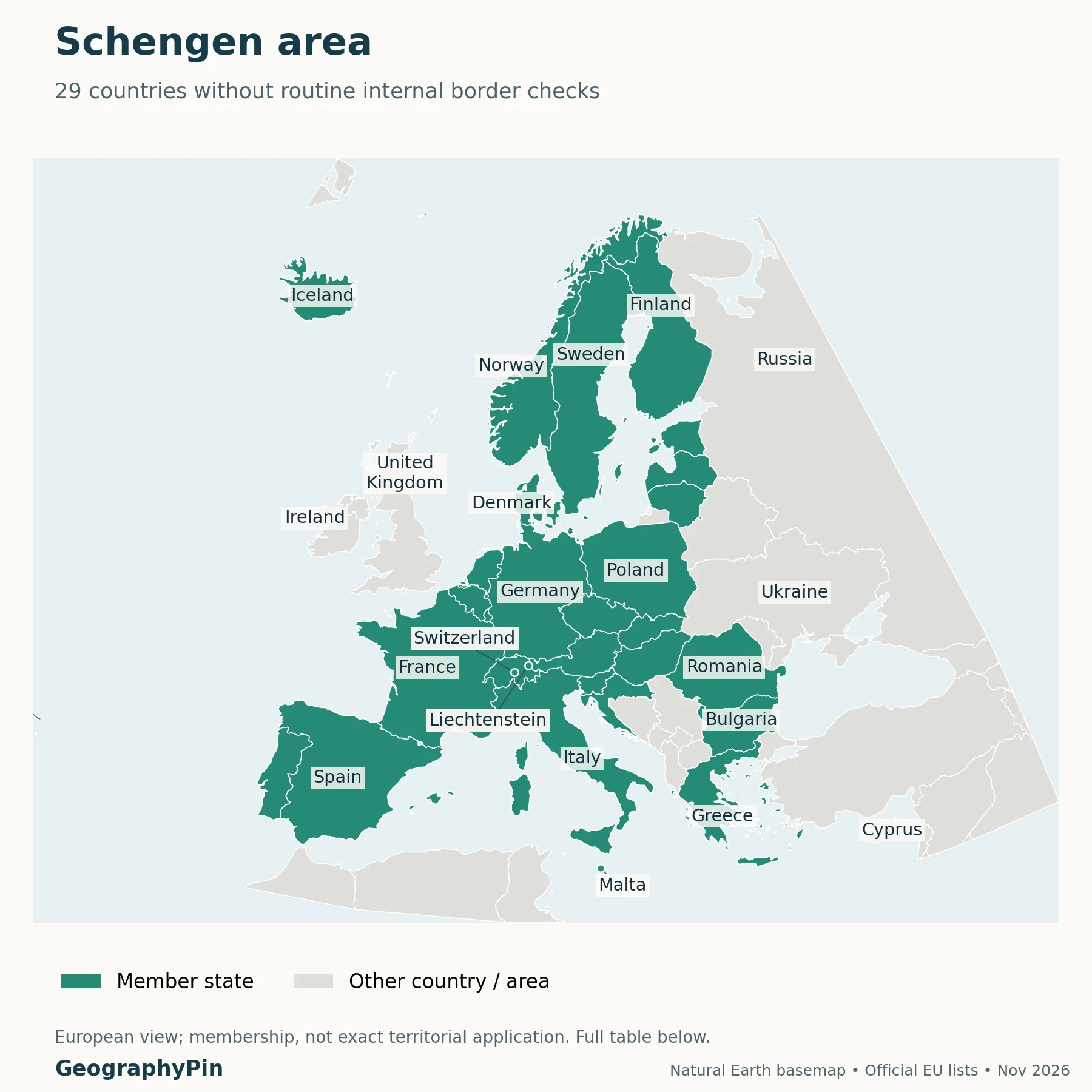
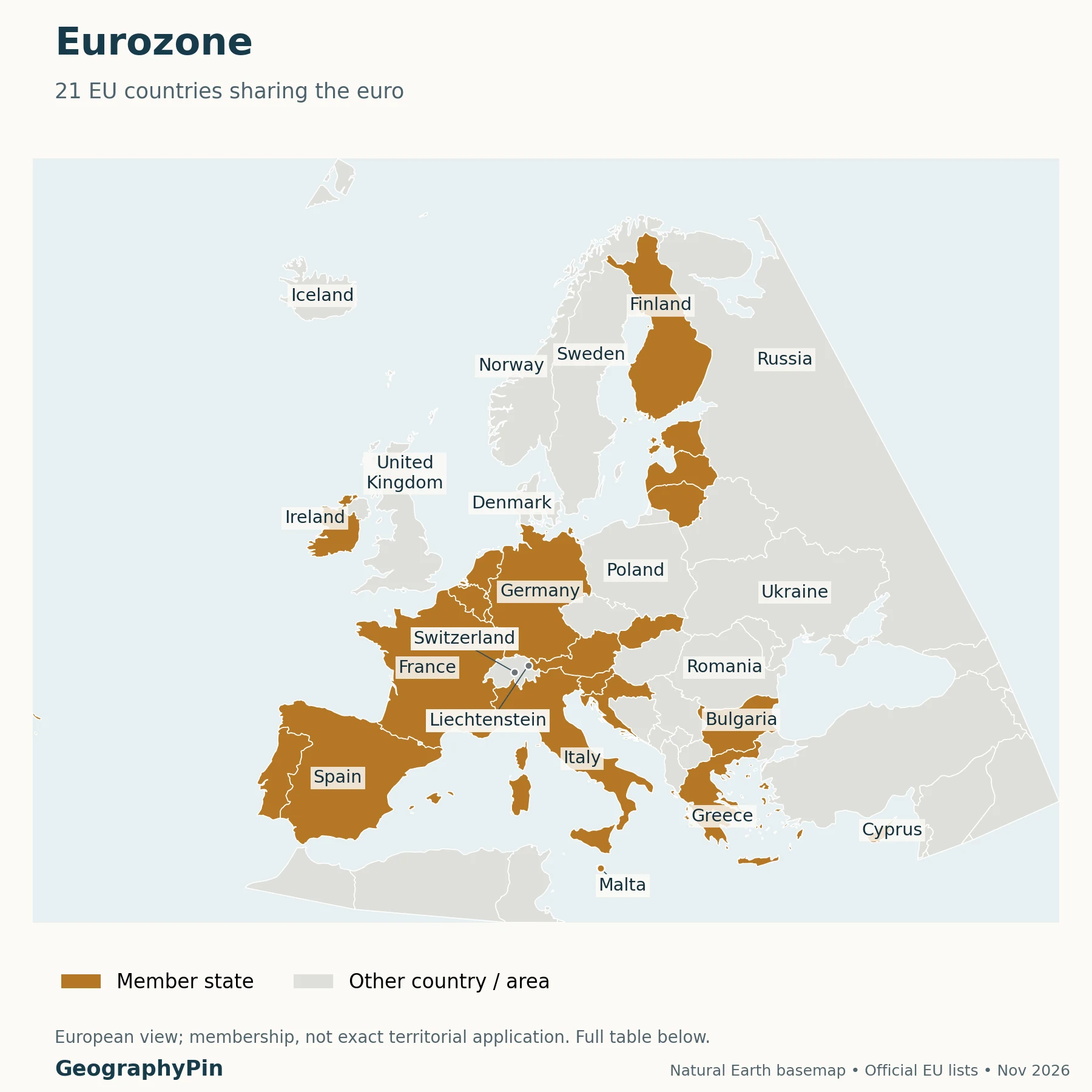
These are state-membership overview maps, not legal border-control maps. They do not show every overseas territory, enclave or territorial exception. Small countries are easier to identify in the table; enlarged locator dots do not represent their land area. The visible coastlines and borders are generalized Natural Earth data, not a statement about sovereignty or present-day military control.
Cyprus needs particular care. Its EU membership does not mean that EU law operates identically across the divided island: the EU states that its law is suspended in areas where the Republic’s government does not exercise effective control. Similarly, coloring a member state’s European territory is not a claim that every overseas possession belongs to all the same arrangements.
3. Country-by-country membership table
The complete institutional comparison
The 31 rows below are the union of the EU and Schengen membership lists: 27 EU states plus four non-EU Schengen states. This is not a complete list of European countries. Countries outside both groups, such as the United Kingdom, Serbia and Albania, are not missing by mistake; they are outside this table’s stated scope.
“Schengen: No” for Cyprus means not yet part of the area without routine internal border checks, not that Cyprus has no Schengen-related obligations. “Eurozone: No” concerns membership, not whether a merchant might accept euros.
| Country | EU | Schengen | Eurozone |
|---|---|---|---|
| Austria | Yes | Yes | Yes |
| Belgium | Yes | Yes | Yes |
| Bulgaria | Yes | Yes | Yes |
| Croatia | Yes | Yes | Yes |
| Cyprus | Yes | No | Yes |
| Czechia | Yes | Yes | No |
| Denmark | Yes | Yes | No |
| Estonia | Yes | Yes | Yes |
| Finland | Yes | Yes | Yes |
| France | Yes | Yes | Yes |
| Germany | Yes | Yes | Yes |
| Greece | Yes | Yes | Yes |
| Hungary | Yes | Yes | No |
| Iceland | No | Yes | No |
| Ireland | Yes | No | Yes |
| Italy | Yes | Yes | Yes |
| Latvia | Yes | Yes | Yes |
| Liechtenstein | No | Yes | No |
| Lithuania | Yes | Yes | Yes |
| Luxembourg | Yes | Yes | Yes |
| Malta | Yes | Yes | Yes |
| Netherlands | Yes | Yes | Yes |
| Norway | No | Yes | No |
| Poland | Yes | Yes | No |
| Portugal | Yes | Yes | Yes |
| Romania | Yes | Yes | No |
| Slovakia | Yes | Yes | Yes |
| Slovenia | Yes | Yes | Yes |
| Spain | Yes | Yes | Yes |
| Sweden | Yes | Yes | No |
| Switzerland | No | Yes | No |
Download the membership table as a CSV spreadsheet. The file contains the same 31 countries, three membership fields and three-letter country identifiers; it uses the reference date above.
For a broader geographic list with different inclusion rules, use the European countries and capitals reference. A geographic list and this institutional matrix serve different purposes.
4. The exceptions that make the difference
Norway, Switzerland and Ireland
Norway and Switzerland are two useful tests of the difference between Europe and the EU. Both are European countries and belong to Schengen, but neither is an EU member. They are also outside the eurozone. Schengen participation alone therefore does not tell you which currency to expect.
Ireland shows the opposite combination. It is an EU and eurozone member but not part of Schengen. The currency question and the border-arrangement question produce different answers for the same country.
Using euros outside the eurozone
Andorra, Monaco, San Marino and Vatican City use the euro under monetary agreements with the EU. They are not EU or eurozone members. Kosovo and Montenegro use the euro as a de facto domestic currency without those monetary agreements. Kosovo’s status is disputed; its inclusion here describes currency use, not a position on recognition.
The distinction matters when reading “countries that use the euro.” That phrase can describe a wider set than the eurozone. A table that silently adds these six places to the 21 EU members is no longer counting the same institutional group.
Bulgaria and Romania: two different changes
Bulgaria and Romania completed their entry into the area without routine internal border checks when the remaining internal land-border controls were removed on January 1, 2025. Their air and sea controls had already been removed in March 2024. This explains why references can give both 2024 and 2025 in discussions of their Schengen integration.
Bulgaria then adopted the euro on January 1, 2026. Romania did not make the same currency change. In the table, both belong to the EU and Schengen, but only Bulgaria is in the eurozone. An enlargement of one group should never be copied automatically into another group’s map.
5. What these groups do not tell you
Schengen does not erase national borders. It changes how checks on people are organized. Temporary internal border controls can still be introduced under the applicable rules, and police checks are a separate matter. A green map is not a promise that nobody will ask for identification on a particular journey.
EU membership does not mean euro adoption. Denmark has a treaty opt-out; the other EU countries outside the eurozone have not yet adopted the currency. Currency pegs, foreign-exchange acceptance and membership of the monetary union are different facts.
A membership table is not personal travel permission. Nationality, passport, residence status, purpose and length of stay can all matter. Use the relevant official immigration or consular information for an actual trip rather than treating membership colors as a visa decision.
Leaving an organization does not move a country. The United Kingdom left the EU on January 31, 2020; it did not leave geographic Europe. The same principle applies to the many European countries that have never belonged to the EU.
Frequently Asked Questions
Why do some official references describe 30 Schengen countries?
Some legal summaries count Cyprus among countries applying Schengen provisions while also explaining that its internal border controls have not been abolished. This comparison follows the Council’s 29-country border-free-area count and identifies Cyprus separately. Read the definition behind the number rather than assuming that every reference is counting exactly the same stage of participation.
Is the Council of Europe another name for the EU?
No. They are separate organizations with different membership and purposes. Neither the Council of Europe nor the European Council should be used as a synonym for geographic Europe. The European Council is an EU institution; the Council of Europe is not.
Do all European countries appear in the membership table?
No. The table includes every EU or Schengen member, not every geographically European state. A country can be European and outside both organizations.
What Did We Learn Today?
The easiest way to avoid confusing Europe’s overlapping groups is to ask separate questions about location, EU membership, border arrangements and monetary membership. Norway, Ireland, Cyprus and Bulgaria show why one answer cannot stand in for the others. A clear map or list must name its group, state its date and explain the exceptions rather than treating all of Europe as one institutional area.
Sources & Data Notes
Institutional lists were consulted in November 2026. The comparison uses 27 EU states, the Council’s 29-country Schengen area without routine internal checks, and 21 EU euro-area states. Membership is distinct from the territorial application of law. The original maps use public-domain Natural Earth 1:50 million outlines in a European equal-area projection, with Cyprus’s state-level membership separated in the text from the suspension of EU law in the north. The maps omit distant territories and should not be used for legal or border-crossing decisions. Membership and implementation dates can change.
- European Union: EU country membership directory
- Council of the EU: the Schengen area explained
- European Union: countries using the euro
- European Central Bank: Bulgaria introduces the euro, January 1, 2026
- European Commission: euro use outside the euro area
- European Union: Cyprus and the application of EU law
- EUR-Lex: Schengen Agreement and Convention, including Cyprus’s partial application
- Council of the EU: relations with the United Kingdom
- Council of Europe: distinguishing European institutions
- Natural Earth: public-domain basemap terms