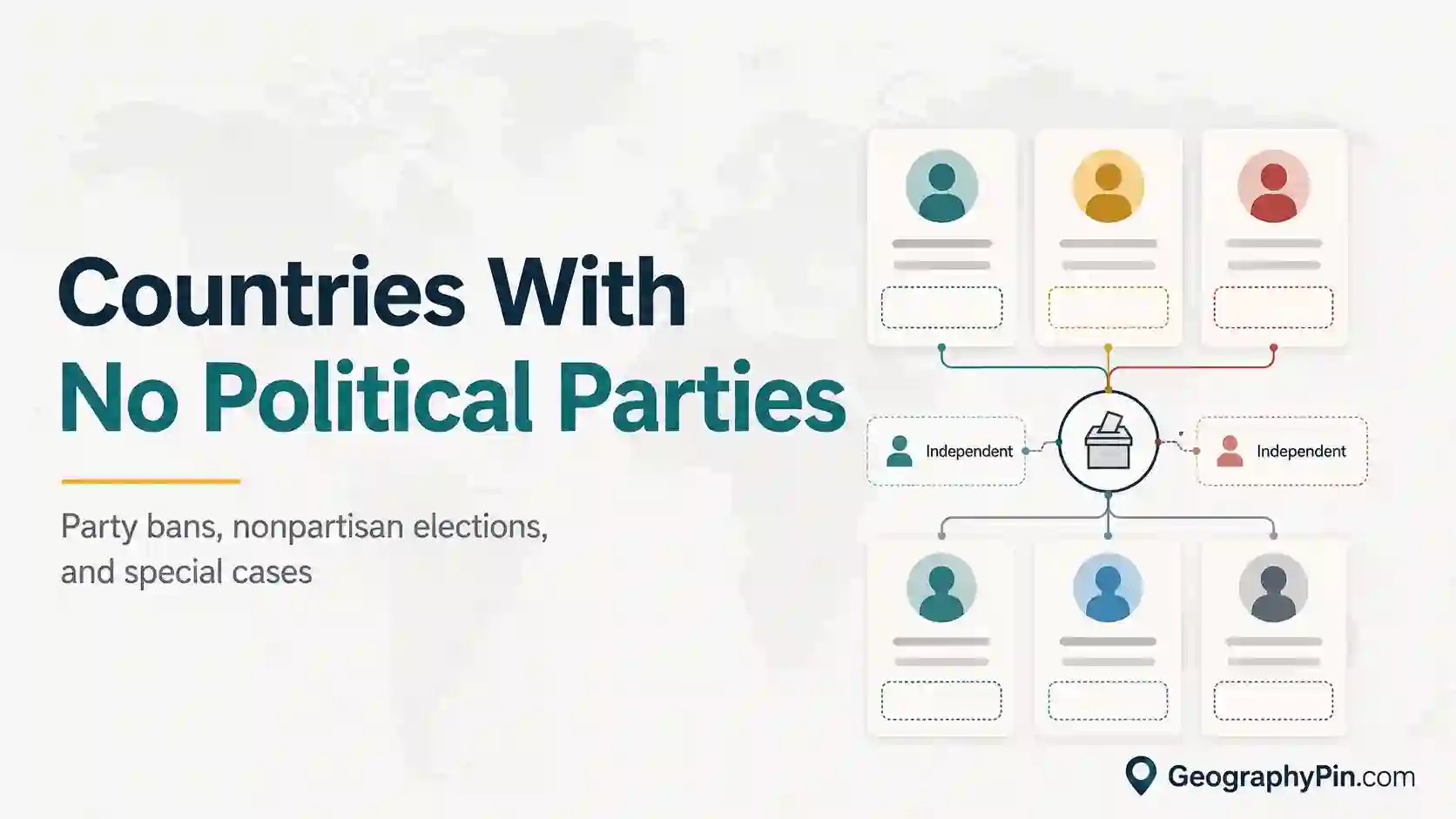
Countries with no political parties include some monarchies and restricted systems, such as Qatar, Oman, the UAE, Saudi Arabia, Vatican City, and Eswatini, plus small nonpartisan democracies such as Nauru, Tuvalu, Palau, Micronesia, and the Marshall Islands. The exact list depends on how “no political parties” is defined.
How to use this article: Use the quick country list for fast examples, check what counts as no-party politics before comparing countries, use the comparison table to separate party bans from nonpartisan elections, or jump to common confusion if you are checking Brunei, Kiribati, or one-party states.
List of Countries With No Political Parties
The countries most often described as having no political parties fall into two broad groups. The first group includes states where formal parties are banned, not permitted, or excluded from national political power. The second group includes small nonpartisan democracies where elections happen, but candidates normally run as independents.
Quick country list
| Country | Best short description | Important caution |
|---|---|---|
| Vatican City | No party politics | A special ecclesiastical state, not a normal electoral democracy. |
| Saudi Arabia | No national party competition | National officials are not chosen through party elections. |
| Qatar | Political parties not permitted | The hereditary emir holds central political authority. |
| Oman | No legal party system | Political loyalties may form through personal, tribal, regional, or family networks. |
| United Arab Emirates | Political parties banned | Limited elections exist for an advisory federal body, not for party government. |
| Kuwait | Formal parties banned | Loose blocs and political groupings have existed in practice. |
| Bahrain | Formal parties illegal | Political societies have existed, but opposition politics has been heavily restricted. |
| Eswatini | Parties excluded from elections | Candidates participate through the Tinkhundla system rather than party lists. |
| Nauru | No political parties | Members of parliament stand as independents. |
| Tuvalu | No political parties | Candidates run as independents, then MPs choose the prime minister. |
| Palau | Nonpartisan democracy | Parties are not the normal vehicle for national politics. |
| Federated States of Micronesia | No formal political parties | Candidates run as independents. |
| Marshall Islands | No fully formalized party system | Unofficial groupings and factions can still matter. |
This list is best read as a practical geography guide, not as a universal legal register. In some countries, parties are banned by law or excluded from elections. In others, parties are simply not the way national politics is organized.
What No Political Parties Actually Means
The phrase “no political parties” sounds simple, but it can describe several different systems. That is why country lists online often disagree.
One country may have no legal political parties at all. Another may allow elections, but only independent candidates can run. A third may ban formal parties while informal blocs still act like political teams inside parliament.
What counts as no-party politics?
For a useful country list, “no political parties” usually means one of four things: parties are banned, parties are not legally registered, parties are absent in practice, or candidates run without party labels.
That is different from a one-party state. In a one-party state, one ruling party dominates national politics. In a no-party system, formal party competition is missing altogether, either by law, custom, scale, or political design.
The main types side by side
| Type | What it means | Example pattern |
|---|---|---|
| Party ban | Formal political parties are not legally allowed or cannot compete. | Qatar, UAE, Oman, Eswatini |
| No-party democracy | Elections happen, but candidates normally run as independents. | Nauru, Tuvalu, Palau, Micronesia |
| Special state structure | The state is not organized around popular party elections. | Vatican City |
| Informal bloc system | Parties are illegal or weak, but political groupings still exist. | Kuwait, Bahrain, Marshall Islands |
Table downloads (2)
- Countries commonly described as having no formal party system, no legal parties, or nonpartisan national politics. (14 × 3)View tableDownload CSV
- The main meanings behind “countries with no political parties.” (5 × 3)View tableDownload CSV
The most accurate answer is not just “these countries have no parties.” The better answer is: some have no parties because politics is restricted, while others have no parties because local political culture works through independents.
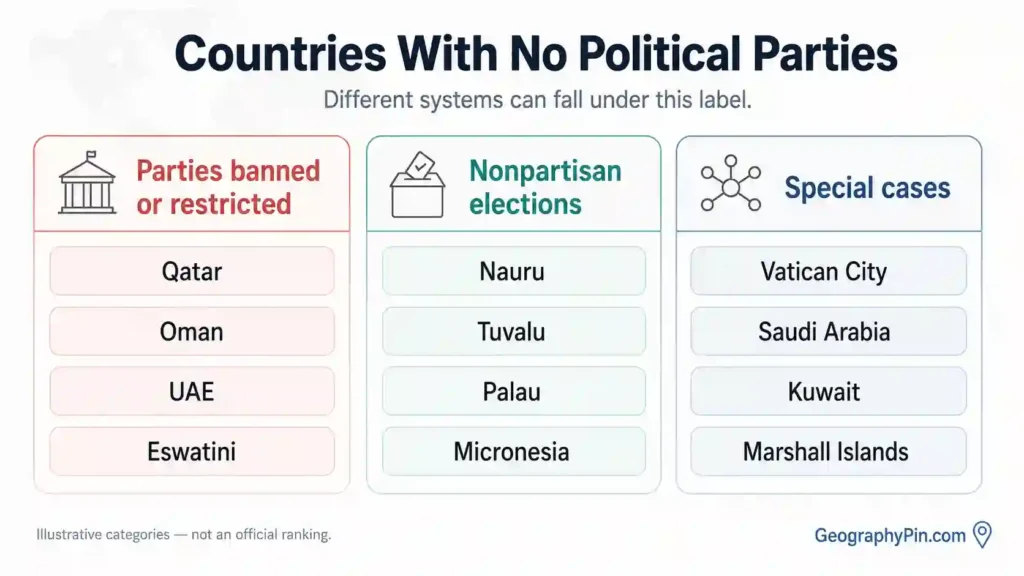
Nonpartisan Democracies vs Party Bans
This is the most important distinction in the whole topic. A nonpartisan democracy is not the same as a country where parties are banned to limit opposition.
In Nauru, Tuvalu, Palau, and Micronesia, national politics is often built around independent candidates, local relationships, parliamentary bargaining, and personal reputation. These countries can still have real electoral competition, even if they do not have formal party labels.
In restricted monarchies or tightly controlled systems, the absence of political parties usually means something different. There, no-party politics can limit organized opposition, reduce public competition for power, or keep final authority in royal, religious, or state institutions.
That is why a no-party list should never be used as a democracy ranking by itself. The phrase describes party structure, not the full level of political freedom.
Countries Often Confused With No-Party Systems
Some countries are easy to mislabel because their party systems are weak, restricted, unofficial, or changing. A short list without context can make these countries look simpler than they are.
Brunei, Kiribati, and one-party states
Brunei is not a clean example of a country with no political parties. It is an absolute monarchy with no national election that decides the government, but some reference sources have listed a registered party with little or no role in national power. A safer description is: Brunei has no meaningful competitive party politics at the national level.
Kiribati should also be handled carefully. It has sometimes appeared in older discussions of Pacific no-party politics, but current descriptions treat it as having active political parties. It should not be listed today as a straightforward no-party country.
One-party states are a different category entirely. China, Cuba, Laos, Vietnam, and North Korea are not countries with no political parties. They are countries where one ruling party dominates the political system.
Why Some Countries Have No Political Parties
Countries end up without political parties for different reasons. In some monarchies, parties are restricted because organized party competition could challenge royal authority. In some small island democracies, formal parties simply never became the main way people organize elections.
In Gulf states such as Qatar, Oman, the UAE, Kuwait, and Bahrain, party politics is tied to wider questions about royal authority, political association, elected power, and public opposition. Some have advisory councils or parliamentary bodies, but they do not operate like party-based parliamentary democracies.
In small Pacific states, the logic can be more local. Small populations, island communities, personal reputation, family ties, chiefly or clan relationships, and local issues can matter more than national party brands. Political alliances still form, but they may form after elections rather than before them.
Eswatini is another important case. Its Tinkhundla system is built around individual candidacy rather than party competition, and political parties have been excluded from normal electoral participation. That makes it different from both a Gulf monarchy and a Pacific nonpartisan democracy.
How to Use This List Without Getting Misled
Before using any list of countries with no political parties, ask one simple question: does “no parties” mean parties are illegal, absent, unofficial, or just not important?
That one question prevents most mistakes. It separates Vatican City from Tuvalu, Qatar from Palau, and Kuwait from a pure no-party democracy.
Also check the date of the source. Party systems change. A country that once had no active parties may later develop them. A country with informal political societies may later restrict them. A country with weak parties may become more formally party-based after a major election.
Finally, remember that no parties does not mean no politics. Power can still move through families, tribes, clans, royal courts, religious institutions, business groups, local networks, regional blocs, or informal parliamentary alliances.
FAQ
Which countries have no political parties?
Common examples include Vatican City, Qatar, Oman, the UAE, Saudi Arabia, Eswatini, Nauru, Tuvalu, Palau, Micronesia, and the Marshall Islands. Kuwait and Bahrain are often included because formal parties are illegal, but both need extra context because informal blocs or political societies have existed.
Does no political parties mean no democracy?
No. Some no-party systems are highly restricted, but some small countries hold competitive elections without formal parties. Nauru, Tuvalu, Palau, and Micronesia are examples often described as nonpartisan democracies.
Are one-party countries the same as no-party countries?
No. A one-party country has one dominant ruling party. A no-party country has no normal party competition at all, either because parties are banned, absent, unofficial, or not used in elections.
Why do some Pacific countries have no political parties?
In some small Pacific countries, elections are shaped more by local identity, personal reputation, family networks, island communities, and parliamentary alliances than by national party organizations.
Is Vatican City a country with no political parties?
Yes, but it is a special case. Vatican City is not a normal electoral democracy where voters choose a government through party competition. It is an ecclesiastical state connected to the Holy See.
Is Brunei a country with no political parties?
Brunei is better described as an absolute monarchy with no meaningful competitive party politics at the national level. It is not the cleanest example of a country with no political parties because the legal and practical details are more complicated.
What Did We Learn Today?
Countries with no political parties fall into very different groups. Some, such as Qatar, Oman, the UAE, Saudi Arabia, Vatican City, and Eswatini, have systems where party competition is banned, excluded, or not part of national power. Others, such as Nauru, Tuvalu, Palau, Micronesia, and the Marshall Islands, show that elections can work without formal party labels. The safest answer is to separate party bans from nonpartisan democracy and to avoid confusing no-party systems with one-party states.
Sources & Data Notes
Party-system labels in this article are based on standard political-reference sources used for country explainers, including Freedom House country reports, International IDEA election notes, DFAT country briefs, World Factbook-style country profiles, and parliament or election reference data where available. Terms such as “no parties,” “banned parties,” “informal blocs,” and “nonpartisan elections” are simplified for readability, because different sources classify these systems in slightly different ways. New elections, legal changes, party registrations, dissolutions, or annual country-report updates may change some details after publication; AI assistance helped with organization and wording, while the final framing was editorially reviewed.