The useful comparison starts with national price levels, then tests the real cost of living legally in a specific city.
The cheapest countries to live in Europe are concentrated in the Balkans and eastern EU, but there is no single official all-Europe winner. Bulgaria and Romania are the EU’s lowest-price countries; North Macedonia, Bosnia and Herzegovina, Serbia, and Albania also belong to Europe’s low-cost group. Rent, legal status, and income source can reverse the order.
How to use this article: Start with what the official data measures, open the country comparison, check the rent problem, or go directly to the legal-stay check.
What “cheap” means in a European comparison
A country can be cheap for restaurant meals but expensive for imported electronics. It can have low national rents while its capital has a severe housing shortage. It may also feel inexpensive to someone earning dollars or euros while remaining difficult for a resident earning a local salary.
What the official price comparison tells us
Eurostat’s 2025 household-consumption comparison covers more than 2,000 goods and services across 36 European countries. Among EU members, overall prices were lowest in Bulgaria at 63% of the EU average, followed by Romania at 65% and Poland at 73%. Bulgaria also had the EU’s lowest housing-cost price level, while Romania recorded the lowest food price level.
Eurostat’s related measure of actual individual consumption also places North Macedonia in the lowest price band among the participating countries. Bosnia and Herzegovina, Bulgaria, Romania, and Türkiye fall into another notably low band, while Albania, Serbia, and Montenegro remain well below the EU average.
These indexes compare the prices of broad baskets. They do not state how much a particular person needs each month, and they are not adjusted for differences in income. That distinction matters: lower prices often exist alongside lower local wages.
Why there is no perfect cheapest-country ranking
A continent-wide ranking changes according to what is measured. A renter needs a housing-heavy calculation. A homeowner cares more about food, utilities, taxes, and maintenance. A family may place schooling and healthcare above restaurant prices, while a remote worker may prioritize internet access, flight connections, and a lawful route for foreign income.
City choice creates another problem. Sofia is not priced like a small Bulgarian town, just as Belgrade is not representative of all Serbia. National averages are useful for building a shortlist, but the final comparison must be made between actual cities and neighborhoods.
The strongest low-cost countries
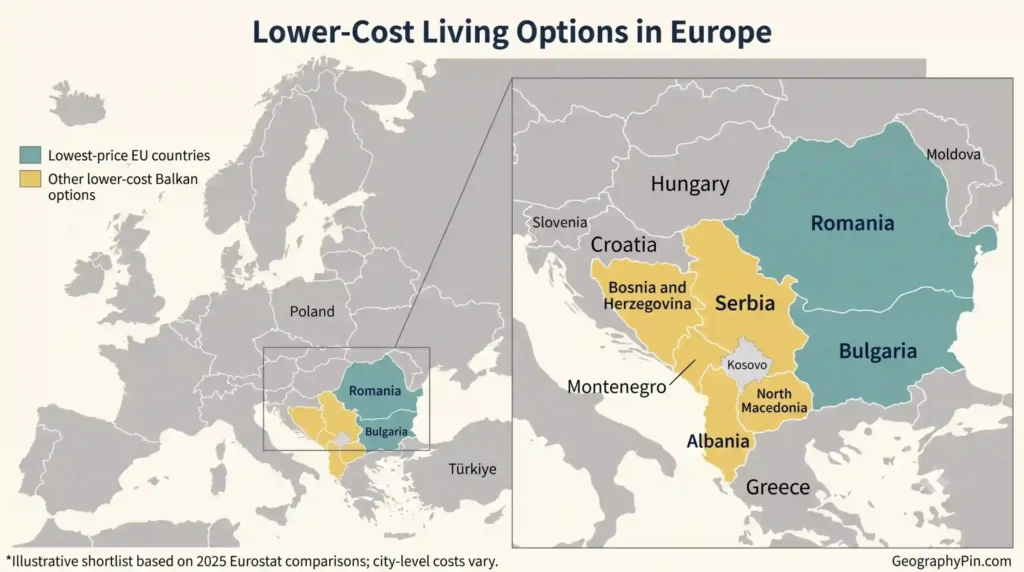
The countries below offer the clearest combination of low comparative prices and realistic interest from foreign residents. This is a practical shortlist, not a claim that every location inside one country is cheaper than every location in another.
Country-by-country comparison
The EU entries use Eurostat’s household-consumption results, while the candidate-country descriptions use broader price bands from its actual-individual-consumption comparison. The two measures support a useful shortlist but should not be treated as one exact combined ranking.
| Country | Official price signal | Strongest practical fit | Main caution |
|---|---|---|---|
| Bulgaria | Lowest overall EU price level in 2025 | Low-cost EU base and modest retirement spending | Sofia and resort locations cost more than national figures suggest |
| Romania | Second-lowest EU overall; lowest EU food price level | Larger-city choice with EU membership | Bucharest and Cluj-Napoca carry substantial city premiums |
| North Macedonia | Lowest Eurostat price band in the broader comparison | Very low everyday costs outside the EU | Smaller labor market and separate residency rules |
| Bosnia and Herzegovina | Well below the EU average | Low-cost urban life in Sarajevo or secondary cities | Administrative and healthcare arrangements require careful local checking |
| Serbia | Well below the EU average | Urban services and a larger non-EU city option | Belgrade is considerably less budget-friendly than smaller cities |
| Albania | Below the EU average | Warm climate and lower-cost life away from prime districts | Tirana and coastal rents can move differently from national prices |
| Montenegro | Below the EU average, but not in the bottom band | Small-country living near the Adriatic | Seasonal coastal housing can weaken its affordability |
| Poland | Third-lowest overall price level in the EU | EU mobility and a larger employment market | Major-city housing makes it a higher-budget choice than Bulgaria or Romania |
Bulgaria: the clearest low-cost EU choice
Bulgaria has the strongest official claim for people who specifically want the cheapest EU member. Its 2025 overall household price level was 37% below the EU average, and its housing category stood at 41% of the average.
Sofia offers the country’s broadest range of jobs and services but is not its cheapest location. Plovdiv and other regional cities may offer a better balance, while Black Sea resort areas require a seasonal rent check. Bulgaria uses the euro from 2026, removing exchange-rate conversion between local prices and the euro but not preventing rents or services from changing.
Romania: low prices with more city choice
Romania sits just behind Bulgaria in the EU comparison and recorded the bloc’s lowest food price level in 2025. Bucharest provides the widest big-city environment, while cities such as Iași, Oradea, Timișoara, and Brașov create different combinations of cost, employment, climate, and transport.
Cluj-Napoca’s housing market is a reminder that a cheap country can contain an expensive city. Romania therefore works best when the comparison begins with a particular rental market rather than the national average.
North Macedonia and Bosnia: lower prices outside the EU
North Macedonia stands out at the bottom of Eurostat’s broader price comparison. Skopje provides the main concentration of services, while Ohrid’s tourism changes its housing pattern. The country can suit someone with outside income, but its non-EU status means separate residence, work, and health-insurance rules.
Bosnia and Herzegovina also belongs to Europe’s lowest-price group. Sarajevo, Banja Luka, Mostar, and smaller cities do not operate as one uniform market. Its complex administrative structure makes it especially important to identify the correct local authority before relying on general relocation advice.
Serbia and Albania: affordable, but location matters
Serbia combines below-average national prices with a larger capital and established regional transport connections. Belgrade attracts the most foreign residents but can undermine the savings that brought them to Serbia; Novi Sad and smaller cities deserve separate comparisons.
Albania can remain inexpensive outside its most sought-after districts and coastal markets. Tirana’s growth and summer demand along the Adriatic and Ionian coasts mean that an old country-wide estimate may not describe the rent currently offered to a foreign tenant.
Montenegro and Poland: affordable rather than rock-bottom
Montenegro is cheaper than much of Western Europe, but coastal rent and seasonal demand make it less consistently inexpensive than North Macedonia or Bosnia and Herzegovina. Podgorica and inland locations should be evaluated separately from Budva, Kotor, and other tourism centers.
Poland is the third-lowest-price EU member in the 2025 household comparison, but it belongs to a higher cost tier than Bulgaria and Romania. It may still be the better value for someone who needs a larger employment market, extensive transport links, or more city choices.
Which country fits which type of mover?
The lowest price index is not automatically the best personal choice. Income source, citizenship, family needs, and the reason for moving determine which savings are usable in practice.
For people earning remotely
Bulgaria and Romania offer low prices inside the EU and Schengen Area. Serbia, North Macedonia, and Bosnia and Herzegovina can offer lower everyday spending outside the EU. In every case, remote work must be compatible with the person’s residence status, tax position, and any restrictions on working while admitted as a visitor.
For someone seeking local employment
Romania and Poland have larger labor markets than the smaller Balkan states, although the relevant test is the salary available in the person’s profession. A low local price level provides limited benefit if wages, job availability, or professional recognition are also weak.
Anyone working in a regulated field should check whether qualifications must be recognized and whether the job can support a work-based residence permit before comparing grocery prices.
For retirees
Bulgaria, Romania, Albania, and North Macedonia may appeal to retirees because housing and daily services can cost less than in Western Europe. The deciding issues are often residence eligibility, access to specialists, prescription coverage, language support, and the price of private insurance.
A healthy person’s current healthcare spending should not be used as the long-term estimate. The comparison should include insurance suitable for residence applications and the cost of reaching a larger medical center when necessary.
For families
Families need to price a suitable home rather than a studio, then add childcare, schooling, transport, healthcare, and trips to visit relatives. International-school tuition can erase much of a country’s cost advantage, while a family able to use local public education may reach a very different result.
The costs that can change the answer
A national cost-of-living index is an average basket. Your budget gives each category a different weight, which is why two people can reach opposite conclusions about the same country.
Rent is usually the first reality check
Compare long-term listings in the exact neighborhood and season in which you plan to move. Tourist platforms, short leases, furnished apartments, deposits, agency fees, and contracts priced in euros can produce a very different total from the rent paid by a long-established local tenant.
Ask what the quoted price includes. Building charges, heating, water, parking, internet, and maintenance may be separate. A cheap apartment with poor insulation can also create unexpectedly high winter costs.
Imported goods do not follow local wages
Phones, computers, cars, specialized tools, foreign food brands, and other traded products may not be dramatically cheaper than elsewhere in Europe. The largest savings are often found in locally supplied services, housing, public transport, and some food categories.
A car can remove the small-city advantage
A smaller city may offer lower rent but require a vehicle. Fuel, registration, insurance, repairs, parking, and imported parts should then be added to the comparison. A more expensive apartment near reliable public transport can produce the lower total budget.
Build the complete monthly stack
A realistic estimate should include rent, utilities, groceries, local transport, healthcare or insurance, phone and internet service, taxes, visa or permit costs, debt payments, trips home, and a contingency allowance. Families should add childcare or schooling before judging whether a country is affordable.
Residency, work, tax, and healthcare
The cheapest apartment is not useful if the tenant has no lawful way to remain in the country, cannot work under the chosen status, or faces an insurance requirement that was left out of the budget.
A short visit is not permission to live there
Eligible non-EU visitors are generally limited to 90 days in any rolling 180-day period across the Schengen Area. Bulgaria and Romania have been full Schengen members since January 1, 2025, so time spent in them now counts toward that shared limit (European Commission, 2025).
North Macedonia, Bosnia and Herzegovina, Serbia, Albania, and Montenegro are outside Schengen, but each has its own entry and residence rules. Traveling outside Schengen does not automatically create a right to settle, work, or repeatedly remain in another country.
EU citizens have much broader movement rights, though stays beyond three months can still involve registration and conditions connected to employment, self-employment, study, or financial self-sufficiency (European Commission, 2026). Non-EU citizens generally need a country-specific basis such as employment, study, family connection, business activity, or another qualifying residence category.
Remote work still creates legal and tax questions
Being paid by a foreign company does not automatically make local immigration, labor, social-security, or tax rules irrelevant. Before moving, confirm that the intended residence category permits the activity and determine where the person and employer may acquire obligations.
For Americans, moving abroad does not end federal filing responsibilities. U.S. citizens and resident aliens generally remain subject to U.S. tax reporting on worldwide income, although exclusions, credits, and treaty provisions may reduce double taxation in qualifying cases (IRS, 2026). Local tax residence is a separate question.
Healthcare must be priced for your status
Public healthcare access depends on nationality, employment, social-insurance contributions, residence status, and national law. A visitor’s travel policy is not necessarily suitable for a residence permit or long-term treatment.
Request written confirmation of coverage before committing to a move. Check emergency care, pre-existing conditions, prescriptions, routine appointments, specialist access, and whether treatment is realistically available in the city under consideration.
Low prices with serious trade-offs
Some countries appear near the bottom of commercial cost indexes but should not be presented as ordinary relocation recommendations without context.
Ukraine, Belarus, and Russia
Prices alone are not a responsible basis for recommending Ukraine during the continuing war. Belarus and Russia also carry major security, legal, financial, and consular concerns for U.S. citizens. Current U.S. guidance lists all three at Level 4, “Do Not Travel” (U.S. Department of State, 2026).
The situation affects far more than personal safety. International payments, banking, insurance, transportation, border access, and the ability of a foreign government to provide consular help can all be restricted.
Moldova
Moldova is frequently identified as a low-cost European country, but it is absent from Eurostat’s current 36-country price comparison. That makes a precise direct ranking against Bulgaria, Romania, and the candidate countries less defensible.
It may still deserve an individual comparison, particularly for someone with regional or family connections. Infrastructure, healthcare availability, residence rules, and the security context around Ukraine and the breakaway Transnistria region need to be part of that decision.
Türkiye and the problem of currency movement
Türkiye is transcontinental and often appears in European cost comparisons. It recorded low comparative prices in Eurostat’s data, but rapid changes in domestic prices and the lira’s exchange rate can make a converted foreign-currency budget look more stable than local reality.
Eurostat specifically notes that exchange-rate movements can substantially alter comparative price levels. Anyone considering Türkiye should rebuild the budget with current local rents and recurring expenses instead of carrying forward an old monthly estimate (Eurostat, 2025).
Resort towns that are cheap only off-season
Coastal Albania, Montenegro, Bulgaria, and parts of Croatia can look inexpensive during quiet months. Summer demand may reduce long-term availability or change rent expectations. A lease that covers the full year is more meaningful than an attractive winter listing.
A practical way to choose
The most reliable choice comes from eliminating countries that do not fit legally, then comparing real city-level expenses among the remaining options.
Use this seven-step shortlist
- Confirm the legal route first. Identify the residence category, work rights, insurance requirement, renewal conditions, and minimum financial evidence.
- Choose three actual cities. Do not compare an expensive capital in one country with a small town in another.
- Price a real home. Use long-term listings that match your required size, neighborhood, contract length, and moving season.
- Add the overlooked expenses. Include utilities, insurance, transport, taxes, permit costs, trips home, deposits, and setup costs.
- Compare income as well as spending. Local wages, foreign income, pension taxation, and currency movement can change the result.
- Test daily life. Spend time in the target neighborhood, use local transport, shop normally, and check access to the services you would rely on.
- Verify before signing. Recheck immigration, tax, healthcare, and lease rules with the responsible authorities or qualified professionals.
For most people seeking the lowest-cost EU base, Bulgaria and Romania deserve the first comparison. For someone able and willing to live outside the EU, North Macedonia and Bosnia and Herzegovina can produce lower day-to-day spending, while Serbia and Albania may offer a more suitable balance of city life, climate, and services.
FAQ
What is the cheapest country to live in Europe?
There is no single official ranking covering every expense and every European country. North Macedonia sits in Eurostat’s lowest broader price band, while Bulgaria is the lowest-price EU member in the 2025 household-consumption comparison. The practical answer changes with rent, city, legal status, and lifestyle.
What is the cheapest country to live in the European Union?
Bulgaria had the EU’s lowest overall household-consumption price level in 2025, followed by Romania and Poland (Eurostat, 2025). Bulgaria therefore has the strongest official claim when the search is limited to EU countries.
Can one person live in Europe on $1,000 per month?
It may be possible in some smaller low-cost cities with modest rent and spending, but it is not a safe country-wide promise. Market rent, winter utilities, insurance, visa costs, taxes, and family expenses can push the total higher. Build the estimate from current written prices rather than a generic budget.
Is Portugal one of the cheapest European countries?
Portugal remains less expensive than several western and northern European countries, but it is not in Europe’s lowest-price group. Eurostat’s comparison places Bulgaria, Romania, Poland, and several Balkan candidate countries lower, while housing pressure can make Lisbon, Porto, and the Algarve particularly difficult for budget movers.
Which cheap European country is best for Americans?
Bulgaria and Romania are strong starting points for Americans seeking low prices within the EU, while Albania, Serbia, North Macedonia, and Bosnia and Herzegovina deserve consideration outside it. The best fit depends on the available residence route, healthcare needs, taxes, language, and income source.
Are non-EU Balkan countries always cheaper than EU countries?
No. North Macedonia and Bosnia and Herzegovina sit in very low price bands, but tourist districts, capital-city rents, imported goods, private healthcare, and transport can reduce the difference. Bulgaria may offer better overall value to someone who benefits from EU membership or its institutions.
Does leaving Schengen reset the 90-day limit?
No. The Schengen rule is generally 90 days within a rolling 180-day period, not 90 days per entry. Time outside Schengen allows earlier days eventually to fall outside that rolling window, but crossing into a non-Schengen country does not immediately reset the count.
Should I choose a country from online cost-of-living indexes alone?
No. Use an index to create a shortlist, then verify long-term rent, utilities, healthcare, transport, taxes, residence eligibility, and work rights in a specific city. A trial stay can reveal practical costs that a national average cannot show.
What Did We Learn Today?
Bulgaria and Romania are the clearest low-cost choices inside the EU, while North Macedonia, Bosnia and Herzegovina, Serbia, and Albania expand the shortlist beyond it. No national ranking can replace a city-level budget: rent, utilities, healthcare, legal residence, taxes, and income determine what is genuinely affordable. The cheapest sustainable choice is the place where low prices still come with a workable legal status and the services you need.
Sources & Data Notes
Price comparisons are based primarily on Eurostat’s 2025 purchasing-power-parity releases covering household consumption across 36 countries, supported by European Commission migration guidance, national immigration and statistics authorities, IRS information for Americans abroad, and official travel advisories. The indexes compare broad national price levels rather than a fixed expatriate budget; figures are rounded, and newer releases, exchange-rate movements, rent changes, or policy updates may alter some details. AI tools assisted with organizing and checking the draft, followed by editorial review and interpretation by the author.