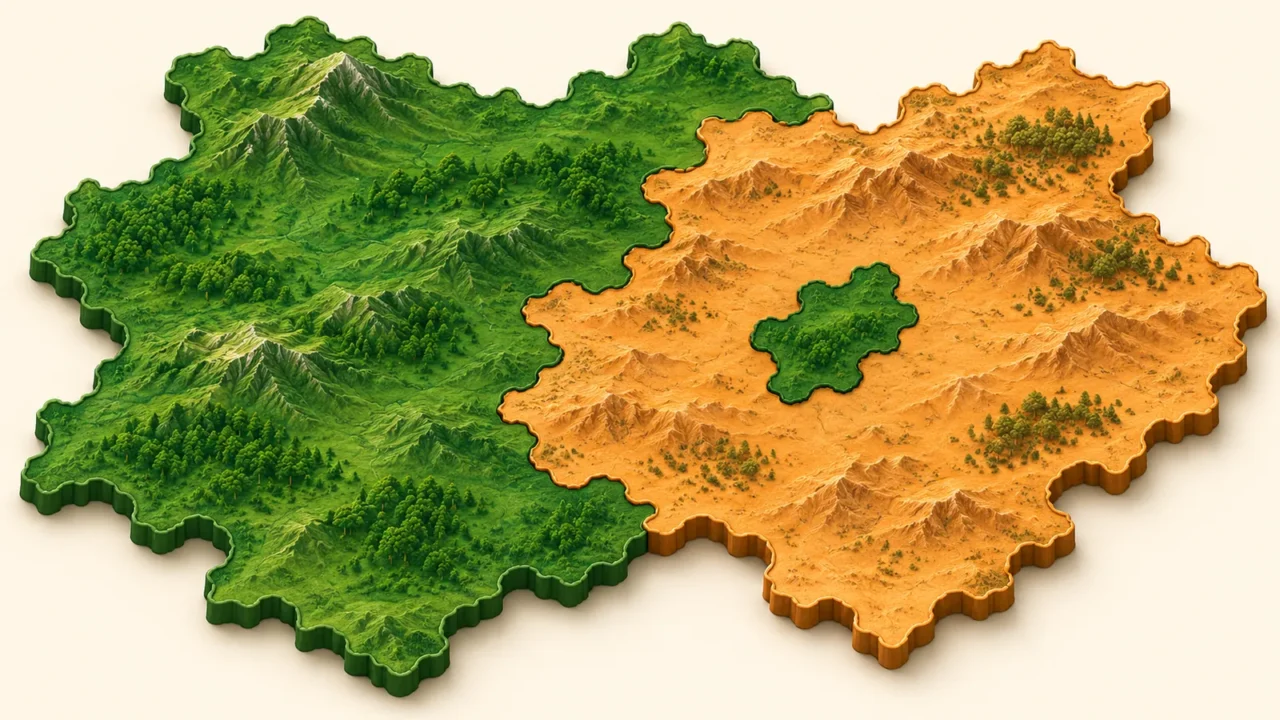
A detached piece of a country and a country surrounded by another state can look similar on a map. The terms enclave and exclave describe different relationships, so the same place may qualify as both, only one or neither.
An enclave is a territory completely surrounded by one other territory. An exclave is a part of a state separated from that state’s main territory by foreign territory. A detached piece of one country enclosed inside another is both. An independent country such as Lesotho is an enclave, but not an exclave of a larger parent state.
How to use this article: You can apply the two tests, see a place that is both, or check the edge cases.
The Difference Comes Down to Two Questions
Enclosed by what, and separated from what?
For enclave, look outward: what surrounds the place? For exclave, look toward the state it belongs to: is the place separated from that state’s main territory? One question concerns enclosure; the other concerns territorial continuity.
This comparison uses the strict political-geography sense of enclave: complete enclosure by a single other state at the same territorial level. Broader writing sometimes uses the word more loosely for isolated regions or cultural communities. That wider usage should not silently replace the map-based test.
| Question | Enclave | Exclave |
|---|---|---|
| Main relationship | Enclosure by another territory | Separation from a parent state’s main territory |
| Must it belong to a larger state? | No; it can be an independent country | Yes, in the territorial sense used here |
| Must one other state surround it? | Yes, under the strict definition here | No; several foreign states can intervene or surround it |
| Can one place be both? | Yes | Yes |
| Does the label establish travel rights? | No | No |

A Place That Is Both: Büsingen
German territory enclosed by Switzerland
Büsingen am Hochrhein is part of Germany but is surrounded by Swiss territory. From Germany’s perspective it is an exclave. From the surrounding Swiss perspective it is an enclave. The municipality’s own explanation makes this distinction directly.
The two words do not compete for the “correct” label. They describe the same territorial arrangement from different relationships. Saying that Büsingen is an enclave in Switzerland does not mean it is sovereign Swiss territory.
The municipality also illustrates why the border map is only the beginning. Büsingen belongs to Germany while participating in the Swiss customs territory under a specific arrangement. Political sovereignty and customs administration are separate questions. The municipal account of the treaty explains that arrangement.
Do not infer the same customs rules for another exclave. The geographic category tells you where the territory sits, not which currency, tax, transit or service arrangements apply.
An Enclave That Is Not an Exclave
Lesotho is an independent country entirely surrounded by South Africa. It is an enclave state, but it is not a detached part of some other, larger Lesotho. There is no parent-state mainland from which it is separated.
The Lesotho Defence Force’s national background identifies the country as wholly surrounded by South Africa. Its sovereign status and surrounding geography answer different questions: independence does not prevent a country from being an enclave.
San Marino and Vatican City are other familiar sovereign enclave examples within Italy. They should not be described as Italian exclaves. Nor should Vatican City State be confused with all properties used by the Holy See: the Vatican’s official geography page distinguishes the state’s territory from properties elsewhere that enjoy special immunities.
The broader question of countries with one land neighbor is different. Having one land neighbor alone does not prove complete enclosure, because a country may also have a coastline.
An Exclave Need Not Be an Enclave
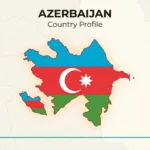
Nakhchivan is an autonomous republic of Azerbaijan separated from Azerbaijan’s main territory. It borders Armenia, Iran and Türkiye, so it is an exclave of Azerbaijan but not an enclave enclosed by one other country under the strict definition used here.
Azerbaijan’s official description of Nakhchivan identifies those three neighboring states and its place within Azerbaijan. The United Nations’ April 2024 map of Azerbaijan also shows the separate territory and its neighbors. The broader Azerbaijan country profile provides the regional setting.
This is the most useful correction to the shortcut “every exclave is an enclave.” A place can be detached from its parent state without being surrounded by one single foreign state. The separation test succeeds while the strict enclosure test fails.
The label does not resolve questions about transport corridors, border openings or transit agreements. Those require separate, dated evidence. A proposed route, a usable road and a transfer of sovereignty are also different things; none should be inferred from the word exclave.
Edge Cases: Coastlines, Access and Cultural Enclaves
A coastline changes the enclosure test
A territory with an open coastline is not a strict enclave entirely enclosed by one other state. Writers may use semi-enclave or related terms for places surrounded on land but open to the sea. Terminology varies, so the clearest approach is to state the actual arrangement before applying a specialized label.
Likewise, a place can be difficult to reach from the rest of its country without being territorially detached. A mountain barrier, missing road or awkward route does not by itself turn a connected area into a strict exclave. Geographic access and political continuity need separate checks.
A cultural enclave is a different use of the word
An ethnic or cultural enclave is a concentration of a community within a wider population. It does not imply a foreign sovereign border around a neighborhood. The University of California, Santa Cruz discussion of enclave terminology distinguishes the word’s territorial, social and economic uses.
Maps can show these ideas at different levels, but the levels must match. A municipal boundary is not a national frontier. A neighborhood’s cultural identity is not proof of independent political status.
Use This Classification Check on Any Map
Begin with a map that identifies political membership, not just separate colored shapes. An inset may move a territory closer to the page’s center, while a small-scale map may omit a narrow connection or a tiny detached area.
- Choose the territorial level. Compare states with states, or municipalities with municipalities.
- Identify membership. Determine whether the place is independent or part of a larger state.
- Trace the enclosure. Is every side enclosed by one other territory, or is there a coast or more than one neighbor?
- Check continuity. Is it attached to its parent state’s main territory without crossing foreign territory?
- State the result precisely. Use both labels if both tests apply, then explain any convention-dependent edge case.
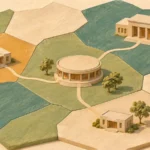
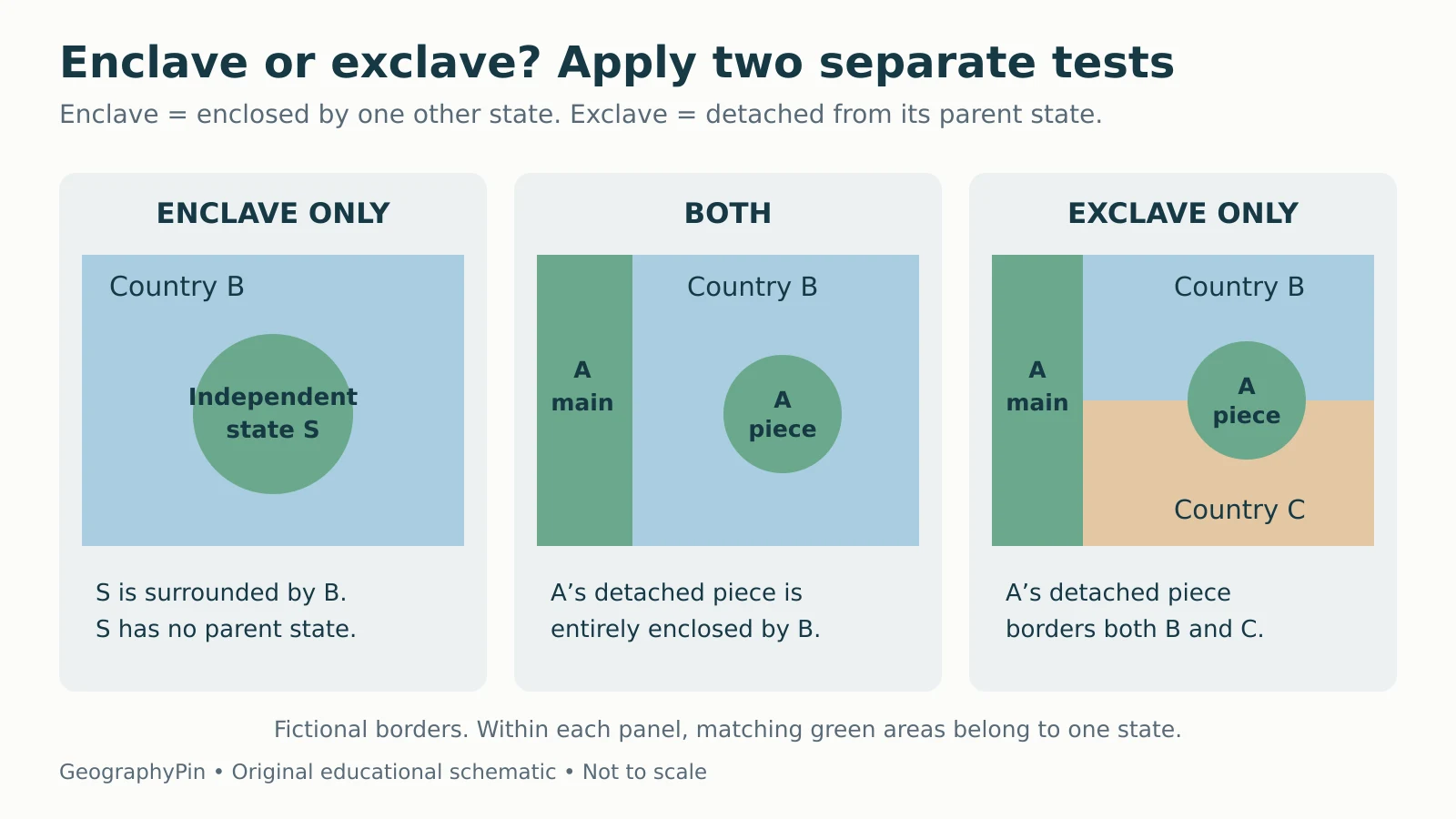
In the fictional diagram, the independent state inside B is an enclave only. The detached piece of A inside B is both. The detached piece of A bordered by B and C is an exclave only. The classification follows the relationships, not the size or shape of each colored area.
What Did We Learn Today?
Enclave describes enclosure and exclave describes separation from a parent state. Büsingen satisfies both tests, Lesotho is an independent enclave, and Nakhchivan shows why an exclave need not be enclosed by one country. Coastlines, access routes, cultural communities and special legal arrangements require their own explanation rather than a label applied by appearance alone.
Sources & Data Notes
The article states a strict single-surrounding-state definition of enclave and treats coastal and cultural uses separately. This is a classification guide, not a current border-crossing or transit guide. All schematic borders are fictional.
- University of California, Santa Cruz: Enclave, Keywords in Political Economy
- Mathematical definitions of enclave and exclave, and applications
- Büsingen municipal government: Mayor’s welcome and enclave/exclave explanation
- Büsingen municipal government: Treaty with Switzerland
- Lesotho Defence Force: National background
- Vatican City State: Geography
- Azerbaijan’s representation to the Council of Europe: Nakhchivan
- UN Geospatial: Azerbaijan map, April 2024