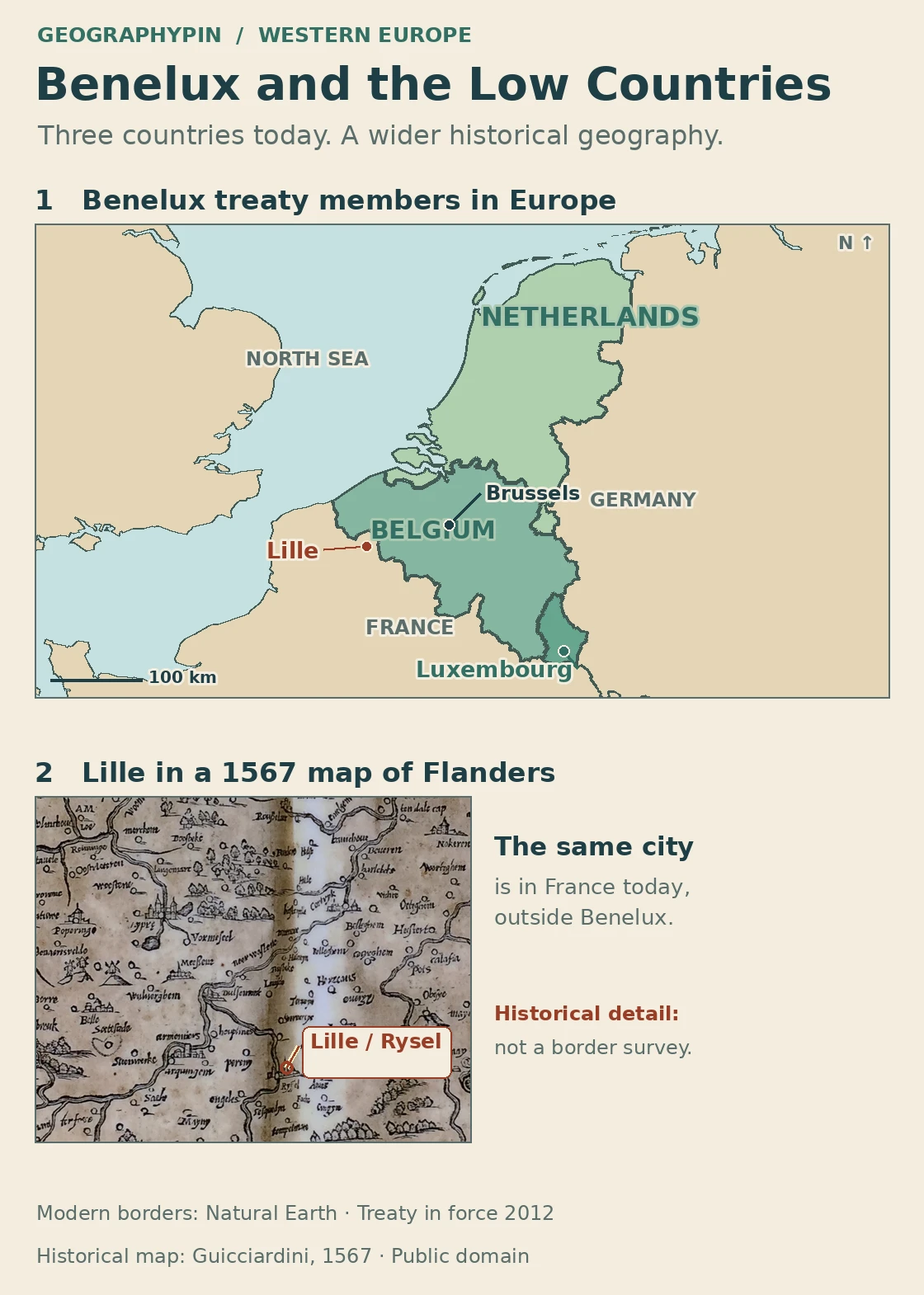
Belgium, the Netherlands and Luxembourg are the three Benelux countries. They cooperate through the Benelux Union, a treaty-based arrangement. The historical Low Countries overlap with those three countries but do not always match their borders. Lille, now in France, is an example.
Belgium, the Netherlands and Luxembourg make up Benelux. The treaty applies to the Netherlands in Europe. The historical Low Countries had no single fixed boundary: Lille, now in France, appears on a 1567 map of Flanders.
How to use this article: Find the three members, see why the treaty map shows the Netherlands in Europe, or learn why a historical map can include Lille.
Which countries are in Benelux?
Belgium, the European Netherlands and Luxembourg
The name combines parts of Belgium, the Netherlands and Luxembourg. The countries signed a customs convention in 1944 that entered into force in 1948. They signed the Benelux Economic Union treaty in 1958, and it took effect in 1960. The successor treaty signed in 2008 entered into force on January 1, 2012.
The three members remain independent countries. The current union supports cooperation in areas such as the internal market, sustainable development and justice and home affairs. France and Germany border the group but are not members.
Belgium: Brussels and the meaning of Flanders
Belgium is one of the three treaty members, and Brussels is home to the Benelux Secretariat. The name Flanders is useful for seeing where historical and modern maps diverge. Flanders is a region of Belgium today. The older County of Flanders extended outside that modern region and included Lille. The same name on two maps does not guarantee the same boundary.
The Netherlands: what the treaty covers
Why the map stops at the European Netherlands
The Netherlands is the northern member. The Dutch treaty database records the modern Benelux Treaty as applying to the Netherlands in Europe. The map therefore shows its European territory, not the wider Kingdom’s Caribbean parts. See our Netherlands country profile for the wider distinction between the Netherlands and the Kingdom of the Netherlands.
Luxembourg: the inland member
Luxembourg is the smallest of the three countries by land area and the only one without a coast. Its capital’s old center sits on a steep rocky spur at the confluence of the Alzette and Pétrusse. That is a reminder not to use the word low as an elevation rule: the historical label was not defined by a single contour line.
Lille and the changing Low Countries
Lille in the historical Low Countries
The Low Countries is a historical and geographical name, not another treaty organization. In writing about the Burgundian Netherlands, the Metropolitan Museum of Art describes a late medieval region that included the area of modern Belgium, the Netherlands and Luxembourg as well as parts of what is now northern France. That does not put all of northern France in the region or make it a modern member.
Lille makes the difference concrete. In the 1500s it appears in Lodovico Guicciardini’s description of the Low Countries and in the book’s map of Flanders. The city’s museum traces its period under Spanish rule and its surrender to Louis XIV in 1667; the museum dates its formal attachment to France in that episode to the 1668 Treaty of Aix-la-Chapelle. Look for Lille in France today, on the other side of Belgium’s modern border.
| Name on the map | How the edge is determined | What Lille tells you |
|---|---|---|
| Benelux Union | The three treaty members, shown here by modern European borders | Lille is in France, outside the union |
| Historical Low Countries | The period and the author’s definition, such as a study of the Burgundian Netherlands | Lille appears in older descriptions and maps of Flanders and the Low Countries |
Frequently Asked Questions
Do the historical Low Countries and Benelux have exactly the same boundaries?
No. The modern group has three treaty members. A historical account can include Lille or other areas that now lie outside them; its own date and definition determine what it includes.
Is Benelux another name for the European Union?
No. The three Benelux members are also members of the much larger EU. Benelux is a separate agreement among those three; it also cooperates with neighboring countries and institutions.
Does an old map labeled “the Netherlands” show today’s Dutch border?
Not necessarily. Historical uses of Netherlands could refer to a wider collection of territories. Check the map’s date, original title and named provinces instead of assuming the modern country outline.
What Did We Learn Today?
Benelux is Belgium, the Netherlands and Luxembourg. The Low Countries can mean a wider historical region. Lille is outside the modern treaty area but appears in older accounts of the Low Countries, so date and purpose matter more than the resemblance between the names.
Sources & Data Notes
Show sources and map notes
- Benelux Union, treaty and current areas of cooperation; Luxembourg Ministry of Foreign Affairs, customs and treaty dates; and Dutch treaty database, current treaty and territorial application, checked November 22, 2026. Treaty on European Union, Article 52, for the separate EU roster.
- Metropolitan Museum of Art, Burgundian Netherlands, for that period’s regional definition; Musée de l’Hospice Comtesse, history of Lille and the museum’s account of 1667 and the 1668 treaty; UNESCO, the terrain and old quarters of Luxembourg City.
- Modern context: Natural Earth, public domain, generalized boundaries. Historical panel: Flanders map in Lodovico Guicciardini’s Descrittione di tutti i Paesi Bassi, 1567, public-domain engraving; cropped and labeled. The historic panel is a source detail, not a line reconstructed using the modern basemap.
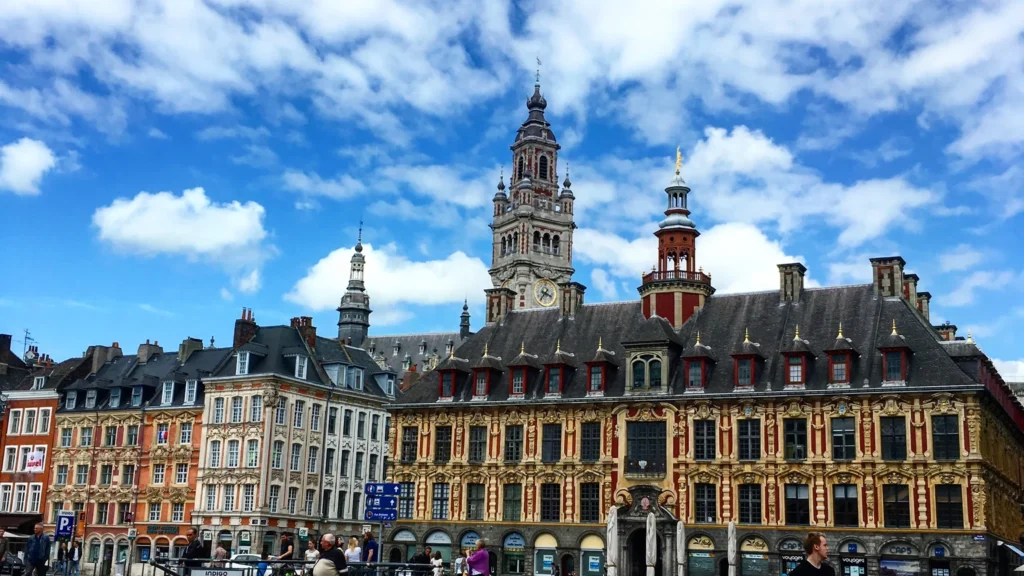
- Featured photograph: Grand Place, Lille, Strukova1409, July 2016, CC BY-SA 4.0; cropped and converted under the same license.