The six GCC countries are Bahrain, Kuwait, Oman, Qatar, Saudi Arabia and the United Arab Emirates. Iran and Iraq border the Persian Gulf but are not members of the Gulf Cooperation Council. Yemen is on the Arabian Peninsula but belongs to neither list.
The GCC is the six-country organization defined by its charter, not a name for every country near the Gulf. All six members have a Persian Gulf coastline under the convention used here. Oman is easy to miss: its detached Musandam territory reaches the Persian Gulf at the Strait of Hormuz.
1. The six GCC countries and their capitals
The numbered dots identify the capital cities, not the centers of the countries. The Bahrain–Qatar inset separates Manama and Doha so readers can match each dot to the right country. Oman and its separated Musandam territory have the same member shading; the UAE lies between them.

| Map / Country | Capital | Find it on the map |
|---|---|---|
| 1. Bahrain | Manama | Islands between eastern Saudi Arabia and Qatar. |
| 2. Kuwait | Kuwait City | At the northwest end of the Gulf, between Iraq and Saudi Arabia. |
| 3. Oman | Muscat | Mainland in southeastern Arabia; Musandam is separated from it by the UAE. |
| 4. Qatar | Doha | A peninsula north of its land border with Saudi Arabia. |
| 5. Saudi Arabia | Riyadh | The largest country on the peninsula, with Riyadh inland. |
| 6. United Arab Emirates | Abu Dhabi | Between Saudi Arabia and Oman; Abu Dhabi faces the Persian Gulf. |
2. How the GCC charter defines the list
The Gulf Cooperation Council is the common name of the Cooperation Council for the Arab States of the Gulf. Article 5 of its charter identifies the members as the six states represented at the February 4, 1981 foreign ministers’ meeting in Riyadh. Those same six signed the charter on May 25, 1981, in Abu Dhabi. The charter places the council’s headquarters in Riyadh.
The roster, checked on November 24, 2026, counts full member states. Hosting a meeting, cooperating with the council or sharing the Gulf’s coastline does not make another country a member.
3. GCC members, Gulf coasts and the Arabian Peninsula
If the question is about the coast, count eight
Count countries with a coast on the Persian Gulf rather than countries in the organization, and Iran and Iraq join the six GCC members. Iran faces the Arabian Peninsula across the Gulf. Iraq has a short coast at the northwest end. Oman qualifies through Musandam. Muscat is farther southeast on the Gulf of Oman. The Strait of Hormuz connects the Persian Gulf and the Gulf of Oman.
If the question is about land, Bahrain and Yemen swap places
Start with the usual seven-country list for the Arabian Peninsula and keep only countries with territory on the connected mainland. The resulting six include Yemen but not offshore Bahrain. The GCC roster makes the opposite choice. The seven-country regional shorthand includes both; the wider Middle East list answers a larger regional question.
Here, Persian Gulf names the water body, following the United Nations Secretariat’s editorial usage. GCC publications also use Arabian Gulf for the same water. Neither name defines who belongs to the council, and the Gulf of Oman is a separate body of water.
Frequently Asked Questions
Is Yemen a GCC member?
No. The GCC works with Yemen on regional issues, but Yemen has no place in the six-state roster. Its coast faces the Red Sea, the Gulf of Aden and the Arabian Sea, not the Persian Gulf.
Is Dubai one of the GCC capitals?
No. Dubai is an emirate and a city in the United Arab Emirates. The national capital is Abu Dhabi. The GCC counts the UAE once, not each of its seven emirates.
What Did We Learn Today?
Use the charter when the question is about GCC membership and the shoreline when it is about the Gulf. Iran and Iraq belong on the coastal list, Bahrain belongs on the council roster despite being offshore, and Yemen belongs in the usual peninsula grouping without belonging to either Gulf list.
Sources & Data Notes
The GCC Charter sets the membership rule. The GCC Statistical Center verifies the capital list, and UN geographical names data distinguish Kuwait City from the country. The coastal comparison follows NASA’s eight-state geographic reference. Hydrographic names separate the Persian Gulf and Gulf of Oman; they are not political boundaries. The map uses generalized Natural Earth land and capital data, marks the disputed island group separately without assigning sovereignty, and shows no maritime boundaries.
View references
- GCC Secretariat: Charter and UN Treaty Collection: charter signatories and date. Recent institutional context: GCC October 2026 Ministerial Council communiqué and GCC statement on relations with Yemen.
- GCC-Stat atlas, Maps 4–5: capitals and water names; UNGEGN: Kuwait City.
- NASA Earth Observatory: eight Persian Gulf coastal countries; UN Secretariat naming directive; IHO S-23, 1953, sections 40–41; Oman Foreign Ministry: mainland and Hormuz.
- UAE Constitution, Articles 1 and 9; World Bank: Yemen’s coastal geography.
- Natural Earth 1:10 million cultural data, public domain. The UN meeting transcript records the competing Iranian and Emirati claims to Abu Musa and the Greater and Lesser Tunbs.
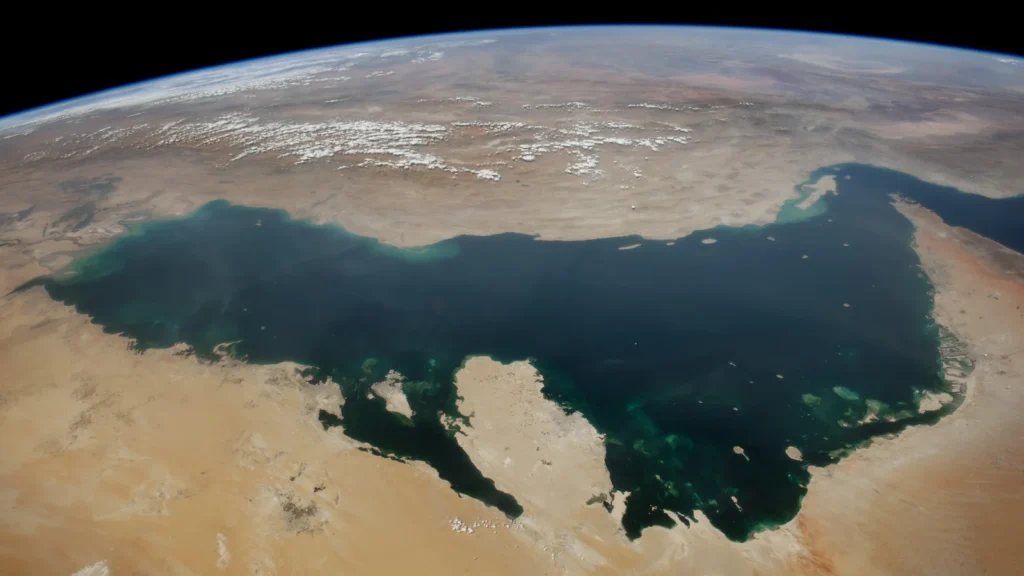
- Persian Gulf from the International Space Station, September 26, 2023. Credit: NASA / Expedition 69 Crew (ISS069-E-92132). Cropped and resized.