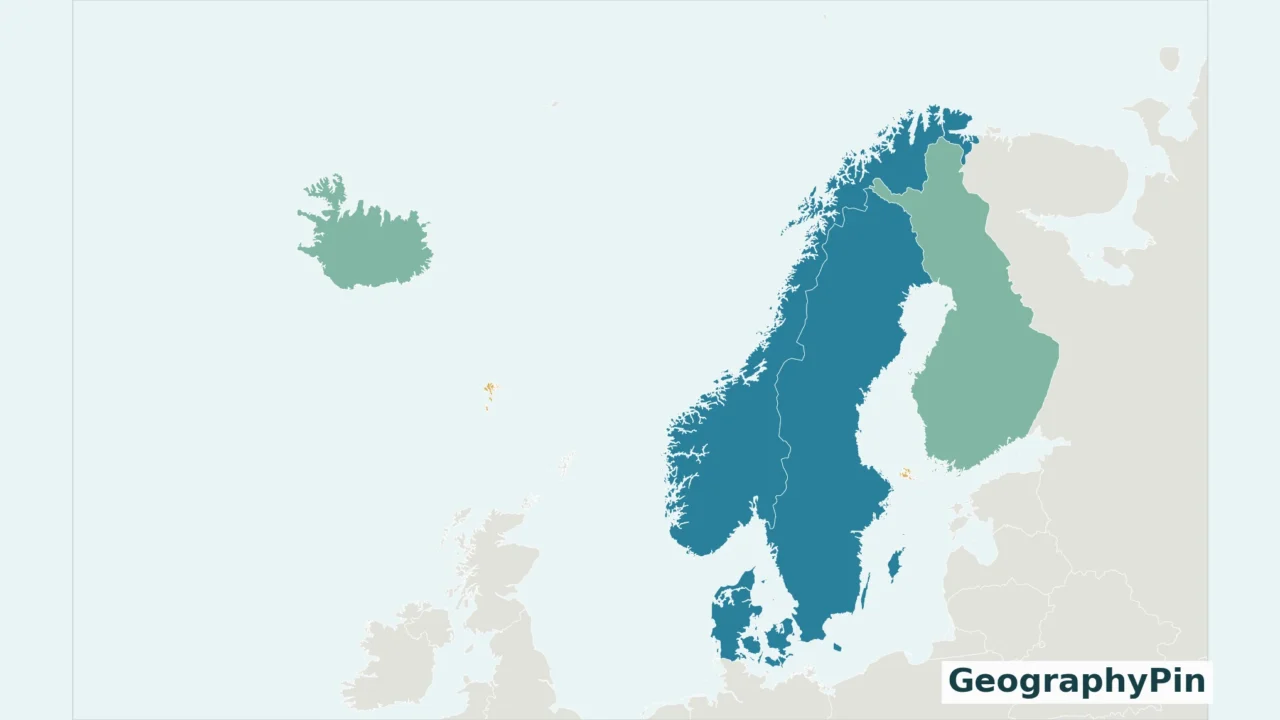
Finland and Iceland are Nordic countries, but are they Scandinavian? The answer depends on how someone is using “Scandinavia.” A useful starting point is to separate a common three-country cultural grouping from the broader Nordic region, then keep both distinct from the physical Scandinavian Peninsula.
Scandinavia commonly means Denmark, Norway and Sweden. The Nordic countries are Denmark, Finland, Iceland, Norway and Sweden; the wider Nordic region also includes Greenland, the Faroe Islands and Åland. Some sources use Scandinavia more broadly, so check their definition. Neither term is identical to the geographical Scandinavian Peninsula.
Find your answer: Check the country list, locate the autonomous territories, or untangle the peninsula distinction.
1. Scandinavia and Nordic countries: the short comparison
The words overlap, but they answer slightly different questions. Scandinavia is commonly a historical and cultural regional label. Nordic is the broader label used in Nordic co-operation. The Scandinavian Peninsula is a landform.
| Term | Useful meaning here | Main caution |
|---|---|---|
| Scandinavia | Denmark, Norway and Sweden | Common narrower usage; broader usage also exists |
| Nordic countries | Denmark, Finland, Iceland, Norway and Sweden | Five sovereign states, not eight |
| Nordic region | The five states plus Greenland, the Faroe Islands and Åland | The three autonomous territories are not three additional sovereign states |
| Scandinavian Peninsula | A physical peninsula dominated by mainland Norway and Sweden | Not the same outline as the cultural grouping |
That narrower definition of Scandinavia is a useful convention, not a rule that every writer follows. If an itinerary, textbook or dataset includes Finland or Iceland under “Scandinavia,” read its stated scope before treating it as a contradiction.
2. Map of the Nordic region
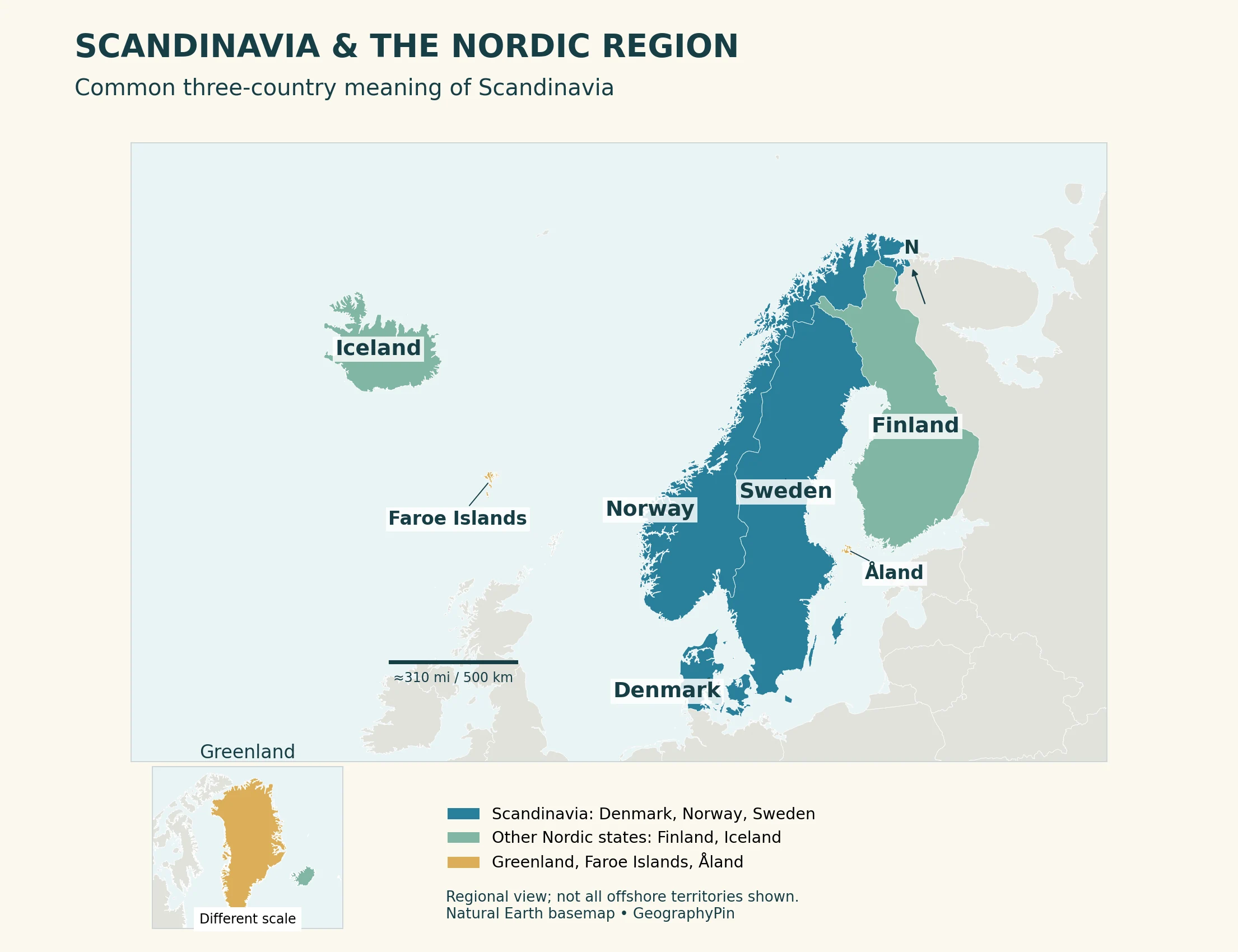
The map is designed to show the relationship between the terms, not an international organization’s jurisdiction or a precise cultural boundary. All five named sovereign states are Nordic. The colors divide that group into the common Scandinavian three and the other two, rather than suggesting that blue countries are “not Nordic.”
Denmark appears south of Norway and Sweden. Finland lies east of Sweden, while Iceland is farther west in the North Atlantic. The Faroe Islands lie between Iceland and Norway; Åland is between Sweden and mainland Finland. Greenland is much farther west and cannot be compared with the main map by its displayed size.
3. Five states, plus three autonomous territories
The five Nordic countries
- Denmark: also part of the common three-country Scandinavia grouping.
- Finland: Nordic, but not normally included in that narrower grouping.
- Iceland: Nordic, but not normally included in that narrower grouping.
- Norway: both Nordic and Scandinavian in the common narrower sense.
- Sweden: both Nordic and Scandinavian in the common narrower sense.
Where Greenland, the Faroe Islands and Åland fit
Nordic co-operation names these three autonomous territories alongside the five states. Greenland and the Faroe Islands are within the Kingdom of Denmark; Åland is an autonomous part of Finland. Their inclusion in the Nordic region does not turn the list into eight sovereign countries.
This is why “Denmark” needs careful handling in a map legend. Denmark proper, shown in blue, is not the entire Kingdom of Denmark. Greenland and the Faroe Islands are shown separately in gold to explain their Nordic regional status, not to imply that they are foreign states outside the kingdom.
Greenland is geographically part of North America while belonging to the Nordic regional framework. Regional affiliation and continent are different classifications. For another example of why labels require context, see Iceland’s relationship to Europe and North America.
4. Why the Scandinavian Peninsula is different
A landform is not a country grouping
The Scandinavian Peninsula is dominated by the mainlands of Norway and Sweden; geographical descriptions also include a northwestern part of Finland. It is not a collection of whole countries selected by political membership.
Denmark illustrates the difference particularly well. It belongs to the common cultural grouping of Scandinavia, but Denmark proper lies on Jutland and nearby islands, not on the Scandinavian Peninsula. Conversely, including part of Finland in a description of the peninsula does not automatically place the whole country in every definition of Scandinavia.
Do not use the colored country borders on our map as the outline of the peninsula. They show regional categories, not a traced landform boundary. A physical map of Europe serves a different purpose: it helps explain terrain and other natural features rather than cultural groupings.
5. Which term should you use?
Use “Nordic” when you mean the five-state group. If Greenland, the Faroes or Åland matter to your question, say “the Nordic region” and name them explicitly. This is clearer than asking a reader to guess whether you have counted states, territories or destinations.
Use “Scandinavia” with a short definition when precision matters. “Denmark, Norway and Sweden” removes ambiguity. Broader usage does not need to be banned; it needs to be explained.
Use “Scandinavian Peninsula” for the landform. A question about its mountains, coastlines or physical extent is not answered by a list of Nordic participants. And neither Nordic nor Scandinavian is a substitute for EU or Schengen membership: those are separate institutional categories.
Frequently Asked Questions
Is Finland Scandinavian or Nordic?
Finland is Nordic. It is normally outside the narrower three-country meaning of Scandinavia, although broader usage sometimes includes it. Part of northwestern Finland is included in geographical descriptions of the Scandinavian Peninsula.
Is Iceland part of Scandinavia?
Iceland is a Nordic country. It is not part of the common narrower grouping of Denmark, Norway and Sweden, but some broader uses of Scandinavia include it.
Are there five or eight Nordic countries?
There are five sovereign Nordic states. Nordic co-operation also includes Greenland, the Faroe Islands and Åland in its regional description; those three are autonomous territories rather than additional sovereign states.
Why is Denmark Scandinavian if it is not on the peninsula?
Because the common cultural region and the physical peninsula are different categories. A historical regional label does not have to follow one landform’s coastline.
What Did We Learn Today?
Scandinavia commonly refers to Denmark, Norway and Sweden. Nordic is broader: five sovereign states, with Greenland, the Faroe Islands and Åland included in the wider region. The Scandinavian Peninsula is a separate physical feature. Clear definitions prevent the same map from accidentally mixing culture, sovereignty and landforms.
Sources & Data Notes
The original GeographyPin map uses Natural Earth 1:10 million map-unit boundaries, with category colors based on the definitions explained above. It is a regional reference map, not a legal boundary survey. Greenland has a separate, differently scaled inset. Small islands are generalized, and offshore territories outside the main frame are not comprehensively depicted.
- Nordic co-operation: Facts about the Nordic countries
- Nordic co-operation: Greenland
- Nordic co-operation: Faroe Islands
- Nordic co-operation: Åland
- Nations Online: Scandinavia and its common three-country definition
- EPFL Graph Search: Scandinavian Peninsula concept overview
- Natural Earth: Public-domain map data