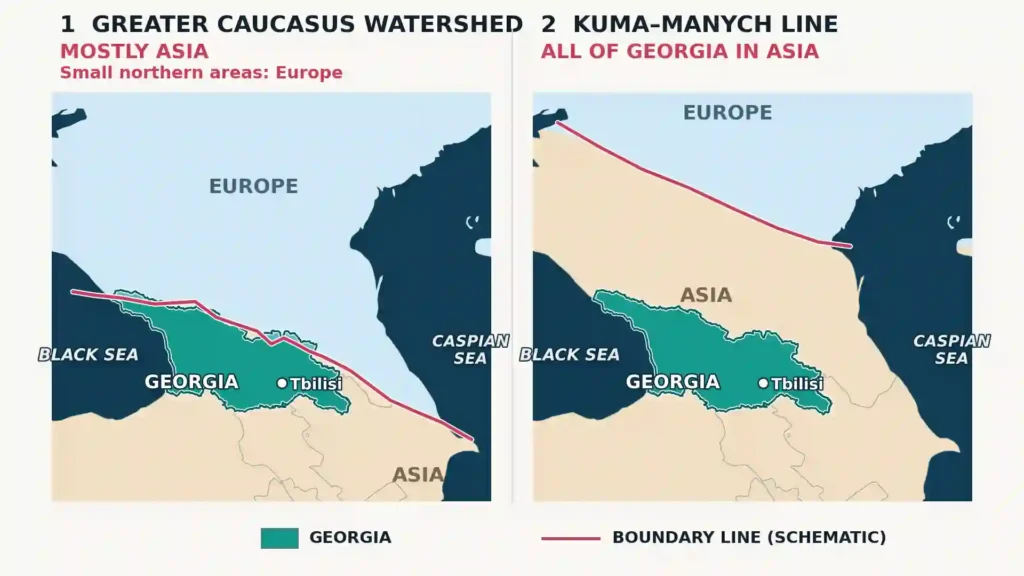
Georgia is a South Caucasus country at the conventional boundary of Europe and Asia. With the Greater Caucasus watershed as the dividing line, it is transcontinental but mostly in Western Asia; with the Kuma–Manych line, it lies entirely in Asia. Culturally and politically, Georgia often identifies with Europe.
How to use this article: Start with Georgia’s map position, compare the watershed boundary, check the UN statistical answer, or go to Tbilisi’s classification.
Where Georgia Is on the Map
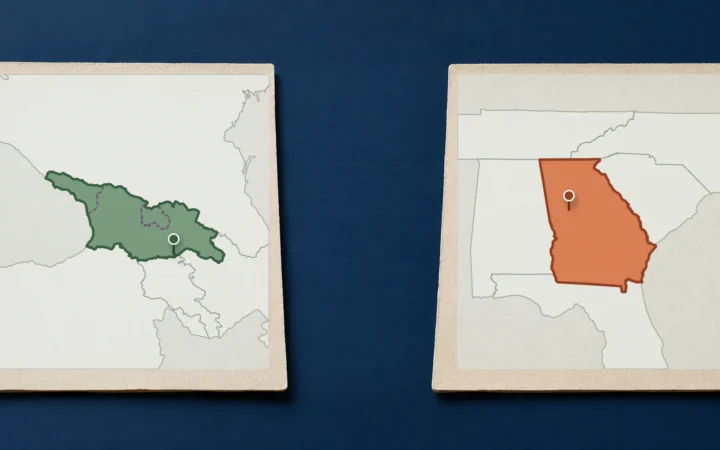
Here, Georgia means the independent country—not the U.S. state. Readers comparing the two names can use the separate guide to Georgia country and Georgia state.
Georgia’s map position
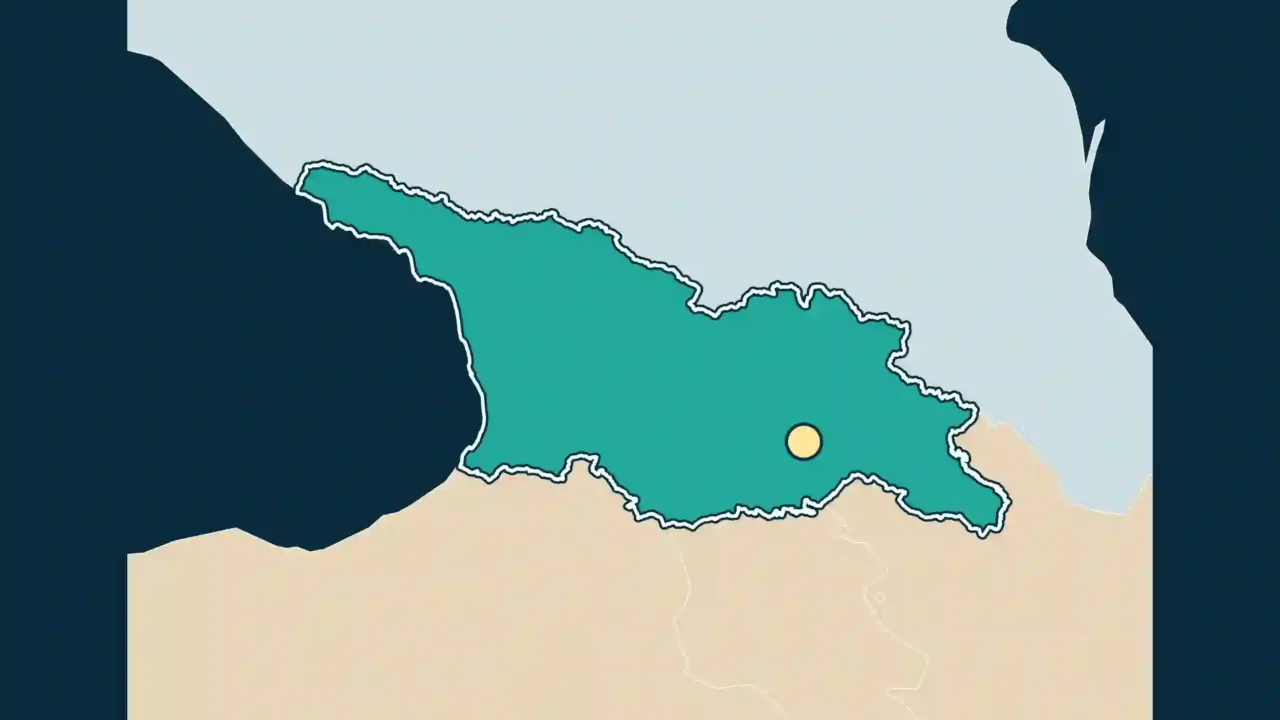
Georgia occupies part of the South Caucasus on the eastern coast of the Black Sea. Russia lies to its north and northeast, Türkiye and Armenia to the south, and Azerbaijan to the southeast. Tbilisi, the capital, is in eastern Georgia.
“South Caucasus” is the most stable regional description because it identifies Georgia without forcing a continent choice. “Eurasian” is also accurate in the broad physical sense, but it does not tell the reader which Europe–Asia convention is being applied.
How the Europe–Asia Boundary Changes the Answer
Europe and Asia are two conventional parts of the continuous Eurasian landmass. National Geographic notes that their boundary is debated and is not determined by one clear geological or tectonic barrier. The deeper issue is therefore where Europe ends and Asia begins, not whether Georgia has moved from one map to another.
The Greater Caucasus watershed convention
One widely used convention follows the main watershed, or drainage divide, of the Greater Caucasus. Land north of that line is assigned to Europe; land south of it is assigned to Asia.
Under this convention, most of Georgia is in Western Asia. A Springer Nature reference entry on Georgia describes the country as transcontinental under this line: its larger part lies south of the divide, while smaller northern areas—including Khevi and Pirikita Khevsureti—are north of it on the European side. The divide therefore does not coincide with the Georgia–Russia border everywhere.
This is a Georgia-specific refinement of the broader question of whether the Caucasus are in Europe or Asia. No exact percentage is given here because that would require a documented GIS watershed line, a defined territorial dataset, and a reproducible area calculation.
The Kuma–Manych convention
Another convention places the continental boundary farther north, through the Kuma–Manych lowland between the Caspian Sea and the Sea of Azov. The European Environment Agency has used this Manych-line definition while also acknowledging that Europe’s exact eastern limits are not commonly agreed.
Because the entire Caucasus lies south of this line, all of Georgia is in Asia under the Kuma–Manych convention. There is no European portion of Georgia in this model.
Georgia Under Four Classification Approaches
The apparent contradiction disappears when each answer is matched to the question it is designed to answer.
| Approach | Basis | Result for Georgia |
|---|---|---|
| Greater Caucasus watershed | Main mountain drainage divide | Transcontinental: mostly in Western Asia, with smaller northern areas in Europe |
| Kuma–Manych | Lowland boundary north of the Caucasus | Entirely in Asia |
| UN M49 | Statistical regional grouping | Western Asia |
| Cultural and political | Identity and institutional alignment | Often considered European or closely connected with Europe |
The UN statistical answer: Western Asia
The United Nations Statistics Division’s M49 system places Georgia in Western Asia. The same source explains that these assignments exist for statistical convenience and do not imply a UN position on political or other affiliation. M49 is useful for consistent datasets; it is not a universal ruling on Georgian identity or the only acceptable geographic convention.
This is also why different continent models, atlases, institutions, and databases can produce different labels without necessarily contradicting one another.
Why Georgia Is Often Considered European
Geographic location is only one part of the label. Georgia’s European self-identification is visible in public symbolism and formal institutions. At the country’s 1999 Council of Europe accession, parliamentary speaker Zurab Zhvania summarized it: “I am Georgian, and therefore I am European.”
Self-identification and European institutions
Article 78 of the Constitution of Georgia directs the country’s constitutional bodies to work toward full integration into the European Union and NATO. Georgia also joined the Council of Europe on April 27, 1999.
These facts show a real European political and institutional orientation, but they do not determine the physical continent boundary. The Council of Europe is also a separate organization from the European Union.
As of August 15, 2026, Georgia is not an EU member. It remains formally an EU candidate country, a status granted in December 2023, but accession negotiations have not opened and the EU says the accession process has been de facto halted since 2024.
What Is the Most Accurate Practical Answer?
The best label depends on the task. For a physical-geography answer, name the boundary convention. For a statistical table, use the system named by the dataset. For a discussion of identity or institutions, explain Georgia’s European orientation without presenting it as a mountain-line calculation.
Is Tbilisi in Europe or Asia?
Tbilisi lies well south of the main Greater Caucasus watershed. Under that boundary convention, it is on the Asian side; the Kuma–Manych convention also places it in Asia. Calling Tbilisi European in a cultural or political context can still be meaningful, but it answers a different question.
For a short general description, “South Caucasus country at the boundary of Eastern Europe and Western Asia” is accurate and avoids hiding the convention behind a one-word answer.
Frequently Asked Questions
Is Georgia a European country?
Georgia can reasonably be called European in cultural and political contexts. In physical geography, it is transcontinental under the Greater Caucasus watershed convention and entirely Asian under the Kuma–Manych convention.
Is Georgia transcontinental?
Yes, if the Europe–Asia boundary follows the main Greater Caucasus watershed. Most of the country is south of the divide, while smaller northern areas are on its European side. Other classification systems place all of Georgia in Asia.
Is Tbilisi in Europe or Asia?
Under the Greater Caucasus watershed convention, Tbilisi is geographically on the Asian side of the line. It is also Asian under the Kuma–Manych convention, although it is often associated with Europe culturally and politically.
Is Georgia in the Middle East?
Georgia is not usually described as a core Middle Eastern country. Some broad definitions may include it because it lies in Western Asia, but “South Caucasus” is the more precise regional label.
Is Georgia in the European Union?
No. As of August 15, 2026, Georgia is a formal EU candidate country, but it is not a member; accession negotiations have not opened, and the EU describes the accession process as de facto halted.
What Did We Learn Today?
Georgia is a South Caucasus country that may be described as transcontinental, geographically mostly Western Asian under the Greater Caucasus boundary, and culturally and politically closely connected with Europe.
Sources & Data Notes
The geographic verdict uses named boundary conventions rather than claiming a universal continent line. No Europe–Asia land percentage is given because this article does not calculate the split from a documented GIS watershed. UN M49 is treated only as a statistical grouping. EU status was checked on August 15, 2026.