Africa’s mineral, energy and agricultural resources can generate substantial wealth, but they do not automatically provide families with secure incomes. The connection depends on jobs, tax revenues, public services and who receives the benefits. Those conditions differ enormously between countries and within them.
To understand why resource wealth and poverty can exist together, we need to look beyond what lies underground. History, trade, infrastructure, conflict and economic policy all help shape what people can earn and the opportunities available to them.
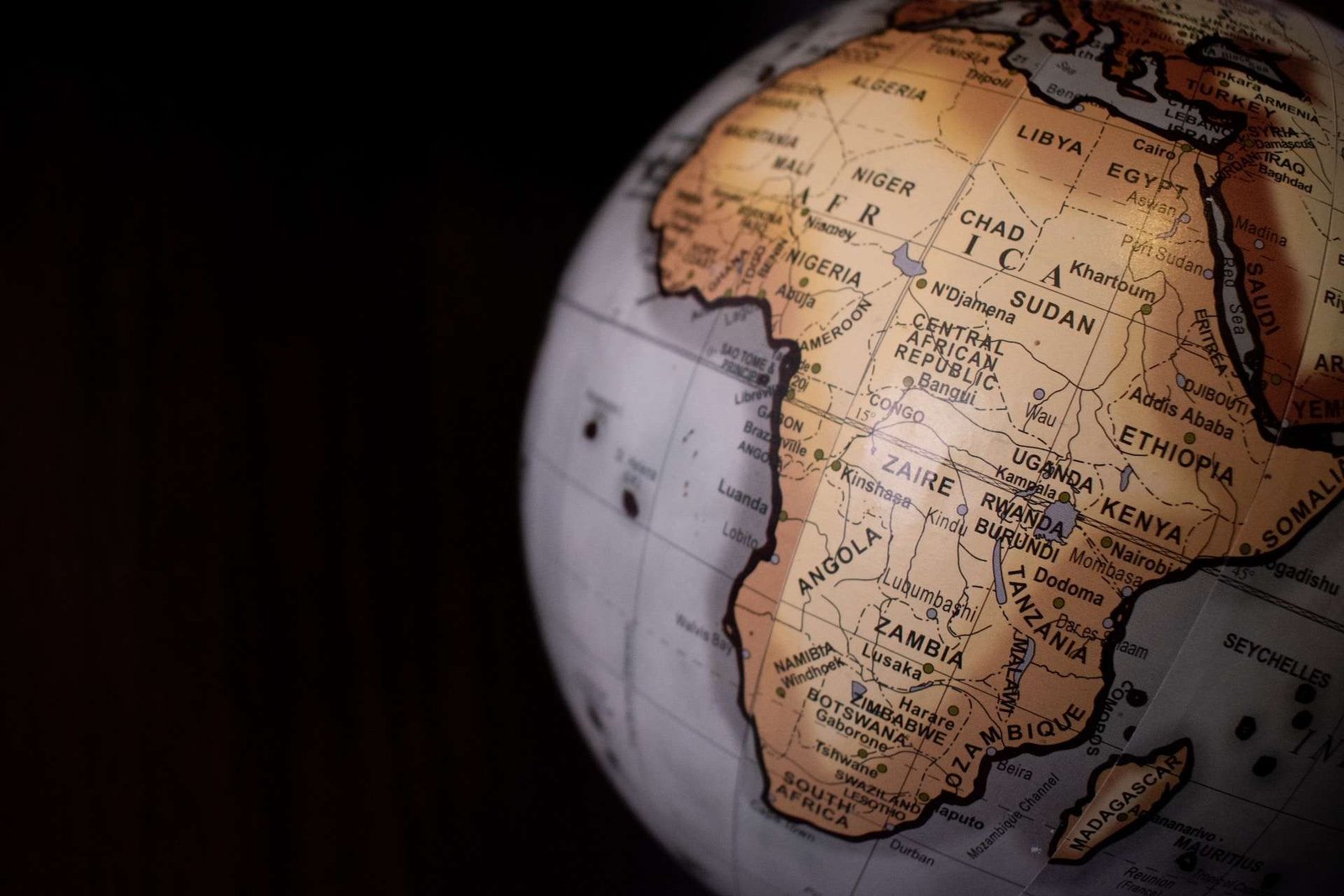
Historical globe used for illustration, not as a current political map. It labels the Democratic Republic of the Congo as Zaire and predates South Sudan’s independence.
Resource deposits are assets, not household income. Extraction may generate large exports while creating relatively few jobs. Unstable commodity prices, weak links to local businesses, poorly managed revenues and unequal access to services can limit the benefits. There is no single explanation for every African country, and resource dependence does not make poverty inevitable.
Resources, Income and Living Standards
Three different measures often get mixed together in this question:
- Natural wealth includes assets such as mineral deposits, forests and agricultural land. Their economic value depends partly on costs, prices and how sustainably they can be used.
- GDP per capita divides the value of a country’s annual production by its population. It describes average economic output, not what the typical person earns.
- Household living standards depend on income or consumption, prices, public services and security. A national average cannot show how evenly those benefits are shared.
The World Bank’s Changing Wealth of Nations 2024 makes a further distinction: a country’s productive wealth also includes infrastructure and people’s skills and health. Extracting a nonrenewable resource can raise today’s GDP while reducing the asset base available tomorrow. Investing the proceeds well matters.
Poverty comparisons also need a stated measure. In June 2025, the World Bank updated its international extreme-poverty line to $3.00 per person per day in 2021 purchasing-power-parity terms. This adjusts for price differences between countries; it is not three US dollars converted at a market exchange rate. National poverty lines and multidimensional measures answer additional questions about deprivation.
Different Countries, Different Economies
Africa is not one economy, and resource wealth is unevenly distributed. These four examples show different economic structures. The figures use the same indicator and year, rather than mixing country totals or poverty surveys from different dates.
On smaller screens, swipe or scroll sideways to see all table columns.
| Country | GDP per capita | Economic context |
|---|---|---|
| Botswana | $7,778 | Diamonds and the need for broader job creation |
| Democratic Republic of the Congo | $807 | Mineral exports alongside major development challenges |
| Morocco | $4,672 | Phosphate-related industry, manufacturing and services |
| Mauritius | $12,991 | Manufacturing, tourism and services after sugar-led development |
Source: World Bank World Development Indicators, GDP per capita in current US dollars, 2025, rounded to the nearest dollar. Retrieved November 9, 2026; dataset last updated October 8, 2026. These are illustrative countries, not a ranking or a test of what causes development. Exchange rates affect the figures, which are neither purchasing-power-adjusted incomes nor amounts received by each resident.
Botswana demonstrates both the opportunities and limits of mineral-led development. Diamond revenues helped support decades of progress, yet poverty, inequality and dependence on diamonds remain concerns. In the Democratic Republic of the Congo, the World Bank identifies limited mining employment and structural weaknesses as barriers to turning growth into broader improvements in living standards.
Mauritius illustrates another path: diversification from a sugar-based economy into manufacturing, tourism and services. Morocco’s economy includes phosphate-related production alongside automotive manufacturing and other exports. Neither example removes the need to address unemployment, inequality or regional disparities.
Mining Investments and Government Role
Large Export Earnings Do Not Guarantee Many Jobs
Industrial mines often require expensive machinery and relatively few workers for the amount invested. The African Union Commission and OECD’s 2024 analysis of mining skills in Central Africa describes the sector’s capital-intensive character and the importance of training and links with local suppliers. Artisanal and small-scale mining has a different employment profile and should not be confused with large industrial operations.
The wider benefits depend on whether mines buy local goods and services, train workers, pay taxes and contribute to useful infrastructure. A profitable operation with few connections to the surrounding economy may have a much smaller effect on household incomes than its export value suggests.
Public Revenue Must Reach Public Services
Governments need the capacity to negotiate and enforce contracts, collect the taxes owed and spend revenues effectively. The World Bank’s Africa’s Resource Future (2023) emphasizes fiscal administration, investment in people and infrastructure, and preparation for commodity-price booms and downturns.
Corruption can weaken this process, but it is not an explanation for every outcome or a trait of an entire continent. Companies, public officials and intermediaries all need scrutiny. The 2023 Extractive Industries Transparency Initiative Standard provides a framework for disclosure and oversight, including information about contracts, company ownership and revenues.
Predictable rules can support investment while protecting workers, communities and the environment. Ownership requirements and local-content policies need country-specific analysis and should be assessed by their design and results. Removing safeguards is not a substitute for administering them fairly.
Historical Context and Modern Struggles
Colonial rule reshaped land use, labor systems, public institutions and trading relationships in different ways across the continent. Many transport networks served colonial export priorities. An OECD study of North and West African transport networks, for example, describes how colonial roads and railways connected coastal ports to the interior and concentrated trade through particular routes.
Such patterns help explain why exporting raw materials can be easier than connecting neighboring markets. Research reviewed in Historical Legacies and African Development (2020) also documents lasting effects of colonial institutions and unequal investments in infrastructure and education. These legacies matter without dictating every present-day outcome.
Post-independence policy choices, international markets and conflict also shape development. In places affected by violence, displacement and insecurity can interrupt farming, schooling, transport and investment. The DRC’s continuing conflict and humanitarian crisis illustrate these pressures; they should not be generalized to every African country.
Trade, Infrastructure and Commodity Dependence
Commodity dependence makes economies vulnerable to changes they do not control. UNCTAD’s State of Commodity Dependence 2025 defines it as commodities providing more than 60% of merchandise export value. Its country profiles compare 2021–2023 with 2012–2014. This is a measure of goods exports, not the proportion of all jobs, government revenue or GDP coming from commodities.
A fall in oil, copper or other export prices can reduce foreign-exchange earnings and public revenue. Heavy reliance on one export also leaves fewer alternative sources of income during a downturn. Debt-service costs can further restrict funds available for services and investment.
Moving into processing and manufacturing can create opportunities, but building a refinery or factory is not enough by itself. Reliable electricity, transport, finance, technical skills and access to customers determine whether it can compete. UNCTAD’s Economic Development in Africa Report 2024, released in February 2025, identifies infrastructure gaps and trade barriers as obstacles to stronger regional supply chains.
The African Continental Free Trade Area offers a route toward larger connected markets. Its benefits depend on implementation, including simpler border procedures and better transport links. The UN Economic Commission for Africa’s 2025 report examines both that potential and the challenges of putting the agreement into practice.
Understanding Urban and Rural Poverty
A skyline, a village photograph or ownership of a smartphone cannot tell us whether people have secure livelihoods. Rural communities have diverse economies and aspirations, and cities contain large differences in opportunity. Respecting someone’s preferred way of life does not mean overlooking inadequate healthcare, unsafe water or food insecurity.
The 2026 Global Multidimensional Poverty Index assesses deprivations across health, education and living standards, including sanitation, electricity and housing. These measures complement income-based poverty statistics. They also help focus attention on actual needs instead of assuming that rural residents are either uniformly deprived or content without services.

The Way Forward: Turning Resources Into Lasting Prosperity
The practical goal is to connect resource earnings with better lives and a more diverse economy. Priorities vary by country, but the research points to several useful directions:
- Make resource revenues accountable. Publish understandable information on contracts, payments and spending, and strengthen independent oversight.
- Invest in people. Improve education, healthcare and training that connects to real employment opportunities.
- Support businesses beyond extraction. Reliable power, transport and access to finance help farmers, manufacturers and service firms grow.
- Prepare for downturns and depletion. Budget cautiously when commodity prices are high and avoid assuming that temporary earnings will last.
- Protect communities and natural systems. Account for environmental and social costs, and include affected people in decisions.
These directions draw on the World Bank’s Africa’s Pulse of April 2025 and the resource, trade and transparency research cited above. Progress depends on domestic institutions and decisions, responsible business conduct and international cooperation. No single reform can replace all the others.
Frequently Asked Questions
Is Africa the richest continent in natural resources?
There is no single meaningful ranking without specifying the resource, measurement and year. Mineral reserves, annual production, agricultural land and the monetary value of natural assets are different things. Claims about a fixed share of “the world’s resources” need a defined dataset.
What is the resource curse?
It describes risks that can accompany dependence on resource revenues, including price shocks, weak diversification and competition over income from extraction. It is not an inevitable outcome. Institutions, investment choices and economic conditions influence the results.
Does exporting minerals make a country rich?
Exports can earn foreign exchange, create jobs and fund public spending. How much reaches households depends on costs, ownership, taxation, local business links and how revenues are used. Export earnings alone do not measure wellbeing.
Is GDP per capita the same as average salary?
No. GDP per capita is annual economic output divided by the whole population, including children and people outside paid employment. It does not describe a typical salary or show how income is distributed.
Are Africa and Sub-Saharan Africa interchangeable in economic statistics?
No. Sub-Saharan Africa is a regional grouping that excludes North Africa. Check the source’s country coverage before applying any regional percentage to the continent as a whole.
What Did We Learn Today?
Natural resources create opportunities, but lasting prosperity depends on the connections between extraction, businesses, public revenue and people’s lives. African countries have different histories, resources and development paths. Better jobs, accountable institutions, functioning services and a broader productive economy matter more than the size of mineral deposits alone.
For more on the measures behind these comparisons, read which country has no poverty?
Sources & Data Notes
Checked November 9, 2026. The table uses 2025 national-accounts data from one World Bank indicator and one retrieval. Values can be revised.
- World Bank, World Development Indicators, NY.GDP.PCAP.CD: GDP per capita in current US dollars. Source values were $7,778.1151 for Botswana, $806.7760 for the DRC, $4,672.4683 for Morocco and $12,991.2936 for Mauritius. Displayed figures are rounded.
- The Changing Wealth of Nations 2024 and the World Bank’s June 2025 poverty-line factsheet: distinctions between assets, production and poverty. The $3.00 line uses 2021 purchasing power parities.
- Botswana, DRC and Mauritius World Bank country overviews, plus the OECD’s Morocco Economic Survey 2024: country context.
- Africa’s Resource Future, World Bank, May 2023; Africa’s Development Dynamics 2024, AUC/OECD, Central Africa chapter; and the 2023 EITI Standard: mining, employment, revenues and accountability.
- Michalopoulos and Papaioannou, Historical Legacies and African Development, 2020, and OECD, Roads and Conflicts in North and West Africa, 2025: historical institutions and transport geography.
- UNCTAD, State of Commodity Dependence 2025, uses 2021–2023 trade profiles. Economic Development in Africa Report 2024 was released February 10, 2025. UNECA’s Economic Report on Africa 2025 examines AfCFTA implementation.
- UNDP, 2026 Global Multidimensional Poverty Index, released October 12, 2026: dimensions of deprivation.