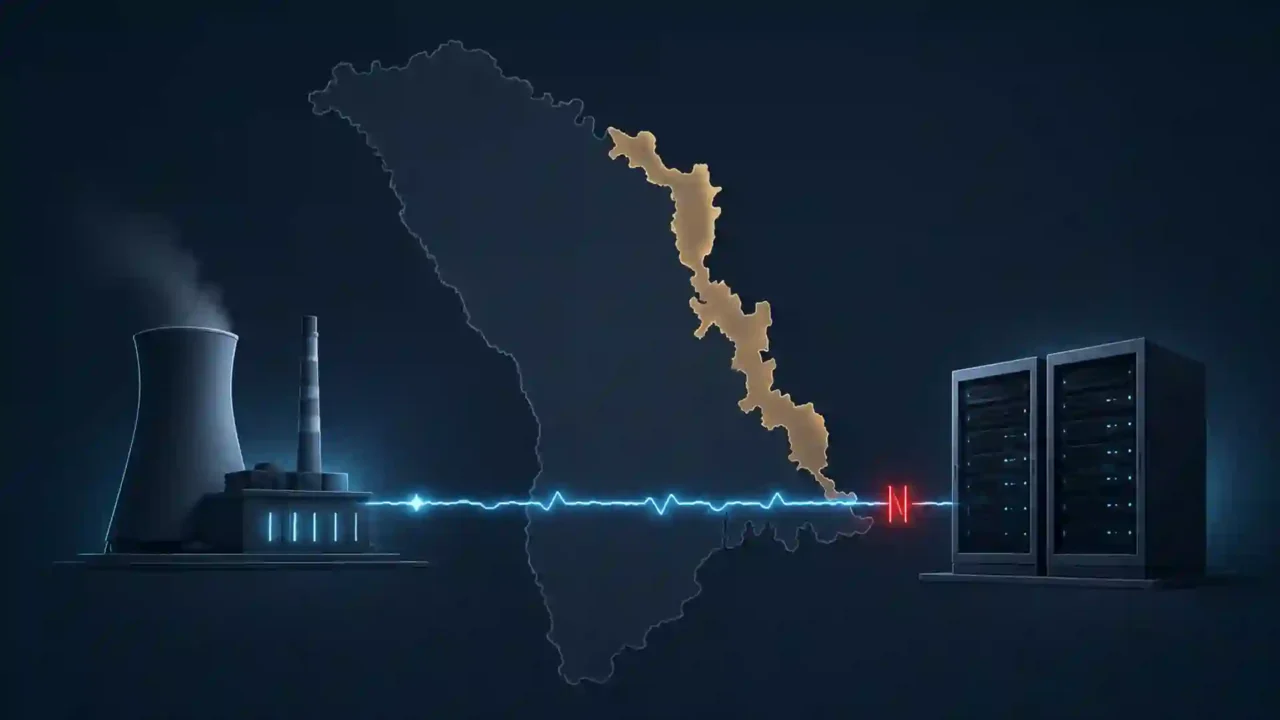
Crypto mining boomed in Transnistria after its de facto authorities created a privileged legal zone in 2018 and paired it with cheap electricity generated from Russian gas. The formal model ended in February 2025, after a gas cutoff caused an energy crisis, electricity supply to blockchain-zone residents was prohibited and the enabling law was repealed.
How to use this article: Start with the political-status check, follow the gas-to-crypto chain, see the verified 2025 timeline, or go directly to the current legal position.
Where Transnistria Fits on the Map
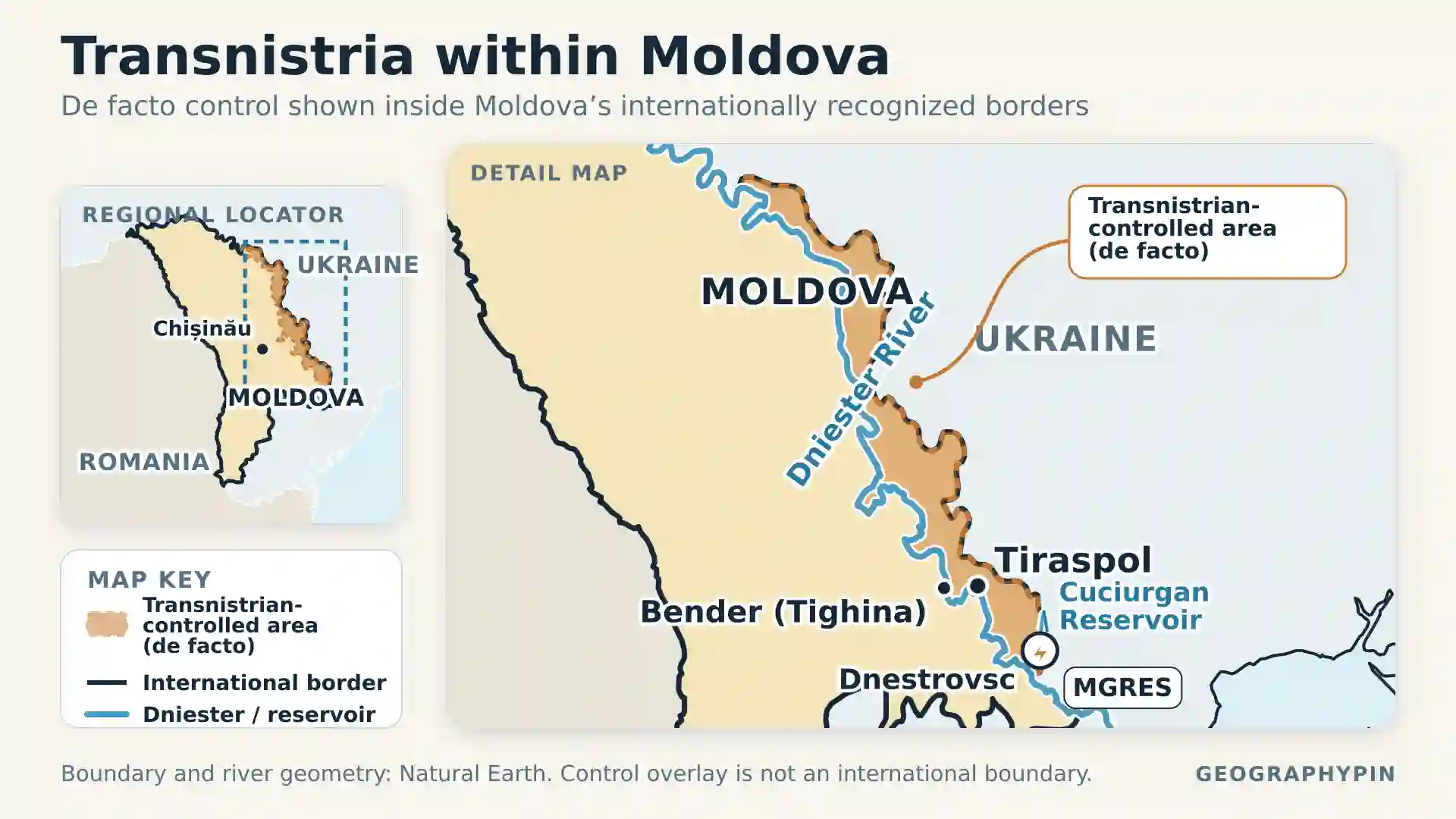
Transnistria is a narrow inland territory along the Dniester River, known in Moldova as the Nistru. Most of the territory controlled by its de facto authorities lies east of the river, between the rest of Moldova and Ukraine, although Bender, also called Tighina, lies on the western bank. Tiraspol functions as its de facto capital and administrative center.
Is Transnistria a country?
Transnistria governs itself separately in practice, but it is internationally recognized as part of the Republic of Moldova. Its authorities use the name Pridnestrovian Moldavian Republic, or PMR, while English-language sources also use Transdniestria and Pridnestrovie. It is not added to the usual 195-country count.
The territory developed separate institutions after the Soviet collapse and the armed conflict of 1992. Russian troops remain there, and the region’s economy has long depended heavily on Russian support. It therefore shares some broad features with Abkhazia and South Ossetia, but each has a different history, recognition pattern and relationship with its internationally recognized state.
For the mining story, the most important location is Dnestrovsc in southern Transnistria. The city sits beside the Cuciurgan Reservoir and the large Moldavskaya GRES power station, usually shortened to MGRES and also called the Cuciurgan or Kuchurgan power station.
Why Crypto Mining Became Attractive
Cryptocurrency mining is a digital activity with a physical constraint: electricity. Proof-of-work miners operate specialized computers continuously, and power is normally their largest recurring cost. A location with cheap electricity, unused industrial buildings and dependable grid access can therefore attract mining even when it has a small technology sector.
Transnistria appeared to offer all three. MGRES was a very large Soviet-era power station operating far below its installed capacity. Russian gas reached the region under the Gazprom–Moldovagaz supply arrangement, but payment for left-bank consumption did not function like an ordinary commercial purchase. Large liabilities accumulated instead, while the de facto authorities collected local gas payments and benefited from cheap energy.
The accurate description is therefore not simply “free gas.” It was gas supplied on deeply preferential, effectively unpaid terms, with the resulting liabilities caught inside a politically disputed Moldova–Gazprom relationship. Before the 2025 cutoff, the International Energy Agency estimated that Transnistria received about 2.1 billion cubic meters of Russian gas per year and described the supply as essentially free of charge to the region.
Mining promoters could turn that energy advantage into a simple offer: import servers with favorable customs treatment, place them near available power and pay an electricity rate far below many commercial markets. Promotional material and reporting from the early period cited prices around 3.8 to 5 U.S. cents per kilowatt-hour. Those were advertised or reported rates, not proof that every operator paid the same price.
How the 2018 Mining Framework Worked
Transnistria’s de facto parliament approved its blockchain framework on January 31, 2018. Law No. 39-Z-VI was signed on February 9 and created a legal basis for cryptocurrency mining, smart contracts and related blockchain activity. A government resolution issued later that month established a 20-year free economic zone covering the territory controlled by the de facto authorities.
The system offered residents favorable treatment that ordinary businesses did not receive. Law No. 39-Z-VI established the framework, while a companion act, Law No. 40-ZD-VI, exempted zone residents from taxation. The wider package also included duty-free equipment imports, simplified participation for some non-resident investors and the possibility of special electricity arrangements. The local legal text is useful evidence of what the de facto authorities enacted; citing it does not imply recognition of Transnistria as a sovereign state.
Tehnopark and the investment campaign
A state-owned company commonly rendered as Tehnopark acted as the zone’s manager and intermediary. It promoted ready-to-use industrial space, access to the grid and proximity to power generation. Russian investors were a particular target, and local leaders openly described mining as a way to sell more electricity and attract capital.
The policy was not simply passive legalization. It was an industrial-development experiment designed around an unusual local resource: subsidized energy. Officials discussed targets as high as 50 or 100 megawatts of mining capacity, but those figures were plans, not verified achievements.
The Energy System Behind the Boom
From Russian gas to digital assets
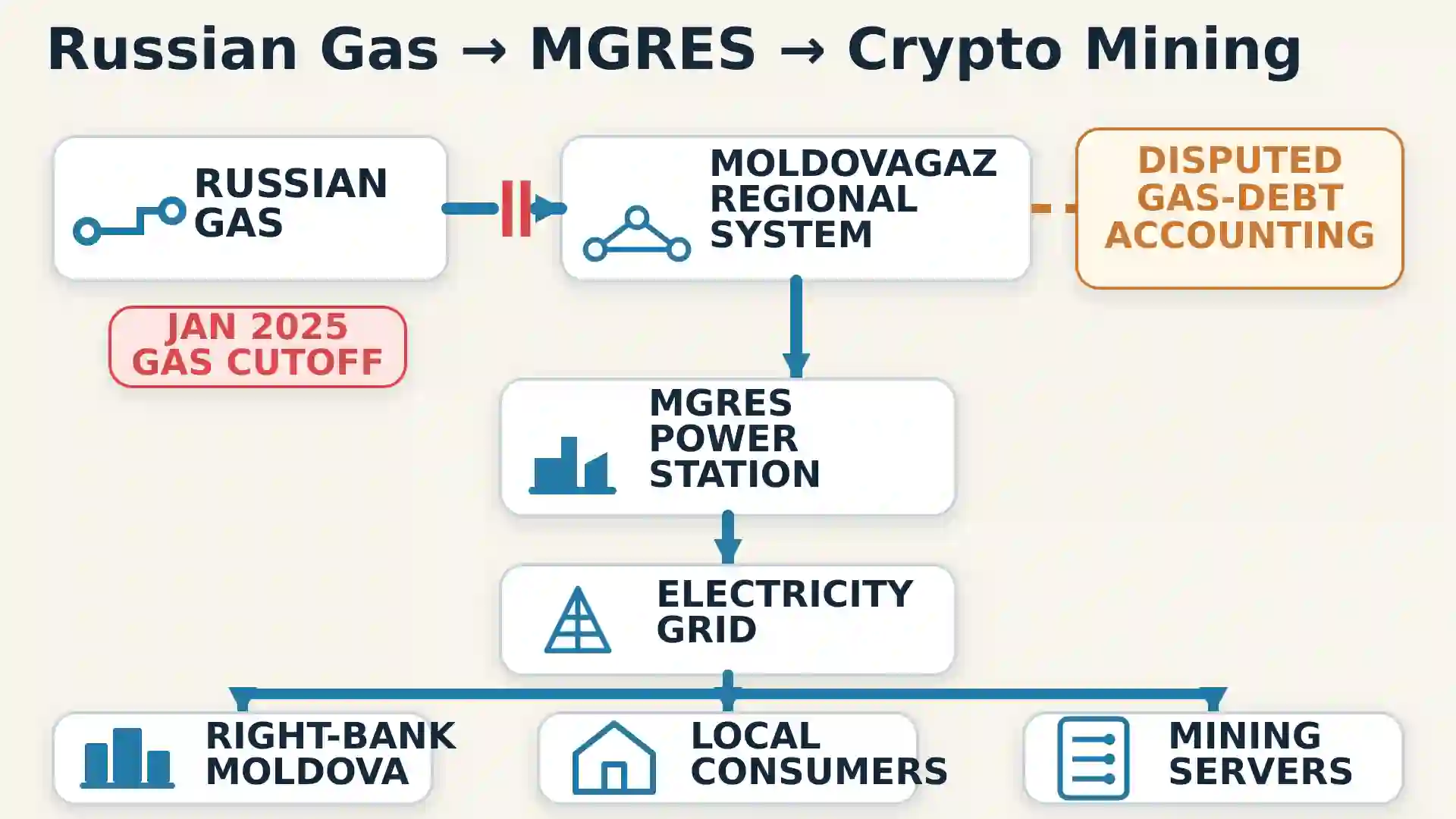
The mining model becomes easier to understand when the energy chain is separated into steps:
- Gazprom supplied gas through Moldovagaz. Gas intended for Transnistria moved under arrangements connected to Moldova’s national gas company.
- The left-bank gas system distributed it locally. Payments and accumulated debt did not follow normal market settlement, creating a large implicit subsidy.
- MGRES converted gas into electricity. The power station has 2,520 megawatts of installed capacity, according to the International Energy Agency, although installed capacity is not the same as its normal output.
- Electricity served households, industry, right-bank Moldova and miners. For years, electricity sales from MGRES were both important to right-bank Moldova’s power supply and a source of income for Transnistria.
- Mining converted low-cost power into transferable assets. Operators used computing equipment to produce proof-of-work cryptocurrency that could be held or moved outside the region’s small local economy.
This created a strange interdependence. Right-bank Moldova bought relatively inexpensive electricity from a plant in territory its central government did not control. Transnistria relied on Russian gas, power sales and the financial advantage produced by unpaid or subsidized fuel. Cryptocurrency mining occupied a poorly measured but revealing place inside that larger system.
How Large Was the Mining Industry?
Transnistria clearly had operating cryptocurrency farms, but the evidence does not support calling it a transparent global mining powerhouse. Local authorities, operators and outside investigators described different snapshots, while no independently audited series tracked total capacity, electricity consumption or cryptocurrency output.
| Period | Documented evidence | Important limitation |
|---|---|---|
| 2018 launch | Laws, tax privileges and free-zone operating rules were formally adopted. | A favorable law proves intent, not the size of the resulting industry. |
| Late 2018 | De facto official outlets reported seven farms using about 3.7 megawatts in October and later described 5–7 megawatts of installed mining load. | These were local official claims, not independent measurements. |
| 2019 | Field reporting observed active equipment and a state-backed campaign to attract additional investors. | A site visit is a useful snapshot, not a territory-wide inventory. |
| 2024 | RUSI found that cheap gas-fired power still created a strong mining incentive. | The review explicitly said no reliable current scale was available and noted that Tehnopark’s website was no longer operating. |
What can be said with confidence
Available evidence does not support a precise, independently verified total for mining’s share of electricity use, GDP, revenue or emissions. What is documented is narrower: Transnistria created a state-supported mining cluster, but its scale and beneficiaries remained unusually opaque.
That uncertainty is not a minor editorial problem. It is central to the story. Mining took place in a territory with limited public accountability, a disputed energy-debt system and little independent economic data. Any exact number should therefore be tied to a named source, date and measurement method.
How the Boom Ended in 2025
The model depended on a continuous supply of cheap gas. That link broke at the beginning of 2025: the transit agreement through Ukraine expired, while Gazprom suspended deliveries amid a separate debt dispute. The European Commission described the resulting cutoff as the trigger for a severe energy crisis.
MGRES switched from gas to coal, virtually all industry except essential food production stopped, heating and hot-water service were disrupted, and rolling electricity cuts followed. Cryptocurrency farms were hard to justify while homes and public services faced shortages.
The shutdown and repeal timeline
| Date | Event | Effect on mining |
|---|---|---|
| January 1, 2025 | Russian gas deliveries stopped and MGRES shifted to limited coal generation. | The cheap gas-fired electricity advantage disappeared. |
| February 1 | An order signed January 31 barred electricity supply to residents of the blockchain free economic zone. | Registered blockchain-zone residents lost electricity supply. |
| February 6 | The de facto Supreme Council voted at an extraordinary session to repeal the 2018 blockchain law. | The industry’s special legal foundation was removed. |
| February 11 | The repeal was formalized as Law No. 3-Z-VII. | The 2018 framework ceased to operate. |
| February 26–28 | The government abolished the resolution governing the blockchain free economic zone. | The zone’s operating rules were dismantled as well. |
Emergency gas purchased with European support began restoring heating and power generation in February. The assistance prioritized households, public services and essential energy needs rather than recreating the former subsidy for mining. The European Commission’s emergency plan and the local electricity restriction show the same practical priority: scarce energy was reserved for people and basic services.
The repeal was not an accidental side effect. The de facto legislature’s own announcement cited the gas crisis, economic instability and energy security when explaining why the law was removed.
What Remains After the Legal Shutdown
Is crypto mining still operating in Transnistria?
The defensible answer is that the formal, privileged mining regime ended. The 2018 law was repealed, the free-zone rules were abolished and electricity supply to registered zone residents was stopped. No authoritative evidence available by August 2026 showed that the special state-backed legal framework or formally authorized industrial mining sector had been restored.
That does not prove that every privately owned mining machine was permanently switched off. Small or unauthorized operations are difficult to rule out in any jurisdiction, especially one with limited transparency. Without verified evidence, however, they should not be described as an active regional industry.
The wider energy system also changed. Moldova’s Ministry of Energy stated in March 2026 that gas for the Transnistrian region had been purchased from European Union markets since the 2025 cutoff, while new reserve requirements were being developed to reduce the risk of another supply crisis. OSW reported in November 2025 that gas deliveries had become intermittent and, even at their standard level, were markedly lower than before the cutoff.
Why the story matters beyond cryptocurrency
Transnistria’s mining experiment was ultimately an energy-geography story. A large power station, a politically protected gas route, disputed debt and a de facto border created an electricity price that ordinary market geography would not have produced. When one part of that chain failed, the digital industry lost its physical foundation.
It also shows why “online” industries are never entirely detached from place. Servers need power, cooling, buildings, grid connections and laws. In Transnistria, those conditions were shaped less by technological innovation than by the geography of pipelines, Soviet infrastructure and an unresolved territorial conflict.
Frequently Asked Questions
Does Transnistria still have its special crypto-mining regime?
The special legal regime created in 2018 was repealed in February 2025, and its free economic zone rules were abolished. No restored state-backed licensing framework had been authoritatively documented by August 2026.
Did crypto mining cause Transnistria’s 2025 energy crisis?
No. The main trigger was the loss of Russian gas supply at the start of 2025. Mining was restricted because it consumes large amounts of electricity and became difficult to justify during shortages; it was not the original cause of the gas cutoff.
Was electricity in Transnistria really free?
No. Miners paid for electricity, and local consumers also paid energy bills. The unusual advantage came from Russian gas supplied on effectively unpaid or heavily subsidized terms, allowing electricity to be sold at prices that did not reflect a normal market-rate fuel cost.
Why is the power station called both Cuciurgan and MGRES?
MGRES is the abbreviation of the plant’s Russian-derived formal name, Moldavskaya GRES. Cuciurgan is the Romanian form and Kuchurgan a common English rendering of the Slavic name for the nearby reservoir and area; both names are also used as shorthand for the plant.
What Did We Learn Today?
Transnistria’s crypto-mining push grew from a specific combination of political status, spare Soviet-era generating capacity, effectively subsidized Russian gas and a privileged 2018 legal zone. The industry was real but poorly measured. When the gas supply failed in 2025, electricity supply to registered blockchain-zone residents was prohibited, the enabling law was repealed and the formal boom ended, showing that even digital industries remain dependent on physical energy geography.
Sources & Data Notes
The principal references used were the International Energy Agency, the European Commission, Moldova’s Ministry of Energy, official legal publications of Transnistria’s de facto authorities used only to document their own actions, Radio Moldova, RUSI, the Pulitzer Center, OSW and Moldovan investigative reporting. Early farm counts, electricity rates and capacity figures are dated, attributed snapshots rather than audited totals; current activity may change and remains difficult to verify. This article was prepared for final factual and editorial review by Zurab Koniashvili (Z.K. Atlas); AI tools assisted with research organization, language refinement and visual planning.