Bandar Abbas is Iran’s main port on the Strait of Hormuz because it is the country’s premier maritime gateway and the mainland city most closely tied to the port complex that handles the bulk of Iran’s container traffic. Its importance comes from geography first: it sits beside one of the world’s most consequential sea passages.
How to use this article: If you only need the essentials, jump to the quick location check, the city-versus-port clarification, why Hormuz changes everything, or the short name-and-history note.
Where Bandar Abbas sits on the Strait of Hormuz
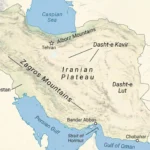
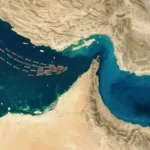
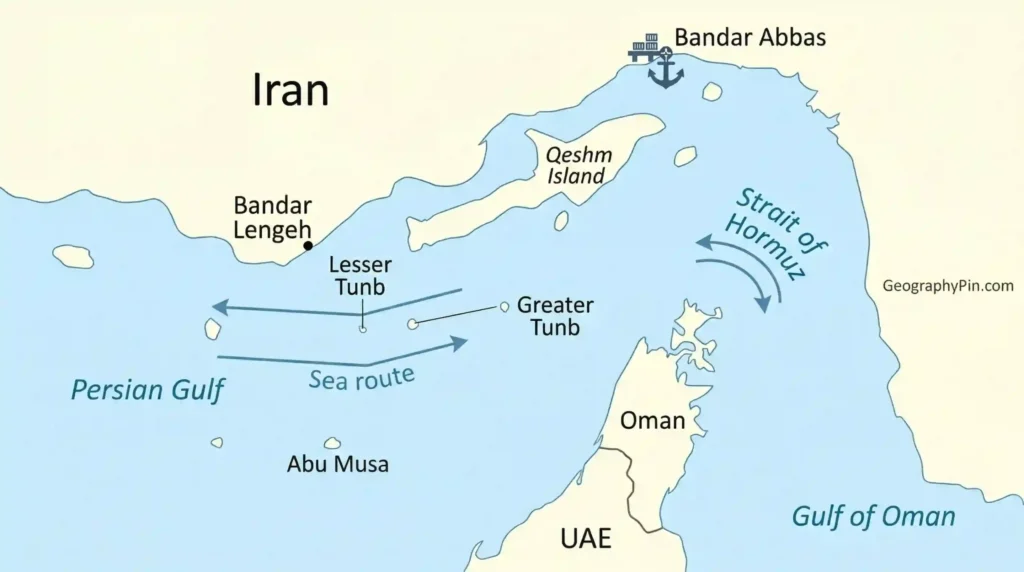
Bandar Abbas lies on the northern shore of Hormuz Bay, opposite Qeshm, Lārak, and Hormuz islands, and it serves as the capital of Hormozgan province. In practical map terms, it sits on Iran’s side of the sea gate that links the Persian Gulf with the Gulf of Oman and the Arabian Sea.
Fast location check
If you imagine the Strait of Hormuz as the narrow exit from the Persian Gulf, Bandar Abbas is one of the key Iranian places looking directly onto that exit. Britannica notes that the strait separates Iran to the north from Oman’s Musandam exclave to the south, while Bandar Abbas sits near the Iranian islands clustered around the passage.
This location explains why Bandar Abbas is more than a normal port city. Iranica describes it as strategically and commercially important because it links Gulf shipping to inland routes through easier passes toward Kermān, Yazd, and Shiraz. That inland connection is part of the answer, not a side note.
What “Iran’s main port” really means
The phrase is accurate, but it needs one clarification. Bandar Abbas is the city, while the heavy commercial function most people mean is the wider Bandar Abbas port system, especially Shahid Rajaee. Britannica describes Bandar Abbas as Iran’s premier maritime gateway and the center of the country’s shipping activity, and it notes that Shahid Rajaee was handling more than four-fifths of Iran’s shipping containers by the 2020s.
The city versus the port complex
This is the distinction that makes the title stronger. When people say “Bandar Abbas,” they often mean the whole mainland gateway area rather than just the urban waterfront. So the city is the geographic anchor, while Shahid Rajaee is the operational core that explains why Bandar Abbas dominates the commercial picture.
| Part of the picture | What it refers to | Why it matters for search intent |
|---|---|---|
| Bandar Abbas | The port city on the Strait of Hormuz | This is the place-name most readers are trying to locate and understand |
| Shahid Rajaee | The main commercial port complex associated with the city | This is why Bandar Abbas functions as Iran’s leading commercial gateway |
| Strait of Hormuz | The wider maritime chokepoint beside the city | This is what gives the port global importance, not only national importance |
That means the cleanest reading of the title is this: Bandar Abbas is the city on the strait, and its “main port” status comes from the larger port infrastructure tied to it, not from a loose slogan. This makes the page more precise than a generic map article or a generic geopolitics article.
Why the Strait of Hormuz gives Bandar Abbas outsized importance
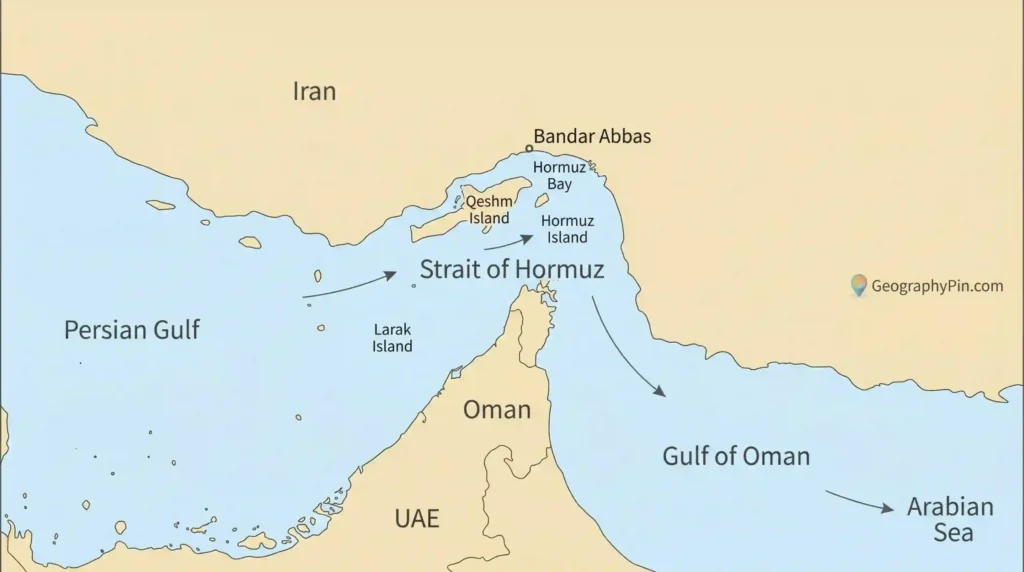
The Strait of Hormuz is not just a narrow body of water on the map. It is the only sea passage connecting the Persian Gulf with the Gulf of Oman and the Arabian Sea, and Britannica describes it as one of the world’s most strategically important chokepoints. A port city beside that passage will always carry weight beyond its local economy.
Why Hormuz changes everything
The U.S. Energy Information Administration reports that oil flow through the strait averaged 20 million barrels per day in 2024, equal to about 20% of global petroleum liquids consumption, and that around one-fifth of global LNG trade also transited Hormuz in 2024. That scale is the real reason Bandar Abbas appears so often in trade, shipping, and geopolitical coverage.
For a searcher, the practical takeaway is simple: Bandar Abbas matters because it sits where Iranian shipping activity meets a passage that global energy markets watch closely. You do not need the city to be a giant metropolis for it to matter; the geography already does most of the work.
A short history of Bandar Abbas
Bandar Abbas is not just strategically placed; it was deliberately made important. Britannica states that the city was established in 1623 by Shah ʿAbbās I to replace Hormuz after the Portuguese had captured the older city in 1514, and that it became the main port of Persia in the 17th century.
Why the name still matters
The name itself preserves the state-building move behind the city. Iranica explains that the mainland site rose in importance after Safavid success against Portuguese power in the area and that its position gave it strong commercial value as a link between the Gulf and the inland hinterland. So the city’s modern identity is rooted in both maritime strategy and inland connectivity.
Its role was not perfectly linear. Britannica notes that Bandar Abbas later lost ground to Bushehr and that from about 1793 it was leased to the rulers of Muscat before Iran resumed direct control in 1868. Even when its rank changed, its location kept it relevant.
City, port, island, and strait: the terms people mix up
This is where many weaker articles blur everything together. Bandar Abbas is not the same thing as Hormuz Island, not the same thing as the Strait of Hormuz, and not identical to every port facility operating near it. Keeping those layers separate makes the topic easier to understand and far more useful for readers.
| Term | What it is | Why readers confuse it |
|---|---|---|
| Bandar Abbas | Iranian port city on Hormuz Bay | It is the main place-name used in shipping and strategy discussions |
| Shahid Rajaee | Main commercial port complex linked to Bandar Abbas | Many people assume it is just another name for the city |
| Hormuz Island | Iranian island near the strait, close to Bandar Abbas | Its name is embedded in both the older history and the strait’s name |
| Strait of Hormuz | The sea passage between the Persian Gulf and Gulf of Oman | People often confuse the wider chokepoint with the city beside it |
Once you separate those terms, the title becomes much cleaner: Bandar Abbas is the mainland city, Shahid Rajaee is the port engine tied to it, Hormuz Island is part of the nearby setting, and the Strait of Hormuz is the larger maritime bottleneck that makes the whole area globally important.
Why Bandar Abbas matters inside Iran’s wider port map
One thing that makes this topic more useful is placing Bandar Abbas against Iran’s other maritime outlets. Britannica notes that Bandar Abbas is Iran’s largest major port on the Persian Gulf, while Iran has also expanded Chabahar on the Gulf of Oman. The EIA additionally notes that Iran’s Goreh-Jask pipeline and Jask export terminal were intended to provide a route avoiding the Strait of Hormuz, even though effective use has remained limited.
| Place | Coastal setting | Main role in plain English |
|---|---|---|
| Bandar Abbas | Strait of Hormuz / Persian Gulf gateway | Iran’s main commercial maritime gateway and the port city most readers mean in this query |
| Chabahar | Gulf of Oman | Important Oman-coast port, but not the main Bandar Abbas-type Hormuz gateway |
| Jask | Gulf of Oman | Associated with bypass potential outside Hormuz rather than the main commercial role readers usually mean here |
| Kharg Island | Northern Persian Gulf | Premier oil export terminal, not the same thing as Iran’s main general commercial port city |
Table downloads (3)
- What the title means in practice (4 × 3)View tableDownload CSV
- What each name actually refers to (5 × 3)View tableDownload CSV
- Bandar Abbas in the wider Iranian maritime picture (5 × 3)View tableDownload CSV
That wider comparison makes Bandar Abbas harder to misunderstand. It is not simply “an Iranian port.” It is the place where Iran’s main commercial port system, inland access routes, and the Strait of Hormuz all line up in one location. That combination is why the name carries more weight than a basic atlas entry.
FAQ
Is Bandar Abbas the same as Shahid Rajaee?
No. Bandar Abbas is the city, while Shahid Rajaee is the major commercial port complex associated with it. People often compress the two into one idea, but the distinction matters if you want to understand how the port system actually works.
Is Bandar Abbas on the Strait of Hormuz or in the Persian Gulf?
Both descriptions appear because the city sits on Hormuz Bay at the Persian Gulf outlet. In practical terms, it is an Iranian port city on the Strait of Hormuz.
Why is Bandar Abbas more important than a normal port city?
Because it combines three advantages at once: a position beside the Strait of Hormuz, a leading commercial port complex, and inland connections that tie Gulf shipping to the Iranian interior.
Does Bandar Abbas handle oil exports in the same way as Kharg Island?
Not in the same way. Kharg Island is described by Britannica as the premier terminal for Iran’s oil exports, while Bandar Abbas is the main commercial maritime gateway and container-centered port area readers usually mean in this topic.
Is Chabahar a replacement for Bandar Abbas?
No. Chabahar is important because it is on the Gulf of Oman, but that does not make it the same type of place in Iranian maritime geography. Bandar Abbas remains the main port city associated with the Strait of Hormuz gateway.
What Did We Learn Today?
- Bandar Abbas is the port city on Iran’s side of the Strait of Hormuz and the capital of Hormozgan province.
- Its “main port” label is grounded in real geography and commercial function, especially the larger port system centered on Shahid Rajaee.
- The city matters globally because it sits beside a chokepoint that carries major shares of oil and LNG trade.
- Its importance also has historical depth: the Safavids elevated it as a mainland replacement for the older Hormuz center.
- It becomes easiest to understand when separated from Hormuz Island, Kharg Island, Chabahar, and Jask rather than blended into them.
Those are the core points that turn the title from a simple location query into a stronger geography-and-logistics explanation.