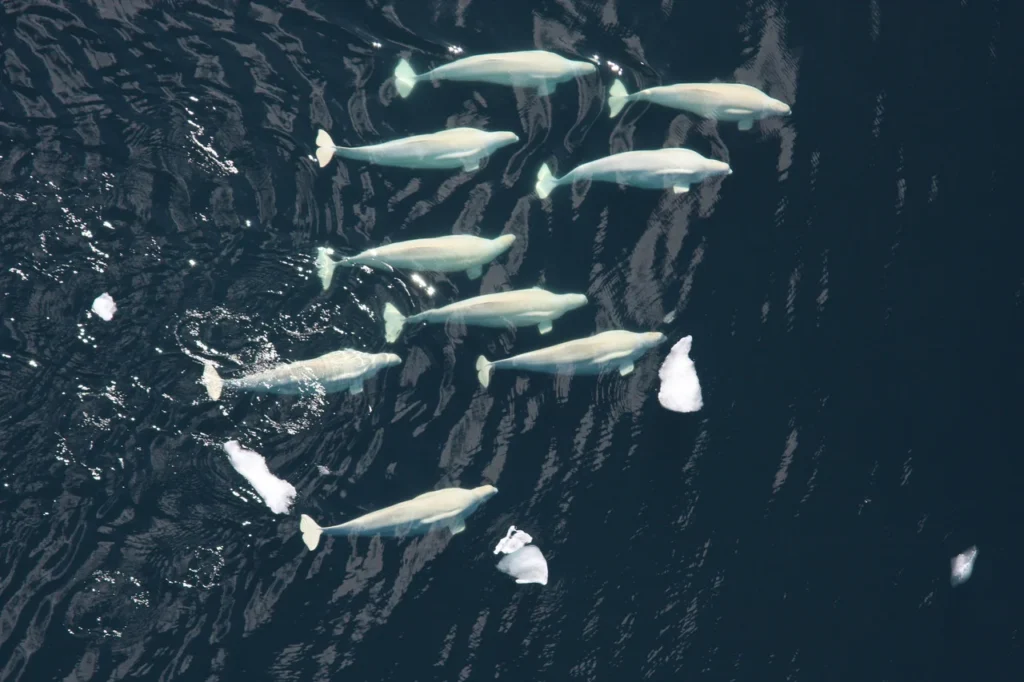
A white whale breaking the surface gives only a brief glimpse of a beluga’s life. Underwater, sound reveals another part of the story: animals calling to one another, listening, and searching for food. Understanding that soundscape also means understanding where belugas live, from northern seas to particular coastal estuaries.
Beluga whales are called canaries of the sea because they produce a varied range of sounds, including whistles, chirps, squeals, and clicks. These toothed whales use sound for communication and echolocation. The nickname is a comparison, not a scientific classification, and does not mean that every sound has a known translation.
1. Why the nickname fits
The beluga, Delphinapterus leucas, is a marine mammal, not a bird or a fish. Its familiar nickname draws attention to sound rather than color or geographic range. A recording can contain strikingly different noises from the same species, so a short clip of one whistle is not a complete portrait of its repertoire.
Descriptions such as “chirp” and “squeal” are human comparisons that help listeners imagine a sound. They are not a dictionary of beluga meanings. Nor does “canary” establish that belugas sing like birds or make their sounds in the same way. It is useful to keep the appealing nickname separate from what researchers can demonstrate.
2. Calls and echolocation do different jobs
Social sounds connect animals
NOAA describes broad categories of whistles, calls, and echolocation clicks. Social sounds are part of interactions between animals, but researchers are still investigating the breadth of beluga communication. It would be misleading to label a particular whistle “hello,” or turn a speculative interpretation into a confirmed message.
That distinction matters when listening to an online recording. A caption should identify the species, place, and recording context where known. Sound alone does not automatically tell a casual listener whether an animal is feeding, alarmed, or communicating with a calf. The absence of an obvious human-like meaning does not make the sound unimportant.
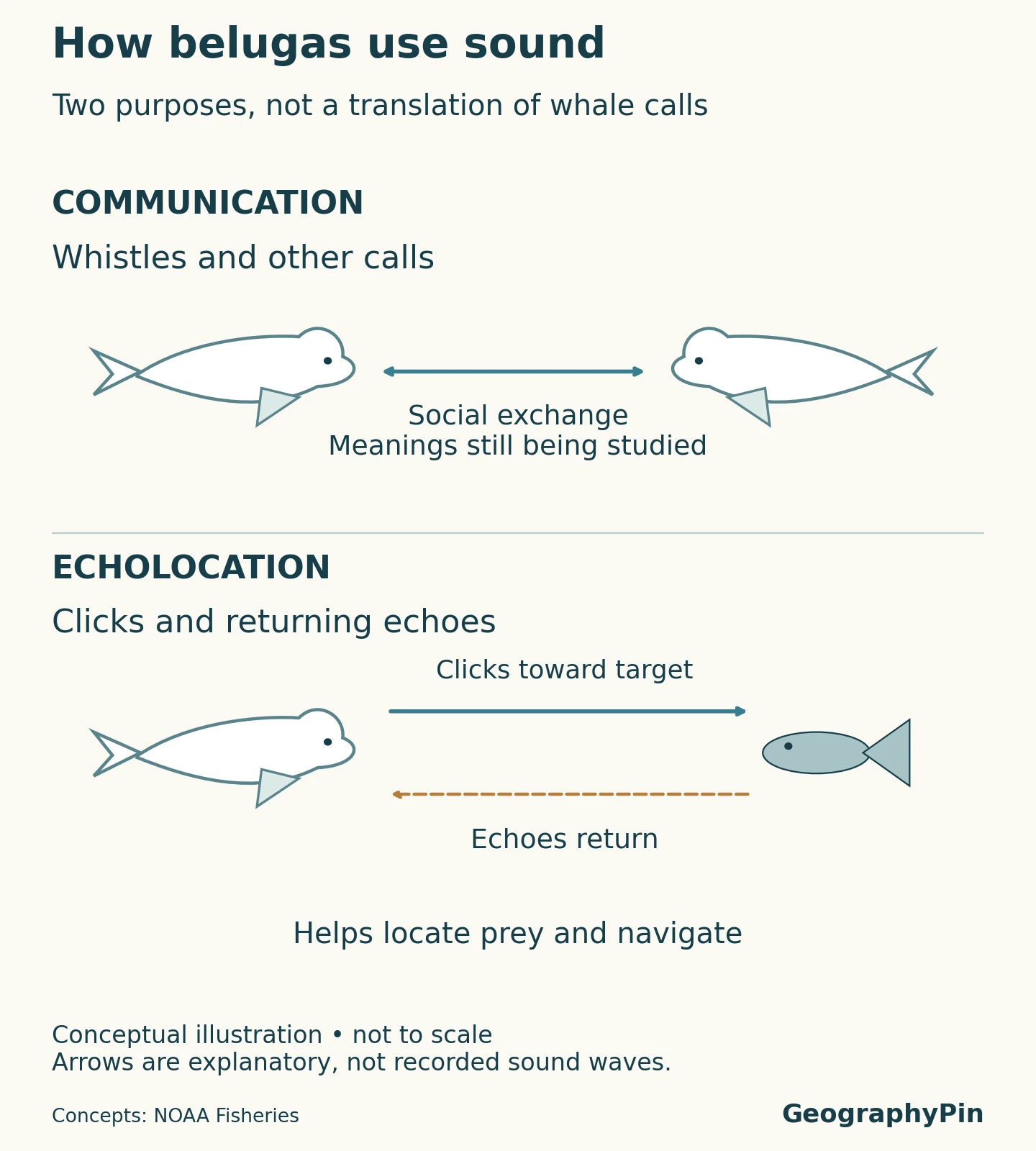
Echolocation follows an outgoing sound and a returning echo
A beluga can emit clicks and listen to echoes returning from objects. During prey pursuit, click sequences can become rapid foraging buzzes. Researchers use those patterns as evidence when investigating feeding activity, rather than treating every underwater noise as the same kind of call.
The diagram separates two useful ideas: sound passing between animals and sound returning from a target. Its arrows are conceptual, not measured acoustic beams, distances, or frequencies. Belugas also have vision; echolocation should not be explained as proof that they are blind.
3. Beluga geography extends beyond one Arctic location
Read the locator as geographic context
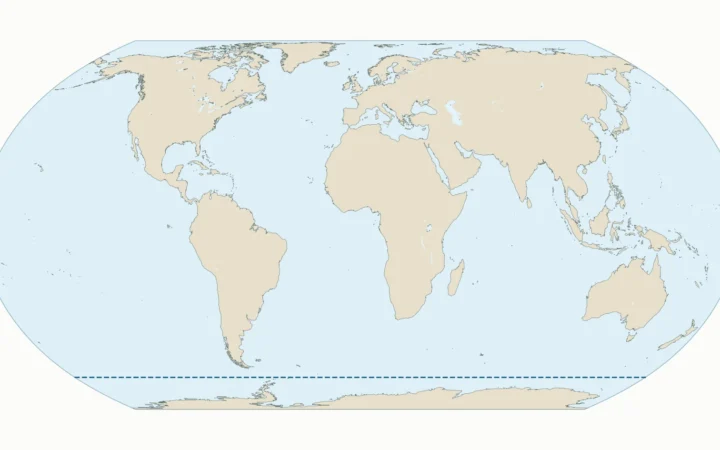
Belugas occupy Arctic and subarctic waters of the Northern Hemisphere, including regions around Alaska, Canada, Greenland, and Russia. That broad description does not mean they occur uniformly throughout every northern sea. Coastal geography and the movements of particular populations matter.
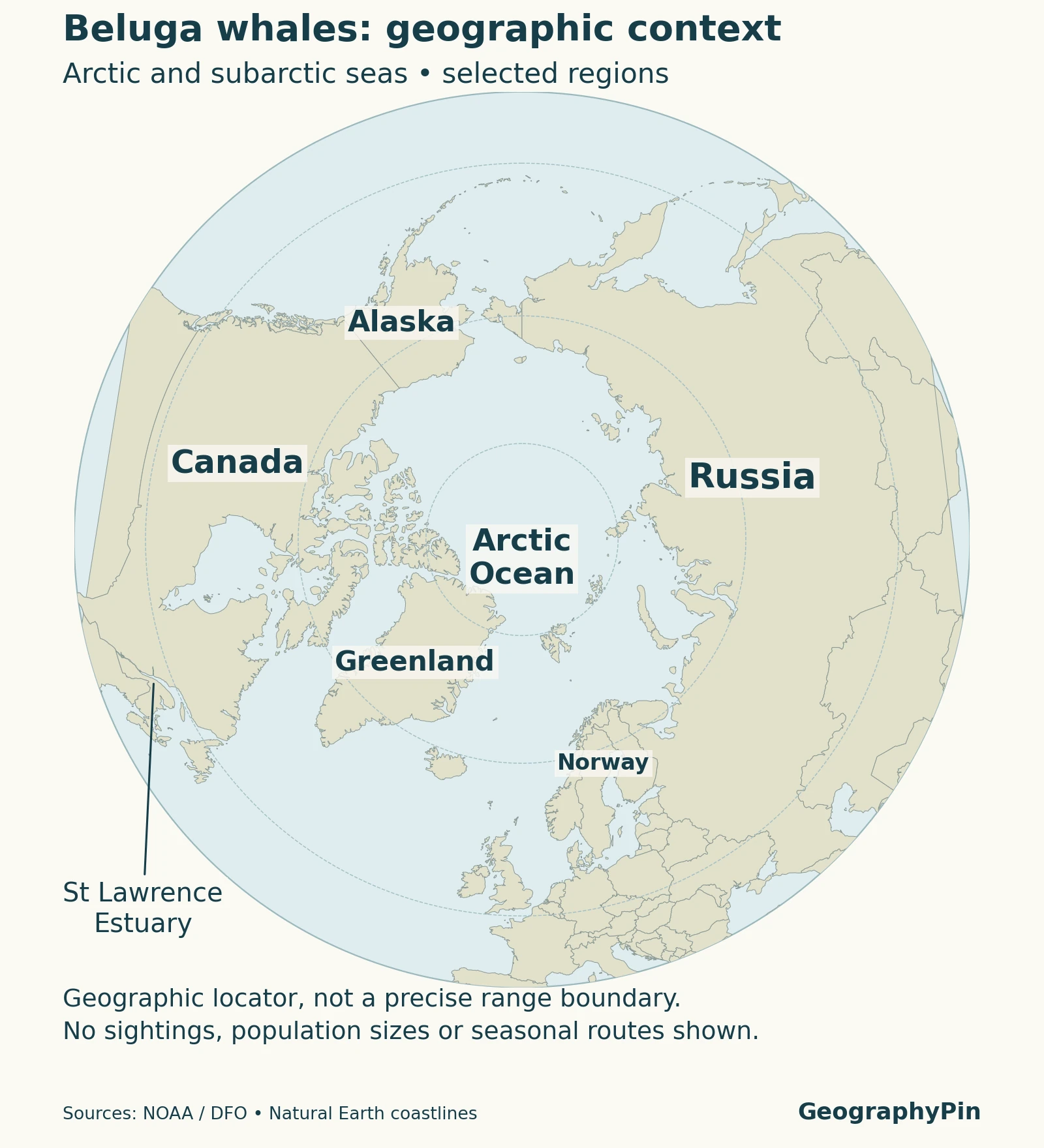
The locator identifies selected places discussed here. It is not a complete species-range polygon, a map of whale sightings, or a boundary separating certain presence from absence. The St. Lawrence label points to the estuary’s geographic setting, not an individual whale or a precise year-round habitat boundary.
The St. Lawrence is an important southern example
The St. Lawrence Estuary population lives far from the stereotype of a whale surrounded by permanent Arctic ice. Fisheries and Oceans Canada describes its present range as the estuary and, seasonally, part of the Gulf of St. Lawrence. This does not extend the population’s habitat to the entire river or the Great Lakes.
Canadian researchers distinguish summer and winter habitat use, while recognizing gaps in knowledge for other seasons. A single map should therefore not be read as a timetable. Present distribution also differs conceptually from historical range: a modern locator cannot show past losses unless historical evidence is mapped separately.
4. Sea ice and estuaries shape habitat use
Belugas lack a tall dorsal fin and can move among ice floes. Ice is part of their environment, not simply an obstacle that every population leaves behind. Its seasonal development changes the setting in which animals travel and feed. Our explanation of how sea ice forms introduces the physical process without predicting where whales will be.
Estuaries add another kind of seasonal habitat: the meeting zone of river water and the sea. Beluga use of these places cannot be reduced to one universal purpose. Feeding opportunities, conditions associated with skin renewal, and other benefits may matter differently among populations and locations.
A Hudson Bay study shows why local evidence matters
A 2017 study examined belugas in the Nelson River estuary of western Hudson Bay using aerial surveys and satellite telemetry from 2002–2005. It investigated how freshwater discharge and environmental conditions related to habitat use. Differences in freshwater discharge were associated with shifts in distribution, suggesting that proximity to the mixing zone between fresh and salt water may matter.
This is a regional study, not evidence that every beluga population responds identically to river flow. Its observation years also matter: the results describe those data, not a live forecast for today. For wildlife geography, separating place, season, and study period is more informative than assigning one explanation to an entire species.
5. Conservation status depends on the population and system
“Are belugas endangered?” needs a more precise answer than one label. A global assessment, a local population assessment, and national legal protection can describe different scopes without contradicting one another.
The IUCN Cetacean Specialist Group’s list updated in October 2025 places the species in Least Concern and the Cook Inlet subpopulation in Critically Endangered. Separately, NOAA identifies the Cook Inlet distinct population segment as Endangered under the U.S. Endangered Species Act. Canada’s St. Lawrence Estuary population is Endangered under its Species at Risk Act. Those categories must not be merged into a single worldwide legal status.
Population counts require similar care. An estimate belongs to a survey or model and a particular time period; a page updated this year does not turn an older estimate into a new census. Population estimates are meaningful only when the population, survey or model, and reference year are identified.
A suitable habitat also needs an acoustic environment
Parks Canada explains that vessel noise can mask sounds used by St. Lawrence belugas. The mouth of the Saguenay is both important summer habitat and a busy boating area. Protection is therefore about more than retaining water on a map: disturbance within that water matters too.
Noise does not affect every location or encounter in exactly the same way. Distance, vessel activity, surrounding conditions, and the animals’ behavior affect the listening environment. A protected-area outline alone cannot establish that communication remains undisturbed throughout it.
6. What recordings can tell researchers
Long-term acoustic monitoring in Cook Inlet, in south-central Alaska, has helped researchers investigate where and when belugas forage. Underwater recorders can collect evidence across periods when direct observation is difficult. Repeated records are more informative than assuming a single encounter represents the population’s full seasonal distribution.
A separate Cook Inlet study classified a vocal repertoire and examined masking by commercial ship noise. Its findings concern that study population and sampling context, not a universal number of beluga call types. This is why a sound-purpose illustration should explain the process without inventing a fixed “language” for the species.
To hear actual examples, NOAA’s beluga sound guide links recordings. Listening adds something a photograph cannot, while the original recording notes supply context that a decorative waveform would not provide.
What Did We Learn Today?
The sea-canary nickname celebrates a varied sound repertoire, but it is not a translation guide. Calls and echoes serve different roles, and beluga geography changes with place and season. Reading a map, a population estimate, or a conservation label carefully means asking which animals, which area, which period, and which evidence it describes.
Sources & Data Notes
The locator provides selected geographic context, not an exhaustive species-range boundary, migration forecast, or sighting-density map. The sound illustration is conceptual, not an actual recording or measured spectrogram. Conservation systems and assessment scopes are kept separate; the IUCN summary cited here was updated in October 2025. The Nelson River case uses observations from 2002–2005 reported in 2017, not current tracking.
- NOAA Fisheries: Beluga whale. Species identity, geographic setting, adaptations, and U.S. protection.
- NOAA Fisheries: How belugas use sound. Broad sound categories and recordings.
- NOAA Fisheries: Long-term acoustic study in Cook Inlet. Foraging signals and monitoring.
- NOAA Fisheries: Cook Inlet vocal repertoire. Population-specific research and ship-noise masking.
- Canada Water Agency and Fisheries and Oceans Canada: St. Lawrence Estuary beluga. Present distribution, seasonal habitat and population-specific status.
- Smith and colleagues (2017), PLOS ONE. Environmental conditions and beluga habitat use in the Nelson River estuary.
- IUCN Cetacean Specialist Group: Red List status. Species and subpopulation categories.
- Parks Canada: Restoring a quiet environment for whales. Noise and the Saguenay–St. Lawrence setting.
- Natural Earth. Public-domain geographic basemap for the original locator.