A manatee can graze underwater like a cow in a meadow, but the resemblance is a feeding habit, not a family relationship. Understanding its names is easier when you connect the animal to its habitat: warm coastal shallows, river systems and, for one species, the freshwater Amazon basin.
Manatees are aquatic mammals commonly called sea cows because they graze on aquatic plants. The broader name also applies to dugongs and the extinct Steller’s sea cow. Three living manatee species inhabit waters of the Americas and western Africa; dugongs live in parts of the tropical Indo-Pacific. Neither group is a reptile.
How to use this article: Compare Atlantic and Caribbean manatees, locate the freshwater Amazonian species, or explore Indo-Pacific dugong habitats.
1. What “sea cow” means
“Sea cow” is a common name, not a single scientific species. In everyday conversation it often means a manatee. In a wider zoological context it can refer to members of Sirenia, the mammal order containing manatees and dugongs. That makes “sea cow versus manatee” an overlapping-name question rather than a contest between two unrelated animals.
The Society for Marine Mammalogy’s April 2026 classification lists three living manatee species in the family Trichechidae and one living dugong species in Dugongidae. It also lists the extinct Steller’s sea cow in Dugongidae. There are therefore four living sirenian species under that classification, not four kinds of manatee.
| Common name | Scientific name | Classification |
|---|---|---|
| West Indian manatee | Trichechus manatus | Living manatee; includes Florida and Antillean subspecies |
| Amazonian manatee | Trichechus inunguis | Living manatee restricted to freshwater |
| African manatee | Trichechus senegalensis | Living manatee of western African coastal and inland waters |
| Dugong | Dugong dugon | Living sirenian in a different family from manatees |
| Steller’s sea cow | Hydrodamalis gigas | Extinct sirenian, not a living northern manatee |
Scientific names help when common names vary. “African manatee” and “West African manatee” refer to the same species here. A Florida manatee is a subspecies of the West Indian manatee, not an additional fourth manatee species.
2. Where manatees and dugongs live
Their distributions make more sense as connected waterways than as colored countries. A country containing manatees is not occupied throughout its land area, and a coastal range does not mean that animals occur along every mile of shoreline.
West Indian manatees: Atlantic coasts and the Caribbean
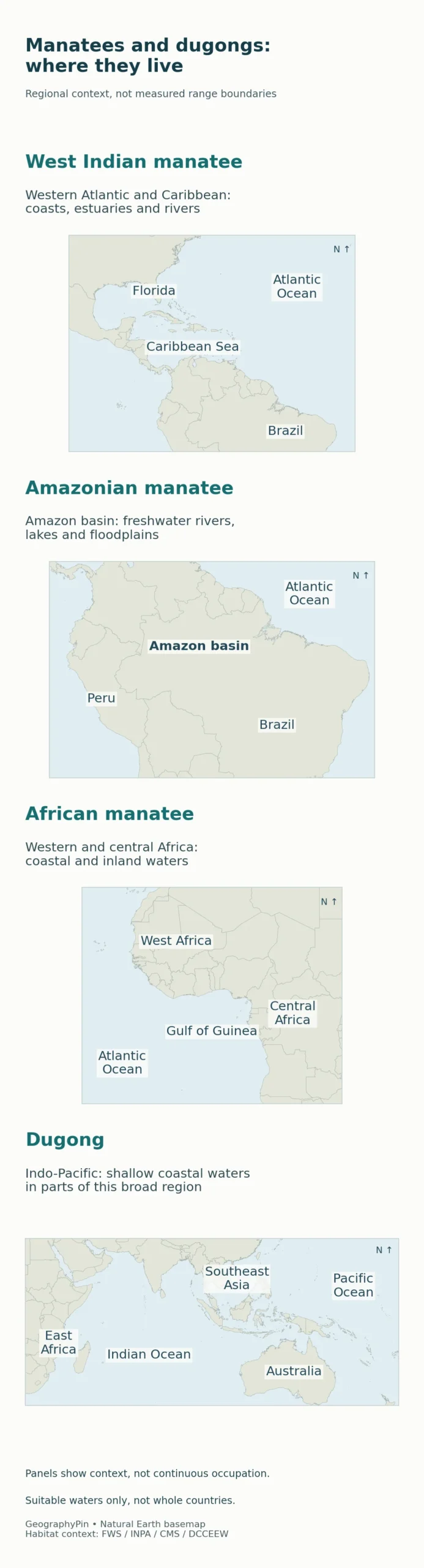
West Indian manatees use coastal, estuarine and river habitats around parts of the western Atlantic and Caribbean. The U.S. Fish and Wildlife Service describes Florida manatees primarily in Florida, with warm-season movements that can extend west to Texas and north to Delaware Bay or beyond. Antillean manatees occur along the Mexican Gulf coast, Central America, northeastern Brazil and parts of the Caribbean.
This is not one continuous population. Local habitat, warm water, food and barriers affect where animals actually occur. A regional overview should not be read as an animal-finding guide or a guarantee of sightings.
Amazonian manatees: a freshwater life
The Amazonian manatee inhabits Amazonian rivers and associated freshwater environments. Brazil’s National Institute of Amazonian Research identifies it as exclusively freshwater. Despite the common name “sea cow,” it does not need the sea.
This difference matters on a map: showing only marine coastlines would miss an entire manatee species. The Amazon basin belongs in the comparison, but coloring the whole basin as occupied habitat would also overstate the evidence. Rivers, lakes and floodplain waters are distinct from the enormous area of land between them.
African manatees: coastlines and inland waters
African manatees occur in western African coastal and inland waters. The Convention on Migratory Species identifies range states across western and central Africa, including inland countries as well as coastal ones. The regional picture therefore includes river systems, not just an Atlantic coastal strip.
Country-level distribution records are useful for orientation but cannot supply precise occupied-water boundaries. They also should not be mistaken for recent population counts or evidence that all habitats in a listed country remain suitable.
Dugongs: Indo-Pacific seagrass habitats
Dugongs occupy parts of the coastal Indo-Pacific, from eastern Africa toward the western Pacific. Their feeding habitat is strongly tied to seagrass. Australian government guidance describes them in shallow coastal waters across northern Australia, illustrating the importance of coastal shelves rather than open-ocean habitat.
The broad arc between Africa and the Pacific is not a continuous belt of dugongs. A locator can show the region; local surveys are needed to describe particular populations and seagrass habitats.
3. How a manatee differs from a dugong
The easiest visible distinction is the tail. Manatees have a broad, rounded paddle; dugongs have a fluked tail with two pointed lobes. Both have foreflippers and streamlined bodies, so a quick underwater glimpse can be misleading.
Geography provides a second clue. Living manatees occur in the Americas and western Africa, whereas dugongs belong to the Indo-Pacific. Habitat is another clue, but it is not a complete identification rule: some manatees use saltwater, so “in the sea” does not automatically mean dugong.
Manatees eat aquatic vegetation in several settings. Dugongs depend largely on seagrass, a group of flowering plants growing underwater. Seagrass is not the same thing as seaweed. The Amazonian species demonstrates why all sirenians should not be described as marine seagrass grazers.
4. Why manatees are mammals, not reptiles
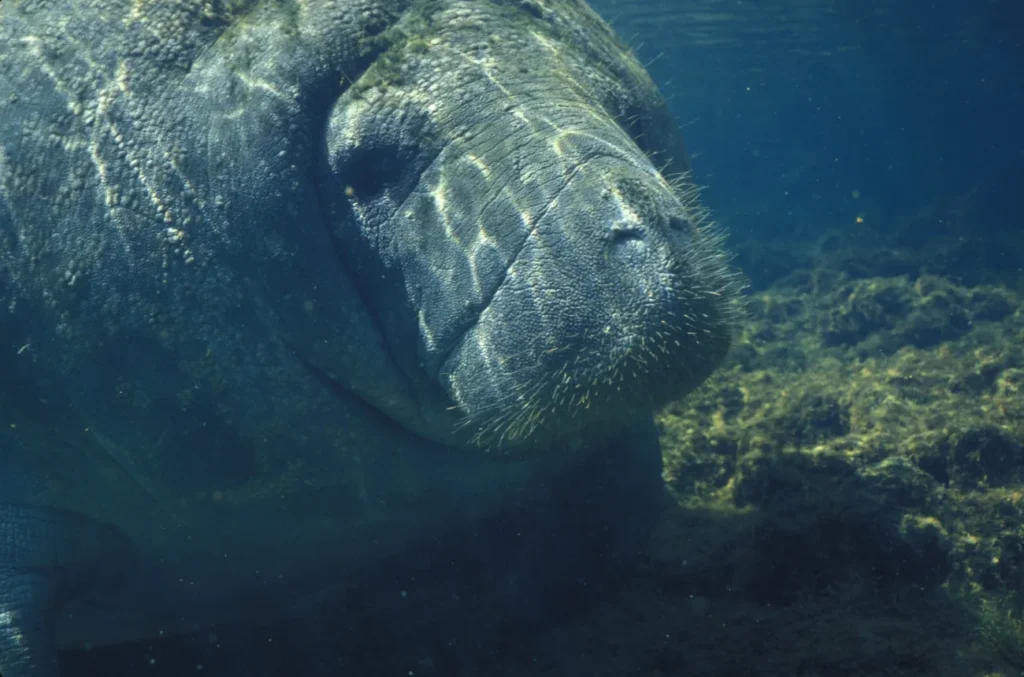
Manatees breathe air with lungs, produce milk for their young and have hairs, including conspicuous bristles around the muzzle. Living underwater does not turn a mammal into a fish or reptile. A calf must reach the surface to breathe, just as an adult does.
Common names create other false associations. Manatees are not seahorses: seahorses are fishes. They are not sea lions either: sea lions belong to a different mammal group, the pinnipeds. Calling an animal a sea cow describes its familiar grazing image, not membership in the cattle family.
The comparison is useful precisely because similar settings can contain unrelated animals. Water habitat alone cannot tell you whether an animal is a fish, reptile or mammal; classification depends on biological relationships and characteristics.
5. Seasonal movement is not the same as permanent range
Florida manatees offer a clear example. Warm-season movements can carry them well beyond their winter concentration areas. As conditions cool, many return toward peninsular Florida and warm-water refuges, including natural springs and other sheltered warm-water habitats.
The Fish and Wildlife Service identifies prolonged exposure to water below about 68°F (20°C) as a problem for Florida manatees. That is a cold-stress warning, not a claim that every animal dies immediately at a single threshold.
A distant sighting therefore does not prove that a location supports a year-round population. Conversely, a winter map may omit waterways used in warmer months. Useful range information should identify the species or subspecies, season, evidence date and whether it shows regular habitat or occasional records.
6. Reading conservation information carefully
Habitat loss, collisions with boats, fishing-gear entanglement and loss of feeding or warm-water areas are important concerns. Their relative importance differs among populations and places. A global species label cannot replace a local account of habitat and threats.
“Threatened” and “endangered” can also be formal legal categories, not interchangeable everyday adjectives. U.S. legal protections, international agreements and IUCN assessments describe different systems and geographic scopes. Compare the named species or subspecies and assessment date before treating two labels as contradictory.
For this reason, this article does not present an undated global population total. Counting animals in different waterways, seasons and survey programs involves uncertainties that a single unsupported number would hide.
What Did We Learn Today?
Manatees are mammals, and “sea cow” is a shared common name rather than one precise species. Three living manatee species occupy different American and African water environments, while dugongs inhabit parts of the Indo-Pacific. The most useful map separates those broad regions without pretending that every river or coastline is occupied, and distinguishes seasonal movement from year-round habitat.
Sources & Data Notes
Taxonomy follows the Society for Marine Mammalogy’s April 2026 list. Geographic descriptions summarize broad habitat regions, not continuous occupied areas or population estimates. Seasonal movement is identified separately from year-round habitat; legal conservation categories and global assessments should not be treated as equivalent.
- Society for Marine Mammalogy: April 2026 taxonomy
- USFWS: West Indian manatee
- USFWS: Florida manatee habitat and seasonal movement
- INPA: Amazonian manatee
- CMS: African manatee
- CMS: Dugong facts
- Australian government: Dugong habitats
- Natural History Museum: Manatees and sea cows
- NOAA Fisheries: Seals and sea lions
- NOAA: Seahorses
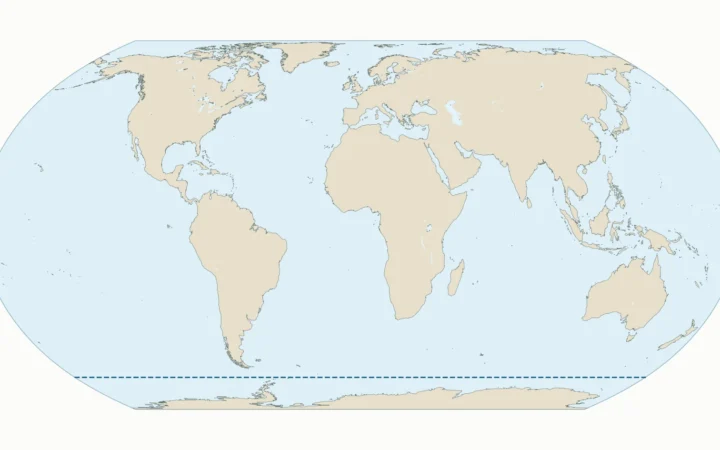
Map: original GeographyPin regional locator using Natural Earth 1:10 million country geometry (public domain). Separate north-up panels use different scales. Geographic labels identify context regions, not animal observations; no measured wildlife-range or occupancy layer is used. Generalized coastlines and borders are not suitable for navigation or exact distance comparison.
Featured photograph: Ryan Hagerty / U.S. Fish and Wildlife Service, public domain; converted to WebP.