A meeting described as “noon Mountain Time” needs more than a place on a map. Denver and Phoenix can show different hours even though both belong to the U.S. Mountain Time zone. The difference is whether the clock follows daylight saving time, and the answer changes across seasons and borders.
Mountain Standard Time (MST) is UTC−7; Mountain Daylight Time (MDT) is UTC−6. Many U.S. Mountain Time locations switch between them seasonally. Most of Arizona stays on MST, while the Navajo Nation observes daylight saving time and Hopi communities do not. Use the location, date and regional time-zone rule; repeated local times also need an offset.
Choose your starting point: Compare MST and MDT, examine Arizona’s exceptions, or follow three dated conversions.
1. Reading a Mountain Time zone map
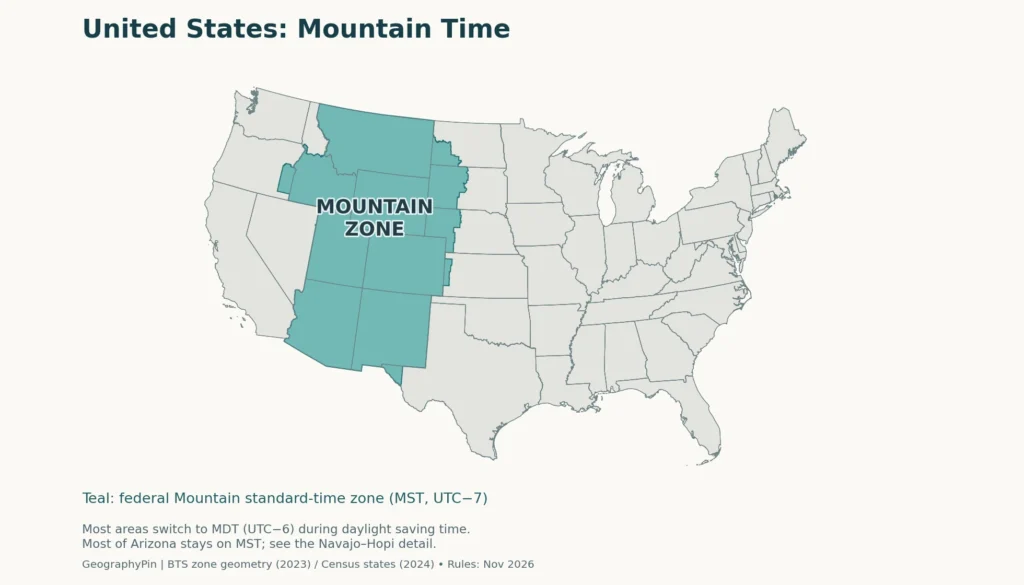
The U.S. Mountain Time zone occupies a broad part of the interior West. Denver, Salt Lake City and Albuquerque are familiar examples of cities using its seasonal clock rules. Phoenix belongs to the same standard-time zone but does not make the seasonal change. A zone boundary and a daylight-saving boundary therefore answer different questions.
The map highlights the U.S. Mountain standard-time area using the Bureau of Transportation Statistics boundary dataset. It is a map of a named zone, not a map of every place in North America currently showing UTC−7. Canada and Mexico have their own rules, terminology and exceptions, discussed below.
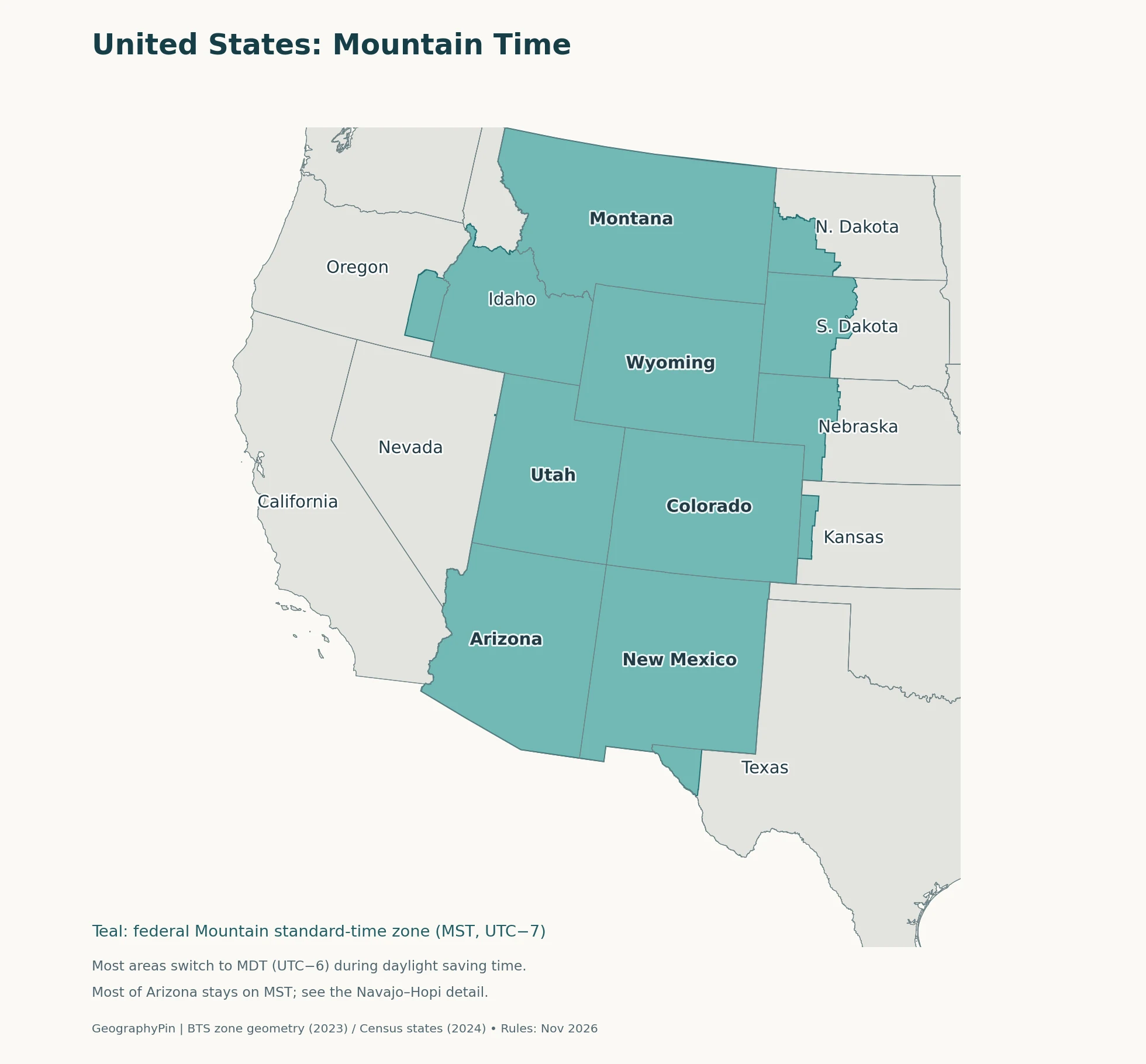
Standard-time boundaries are established geographically; they do not shift back and forth when clocks change. Daylight saving changes the applicable offset in participating places. A map that colors the whole zone identically without explaining Arizona can hide a practical one-hour difference during part of the year.
State names alone are not always enough. Some states are split between zones, and small boundary details do not follow a simple line of longitude. Use the map for regional understanding and identify the actual community for an appointment. The broader U.S. time-zone map explains the country's other zones; this guide concentrates on Mountain Time and its exceptions.
2. MST, MDT and the meaning of UTC offsets
Two offsets, one seasonal distinction
UTC provides a common reference against which local civil time can be expressed. The minus sign means the local clock is behind UTC. At 18:00 UTC, an offset of UTC−7 gives 11:00 a.m.; an offset of UTC−6 gives noon, on the same calendar date in this example.
| Label | Meaning | Offset | Example |
|---|---|---|---|
| MST | Mountain Standard Time | UTC−7 | 11:00 a.m. when UTC is 18:00 |
| MDT | Mountain Daylight Time | UTC−6 | Noon when UTC is 18:00 |
| MT | Mountain Time | Depends on the location and date | Not a fixed offset by itself |
MST is not a year-round synonym for every local clock in the Mountain zone. For Denver during its daylight-saving period, MDT is the accurate label. Conversely, calling Phoenix “MDT” in summer would assign the wrong offset.
There is also a difference between sharing an hour and sharing a time-zone identity. During U.S. daylight saving time, Los Angeles uses PDT at UTC−7, matching Phoenix's MST. Phoenix has not moved into the Pacific zone. Their clocks agree because two different rules happen to produce the same offset then.
3. When U.S. Mountain clocks change
Under the U.S. rules applicable in 2026, participating locations advance at 2:00 a.m. local time on the second Sunday in March and return on the first Sunday in November. The 2026 dates were March 8 and November 1.
In Denver on March 8, 1:59:59 a.m. MST was followed by 3:00 a.m. MDT. The intervening local hour did not occur. On November 1, 1:59:59 a.m. MDT was followed by 1:00 a.m. MST, so the hour beginning at 1:00 occurred twice.
This matters when saving timestamps. “1:30 a.m. in Denver on November 1, 2026” identifies two possible instants unless the offset or another disambiguation is supplied. “2:30 a.m. in Denver on March 8, 2026” names a local clock reading skipped by that transition. Converting from a specified UTC instant avoids both problems.
A recurring meeting should normally use a location-based time-zone setting rather than a manually fixed UTC−7 offset. The fixed offset may describe a winter occurrence correctly and a summer occurrence incorrectly. Software also needs current time-zone data when governments alter the rules.
4. Arizona, the Navajo Nation and Hopi communities
Different clock practices within Arizona
Most of Arizona remains on Mountain Standard Time throughout the year. That includes Phoenix and Tucson. The Arizona State Library identifies the Navajo Nation as the daylight-saving exception, and the Navajo Nation's own March 2026 announcement confirms its spring clock change.
The Navajo Nation extends into Arizona, Utah and New Mexico. Its announcement explains that observing daylight saving keeps its communities and services aligned across those connections. In the daylight-saving period, Navajo clocks are one hour ahead of most of Arizona; after the autumn change they agree again.
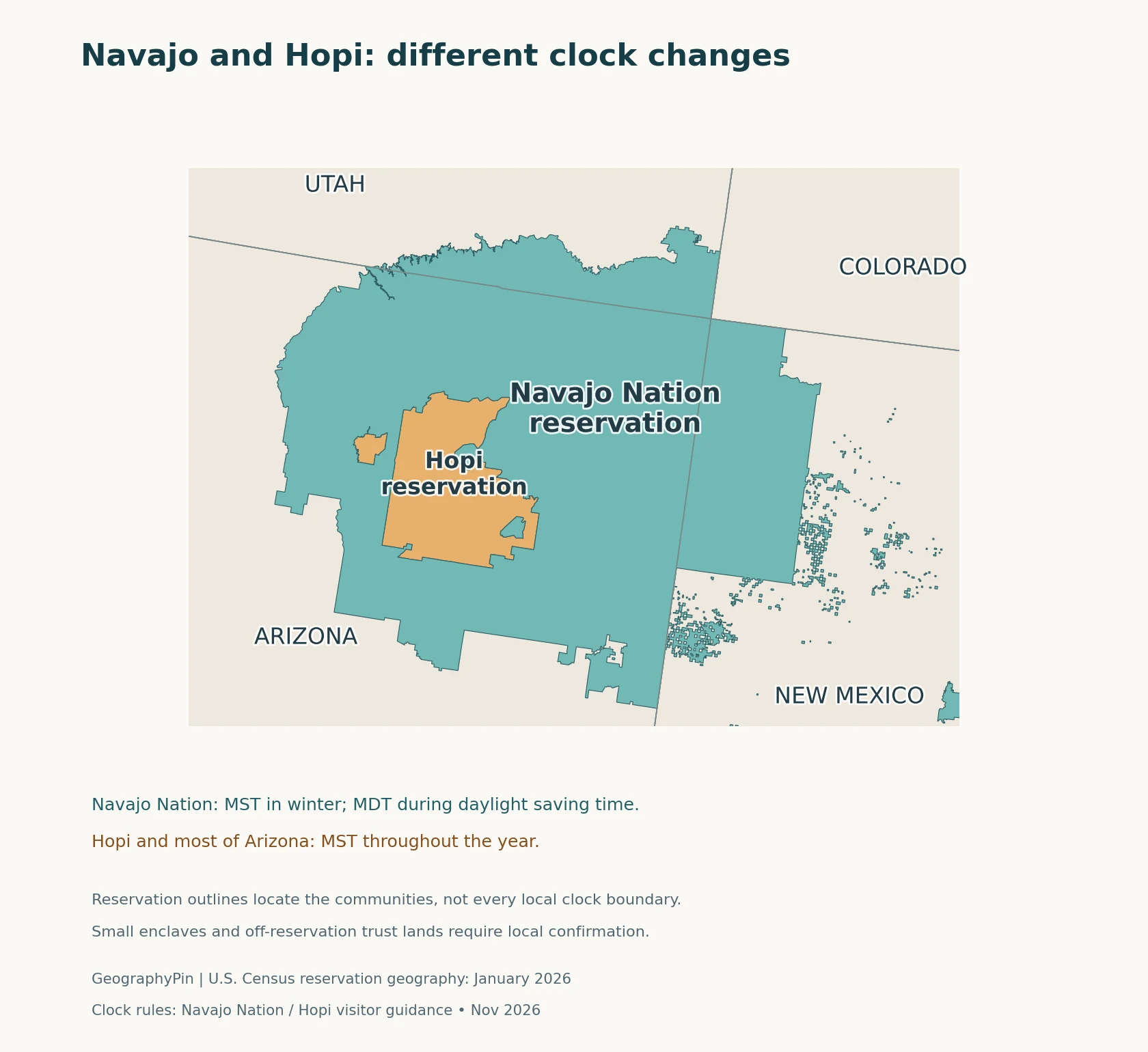
Hopi communities do not follow the Navajo daylight-saving schedule. The Hopi visitor information center explains that its villages stay on Arizona time: during the daylight-saving months, the Navajo Nation is an hour ahead of Hopi communities. This is why coloring all northeastern Arizona as one uniform clock region would be misleading.
The regional map shows the distinction, but it is not a parcel-level guide to every enclave or the operating hours of individual organizations. For a tour, medical visit, transport connection or other appointment near the boundary, ask the provider which local clock its stated time uses. A phone's displayed time alone is not a substitute for that clarification.
5. Canada and Mexico: matching offsets are not identical rules
Cross-border comparisons need a date. Several Canadian arrangements changed in 2026, so an older map can give the wrong impression even when its arithmetic is correct.
Alberta adopted year-round UTC−6, officially called Alberta Time, from November 1, 2026. The Northwest Territories likewise adopted year-round UTC−6. These places therefore no longer follow Denver's autumn return to UTC−7 under the rules described here. Treating every Canadian location formerly associated with seasonal Mountain Time as a copy of Denver is now incorrect.
Most of British Columbia uses year-round UTC−7 after its 2026 change, while Yukon has used UTC−7 year-round since 2020. Their official time names need not be MST just because the offsets match Phoenix. Local arrangements in parts of eastern British Columbia require separate attention; Golden and surrounding Area A, for example, retained UTC−6 year-round after their 2026 decisions.
Mexico also cannot be summarized as a single extension of the U.S. Mountain zone. Its Pacific zone includes Sonora, Sinaloa, Baja California Sur and most of Nayarit, using UTC−7 without the U.S. seasonal clock change. Bahía de Banderas is a Nayarit exception in the Central zone.
Chihuahua needs particular care. The city of Chihuahua uses UTC−6 year-round, while specified northern-border municipalities have seasonal rules. Ciudad Juárez follows the UTC−7/UTC−6 pattern; Ojinaga belongs to a different border group using UTC−6/UTC−5. An old list placing the entire state of Chihuahua on one Mountain schedule is not suitable for current conversions.
6. Three dated conversions using named zones
The same UTC instant in three places
These examples use 18:00 UTC on three real dates in 2026. The calculation uses IANA Time Zone Database release 2026f and the identifiers America/Denver, America/Phoenix and America/New_York. They are fixed historical examples, not a display of the current time.
| Date | UTC | Denver | Phoenix | New York |
|---|---|---|---|---|
| March 7, 2026 | 18:00 UTC | Denver 11:00 a.m. MST | Phoenix 11:00 a.m. MST | New York 1:00 p.m. EST |
| March 8, 2026 | 18:00 UTC | Denver noon MDT | Phoenix 11:00 a.m. MST | New York 2:00 p.m. EDT |
| November 1, 2026 | 18:00 UTC | Denver 11:00 a.m. MST | Phoenix 11:00 a.m. MST | New York 1:00 p.m. EST |
The first two rows show the spring transition: Denver advances while Phoenix does not. The final row shows that Denver and Phoenix agree again after Denver's autumn change. New York is included to illustrate an Eastern Time comparison, not to imply that every place using an Eastern or Mountain label shares these rules.
IANA identifiers describe regional clock histories and rules, not only the city named in the identifier. The database identifies America/Denver as suitable for Navajo Nation rules. America/Phoenix represents Arizona's non-daylight-saving pattern. For international scheduling, select the actual destination's supported regional identifier rather than substituting Denver wherever a map once said “Mountain.”
Frequently Asked Questions
Is Mountain Time always two hours behind Eastern Time?
Denver and New York are two hours apart in the three examples above. That is not a universal rule for every location or every historical date associated with those labels. Phoenix is three hours behind New York during the U.S. daylight-saving period and two hours behind it in the standard-time period.
Is this page a live Mountain Time clock?
No. The maps explain geographic boundaries and clock rules, and the tables contain dated examples. For the current U.S. time, use the official time.gov display and choose the appropriate region. For a scheduled event, retain its date and regional time-zone identifier.
What Did We Learn Today?
Mountain Time combines geography with calendar rules. MST means UTC−7 and MDT means UTC−6, but the letters alone do not tell you which communities change their clocks. Arizona, Navajo and Hopi distinctions demonstrate why a state-level label can be insufficient. Cross-border changes make the date equally important. A clear time conversion identifies the place, the calendar date and the applicable regional rule rather than relying on an undated abbreviation.
Sources & Data Notes
The geographic map covers the United States, not every North American location sharing a UTC offset. The BTS zone geometry is the dataset described as updated in January 2023; the written federal boundary definitions govern. Clock-rule discussion reflects the arrangements in effect in November 2026. The Canadian changes described above are substantive rule changes, not simply new labels for unchanged seasonal schedules.
- NIST: local-time definitions and offsets; U.S. daylight-saving rules and 2026 dates.
- U.S. Department of Transportation: time-zone administration; Bureau of Transportation Statistics: official zone boundary dataset.
- U.S. Census TIGERweb: January 2026 federal reservation geometry; state outlines use Census 2024 cartographic boundaries. The regional reservation locator retains the source’s holes and separate pieces; off-reservation trust lands are not included and some outlying parcels fall beyond its displayed extent. These are geographic outlines, not surveyed clock-rule boundaries.
- Arizona State Library: Arizona time; Navajo Nation: March 2026 clock-change announcement; Hopi visitor information: local clock distinction.
- Alberta: permanent Alberta Time; Northwest Territories: end of seasonal changes.
- British Columbia: Pacific Time naming and exceptions; Yukon: its own year-round UTC−7 rule; Golden’s final October 2026 notice and Area A’s final notice.
- Mexico: 2022 time-zone law and November amendment for northern-border municipalities.
- IANA Time Zone Database 2026f, released October 27, 2026, supplies the regional rules used to calculate the dated examples. Governments establish civil rules; database abbreviation strings are not always the same as current governmental time-zone names.
The conversion table was calculated from the specified UTC instants using the named zones in release 2026f. It does not use a visitor’s device clock and is not a live-time service. For the current U.S. time, see the official time.gov display. Future scheduling requires current rules for the actual destination.