Evenings can start getting lighter while the days are still getting shorter. The apparent contradiction comes from comparing two different things: the clock time of sunset and the total interval between sunrise and sunset.
At Northern Hemisphere midlatitudes, the earliest sunset comes before the winter solstice because solar noon is shifting later on the clock. Near the solstice, that shift can outweigh the small remaining loss of afternoon daylight. Sunset then gets later even while sunrise continues getting later and the total daylight interval still shrinks.
How to use this article: Compare the daylight windows, understand solar noon, or find your local date.
1. Shortest Day Is Not the Same as Earliest Sunset
Compare the daylight windows
Think of daylight as a window with two edges. Sunrise opens it; sunset closes it. A shorter window does not require its closing edge to move earlier. It can slide later while its opening edge moves later by an even greater amount.
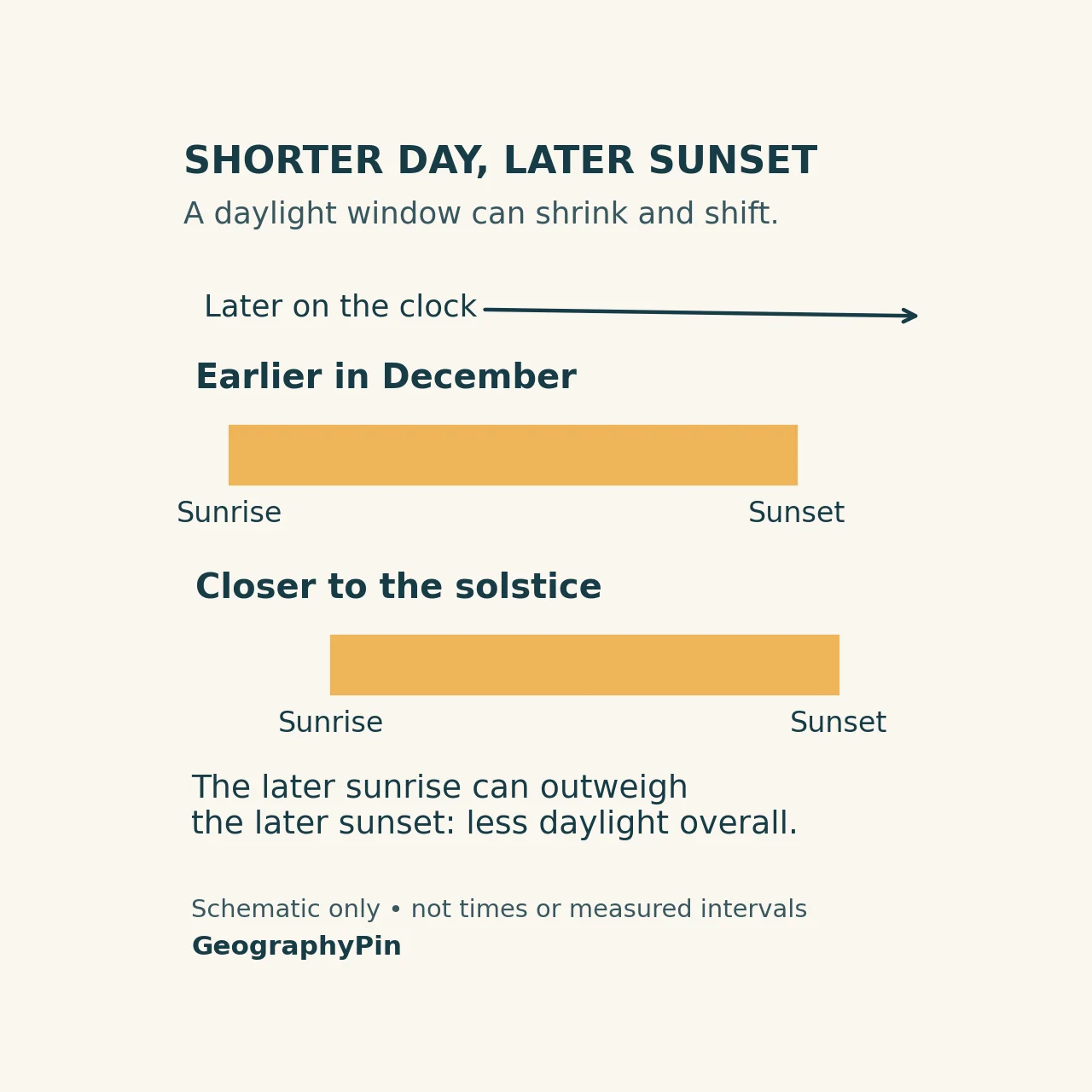
For a straightforward check in a sunrise table, subtract sunrise from sunset on each date. Compare that daylight duration separately from the sunset column. Those two comparisons answer different questions, so they need not identify the same date.
This is why “the evenings are improving” can be true before “the days are lengthening.” Neither statement should be used as a substitute for the other.
2. Why Solar Noon Moves on the Clock
A moving reference point
Solar noon is the Sun’s passage across your local meridian. It is not necessarily 12:00 on a civil clock. Longitude within a time zone affects its clock time, and a seasonal variation changes it from day to day.
A sundial follows apparent solar time; ordinary clocks follow a uniform time standard. The U.S. Naval Observatory’s equation-of-time explanation describes the changing difference between apparent and mean solar time. Earth’s tilted axis and its noncircular orbit both contribute. The explanation is not simply that Earth suddenly rotates more slowly in December.
Around the December solstice, successive solar noons drift later relative to clock time. Meanwhile, the seasonal change in daylight duration becomes small. The competition between the shifting daylight window and its changing width separates the sunset minimum from the shortest day. After the solstice, mornings can still get darker for a while even as total daylight increases.
Changing the clocks for daylight saving time is a separate effect. It produces an abrupt change in the displayed time; the astronomical shift discussed here develops gradually.
3. When Does the Earliest Sunset Happen?
There is no single earliest-sunset date for every location. As a useful midlatitude reference, the U.S. Naval Observatory gives approximately December 8 for earliest sunset and January 5 for latest sunrise at 40° north. These are approximate recurring dates, not a prediction for a named city in a specified year.
That example places the two events on opposite sides of the December solstice. It should not be turned into a rule that every town has exactly two weeks between each event and the shortest day.
The December framing is Northern Hemisphere-specific. Southern Hemisphere winter occurs around the June solstice. Near the poles, periods without a daily sunrise or sunset require a different treatment; near the equator, do not assume the midlatitude dates apply. Use a location-specific table rather than stretching one example worldwide.
4. How to Find the Date Where You Live
Read a local sunrise and sunset table
The USNO annual sunrise and sunset table lets you choose a year and location. Its output uses local standard time in a 24-hour format, so check the time convention before comparing it with an app displaying daylight time.
- Use the correct latitude and longitude and year, not just a nearby city’s name.
- Scan the sunset column around your winter season and identify the lowest clock time.
- If several dates show that same minute, retain the tie rather than declaring one uniquely earliest day.
- Compare sunrise and daylight duration separately. Do not infer either from sunset alone.
Calculated sunset is also not necessarily the moment the Sun disappears behind a particular building or hillside. USNO’s definitions use the Sun’s upper edge at an unobstructed horizon under assumed atmospheric conditions. The skyline outside your window can produce a different visible disappearance time.
NOAA’s calculation notes explain that atmospheric conditions can make observed times differ from calculated ones. A minute-resolution table is useful for understanding the seasonal pattern, not a guarantee of the exact instant you will see sunset.
Frequently Asked Questions
Is sunset the moment it becomes completely dark?
No. Twilight continues after sunset. If you are planning an outdoor activity, consult the relevant twilight time rather than treating sunset as the end of all natural light.
Should two nearby places have exactly the same sunset time?
Not necessarily. Their coordinates, horizon conditions and chosen time convention can differ. Compare predictions made with the same definitions before interpreting a small discrepancy.
What Did We Learn Today?
A daylight window has both a width and a position on the clock. That distinction explains how a later sunset can coexist with a shorter day. For local planning, keep three checks separate: sunset time, sunrise time and total daylight duration. Then check whether the figures describe a calculated horizon or the skyline you actually see.
Sources & Data Notes
This explanation focuses on Northern Hemisphere midlatitudes. The 40° north dates are USNO’s approximate examples, not newly computed observations. The original GeographyPin diagram is qualitative and has no time scale. Local predictions depend on coordinates, year, time convention and horizon assumptions. NOAA’s calculator is no longer actively maintained; its methodological notes are cited here for limitations, not as a promise of current tool support.