Planning to travel to Tbilisi? This first-time Tbilisi travel guide explains when to visit, how many days you need, where to stay, how to reach the center from Tbilisi International Airport, how to use local transport, what to see, and which day trips are realistic. It also covers Georgia’s 2026 insurance requirement, current safety considerations, money, SIM cards, food, wine, and sulfur baths.
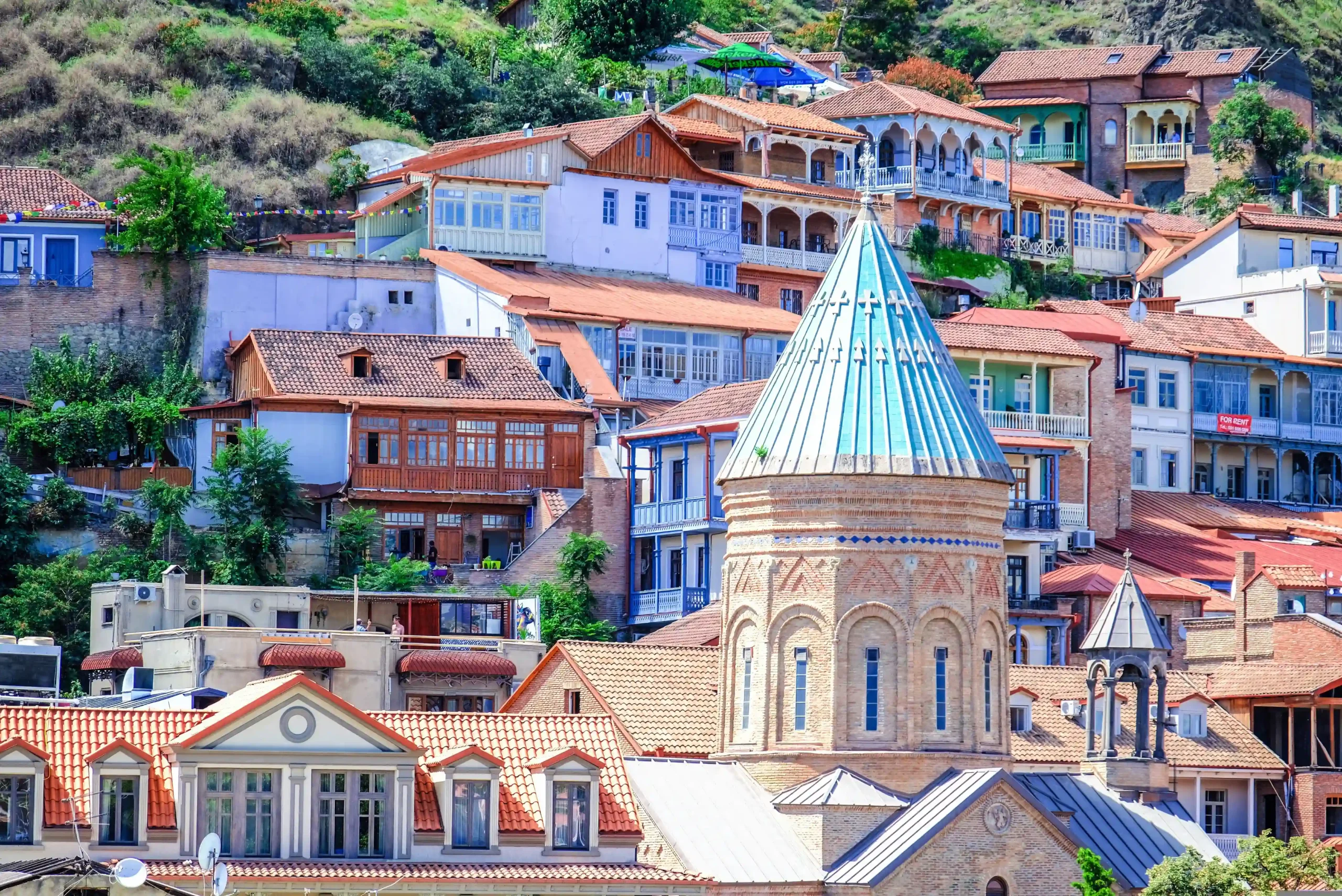
Tbilisi brings together historic balconies, bathhouse culture, hilltop views, Georgian food, wine traditions, museums, and traces of Persian, Russian, Soviet, and modern Georgian history. It is compact enough for a short city break, but its steep terrain and layered neighborhoods reward travelers who leave enough time to explore without rushing.
Tbilisi is worth visiting for its historic neighborhoods, sulfur baths, Georgian food and wine, city views, and easy access to other parts of Georgia. Allow three full days for the capital itself. Add a fourth day for Mtskheta or more time for Kakheti and the Caucasus Mountains.
Plan your Tbilisi trip faster
For the quickest route through this guide, jump to airport arrival and your first 24 hours, where to stay, the 3-day itinerary, money and SIM advice, or the day-trip comparison.
Is Tbilisi worth visiting?
Yes. Tbilisi is particularly rewarding for travelers interested in old architecture, food, wine, urban viewpoints, religious and cultural history, and cities that do not feel completely polished or standardized. Its appeal comes from contrast: restored streets stand beside weathered courtyards, medieval landmarks overlook Soviet-era districts, and traditional restaurants share neighborhoods with contemporary cafés and galleries.
Tbilisi is not a resort capital, a beach destination, or a substitute for Georgia’s high mountains. It works best as both a destination and a starting point. A strong first visit combines Old Tbilisi, Abanotubani, a high viewpoint, Rustaveli Avenue, one carefully chosen museum, Georgian food, a sulfur bath, and enough unplanned time to notice the city between the landmarks.
Who Tbilisi suits best
| If you want… | Tbilisi fit | What to expect |
|---|---|---|
| Historic city atmosphere | Excellent | Old Tbilisi, Abanotubani, Sololaki, churches, courtyards, and hilltop views give the city a distinctive identity. |
| Food and wine | Excellent | The capital makes regional Georgian dishes, qvevri wine, modern restaurants, and casual bakeries easy to explore. |
| A 2–3 day city break | Very good | The main visitor areas can be explored without renting a car. |
| Mountain scenery | Useful as a base | Begin in Tbilisi, then continue to Kazbegi, Gudauri, Svaneti, or another mountain area. |
| A beach holiday | Poor fit | Georgia’s main beach destinations are on the Black Sea coast, especially around Batumi. |
Before you book: entry rules, insurance, and safety
Before paying for flights, check whether your passport can enter Georgia visa-free, how long you may stay, and whether any additional documents apply to your nationality. Georgia permits many nationalities to visit without a visa, but the allowed period and entry conditions are not identical for everyone. Use the official Georgian consular portal rather than an old forum post or an airline summary.
Georgia’s mandatory tourist insurance rule for 2026
Since January 1, 2026, tourists entering Georgia have been required to carry valid health and accident insurance. Buying a general policy is not enough unless its document meets the Georgian requirements.
- The minimum insurance coverage must be at least 30,000 GEL.
- The policy must cover the complete stay, including arrival and departure dates.
- It must be available in Georgian or English.
- A printed policy or an electronic copy is accepted.
- The policy may come from a Georgian or foreign insurance company.
- The document must show the insured parties, covered territory, dates, risks, coverage limit, and required payment information.
Keep the policy accessible offline on your phone and consider carrying a printed copy. Read the official Georgian Ministry of Foreign Affairs explanation before departure because entry requirements can change.
Is Tbilisi safe to visit in 2026?
Many visits to Tbilisi take place without serious problems, and the current United States advisory recommends normal precautions for Georgia overall. However, political demonstrations remain an important practical concern in central Tbilisi. Gatherings frequently focus on the Parliament building along Rustaveli Avenue and can cause road closures, transport disruption, or confrontations with police.
- Avoid demonstrations, political rallies, and large gatherings, even when they appear peaceful.
- Check local news before visiting Parliament or walking the central part of Rustaveli Avenue at night.
- Use normal precautions with belongings, drinks, ATMs, and poorly lit streets.
- Use an app-based or clearly identified taxi rather than accepting an unclear offer.
- Call 112 for police, fire, rescue, or a medical emergency.
Risk levels and wording differ between governments, so check the latest advice for your nationality. Useful starting points include the U.S. travel advisory for Georgia and the UK’s current Georgia safety guidance.
Tbilisi Airport to the city center
Tbilisi International Airport, identified by the airport code TBS, is approximately 10.5 miles (17 kilometers) southeast of central Tbilisi. The right transfer depends mainly on your arrival time, luggage, accommodation location, and whether you already have mobile data.
| Option | Cost and timing | Best for |
|---|---|---|
| Municipal bus 337 | 1 GEL; normally about 45–60 minutes to the center. Current 2026 information places service at approximately 7:00 a.m.–11:00 p.m., but verify the live schedule. | Budget travelers arriving during operating hours with manageable luggage |
| Taxi app | The live app price varies; often roughly 25–40 GEL to central areas. Allow around 20–40 minutes depending on traffic. | Door-to-door convenience, late arrivals, couples, and travelers with luggage |
| Official airport taxi | The airport publishes a metered range of approximately 40–60 GEL and a normal journey of 20–30 minutes, traffic permitting. | Travelers who do not want to install an app |
| Pre-arranged transfer | Price depends on the company, vehicle, and destination. | Families, groups, child-seat requests, heavy luggage, and very late arrivals |
Bus 337 stops outside the arrivals area and travels toward central Tbilisi. The official fare is 1 GEL for 90 minutes of municipal travel, payable with MetroMoney or supported bank cards. Check the official airport bus page and a live route planner because operating hours and stops can change.
If using a taxi app such as Bolt, install it and complete phone verification before flying. Compare the displayed pickup point and license plate before entering the vehicle. Avoid unsolicited drivers approaching inside the terminal. Travelers choosing the airport taxi can check the airport’s published taxi information.
Your first 24 hours in Tbilisi
After checking in, keep the first outing simple. Walk through part of Old Tbilisi, see Abanotubani and the bathhouse domes, cross the river or continue toward a viewpoint, and finish with a Georgian dinner. If your flight arrives late, save the sightseeing for the next morning.
Do not make your first evening depend on several timed attractions. One neighborhood walk, one view, and one meal are enough to understand the city’s layout without turning an arrival day into an endurance test.
Best time to visit Tbilisi and how many days to stay
Spring and fall are the easiest seasons for a first Tbilisi trip. Georgia’s official tourism guidance identifies April to early June and September to late November as favorable periods for cultural and historical travel. For long days of walking in the capital, May and September through October are particularly practical choices, although no season guarantees perfect weather.
| Season | Advantages | Tradeoffs |
|---|---|---|
| Spring | Pleasant walking weather, greener hills, and a good balance for city and cultural trips | Rain, wind, and temperature changes are possible |
| Summer | Long daylight, active evenings, and easy connections with wider summer travel | Tbilisi can become very hot; plan outdoor sights for morning and evening |
| Fall | Comfortable city walking and a natural pairing with Kakheti’s wine country | Later fall brings shorter days and more variable weather |
| Winter | Quieter city days, museums, cafés, food, and sulfur baths | Cold walks, shorter daylight, and possible disruption on mountain roads |
How many days do you need in Tbilisi?
- 2 days: enough for Old Tbilisi, Abanotubani, one major viewpoint, Rustaveli Avenue, and either a museum or sulfur bath.
- 3 full days: the strongest first-trip balance and enough time for the itinerary in this guide.
- 4 to 5 days: suitable for three city days plus Mtskheta, Kakheti, or another excursion.
- 6 or more days: consider turning the stay into a wider Georgia trip instead of commuting from Tbilisi every day.
Do not count a late-night arrival as a full sightseeing day. If you want three proper Tbilisi days, book at least three full days between arrival and departure.
Where to stay in Tbilisi
The best neighborhood depends on trip length, mobility, budget, noise tolerance, and whether atmosphere matters more than convenience. Old Tbilisi and Sololaki are neighboring areas, not interchangeable names: Old Tbilisi places you close to the bath district and historic core, while Sololaki offers historic streets closer to Freedom Square.
Freedom Square is also translated as Liberty Square in some English-language transport material. Both names refer to the same central square.
The best area for a first Tbilisi trip
For most first-time visitors, Old Tbilisi or nearby Sololaki provides the most memorable short-stay base. Choose Old Tbilisi for immediate access to Abanotubani, the river, historic lanes, and the Narikala side. Choose Sololaki for atmospheric residential streets, restaurants, and easier access to Freedom Square. Check the exact block before booking because hills, building condition, and nighttime noise vary considerably.
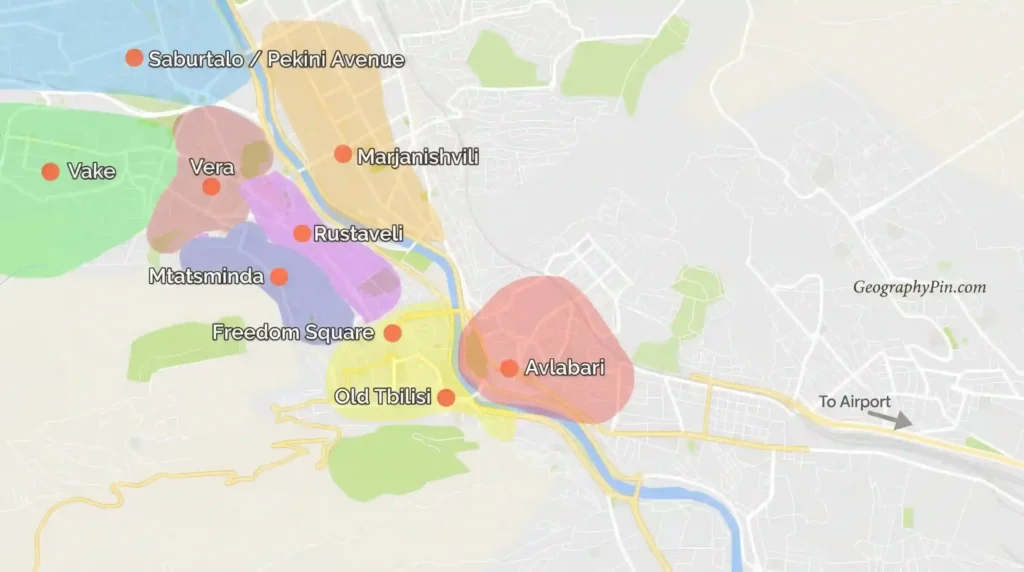
| Area | Best for | Consider before booking |
|---|---|---|
| Old Tbilisi | Historic atmosphere, bathhouses, first visits, and short stays | Steep lanes, uneven surfaces, older buildings, and possible tourist noise |
| Sololaki | Architecture, restaurants, Freedom Square access, and a residential historic feel | Many streets climb sharply and building quality varies |
| Rustaveli / Mtatsminda edge | Museums, theaters, central transport, and main-road convenience | Traffic, demonstrations near Parliament, and a less intimate atmosphere |
| Avlabari | Metro access, value, Sameba Cathedral, and proximity to Old Tbilisi | Street character and walking comfort differ significantly by block |
| Vera | Cafés, longer stays, evening options, and a less tourist-centered base | Some central sights require longer walks, metro use, or taxis |
| Vake | Families, restaurants, parks, and calmer longer stays | Farther from the historic core and less efficient for a two-day visit |
| Saburtalo | Apartments, business trips, practical services, and metro access | Limited historic atmosphere for a first sightseeing trip |
Travelers with limited mobility should examine elevation and entrance access carefully. A property described as “five minutes from Old Tbilisi” may involve steep stairs, damaged pavement, or a substantial climb.
How to get around Tbilisi without a car
You do not need a rental car for the standard Tbilisi trip. Traffic, parking, narrow streets, and central one-way roads can turn a car into a burden. Walking, metro, buses, ropeways, and taxi apps cover most visitor needs.
The standard municipal fare is 1 GEL for 90 minutes of unlimited travel on participating city transport. Payment is possible with a MetroMoney card or supported bank cards. A MetroMoney card costs 2 GEL, while day and longer-duration passes require the appropriate subscription card. The Rike–Narikala ropeway has a separate one-way fare of 2.5 GEL. Check the official Tbilisi Transport Company fare page before traveling.
Walking, public transport, taxi apps, and ropeways
| Option | Best use | Practical note |
|---|---|---|
| Walking | Old Tbilisi, Sololaki, river crossings, and short central routes | Wear shoes suitable for hills, stairs, and uneven paving. |
| Metro and bus | Moving between districts and reducing long uphill walks | Use a live route planner because road diversions can affect buses. |
| Taxi app | Airport trips, late evenings, restaurants outside the core, and luggage | Confirm the plate, driver, pickup point, and live fare before entering. |
| Rike–Narikala ropeway | Access to the ridge, Mother of Georgia area, and city views | The ropeway fare is separate from the standard municipal fare. |
| Rental car | A wider Georgia road trip after leaving Tbilisi | Usually unnecessary for the city itself. |
Best things to do in Tbilisi
The essential Tbilisi experiences combine the historic city, bathhouse district, religious landmarks, museums, viewpoints, food, and neighborhoods beyond the postcard center. Choose a manageable route instead of trying to cross every attraction off a list.
The essential Tbilisi shortlist
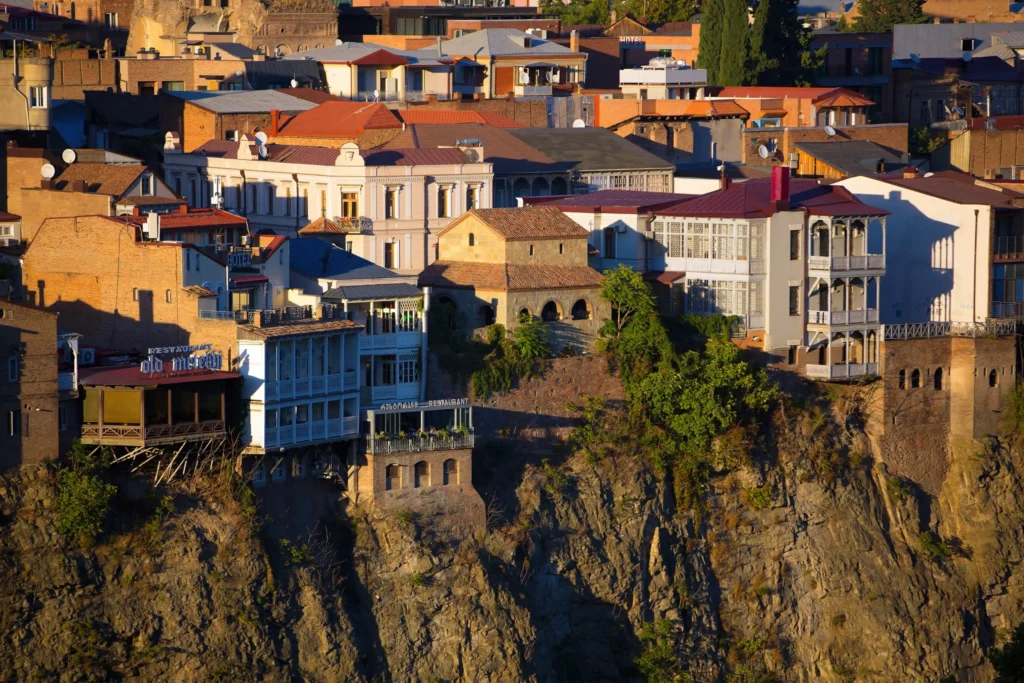
- Explore Old Tbilisi: Walk through the historic lanes around Kala, Meidan, Metekhi Bridge, and the river-facing side of the old city.
- Visit Abanotubani: See the brick bathhouse domes, continue toward the mosque and Leghvtakhevi area, and book a sulfur bath if the experience interests you.
- Ride the Rike–Narikala ropeway: Use it for the aerial view and access to the ridge near the Mother of Georgia statue, while observing current fortress restrictions.
- See Sameba Cathedral: The Holy Trinity Cathedral provides a different architectural scale and a broad view over the city from Avlabari.
- Walk Rustaveli Avenue: This is the formal central axis for theaters, government buildings, museums, and larger-scale city architecture. Avoid demonstrations and reroute if gatherings are forming.
- Choose one museum: The Georgian National Museum system or Tbilisi History Museum can provide context that the streets alone cannot. Confirm current opening hours before visiting.
- Browse Dry Bridge Market: Go for antiques, old photographs, Soviet-era objects, art, and the atmosphere rather than expecting every item to be a bargain.
- Add one second viewpoint: Mtatsminda, the upper Sololaki side, or another open viewpoint lets you understand Tbilisi’s river valley and hills from a different angle.
If you have additional time, consider the National Botanical Garden, Fabrika, Vera, Vake, the Chronicles of Georgia, or a slower architecture walk through Sololaki. The goal is not to visit everything; it is to combine major landmarks with enough ordinary street life for the city to feel coherent.
A realistic 3-day Tbilisi itinerary
This itinerary gives all three days to Tbilisi. It is designed for a first-time visitor without a rental car, staying in or near the central districts and using a combination of walking, public transport, ropeway, and taxi apps.
Day 1: Old Tbilisi, Abanotubani, and the first city view
Begin around Freedom Square, Sololaki, or the lower part of Old Tbilisi. Continue toward Meidan and Abanotubani, see the sulfur bath domes, and walk through the nearby historic streets. Cross toward Rike Park and take the ropeway if it is operating. Use the ridge for views and the Mother of Georgia area, but follow the current Narikala access restrictions.
Return to the old center for dinner. Keep the first day geographically compact rather than adding a distant museum or neighborhood.
Day 2: Rustaveli, museum time, and a sulfur bath
Walk part of Rustaveli Avenue and choose one museum, gallery, or theater-related stop. Check local news before entering the Parliament area and change the route if a demonstration is taking place. Continue toward Dry Bridge Market or another nearby central area in the afternoon.
Book a sulfur bath for late afternoon or early evening. Reserving it for the second day avoids rushing the experience on arrival night or risking a missed booking immediately before departure.
Day 3: Sameba, a second viewpoint, and neighborhood time
Start in Avlabari with Sameba Cathedral, then choose between the Botanical Garden, Mtatsminda, or a deeper walk through Sololaki. Use the remaining afternoon for Vera, Vake, Fabrika, the Chronicles of Georgia, or another place that matches your interests.
This third city day is what turns the trip from a quick collection of landmarks into a proper introduction. Finish with a Georgian meal or wine experience rather than another long transfer.
Optional Day 4: Mtskheta
If you have a fourth day, use it for Mtskheta, Jvari Monastery, and Svetitskhoveli Cathedral. This preserves three complete days for Tbilisi while adding one of Georgia’s most important historical destinations without an exhausting journey.
How to keep the itinerary realistic
- Do not schedule every major viewpoint on the same afternoon.
- Keep museum and bathhouse hours flexible enough for closures or demonstrations.
- Do not treat a late arrival as Day 1 of a three-day itinerary.
- Do not add Kazbegi to a 48-hour Tbilisi trip unless the mountains are your main reason for visiting Georgia.
Food, wine, sulfur baths, money, and SIM cards
Food and wine are not optional background details in Tbilisi; they are part of understanding Georgia. You do not need a complicated restaurant schedule, but you should leave enough time for more than one rushed meal near a major attraction.
What to eat and drink first
- Khinkali: Georgian dumplings traditionally eaten by hand. Different fillings and regional styles make them more varied than a single first plate suggests.
- Khachapuri: Georgian cheese bread with several regional versions. Adjarian khachapuri is the boat-shaped version many visitors recognize.
- Pkhali: Vegetable and walnut-based dishes that work well alongside heavier breads, dumplings, and meats.
- Mtsvadi: Georgian grilled meat, often served simply with onions and other accompaniments.
- Lobio and mchadi: Bean stew with cornbread, offering a useful alternative to the dishes most heavily promoted to tourists.
- Georgian wine: Try both familiar European-style wines and qvevri-made wine to understand the range of Georgian winemaking.
How to approach the sulfur baths
For a first visit, a private room is usually the simplest choice. Public bath areas can cost less and feel more traditional, but a private room removes uncertainty about shared spaces and etiquette. A scrub treatment is optional and normally booked separately.
Confirm the total price, room duration, towel arrangements, and treatment cost before the session begins. Book earlier in the trip so a schedule change does not eliminate the opportunity completely.
Is Tbilisi expensive?
Tbilisi can still work for budget-conscious travelers, especially because municipal transport remains inexpensive. However, central hotels, fashionable restaurants, wine bars, and short-notice accommodation should not automatically be described as “cheap.” Prices depend on season, neighborhood, and the type of experience.
The local currency is the Georgian lari, identified as GEL. Cards are useful in hotels, supermarkets, and many restaurants, but some cash remains helpful for markets, smaller businesses, tips, and places with payment problems. When an ATM or card terminal offers to convert the transaction into your home currency, paying in GEL will usually let your own bank handle the conversion instead.
SIM cards and mobile data
Georgia’s main mobile operators include Magti, Silknet, and Cellfie. Most city-focused tourist packages provide enough data for maps, taxi apps, translation, and restaurant searches. Take identification when buying a physical SIM because the operator may need to register it.
If your trip continues into mountain regions or remote villages, compare current coverage rather than choosing only by price. Download offline maps before leaving Tbilisi because mobile reception can change quickly outside major settlements.
| Topic | Practical first-trip choice | Why it helps |
|---|---|---|
| Money | Use cards but keep a modest amount of GEL | Small shops, markets, and occasional payment failures are easier to handle. |
| Mobile data | Arrange a local SIM or eSIM early | Maps, transport, translation, and taxi apps become useful immediately. |
| Sulfur bath | Reserve a private room for the first visit | It reduces uncertainty about etiquette and shared spaces. |
| Shoes | Prioritize grip and comfort | Hills, stairs, old paving, and uneven sidewalks are part of the city. |
| Current information | Recheck transport and attraction access | Schedules, prices, demonstrations, and restoration closures can change. |
Best day trips from Tbilisi
Tbilisi works well as a base, but not every major Georgian destination makes a comfortable day trip. Mtskheta is the easiest historical addition, Kakheti suits wine and countryside interests, and Kazbegi provides mountain scenery at the cost of a very long day.
Day trips compared
| Destination | Approximate road distance and time | Best for | Practical approach |
|---|---|---|---|
| Mtskheta and Jvari | Roughly 15–20 miles (25–30 kilometers); normally 30–45 minutes each way, depending on traffic | Ancient history, churches, and an easy half-day or relaxed full day | Private driver, taxi, or tour; local minibus to Mtskheta plus separate transport to Jvari |
| Kakheti and Sighnaghi | Approximately 70–75 miles (110–120 kilometers) to Sighnaghi; around 2 hours each way before stops | Wine, monasteries, countryside, and Alazani Valley views | Organized wine tour or private driver, especially if tasting wine |
| Kazbegi / Stepantsminda | About 98 miles (157 kilometers); at least 3 hours each way in favorable conditions | Gergeti Trinity Church, mountains, and Georgian Military Road scenery | Organized tour or private driver; an overnight stay is better when possible |
| Gori and Uplistsikhe | Around 53 miles (85 kilometers) to Gori, plus roughly 9 miles (15 kilometers) to Uplistsikhe | Cave-city archaeology, modern history, and a westward day route | Private driver, organized tour, or train to Gori with additional local transport |
Table downloads (7)
- Is Tbilisi the right kind of trip for you? (6 × 3)View tableDownload CSV
- Tbilisi Airport to the city: current planning comparison (5 × 3)View tableDownload CSV
- Tbilisi by season (5 × 3)View tableDownload CSV
- Where to stay in Tbilisi by trip style (8 × 3)View tableDownload CSV
- Transport options in Tbilisi (6 × 3)View tableDownload CSV
- Small decisions that make a Tbilisi trip easier (6 × 3)View tableDownload CSV
- Best day trips from Tbilisi by interest and travel time (5 × 4)View tableDownload CSV
Choose Mtskheta if you have only one spare day and want the lowest-effort addition. Choose Kakheti if wine and countryside are central to the trip. Choose Kazbegi only if you accept at least six hours of road travel or can stay overnight. Mountain weather, traffic, roadworks, and winter conditions can extend every estimate.
First-time mistakes to avoid in Tbilisi
- Relying on old airport-bus information: Bus 337 is no longer generally described as a 24-hour service. Check the live schedule before depending on it for a late arrival.
- Assuming Narikala Fortress is fully accessible: Restoration restrictions were still being reported in 2026. Separate the ropeway and ridge experience from entry to the fortress.
- Ignoring demonstrations on Rustaveli Avenue: Avoid gatherings and change your route when Parliament-area protests are forming.
- Buying insurance without checking the document: The policy needs at least 30,000 GEL of coverage and must meet Georgia’s language, date, and information requirements.
- Staying too far away during a short visit: A cheaper room can cost more in time, uphill walking, and repeated taxi trips.
- Underestimating the terrain: Distances can feel longer when a route includes steep streets, stairs, traffic crossings, and uneven paving.
- Accepting an unclear airport taxi offer: Use the municipal bus, a verified app ride, the official airport taxi, or a pre-arranged transfer.
- Giving Day 3 to Kazbegi: Three days is appropriate for Tbilisi itself. Add mountain travel after the city itinerary rather than removing a third of it.
- Trying to see every neighborhood: A smaller number of well-planned areas produces a better trip than repeatedly crossing the city for short stops.
FAQ
How many days do you need in Tbilisi?
Allow three full days for a first visit. Two days can cover the main historic sights, but three provides enough time for Old Tbilisi, Rustaveli, a museum, a sulfur bath, Sameba Cathedral, and a second neighborhood or viewpoint.
What is the best time to travel to Tbilisi?
Spring and fall provide the most practical walking weather. May and September through October are especially useful starting points, while summer requires early sightseeing and slower afternoons because Tbilisi can become very hot.
Is Tbilisi safe for tourists?
Many travelers visit without serious problems, but demonstrations remain a current concern around Parliament and Rustaveli Avenue. Avoid political gatherings, monitor local information, use normal city precautions, and check your government’s latest Georgia travel advisory.
What is the easiest way from Tbilisi Airport to the city center?
Bus 337 is the lowest-cost option during operating hours, with a 1 GEL municipal fare. A taxi app is the simplest door-to-door choice, especially at night or with luggage. Verify the bus schedule because it is not normally treated as a 24-hour service.
Where should first-time visitors stay in Tbilisi?
Old Tbilisi and nearby Sololaki are the strongest choices for historic atmosphere and short-stay convenience. Rustaveli suits museums and transport, while Avlabari can offer useful metro access and value. Examine the exact street because hills and noise vary by block.
Do you need a car in Tbilisi?
No. Walking, metro, buses, ropeways, and taxi apps are normally sufficient. A rental car becomes more useful when leaving Tbilisi for a wider Georgia road trip.
Is Tbilisi expensive to visit?
Tbilisi can suit a moderate budget, particularly because public transport is inexpensive. Accommodation, fashionable restaurants, wine bars, and private tours vary widely, so compare current prices instead of relying on older descriptions of Tbilisi as uniformly cheap.
Is a sulfur bath in Tbilisi worth it?
Yes, if you are comfortable with the experience. The sulfur baths are closely connected to Tbilisi’s history and identity. A private room is the simplest first option, and any scrub treatment should be confirmed and priced separately.
What is the best day trip from Tbilisi?
Mtskheta is the easiest first day trip because it is close and historically important. Kakheti is better for wine and countryside, while Kazbegi offers the strongest mountain scenery but requires a long day or an overnight stay.
Is Narikala Fortress open in 2026?
The fortress interior was still reported closed for rehabilitation when this guide was checked in July 2026. The ropeway, ridge, Mother of Georgia area, and nearby viewpoints may still be visited, but check current local information before planning to enter the fortress.
What Did We Learn Today?
A first trip to Tbilisi works best with three full city days, accommodation near the central visitor areas, a confirmed airport plan, and realistic routes built around Old Tbilisi, Abanotubani, Rustaveli Avenue, Sameba Cathedral, one museum, Georgian food, wine, and a sulfur bath. Travelers visiting in 2026 must also check Georgia’s mandatory insurance rules, current demonstrations, live transport schedules, and Narikala’s restoration access. Add Mtskheta on a fourth day, choose Kakheti for wine country, and give Kazbegi an overnight stay whenever possible.
Sources & Data Notes
This guide was written by Z.K. Atlas and checked for GeographyPin using Georgia’s official tourism and consular information, Tbilisi International Airport, Tbilisi Transport Company, current government travel advisories, mapping references, and current reporting on Narikala’s rehabilitation. Entry rules, insurance requirements, demonstrations, fares, schedules, taxi prices, attraction access, mobile packages, road conditions, and travel times can change after publication, so time-sensitive details should be confirmed before departure. Distances are approximate road distances from central Tbilisi. Some maps or visual edits may use AI-assisted design tools under editorial review.