Edinburgh fits best as a compact city break rather than a rushed stop on a longer route. Most people searching this topic are really trying to answer a handful of practical questions at once: when to go, where to stay, how to get in from the airport, and whether the city needs two days or three to feel complete.
Travel to Edinburgh works best as a 2–3 day city break built around walking, public transport, and advance booking for the busiest sights. For most first visits, May, June, and September give the strongest balance of weather, daylight, and manageable crowd levels, while August suits travellers who specifically want festival season.
How to use this article: If you want the planning answers first, jump to the trip-shape check, the best season choice, the airport transfer comparison, or the 2-day vs 3-day decision.
Edinburgh at a Glance
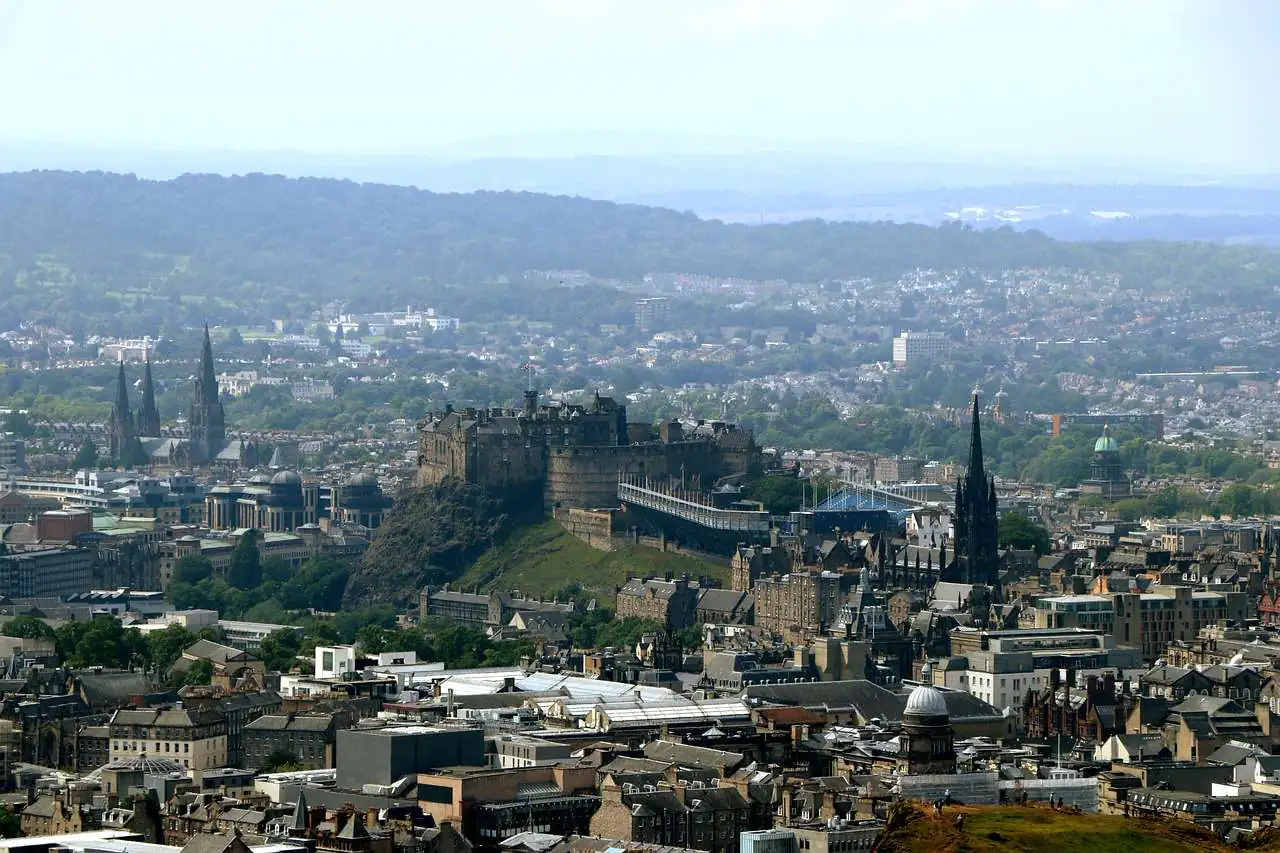
Edinburgh’s main advantage is concentration. The city’s best-known historic core, museum zone, viewpoints, and many of its strongest hotel areas sit close enough together that a short stay can still feel full. The city’s character also comes from a very clear contrast: the medieval Old Town and the Georgian New Town stand side by side, which is a big part of why the centre feels so distinctive on a first visit.
A quick trip-shape check
| Trip type | Best if this sounds like you | Strong default choice |
|---|---|---|
| 2-day city break | You want the classic Edinburgh experience without overextending the schedule | Stay central and keep the trip focused on Old Town, one museum block, and one viewpoint |
| 3-day first trip | You want the essentials plus one slower neighbourhood or waterfront layer | Base yourself in Old Town or New Town and add Leith or Stockbridge on day three |
| Festival trip | You care more about August atmosphere and events than low-friction sightseeing | Book early and stay as central as your budget allows |
| Scotland add-on | Edinburgh is one stop inside a longer route | Stay near Waverley or use a simple airport-to-centre transfer |
When to Go
For most travellers, the best balance comes in late spring or early autumn. Official climate averages show that late spring and summer are milder than winter, but crowd pressure matters just as much as temperature in Edinburgh. August is the city’s most event-heavy month, and that changes accommodation pressure, street activity, and the overall feel of the trip.
The best season choice
| What matters most | Best timing |
|---|---|
| Best overall first trip | May, June, or September |
| Festival atmosphere | August |
| Lower-pressure sightseeing | Late spring or early autumn |
| Winter city-break mood | December and New Year season |
The key trade-off is simple: August brings the Fringe and a very different atmosphere, but it is usually not the easiest month for a calm first trip. The 2026 Edinburgh Festival Fringe runs from 7 to 31 August.
Getting to Edinburgh
Most visitors arrive through Edinburgh Airport or Edinburgh Waverley. Waverley is the simpler arrival if you are already travelling by rail because it places you directly in the city centre. Airport arrivals are also straightforward, but they add one more practical decision at the start of the trip: tram, Airlink, or taxi.
If you are flying in from abroad, entry rules matter before you book. An ETA allows eligible visitors to travel to the UK for tourism for up to six months. GOV.UK says the ETA costs £16 at present and rises to £20 from 8 April 2026.
From the Airport or Station to the Centre
The tram is usually the cleanest first-arrival option because it is predictable and simple with luggage. Edinburgh Airport says trams run every 7 minutes from 7am to 7pm and every 10 minutes early and late, with the first departure from the airport at 06:26 and the last at 22:48. Official tram ticket sales currently list an adult airport single from £7.50 online.
The airport transfer comparison
| Choose this | If this matters most |
|---|---|
| Tram | Predictable routing and a low-friction first arrival |
| Airlink 100 | 24/7 service and a lower airport-bus fare |
| Taxi | Door-to-door ease with heavy luggage or late-night arrival |
| Waverley arrival | You want to begin in the middle of the city with no extra transfer |
The Airlink 100 is the stronger bus option if you want round-the-clock service. Lothian’s visitor guide describes it as a 24/7 airport express and lists an adult airport single at £5.50, an adult open return at £8.00, and an adult Network DAYticket at £12.50.
Where to Stay
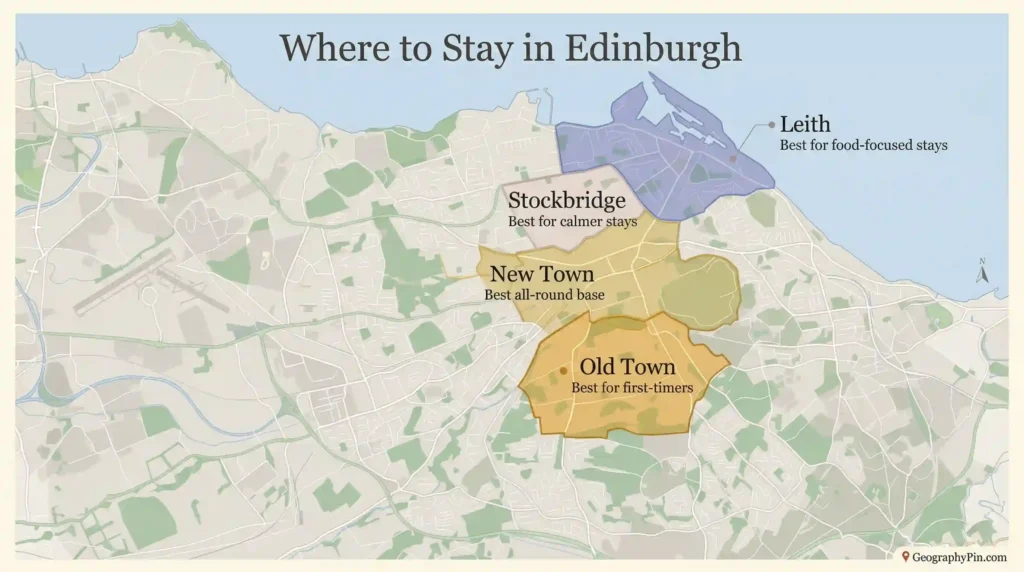
Location matters more than hotel style for a first Edinburgh trip. Old Town and New Town are still the strongest default answers because they keep the main sights, the station area, and most short-trip logistics within easy reach. Leith becomes more attractive when the trip is more food-led, more local in feel, or part of a repeat visit rather than a first one.
| If you are this kind of traveller | Best area | Why it fits |
|---|---|---|
| First-timer | Old Town or New Town | Best access to the main Edinburgh experience |
| Short rail-based trip | Central Old Town or New Town edge | Less transfer friction on arrival and departure |
| Food-focused repeat visit | Leith | Stronger waterfront and restaurant rhythm |
| Calmer stay | Stockbridge or a quieter central edge | A slower evening pace without losing the centre completely |
Top Things to Do
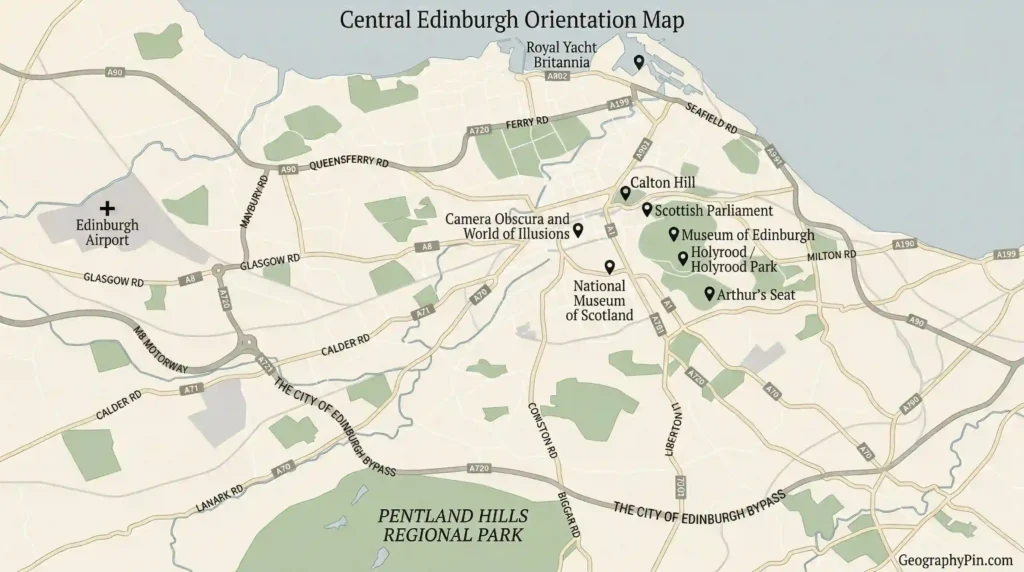
The strongest first Edinburgh plan is not a long attraction list. It is a balanced core: Edinburgh Castle, the Royal Mile spine, one viewpoint, one major museum stop, and one slower neighbourhood or waterfront layer. That structure matches the way official destination pages and short-itinerary pages already frame the city.
Edinburgh Castle is one of the few places where advance booking matters a lot. The official site says tickets often sell out far in advance, especially over the summer months, and that once online tickets are sold out there are no further tickets available at the castle. National Museum of Scotland is the opposite kind of stop: central, high-value, and free to enter.
For viewpoints, choose by energy level. Calton Hill is the easier panorama. Arthur’s Seat is the stronger landscape experience and helps Edinburgh’s volcanic setting make visual sense on the ground, but it takes more time and effort than the city-centre lookout options.
Getting Around Edinburgh
Edinburgh is highly walkable, but it is not flat. Hills, steps, and cobbled stretches make clustered sightseeing smarter than constant zigzags. A short-looking route on a map can feel much longer once you add gradients, weather, and queues at the main sights.
For day-to-day transport, contactless payment is usually the easiest option. Lothian currently lists an adult City DAY at £6.00 and a TapTapCap at £5.70 for city travel, while standard airport travel remains separate. Edinburgh Trams also announced 2026 city fare changes, including a City Zone single at £2.40 and City Zone day travel at £4.60 in tram-only ticketing products.
Costs, Food, and Money
Edinburgh is not a bargain city, but it is manageable if you control the main variables early: the month you travel, how central you stay, and how many paid sights you stack into the same day. August is usually the point where hotel pressure becomes most obvious. Outside peak festival season, the city is easier to shape into a balanced mid-range trip.
| Style | What it usually means in Edinburgh |
|---|---|
| Lean | Simple room, heavy walking, one major paid sight, and strong use of free museums |
| Balanced | Central hotel, a mix of paid and free stops, pub meals plus one stronger dinner |
| Higher-end | Boutique central stay, more ticketed sights, taxis when helpful, and restaurant reservations |
Card payment is standard across the city, so cash rarely needs to shape your day. Food-wise, the best planning distinction is between classic first-trip areas such as Old Town and the more restaurant-driven feel of Leith. That helps much more than chasing one “best restaurant” list inside a general travel guide.
Practical Tips, Safety, and Accessibility
Edinburgh is usually straightforward for independent travel. The bigger challenge is physical rather than procedural: the city’s terrain, weather shifts, and older street surfaces can make a packed day feel heavier than expected. Good shoes and a waterproof layer matter more here than overcomplicated planning.
For accessibility, pre-checking routes and attraction details is worth the effort. Forever Edinburgh provides accessible planning resources, Edinburgh Trams says every tram has two dedicated spaces for wheelchairs or mobility scooters, and Lothian says its buses have at least one wheelchair-accessible space. That means the public-transport system is workable, but planning ahead still help.
For emergencies, the UK uses 999 and 112. If you are travelling with children by car, the general rule is that a child car seat is normally required until age 12 or 135 centimetres (4 feet 5 inches), whichever comes first.
2-Day and 3-Day Edinburgh Itineraries
Edinburgh can support longer stays, but for most travellers the real decision is between two days and three. Official tourism pages already publish both weekend and 72-hour Edinburgh itineraries, which is a useful signal that both trip lengths fit real travel behaviour. For a first visit, though, three days is usually the stronger answer because it lets the city breathe a little.
The 2-day vs 3-day decision
| If you have… | What it realistically gives you |
|---|---|
| 2 days | A strong first Edinburgh experience if you stay central and keep the plan tight |
| 3 days | A better first trip because you can add one slower neighbourhood or waterfront layer |
| 4+ days | Room for a proper day trip or a much looser pace |
Table downloads (6)
- Which version of Edinburgh fits your trip? (5 × 3)View tableDownload CSV
- Best season by travel goal (5 × 2)View tableDownload CSV
- Best arrival choice by need (5 × 2)View tableDownload CSV
- Best area to stay by trip type (5 × 3)View tableDownload CSV
- A better budget framework than one rigid daily figure (4 × 2)View tableDownload CSV
- How much time really changes the trip? (4 × 2)View tableDownload CSV
A strong 2-day shape: Day one for Edinburgh Castle, the upper Royal Mile, and the museum core; day two for the lower Royal Mile, Holyrood side, and one viewpoint. A stronger 3-day shape: keep those first two days, then add New Town plus Leith, or a slower Dean Village and Stockbridge day. That usually makes the city feel complete instead of compressed.
FAQ
Is Edinburgh better as a weekend or a three-day trip?
A weekend works well, but three days is better for a first visit because it gives you room for the classic sights and one calmer neighbourhood layer.
What is the best month to visit Edinburgh?
For most people, May, June, and September are the strongest all-round choices. August is the better answer only if the festivals are central to the trip.
Should first-timers stay in Old Town or New Town?
Either works. Old Town is stronger on atmosphere and immediate landmark access, while New Town is usually easier for movement and a more balanced base.
Is the tram better than Airlink from the airport?
The tram is usually the simplest first-arrival option. Airlink is stronger if you need 24/7 service or want the cheaper airport-bus fare.
Do you need a car in Edinburgh?
No. For most short stays, Edinburgh works best on foot plus public transport, especially if you stay centrally and plan the days by area.
What Did We Learn Today?
Travel to Edinburgh becomes much easier once the trip is treated as a practical 2–3 day city break instead of a vague “see everything” plan. Pick the right season, stay central, use the airport transfer that matches your arrival, and build each day around one part of the city rather than trying to cross the whole map repeatedly.
Sources & Data Notes
I shaped this page around official destination and transport sources first, especially Forever Edinburgh, VisitScotland, Edinburgh Airport, Edinburgh Trams, Lothian Buses, GOV.UK, the Met Office, Historic Environment Scotland, National Museums Scotland, and Edinburgh Castle. Prices, entry rules, and transport details can change, so some figures are best treated as planning guidance and newer releases may shift specifics. I also used AI to tighten the structure and sharpen the decision-making flow, but not to invent fares, entry rules, or local facts.