Singapore, Switzerland and the Netherlands are the clearest broad-based examples, while Sweden, Denmark, Israel and Estonia stand out in innovation; Norway, the United Arab Emirates, Qatar and Ireland in specialized economic or strategic reach; and Jamaica, Uruguay, New Zealand and Iceland in culture or sport. There is no authoritative overall ranking because the result depends on what influence means.
How to use this article: Apply the quick three-part test, scan the broadest all-round cases, compare specialists with generalists, or run the false-positive check.
What Does “Punch Above Population Size” Mean?
A country punches above its population size when its share of an important global result is substantially greater than its share of the world’s people. The result might be exports, scientific output, technological innovation, financial activity, diplomatic access, energy supply, cultural reach or sporting achievement.
That is different from simply being rich. GDP per person measures output relative to population, but it does not show whether other countries depend on, imitate or respond to that economy. GeographyPin’s comparison of the world’s richest countries by different measures explains why high per-capita GDP and international influence should not be treated as the same question.
A quick three-part test
A persuasive case should pass more than one flattering per-capita calculation:
- Scale mismatch: The country produces, controls, hosts or influences far more than its population share would suggest.
- Persistence: The advantage survives for several years rather than resting on one tournament, commodity-price spike or unusually successful company.
- External consequence: Governments, firms or audiences elsewhere would notice if the country’s contribution suddenly disappeared.
Countries that pass all three tests across several unrelated fields are broad overperformers. Those that pass them in one important field are better described as specialists.
Small population is not enough
Most examples below have fewer than 20 million residents because the mismatch is especially visible at that scale. The threshold is a practical editorial boundary, not an international standard, and larger countries such as the United Kingdom, France and South Korea can also outperform their population share.
This is also not a list of the smallest countries by land area. Many microstates are wealthy, famous or diplomatically distinctive, but smallness alone does not prove sustained international reach.
The Strongest Cross-Domain Shortlist
The shortlist separates broad influence from narrower strategic or technological strength. Approximate populations are included only to show scale; they are rounded from recent United Nations, World Bank and national estimates, whose treatment of temporary and nonresident populations can differ.
The broadest all-round cases
Singapore, Switzerland and the Netherlands have the most balanced cases. Each combines international trade or finance with high innovation performance, major transport or institutional networks, and influence that is not dependent on one sport, resource or company.
| Country | Approximate population | Strongest channels | How to classify the case |
|---|---|---|---|
| Singapore | 6.1 million | Trade, shipping, aviation, finance and innovation | Broad, with gross trade amplified by its hub role |
| Switzerland | 9.0 million | Innovation, pharmaceuticals, finance and diplomacy | Broad, partly strengthened by institutions based in Geneva |
| Netherlands | 18.1 million | Trade, logistics, technology, finance and international law | Broad, with re-exports and European integration adding scale |
| Sweden | 10.6 million | Research, technology, global brands, design and music | Innovation-led but spread across several industries |
| Denmark | 6.0 million | Shipping, pharmaceuticals, engineering and clean technology | Innovation-led with several powerful industry clusters |
| Israel | About 10 million | Research, venture capital, cybersecurity and life sciences | Technologically strong, with substantial security influence |
| Estonia | 1.4 million | Digital government, cybersecurity and startups | A small but unusually visible digital specialist |
| Norway | 5.6 million | Energy, maritime industries, global investment and diplomacy | Strategic, with resources and accumulated capital central to its reach |
| United Arab Emirates | 11.3 million | Aviation, ports, finance, investment and regional diplomacy | A highly connected hub with influence concentrated in a few sectors |
| Qatar | 3.1 million | Liquefied natural gas, aviation, media and mediation | A powerful specialist whose reach depends heavily on energy |
| Ireland | 5.5 million | Pharmaceuticals, technology services, investment and culture | Genuinely connected, although multinational accounting enlarges headline figures |
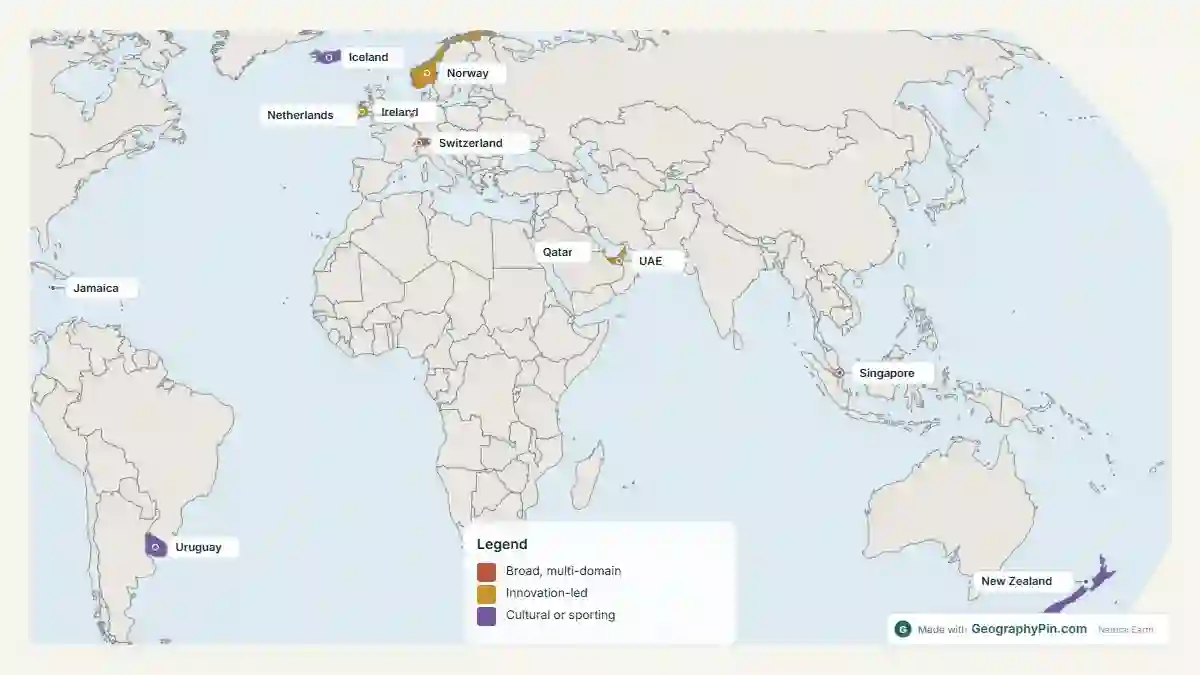
The table is not a numbered power ranking. Moving from trade to culture, military capability or sport changes the shortlist because each field measures a different kind of reach.
Singapore, Switzerland and the Netherlands
Singapore: the clearest numerical mismatch
Singapore had about 6.11 million residents and exported approximately $504.8 billion in merchandise during 2024. That was about 2.1% of the world’s $24.43 trillion in merchandise exports, while Singapore contained roughly 0.075% of the world’s population. Its export share was therefore about 28 times its population share, using the same year for both sides of the calculation.
Gross exports are not the same as domestic value added: goods can be imported, processed lightly or transferred onward. That qualification is central to Singapore’s case rather than fatal to it, because its importance comes partly from connecting producers and buyers across Asia and the wider world.
Singapore handled 41.12 million twenty-foot-equivalent container units in 2024, with around 90% associated with transshipment, retaining its position as the world’s largest container transshipment hub. WIPO also placed it fifth in the 2025 Global Innovation Index and first on 10 of the index’s 78 indicators.
Switzerland: innovation joined to institutional reach
Switzerland led WIPO’s Global Innovation Index for the fifteenth consecutive year in 2025. Its strength extends through pharmaceuticals, precision engineering, research, finance and high-value brands rather than one dominant export alone.
Geneva adds another layer by hosting the United Nations Office at Geneva, the World Trade Organization, the World Health Organization, the International Committee of the Red Cross and many other international bodies. Hosting an institution does not mean controlling it, but it creates durable diplomatic networks and places Switzerland at the center of negotiations far beyond what a population of about nine million would normally suggest.
The Netherlands: the gateway effect
Dutch goods exports reached €666.5 billion and services exports €306.6 billion in 2024. Rotterdam, Amsterdam Schiphol Airport, financial networks and close access to Germany and the wider European market make the Netherlands a major entry and distribution point.
The Hague also hosts the International Court of Justice, International Criminal Court and Organisation for the Prohibition of Chemical Weapons. As with Geneva, this institutional geography strengthens visibility and access without turning the host government into the decision-maker.
A substantial part of Dutch goods trade consists of re-exports, so headline export values should not be presented as entirely Dutch production. Even after that adjustment, the infrastructure, specialist firms and legal institutions behind those flows support a broad case for outsized influence.
Innovation Multipliers: Sweden, Denmark, Israel and Estonia
Innovation rankings are useful here because they combine research, institutions, investment, technology outputs and creative activity. They should still be treated as structured evidence rather than a complete measurement of national power.
Sweden and Denmark
Sweden ranked second in WIPO’s 2025 index, supported by researchers, business sophistication, research spending, knowledge-intensive employment and valuable global brands. Denmark ranked ninth, with especially strong results in institutions, information-technology access and online creativity.
The two countries also convert knowledge into internationally important companies and specialist industries. Sweden’s influence spreads across telecommunications, industrial technology, consumer brands, music and design. Denmark combines shipping, pharmaceuticals, engineering, food systems and wind-energy expertise. Their strength is more durable than a single per-capita statistic because several independent sectors reinforce it.
Israel and Estonia
Israel ranked fourteenth in the 2025 Global Innovation Index and placed first on WIPO indicators covering research-and-development expenditure, venture capital received, university–industry research collaboration and business-performed research. Its technological reach is concentrated in fields such as software, cybersecurity, defense technology and life sciences.
Estonia ranked sixteenth despite having only about 1.4 million residents. WIPO placed it second for information-technology use, third for government online services and first on its venture-capital-received and venture-capital-investor indicators. Its digital-government systems and cybersecurity institutions have given the country an international profile far larger than its domestic market.
Neither case should be converted into a claim that technological strength automatically produces broad approval, equal prosperity or diplomatic power. It shows that a focused research and institutional system can create global relevance without a large home population.
Strategic Leverage: Norway, the UAE, Qatar and Ireland
Specialists can matter as much as generalists
A specialist country may lack Switzerland’s or Singapore’s breadth yet still occupy a position that much larger states cannot easily replace. Energy routes, investment capital, air connections, medicines and digital services can all create this form of leverage.
Norway: energy converted into global capital
Norway combines oil and gas exports, maritime expertise, Arctic geography and a large state investment fund. Norges Bank Investment Management reports that the Government Pension Fund Global owns, on average, about 1.5% of shares in the world’s listed companies and holds investments in roughly 7,200 companies.
This gives a country of about 5.6 million residents a financial presence across much of the global corporate economy. The achievement also depends heavily on petroleum income, disciplined saving and favorable resource geography, so it cannot be copied simply by adopting the same administrative model.
The United Arab Emirates and Qatar: hub power and energy power
The United Arab Emirates has built influence around ports, airlines, finance, investment and its location between Europe, Asia and Africa. Dubai International handled about 95.2 million international passengers in 2025, making it the world’s busiest airport for international passenger traffic despite the UAE having around 11 million residents (Airports Council International, 2026).
Qatar presents an even sharper sector mismatch. It was the world’s second-largest liquefied-natural-gas exporter in 2024 and supplied nearly one-fifth of global LNG exports, while its resident population was only about 3.1 million. International broadcasting, aviation and mediation broaden its reach, but energy remains the foundation of its leverage.
Both countries have large expatriate populations. Comparing influence only with the number of citizens would produce a much larger ratio, but total resident population is the more consistent denominator for comparisons with other states.
Ireland: real reach behind distorted statistics
Ireland ranked eighteenth in WIPO’s 2025 innovation index, including first-place indicator results for information-and-communication-technology service exports and intellectual-property payments. Medical and pharmaceutical products accounted for 45% of Irish goods exports in 2024, showing genuine importance in high-value international supply chains.
However, multinational ownership and the location of intellectual property inflate conventional GDP. Ireland’s modified gross national income, designed to remove major globalization effects, equaled only about 57% of GDP in 2024. Ireland still punches above its population size, but headline GDP is the wrong evidence to use without that correction.
Cultural and Sporting Influence Changes the List
Changing the numerator from trade or technology to culture or sport produces different winners. These countries should not automatically be called geopolitical powers, but their international recognition is unmistakably large relative to their populations.
Jamaica, Uruguay, New Zealand and Iceland
- Jamaica: A country of fewer than three million people has shaped global popular music through reggae and related forms while building an exceptional sprinting tradition. UNESCO inscribed reggae music of Jamaica on its Representative List of the Intangible Cultural Heritage of Humanity in 2018.
- Uruguay: With roughly 3.4 million residents, Uruguay won the men’s FIFA World Cup in 1930 and 1950 and maintains one of international football’s strongest records relative to population.
- New Zealand: A population of about 5.3 million supports globally recognized film, tourism and agricultural identities as well as a national rugby team that won the men’s Rugby World Cup in 1987, 2011 and 2015.
- Iceland: With fewer than 400,000 residents, Iceland reached the quarterfinals of UEFA Euro 2016 on its major-tournament debut. That achievement is a striking sporting example, although one tournament cannot prove broad national influence.
Jamaica, Uruguay and New Zealand have the strongest cases here because their cultural or sporting records extend across generations. Iceland illustrates the narrower meaning of overperformance: an extraordinary result relative to a tiny player pool, but not evidence of equivalent economic or diplomatic reach.
Where Population-Adjusted Comparisons Go Wrong
Per-capita comparisons are powerful because they reveal scale mismatches, but the smallest denominator can also produce the most misleading headline.
The false-positive check
- Residents and citizens are mixed: Qatar and the UAE look dramatically different if only citizens are counted. Consistent comparisons should normally use all residents.
- Gross flows are treated as domestic production: Singaporean and Dutch export totals include re-exports and hub activity. Those flows prove connectivity, but not that every exported dollar was created locally.
- Corporate accounting is mistaken for household prosperity: Ireland’s GDP and intellectual-property flows are affected by multinational structures.
- Institutional location is confused with control: Switzerland and the Netherlands benefit from hosting major international bodies without controlling their decisions.
- One exceptional year becomes a permanent label: A tournament run, commodity boom or temporary policy can produce a dramatic ratio that later disappears.
- Closely related indicators are counted repeatedly: Exports, port traffic and logistics income may describe the same underlying hub function rather than three independent strengths.
Luxembourg illustrates the denominator problem particularly well. Cross-border workers make up about 43% of its workforce, so they add to production without being included in the resident-population denominator used for GDP per person. This does not erase Luxembourg’s financial importance, but it makes simple per-resident comparisons look stronger than the underlying mismatch.
The Holy See and Vatican City form an even less comparable case. Their international significance comes from a worldwide religious institution, not from the productive or diplomatic capacity of Vatican City’s tiny resident population. Dividing that reach by fewer than 1,000 residents creates a spectacular number that answers little about ordinary state power.
The safest conclusion therefore names the field, population definition, evidence year and limitation. “Qatar punches above its population in LNG” is defensible; “Qatar is the most influential small country” requires a value judgment and a weighting system that no international authority has established.
Frequently Asked Questions
Is there an official ranking of countries that punch above their population?
No. International organizations rank individual subjects such as innovation, trade, military capability or sport, but there is no accepted formula combining them into one population-adjusted influence score.
Which country has the strongest all-round case?
Singapore is probably the clearest numerical example because its trade, shipping, aviation, finance and innovation roles are all large relative to about six million residents. Switzerland and the Netherlands are equally credible choices if diplomacy, research or international institutions receive more weight.
Why are Luxembourg and Vatican City not placed at the top?
Their denominators are unusually difficult to compare with normal states. Luxembourg relies heavily on nonresident workers, while Vatican City’s reach comes from the worldwide Catholic Church rather than its resident population.
Should military power count as influence?
It can, but capability, actual use and political influence should be separated. Military reach is also not evidence that a country’s influence is beneficial, popular or economically sustainable.
Can a fairly populous country still punch above its size?
Yes. The United Kingdom and France retain unusually extensive diplomatic, military, financial and cultural reach, while South Korea has major technological and cultural influence. The mismatch is simply less visually dramatic than it is for a country with five or ten million residents.
What Did We Learn Today?
Singapore, Switzerland and the Netherlands make the strongest broad-based cases for influence beyond population size, while Sweden, Denmark, Israel and Estonia lead through innovation; Norway, the UAE, Qatar and Ireland through specialized strategic sectors; and several smaller countries through culture or sport. The useful comparison is not one universal ranking but a stated measure tested for persistence, external importance and statistical distortions.
Sources & Data Notes
Population baselines were checked against UN DESA’s World Population Prospects 2024, World Bank series and relevant national figures; innovation evidence came from WIPO’s 2025 Global Innovation Index; trade and industry figures came from the WTO, Statistics Netherlands and Ireland’s Central Statistics Office; sector evidence came from the Maritime and Port Authority of Singapore, Airports Council International, the U.S. Energy Information Administration and Norges Bank Investment Management; cultural and sporting records were checked through UNESCO, FIFA, UEFA and World Rugby. Populations are rounded, trade values are gross flows, and the Singapore share comparison is a GeographyPin calculation from cited 2024 totals. Zurab Koniashvili (Z.K. Atlas) completed the final factual and editorial review and accepts responsibility for publication; AI tools may have assisted with language refinement and the creation or editing of visual materials.