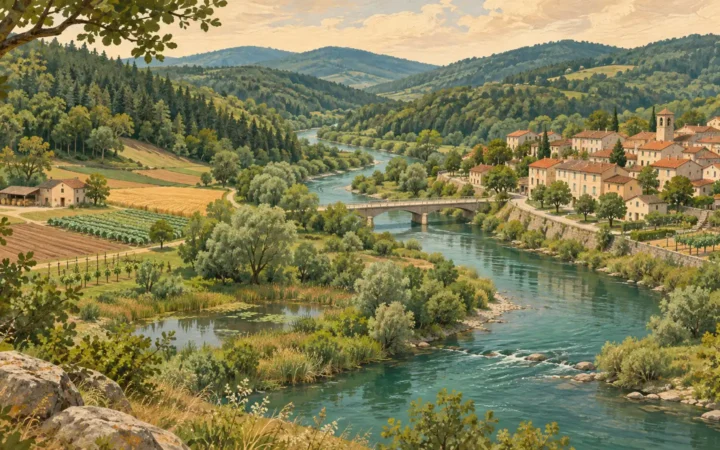
This hydrology quiz tests how water moves, where it is stored and how people change its path. Work through 20 questions on catchments, river flow, groundwater, lakes and water use, with explanations and a score out of 20.
Hydrology studies water and its movement through the environment. This geography-focused set combines core concepts with hypothetical water budgets and practical scenarios. It tests processes and interpretation rather than river-length records or lake-name trivia.
Follow the water. Test your reasoning.
20 questions · No timer · One point per correct answer
Easy, Medium and Hard are relative editorial difficulty levels for general geography learners, not standardized ratings. Every correct answer earns one point.
Choose an answer, then open “Show answer” to check it yourself. Interactive scoring appears when JavaScript is available.
Choose one answer, select Check answer, then continue to the next question.
Your Hydrology quiz result
Easy
Show answer
Correct answer: Water held in a reservoir at a particular moment.
A store is the amount of water held in a place at a given time. Rainfall, evaporation and river discharge describe transfers into, out of or between stores. Keeping amounts separate from rates is essential for a water budget.
Easy
Show answer
Correct answer: A drainage divide between catchments.
A drainage divide separates land draining toward different outlets. A catchment, also called a drainage basin or watershed, is the land area draining to a chosen outlet. This question concerns surface drainage, not the separate problem of mapping groundwater boundaries.
Medium
Show answer
Correct answer: There is little unfilled soil storage left to accept more water.
Infiltration is water entering the soil. When saturation reaches the surface, little additional pore storage remains, so further rain can run over the ground. This differs from runoff caused when rain falls faster than an unsaturated soil can absorb it.
Easy
Show answer
Correct answer: Evaporation from surfaces and transpiration through plants.
Evapotranspiration combines evaporation, including from soil and surface water, with transpiration through vegetation. Both transfer water to the atmosphere. Infiltration and runoff move water along different parts of the water cycle.
Hard
Show answer
Correct answer: An increase of 100 mm.
Storage change = inputs − outputs = 900 − 550 − 250 = +100 mm. The positive sign means water accumulated in the basin. All amounts cover the same year and basin area; infiltration within the basin redistributes water rather than creating a new external input.
Medium
Show answer
Correct answer: 12 m³/s.
Discharge = cross-sectional area × mean velocity = 24 m² × 0.5 m/s = 12 m³/s. Velocity alone gives speed, while discharge measures water volume passing per unit time. The velocity must represent the cross section, not just one fast surface point.
Medium
Show answer
Correct answer: 4 hours.
Using the definition given, lag is 17:00 − 13:00 = 4 hours. A discharge hydrograph shows how river flow changes through time. Hydrologists use several lag conventions, so the reference points must be stated before comparing values.
Easy
Show answer
Correct answer: Groundwater seeping into the channel from surrounding aquifers.
Groundwater can discharge slowly into a river and sustain flow between storms. This contribution is often called baseflow. It is different from the rapid response to a new rainfall event, and its importance varies with the catchment’s geology and climate.
Medium
Show answer
Correct answer: Less infiltration and a faster rise in river flow.
Paved surfaces reduce opportunities for infiltration, and connected drains move runoff quickly into channels. That combination commonly makes the storm response faster. The size of the change still depends on the basin, storm and drainage design.
Hard
Show answer
Correct answer: It has an estimated 1% annual chance of being equaled or exceeded under the analysis assumptions.
The return period describes probability, not a timetable: a 100-year flood corresponds to a 1% annual exceedance probability. Its estimated discharge is uncertain because records, measurements and statistical fits are limited. Land-use or climate changes can also alter the probability relationship.
Medium
Show answer
Correct answer: Pore size and connections can differ even when porosity is similar.
Porosity describes the proportion of open space. Permeability describes how readily water can pass through the material, which depends on the size and connections of pores or fractures. Similar pore-space amounts therefore do not guarantee similar groundwater movement.
Easy
Show answer
Correct answer: The upper surface of the main saturated groundwater zone.
The water table is the upper surface of the saturated groundwater zone in an unconfined aquifer. Soil above it may still contain moisture in an unsaturated zone. The water table can rise or fall as recharge and discharge change.
Hard
Show answer
Correct answer: The aquifer is under artesian pressure, but the well is not a flowing artesian well.
Confinement by poorly permeable layers can keep groundwater under pressure. A well may rise above the top of the confined aquifer yet stop below land level. Artesian conditions do not necessarily mean that water flows out at the surface without pumping.
Medium
Show answer
Correct answer: It decreases.
The aquifer’s water budget has a net outflow, so stored water decreases. Groundwater can be renewable, but replenishment is not automatically fast enough to match withdrawals. Real pumping can also change river exchange and natural discharge, which is why all inputs and outputs matter.
Hard
Show answer
Correct answer: Groundwater flows toward the stream, making it a gaining reach.
Water moves in response to differences in hydraulic head. With the stated connection and higher nearby groundwater level, groundwater tends to discharge into the stream. A reach can switch between gaining and losing as groundwater levels and river stage change.
Easy
Show answer
Correct answer: It has no surface-water outlet to an external drainage system.
An endorheic basin has closed surface drainage: streams may flow into an inland lake or depression, but no surface outlet carries water out of the basin. Closed drainage does not mean that water cannot leave by evaporation or subsurface pathways.
Medium
Show answer
Correct answer: 3 years.
Nominal residence time = 6 million m³ ÷ 2 million m³/year = 3 years. This is a bulk turnover timescale under the steady-flow assumption, not a promise that every parcel of water remains exactly three years. Mixing and flow paths make real water ages vary.
Medium
Show answer
Correct answer: Cooling reduces the density contrast that resisted vertical mixing.
As the warm surface cools toward the deep-water temperature, the density difference weakens and wind can mix water more deeply. This helps explain autumn turnover in suitable temperate lakes. It does not mean that every lake mixes completely or overturns twice each year.
Medium
Show answer
Correct answer: Aerobic respiration by decomposing microorganisms.
Nutrient enrichment can stimulate algal growth. Microorganisms use oxygen while decomposing the resulting dead organic matter, potentially leaving too little for aquatic animals. The sequence matters: nutrient input can cause an oxygen problem through biological growth and decay.
Medium
Show answer
Correct answer: Withdrawal 100 m³; consumptive use 20 m³.
Withdrawal is the full 100 m³ taken from the river. The 80 m³ return flow remains in the local water system, while the 20 m³ that evaporates is consumptive use for this accounting. Water quantity accounting alone does not establish the quality of the returned water.
Use your results to understand water systems
Each correct answer earns one point, with no penalty for a wrong answer. At the end, select Review answers to see every question and explanation, or Try again to replay the same set. The quiz does not save your score between visits.
- Separate stores from flows. A reservoir volume is an amount; discharge is a volume per unit time. Match the time period and area before closing a water budget.
- Look for the connections. Soil moisture affects runoff, groundwater can feed a river, and paving a catchment changes how quickly rain reaches its channels.
- Check the assumptions. A stated lag convention, a steady reservoir or a specified return-flow boundary makes a calculation interpretable. Real systems are more variable.
- Treat flood estimates as probabilities. A return period is not a schedule, and its estimated discharge can change when observations or catchment conditions change.
For more context on the final questions, explore how lakes store, lose and mix water.
For a broader, configurable mix of places and geography topics, try the world geography quiz.
What Did We Learn Today?
Hydrology connects water stores with the processes that move water between them. Catchment boundaries, infiltration, evapotranspiration and groundwater exchange help explain river flow. Water budgets and residence times require consistent units and clear assumptions, while withdrawals are not the same as consumption. Good interpretation also recognizes uncertainty: a flood return period is a probability estimate, not a countdown.
Sources & Data Notes
The questions draw on the directly linked hydrology explanations below. Numerical exercises are hypothetical, not observations from named rivers or lakes, and their accounting boundaries and time periods are stated. Basin lag has more than one convention; the question defines the one it uses. Residence time is a nominal bulk estimate, and lake turnover is considered under specified temperate conditions. Real water budgets and flood estimates carry measurement and model uncertainty. Easy, Medium and Hard are editorial labels, not a standardized qualification.
- U.S. Geological Survey: Water cycle; Watersheds and Drainage Basins; Infiltration and the Water Cycle; Evapotranspiration and the Water Cycle; Water Budgets: Foundations for Effective Water-Resources and Environmental Management; How Streamflow is Measured; Floods and Recurrence Intervals; Aquifers and Groundwater; Groundwater Flow and the Water Cycle; Groundwater Decline and Depletion; Rivers Contain Groundwater; Drainage Area; Eutrophication.
- National Oceanic and Atmospheric Administration: Weather Glossary: L’s; What is eutrophication?.
- Minnesota Department of Natural Resources: Hydrologic terms; Minnesota water use data.
- North American Lake Management Society: Basics of Lake Science.
- IISD Experimental Lakes Area: Back to Basics: Lake Residence Time, How fresh is your fresh water?.