South Sudan remains one of the world’s poorest nations, but it is not unambiguously the single poorest under every current measure. The IMF’s April 2026 estimate puts its nominal GDP per capita near $488, while UNDP ranks it 193rd of 193 countries on the Human Development Index using 2023 data.
How to use this article: Start with the ranking fast check, trace the oil-shock chain, review the current humanitarian figures, or go straight to the recovery priorities.
Why the “Poorest Nation” Ranking Depends on the Metric
GDP per capita divides a country’s economic output by its population. It is an average of production, not average pay, household wealth, or a poverty rate. Rankings can also use nominal dollars at market exchange rates or purchasing power parity (PPP), which adjusts for price differences; GeographyPin’s comparison of nominal and PPP GDP per capita explains why the method can change a league table.
The ranking fast check
The IMF’s April 2026 World Economic Outlook estimates South Sudan’s nominal GDP per capita at about $488 for 2026. The same release estimates about $384 for Yemen, so South Sudan is not last in that comparison. Missing country estimates and later revisions can also change an apparent rank.
UNDP measures something broader. Its 2025 Human Development Report, using 2023 data, gives South Sudan an HDI value of 0.388 and ranks it 193rd of 193 countries assessed. HDI combines health, education, and income indicators, so this last-place result answers a different question from nominal GDP per capita.
| Measure | Current reading | How to interpret it |
|---|---|---|
| Nominal GDP per capita | About $488 for 2026 | IMF estimate at market exchange rates; Yemen is lower in the same release |
| Human Development Index | 0.388; rank 193 of 193 | UNDP’s 2025 report using 2023 data |
| National poverty rate | 76% in 2022 | Household survey result using South Sudan’s national poverty line |
| International extreme-poverty estimate | 87% in 2025 | World Bank nowcast at $3.00 a day in 2021 PPP, based on older survey data |
The two poverty percentages are not interchangeable. The 76% figure comes from a 2022 household survey and a national line; the 87% figure is a modeled 2025 estimate using the World Bank’s international $3.00-a-day line and a 2016 survey base. Both point to severe deprivation, but the definitions and methods must travel with the numbers.
Historical Context & Nationhood
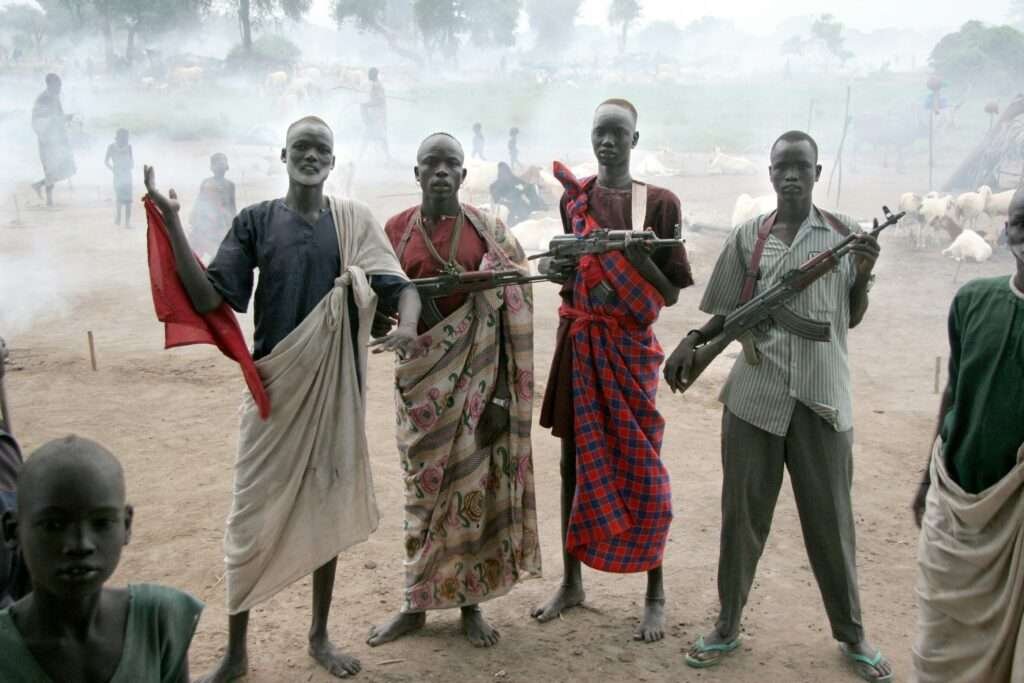
From the moment of its birth, South Sudan faced a daunting state-building challenge. Independence in 2011 brought high expectations, but decades of war had left limited infrastructure, a thin civil service, weak revenue administration, and little state presence across much of the country. Institutions did exist—including the Bank of South Sudan as the new central bank—but their reach and capacity were constrained.
From independence to renewed political danger
- 2011 — Independence: South Sudan became independent on July 9 after the January referendum. The new state inherited most of the former united Sudan’s producing oil fields, but remained dependent on Sudanese export infrastructure.
- 2013–2016 — Civil war: Fighting that began in Juba in December 2013 spread across the country. A 2015 settlement broke down when major fighting returned in July 2016, deepening displacement and economic disruption.
- 2018 — Revitalized peace agreement: The agreement combined power-sharing with security, justice, economic-management, and transparency reforms. The problem has been incomplete implementation, not the absence of economic provisions.
- 2020 — Transitional unity government: The main parties formed a government of national unity, but important security, constitutional, and institutional benchmarks remained unfinished.
- 2024 — Transition extended: The transition was extended to February 2027 and elections were moved from December 2024 to December 2026.
- 2025–2026 — Renewed escalation: Political deadlock, fighting, airstrikes, and the detention and prosecution of First Vice-President Riek Machar placed the peace agreement at serious risk. The United Nations warned in 2026 of a possible relapse into full-scale civil war.
The sequence and current status above follow UNMISS and UN Secretary-General reporting through April 2026. This history affects household livelihoods directly: violence displaces farmers, closes markets and schools, interrupts trade, redirects public spending, and makes long-term investment much harder. Scheduled elections may matter for the transition, but their credibility depends on security, legal preparation, funding, and political participation.
The Resource Curse: Oil & Conflict
Oil was central to South Sudan’s economic hopes, but it was not first developed after independence. Commercial production began under unified Sudan in 1999. When South Sudan seceded, most producing fields lay within its borders while the pipelines, storage, and export terminal remained in Sudan, creating a structural dependence that still shapes public finance.
How an oil shock spreads through the economy
- Export concentration: Oil accounts for roughly 60% of GDP, 99% of exports, and 85% of government revenue in the World Bank’s current public-finance assessment. The shares vary by year, but the concentration is consistently extreme.
- Route dependence: South Sudan’s crude must travel through Sudan to reach the Red Sea. Conflict or damage along that corridor can stop exports even when South Sudanese fields remain productive.
- Fiscal transmission: Lower oil output reduces foreign currency and government receipts, contributing to exchange-rate pressure, inflation, public-service cuts, and salary arrears.
- Governance exposure: Weak oversight and off-budget spending make it harder to convert oil income into dependable roads, schools, clinics, and local services.
The Dar Blend pipeline carrying most South Sudanese oil was closed from February 2024 into 2025 because of the war in Sudan. The World Bank estimates output at about 95,000 barrels a day in FY2025, moving toward 157,000 barrels a day in the first half of FY2026 as exports recovered. It estimates that real GDP still contracted 7.7% in FY2025; a later oil-led rebound does not mean that household living standards recover at the same speed.
| Measure | Current assessment |
|---|---|
| Oil share of GDP | About 60% |
| Oil share of exports | About 99% |
| Oil share of government revenue | About 85% |
| Recent production path | About 95,000 barrels a day in FY2025, moving toward 157,000 in early FY2026 |
Corruption is not a safe subject for vague percentages. A stronger documented finding is that the UN Commission on Human Rights in South Sudan identified more than $25.2 billion in oil-related inflows since independence and described systemic diversion and gross mismanagement. It reported that only 48% of total revenues and oil entitlements entered the regular national budget over fiscal years 2020–2024.
Agriculture, Infrastructure & Economic Disruption
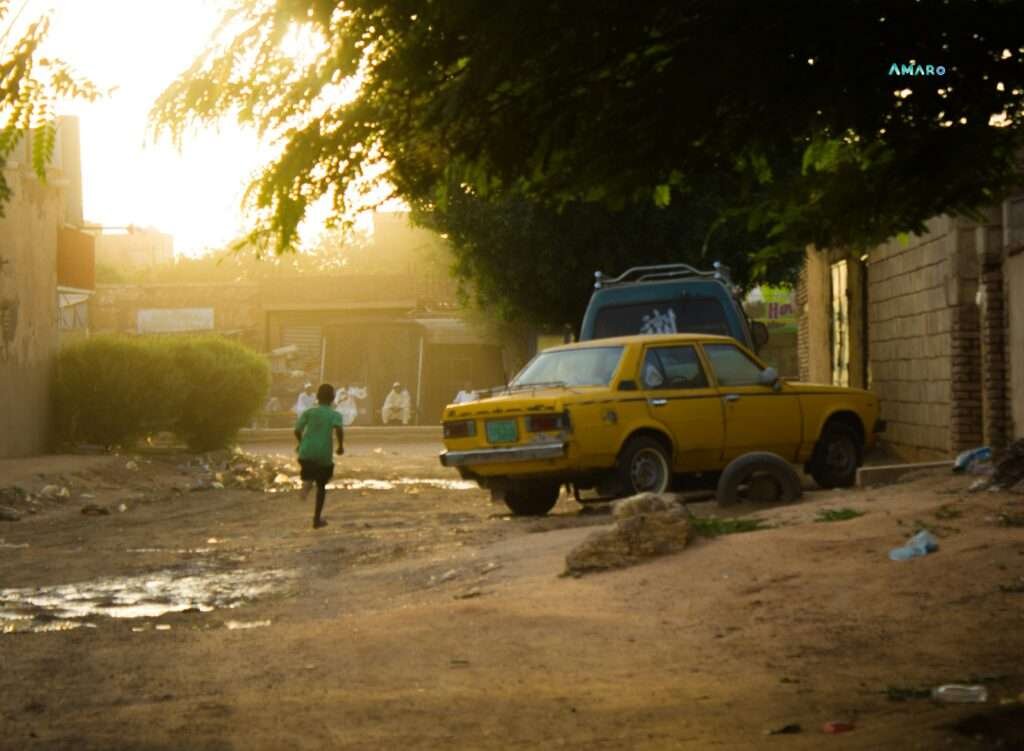
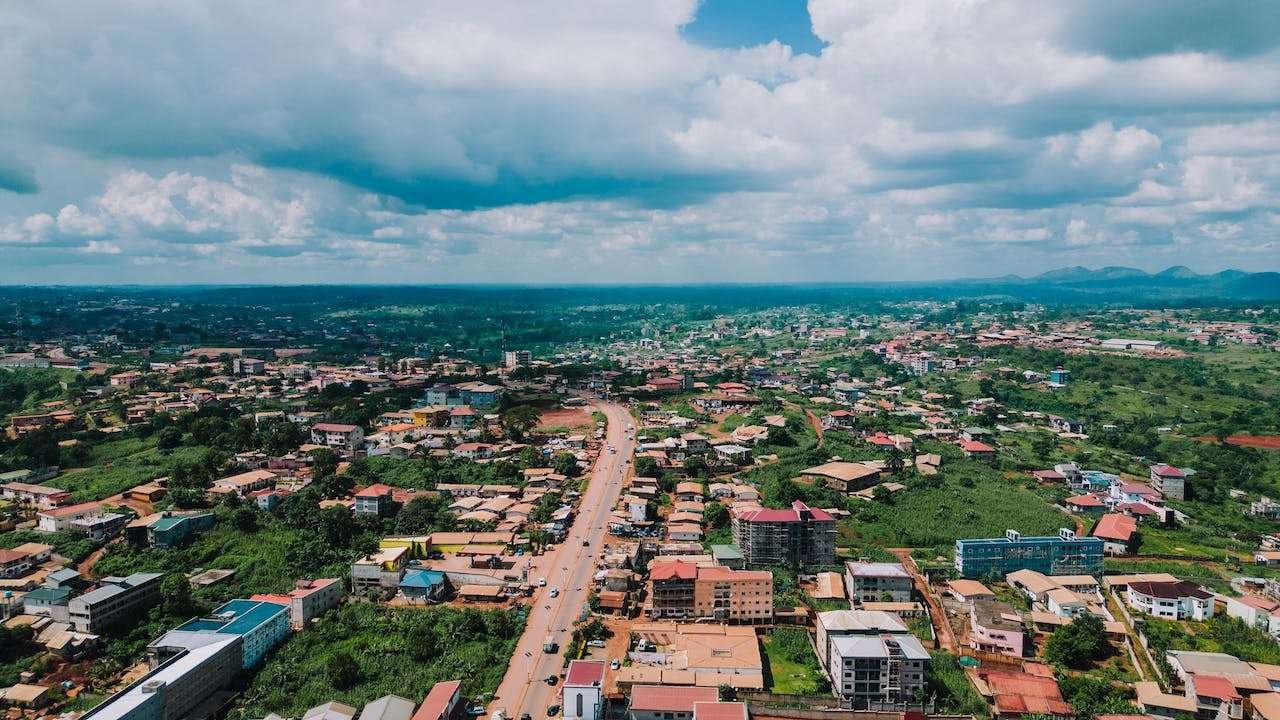
The photograph above was taken in Khartoum, in neighboring Sudan. It provides regional context rather than depicting a location in South Sudan.
Agriculture remains the livelihood backbone for most South Sudanese. FAO reports that more than 80% of people depend on farming, livestock, or fisheries, while agriculture contributes roughly 10% of GDP. That gap reflects low productivity, limited market access, conflict, displacement, animal disease, and repeated climate shocks rather than a lack of agricultural potential.
Why productive land does not guarantee food security
- Subsistence production: Many households cultivate small rain-fed plots or depend on livestock, with limited access to quality seed, veterinary care, storage, finance, and irrigation.
- Conflict and displacement: Violence can separate people from land, cattle, tools, and local markets during planting or harvest periods.
- Flood and drought risk: Recurrent floods, dry spells, and disease outbreaks can damage crops, pasture, roads, and household assets at the same time.
- Market isolation: Weak roads and insecurity raise the cost of bringing inputs in and moving food to towns, so a local surplus may not reach an area with a deficit.
Infrastructure magnifies those problems. The World Bank’s April 2026 assessment says only about 2% of roads are paved and roughly 5% of households have electricity. South Sudan is also a landlocked country, so overseas trade relies on long cross-border corridors; oil has the added constraint of pipeline access through Sudan.
Without reliable roads, power, storage, communications, and secure market routes, even a better harvest may not become stable household income. Rural infrastructure is therefore not separate from food security: it determines whether farmers can obtain inputs, sell output, and reach schools and health facilities.
Humanitarian Crisis & Development Indicators
Years of conflict and underinvestment have damaged health, education, nutrition, water, and sanitation systems. Current humanitarian figures are not another way of stating GDP; they show how economic and political shocks are experienced in daily life.
The humanitarian picture in current figures
| Indicator | Dated figure | Source context |
|---|---|---|
| People needing humanitarian assistance | 9.9 million in 2026 | OCHA humanitarian plan |
| Acute food insecurity | 7.8 million, April–July 2026 | IPC Phase 3 or worse; Crisis or above |
| Catastrophic food insecurity | About 73,000, April–July 2026 | IPC Phase 5 projection |
| Children requiring acute-malnutrition treatment | About 2.2 million in 2026 | IPC projected treatment caseload |
| Internally displaced people | More than 1.9 million at the end of 2025 | UNHCR dated stock estimate |
Table downloads (2)
- Oil dependence and the recent pipeline shock (5 × 2)View tableDownload CSV
- Selected humanitarian and social indicators (6 × 3)View tableDownload CSV
The 2025 South Sudan Multiple Indicator Cluster Survey found that 19% of children under five were stunted and 17% were wasted. Those prevalence rates should not be confused with the larger projected treatment caseload, which counts children expected to require services over a period rather than the share affected at one survey date.
Human-capital constraints extend beyond nutrition. The same survey reported 42% primary-school attendance and only 15% primary completion. UNICEF’s 2024 estimate put infant mortality at 72 deaths per 1,000 live births. These indicators reflect limited access and service quality as well as the effects of insecurity, displacement, poverty, and disease.
International Aid & Policy Responses
Since independence, South Sudan has received substantial support for peacekeeping, humanitarian relief, basic services, institution building, and livelihoods. The response saves lives and keeps parts of the health, education, nutrition, and water systems operating, but it cannot substitute for a durable political settlement and accountable national institutions.
What the current response covers
- Peacekeeping and civilian protection: UN Security Council Resolution 2820 extended UNMISS through April 30, 2027, with an authorized ceiling of 12,500 troops and 2,101 police. Its core work includes protecting civilians, supporting humanitarian access, monitoring human rights, and helping prevent a return to civil war.
- Humanitarian response: OCHA’s 2026 plan identifies 9.9 million people in need and targets 4.3 million for assistance. Food, nutrition, health, shelter, water, and protection programs must operate amid severe access and funding constraints.
- Development and institutional support: As of March 2026, the World Bank reported a $1.18 billion portfolio spanning 11 national and two regional operations in sectors including health, education, agriculture, social protection, governance, energy, water, and digital development.
- Regional diplomacy: The African Union, IGAD, and the United Nations continue to press the parties to implement the 2018 agreement and prepare credible elections without another slide into widespread war.
The main barriers are not captured by a single “aid effectiveness” percentage. Conflict restricts access, funding shortfalls force agencies to narrow coverage, and weak public-finance and administrative systems limit the state’s ability to take over services. By January 2026, government agencies had accumulated roughly 8–13 months of salary arrears, illustrating why institutional support and fiscal discipline matter alongside emergency relief.
Challenges & Pathways Forward
South Sudan’s resources create possibilities, but recovery is not automatic. A temporary oil rebound can lift national GDP while conflict, inflation, unpaid salaries, and weak services keep households under pressure. The priority is to turn public revenue and external support into predictable security, institutions, and productive capacity.
The recovery priorities that reinforce one another
- Protect peace and political participation: Halt military escalation, protect civilians, complete viable security arrangements, and create legal and political conditions for credible elections and an inclusive transition.
- Put oil money on budget: Publish receipts and transfers, audit oil-backed obligations, limit off-budget spending, and strengthen independent oversight. As of August 2026, South Sudan is not on EITI’s implementing-country register; meeting the standard could support, but not replace, domestic accountability.
- Strengthen existing institutions: Improve the Bank of South Sudan’s operational capacity, restore regular national statistics, strengthen tax and public-finance administration, and clear salary arrears within a credible fiscal plan.
- Reconnect farms and markets: Invest in feeder roads, storage, veterinary services, improved seed, flood resilience, and safe market access so agricultural production can generate income as well as food.
- Diversify jobs and infrastructure: Expand reliable electricity and communications while supporting livestock, fisheries, agro-processing, trade, and small businesses that are less exposed to an oil-pipeline shock.
- Protect human capital: Treat nutrition, primary education, basic health care, safe water, and sanitation as productive investment rather than residual spending.
These steps cannot wait in a perfect sequence. Peace and fiscal credibility make investment safer, while visible improvements in livelihoods and services can give communities a stake in stability. The practical test is whether reforms reduce the distance between South Sudan’s resource base and the living standards of its people.
Frequently Asked Questions
Is South Sudan currently the poorest country in the world?
Not under every current measure. The IMF’s April 2026 nominal GDP-per-capita estimate places Yemen below South Sudan, while UNDP’s 2025 report ranks South Sudan last among 193 countries on the Human Development Index. The answer must name the metric and data year.
What is South Sudan’s GDP per capita?
The IMF estimates about $488 per person for 2026. The World Bank’s April 2026 outlook gives about $491 for 2025. Both are nominal estimates, not household income, and they can change with exchange rates, national-account revisions, and population estimates.
How many people live in extreme poverty in South Sudan?
The World Bank estimates that 87% lived below $3.00 a day in 2021 PPP terms in 2025. This is a modeled nowcast based on older survey data. A separate 2022 household survey found 76% below South Sudan’s national poverty line.
Why does oil dependence make the economy vulnerable?
Oil supplies most export and government revenue, and South Sudan relies on pipelines through Sudan. A production or corridor disruption therefore cuts foreign currency and public income at once, putting pressure on the exchange rate, prices, salaries, and services.
What would most improve South Sudan’s development prospects?
The strongest package combines conflict de-escalation, implementation of the peace agreement, transparent oil and budget management, stronger institutions, reliable farm-to-market infrastructure, economic diversification, and sustained investment in nutrition, health, education, water, and power.
What Did We Learn Today?
South Sudan is among the world’s poorest nations and last on UNDP’s current HDI ranking, but it is not the single poorest under every current GDP series. Its hardship reflects the combined effects of renewed conflict, oil and export-route dependence, weak public finance, limited infrastructure, and severe human deprivation; recovery requires peace and transparent institutions alongside investment in farms, roads, power, health, and education.
Sources & Data Notes
Principal sources consulted were the IMF’s April 2026 World Economic Outlook; the World Bank’s 2024 Poverty and Equity Assessment, April 2026 Macro Poverty Outlook, 2026 Public Finance Review, and South Sudan country overview; the 2025 UNDP Human Development Report; 2026 IPC, OCHA, UNHCR, UNICEF, UN Security Council, and UNMISS materials; the 2025 South Sudan Multiple Indicator Cluster Survey; FAO agriculture materials; U.S. Energy Information Administration oil background; OHCHR findings; and the EITI country register. GDP, poverty, food-security, and displacement figures are estimates or dated snapshots and may change with later releases; the World Bank’s 2025 extreme-poverty figure is a modeled nowcast based on older survey data. This article was prepared and editorially reviewed by Zurab Koniashvili (Z.K. Atlas), who completed the final factual checks and publication approval. AI tools may have assisted during the editorial process, including with language refinement and the creation or editing of visual materials.