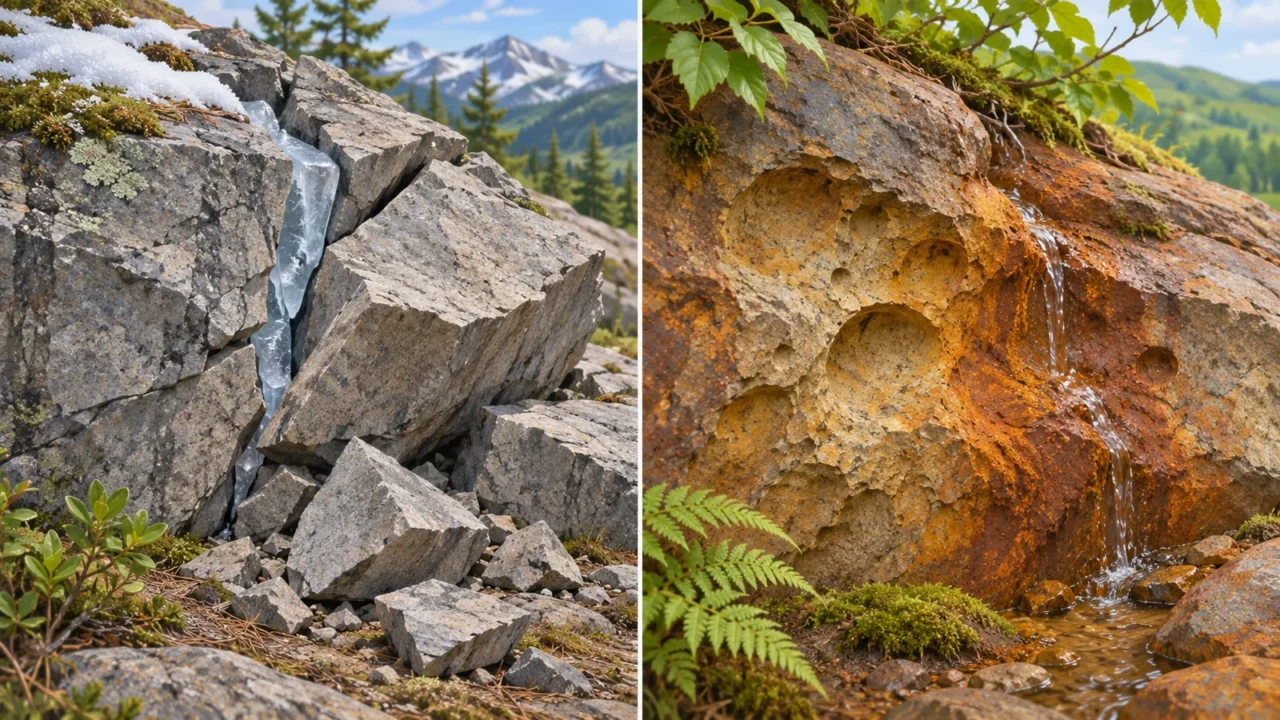
A cracked rock and a rock with altered minerals can both be weathered. The useful distinction is what changed: the size and arrangement of pieces, or the minerals that make up the rock.
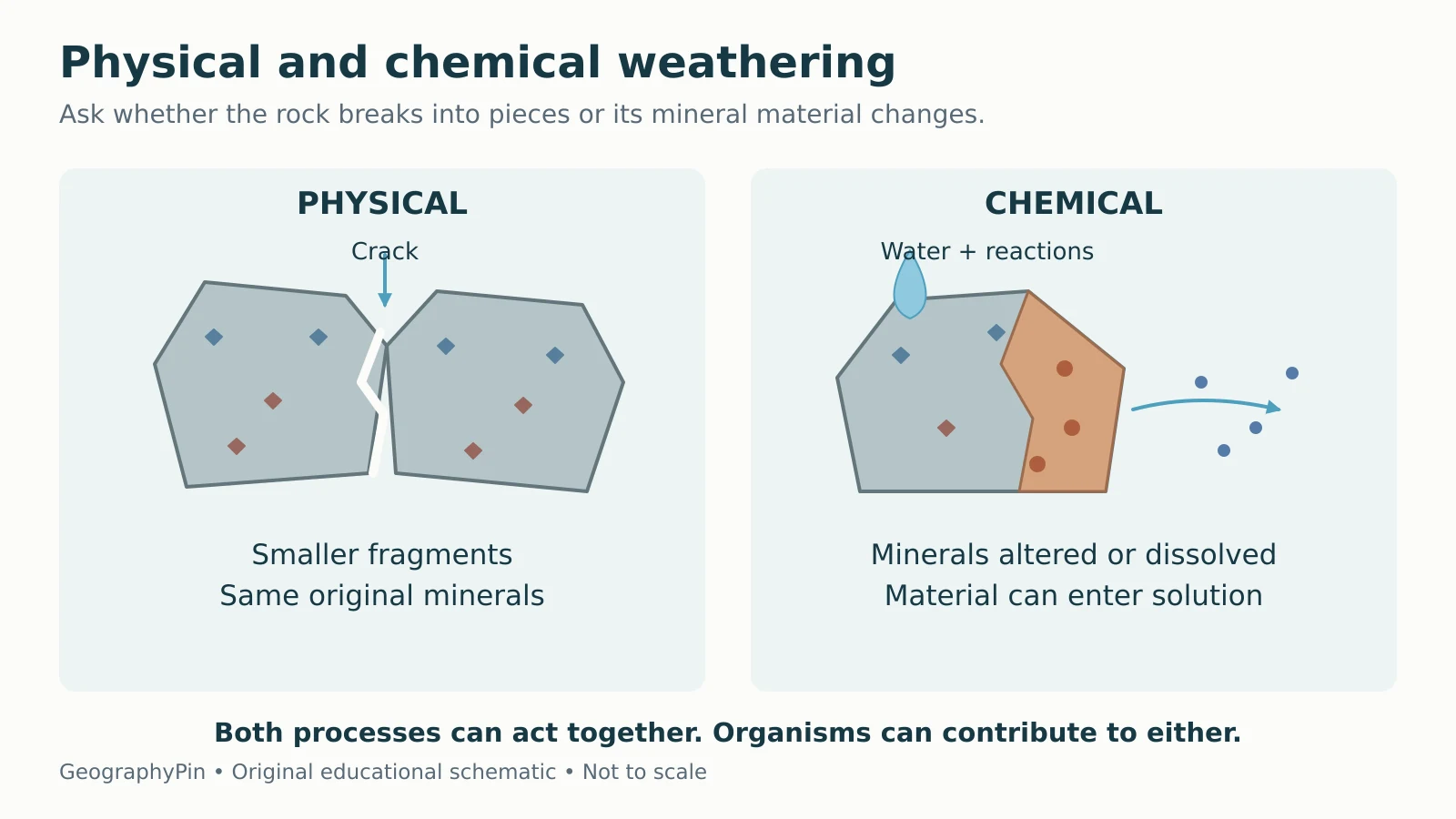
Physical weathering breaks rock into smaller fragments without changing the chemical composition of its minerals. Chemical weathering alters or dissolves minerals through reactions with water, gases or other substances. The processes often work together. Living things can drive either one, so biological weathering is not always a separate, mutually exclusive mechanism.
How to use this article: You can recognize physical breakdown, place biological activity correctly, or test the distinction.
Weathering Changes Rock at or Near the Surface
Weathering is the physical breakdown or chemical alteration of rock at or near Earth’s surface. It helps produce loose material and changes the properties of exposed rock. A weathered surface may become fractured, weakened, discolored or partly dissolved, depending on the process and material.
The National Park Service’s weathering explanation distinguishes mechanical breakdown from chemical changes in minerals. This comparison uses those two mechanisms as its starting point.
Weathering and erosion are closely connected but answer different questions. Weathering describes breakdown or alteration at the material’s location. Erosion involves removal and transport. A fragment can weather further while it is being transported, so the processes need not occur in isolated stages.
GeographyPin’s broader guide to landforms created by erosion follows what removal does to the landscape. Here, the focus is the change happening to the rock itself.
| Question | Physical weathering | Chemical weathering |
|---|---|---|
| What changes? | Fragment size, cracks or physical structure | Mineral composition or minerals entering solution |
| What happens to the original minerals? | They remain chemically the same in the idealized process | Some are altered, transformed or dissolved |
| Typical example | Ice growth widens a rock crack | Weakly acidic water dissolves calcite |
| Can it help the other process? | Yes; fractures expose more reactive surface | Yes; alteration can weaken the rock |
| Can organisms contribute? | Yes | Yes |
Physical Weathering: Breaking Without Mineral Change
Look for a mechanical action
Physical weathering, also called mechanical weathering, splits or wears rock into smaller pieces. If a granite fragment breaks into two, the new surfaces do not by themselves imply that the minerals have changed chemically.
Water and ice can widen existing cracks under suitable conditions. The familiar freeze–thaw explanation describes water entering cracks, freezing and exerting pressure as ice develops. The details depend on moisture supply, temperature and the crack system; cold weather alone does not guarantee rapid breakdown.
Other mechanisms include salt-crystal growth in pores, expansion and contraction associated with temperature changes, and abrasion as particles rub or collide. The South Carolina Geological Survey’s weathering teaching guide describes these mechanisms and their overlap with erosion and mass movement.
The label identifies the process, not a particular rock type. Different rocks respond differently because their minerals, grain arrangement, fractures and exposure vary. A sharp-edged fragment or cracked surface may be evidence, but shape alone does not prove exactly which mechanism produced it.
Chemical Weathering: Minerals React or Dissolve
Chemical weathering changes the material at the mineral level. Some reactions produce new minerals; others transfer components of the original mineral into water as dissolved substances. The rock can weaken even without an obvious pile of loose fragments.
Dissolution is an important example. Water containing dissolved carbon dioxide is weakly acidic and can react with susceptible minerals. Calcite in limestone can dissolve, contributing to the development of enlarged joints and karst features such as dolines. The British Geological Survey’s weathering guide explains the role of carbon dioxide in rainwater.
Oxidation involves reactions with oxygen. Iron-bearing minerals can produce iron oxides or related alteration products, often associated with reddish or brownish colors. Hydrolysis involves reactions with water that can transform some silicate minerals into secondary minerals, including clays.
“Chemical” does not mean the process must involve manufactured chemicals or severe pollution. Natural water, oxygen and carbon dioxide participate in ordinary weathering. Nor does a color change alone identify one reaction: the mineral composition and surrounding evidence still matter.

Where Biological Weathering Fits
Organisms can cause physical or chemical effects
A root growing into an existing crack can widen it mechanically. Organisms and decaying organic matter can also supply substances that help minerals react or dissolve. The biological label tells you that living things contribute; the physical or chemical label tells you how the change occurs.
This is why educational sources do not always list weathering types in the same way. Some emphasize two main mechanisms, physical and chemical. Others list biological weathering alongside them to emphasize the organisms involved. These are different classification choices, not proof that one process has disappeared.
| Observation | Useful classification | Reason |
|---|---|---|
| A growing root widens a crack | Biologically assisted physical weathering | Mechanical pressure separates material |
| Organic acids help dissolve minerals | Biologically assisted chemical weathering | A chemical reaction changes or removes mineral material |
| Sand grains strike an exposed rock | Physical weathering by abrasion, alongside transport | Impacts wear the surface; moving grains also involve erosion |
| Iron-bearing minerals react with oxygen | Chemical weathering | Mineral material undergoes oxidation |
The South Carolina teaching guide explicitly describes biological weathering as activity involving physical or chemical agents. That overlapping view is more useful than forcing every example into one exclusive box.
Why Both Processes Often Work Together
Mechanical fractures expose surfaces that water and gases can reach. Chemical alteration can then weaken minerals or the material holding grains together, making further physical breakdown easier. The result may reflect several processes operating over different periods.
Rates depend on more than a label. Rock composition, available water, temperature, fractures, drainage, biological activity and the length of exposure all matter. A statement that one type is always faster than the other leaves out the conditions needed to make the comparison.
Weathering can contribute mineral material to soil, but soil is not simply a pile of crushed rock. Organic matter, organisms, water, air, movement and time also influence soil development. Likewise, fresh sediment does not immediately become solid sedimentary rock: later processes such as compaction and cementation can be involved, as the National Park Service’s sedimentary-rock guide explains.
Keep the stages distinct while allowing them to interact. Breaking, reacting, moving, depositing and becoming rock again are related parts of landscape change, not interchangeable words.
Try the Classification on Three Short Examples
Ask what changed and whether material moved
Example 1: A block splits along a crack, leaving smaller pieces with the same minerals. This is physical weathering. If one piece then falls downslope, that movement is a separate part of the event, commonly described as mass movement.
Example 2: Water reacts with a mineral and carries some of its components away in solution. The reaction and dissolution are chemical weathering. The dissolved material can then move through the wider water system; there need not be a visible sand grain.
Example 3: A root widens a crack while organic compounds around it promote mineral alteration. Both physical and chemical weathering can be involved, with biological activity contributing to each.
The reliable sequence is to identify the material change first, then the agent, then any transport. A photograph may suggest a process without proving it. When the evidence is incomplete, describe the observed crack, fragment or alteration rather than assigning a mechanism with false certainty.
What Did We Learn Today?
Physical weathering changes the size or structure of rock fragments, while chemical weathering changes or dissolves minerals. Biological activity can contribute to either mechanism, and physical and chemical effects often reinforce one another. Classifying an example becomes clearer when you separate the material change from its cause and from any later movement.
Sources & Data Notes
This guide classifies weathering by physical and chemical mechanism, while treating biological activity as a possible cause of either. Educational sources group these categories differently. Examples and diagrams are simplified and do not diagnose a real site, estimate a weathering rate or assess slope safety.