Iran news in mid-January 2026 centers on nationwide unrest met by a heavy security crackdown and a near-total communications squeeze, while Washington escalates pressure through sanctions and public deterrence signals. The hard part is verification: actions that leave an outside trail are easy to confirm; nationwide totals inside Iran are not.
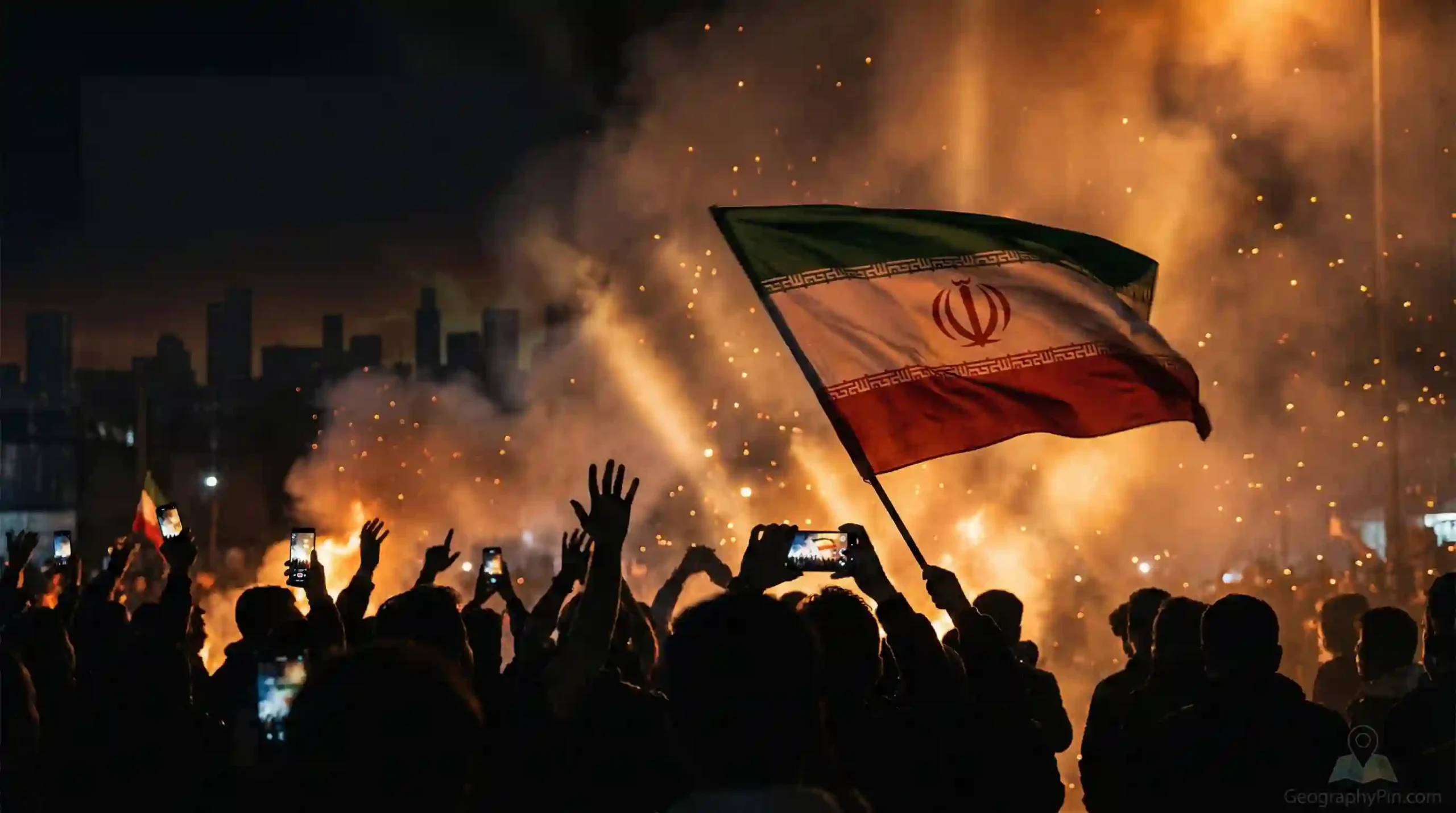
As of January 16, 2026, protests that began December 28 have been met with a sustained crackdown and a major internet blackout. Outside-verified developments include a UN Security Council emergency meeting (Jan 15), new U.S. sanctions (announced Jan 15), a brief Iranian airspace restriction (Jan 14), and measurable caution in Gulf shipping near Iran’s ports. Death and arrest totals vary widely because independent verification inside Iran is limited during the blackout (Reuters, Jan 14–15, 2026; AP, Jan 15, 2026; OHCHR, Jan 10–13, 2026).
What’s changed since the last update
The big shift is that “scheduled” became “happened”: the UN Security Council held its emergency Iran session on Jan 15, and the U.S. sanctions package is now fully described in Treasury and wire reporting (Reuters/AP/U.S. Treasury, Jan 15). Meanwhile, transport risk signals have become clearer: Iran’s brief airspace restriction on Jan 14 was widely tracked, and Reuters documented dozens of ships holding outside Iranian port limits plus elevated GNSS/GPS interference warnings in the Gulf/Hormuz area (Reuters, Jan 14). Human-rights reporting also intensified: UN statements and Human Rights Watch reports in Jan 10–16 emphasized the blackout’s role in concealing the scale of violence (OHCHR/HRW, Jan 10–16).
How to use this article: If you want the clean facts first, start with the fast check. For the latest verified position, jump to where things stand. If you care about ports, chokepoints, and why Iran’s map amplifies risk, read the geography lens. For quick answers, go to the FAQ.
Fast Check: What’s Verified vs Disputed
Fast check (read this before you trust a headline)
When information inside a country is restricted, the safest anchors are things that leave an outside trail: sanctions lists, UN meeting dates, airline advisories, ship positions, and official statements that can be cross-checked. The most fragile claims are sweeping nationwide totals and viral “proof” that cannot be independently verified during a blackout.
| Category | Examples | How to treat it |
|---|---|---|
| Verified actions | U.S. sanctions; UN Security Council meeting; brief airspace restriction | High confidence; date + source |
| Operational risk signals | Flights reroute; ships hold offshore; GNSS/GPS interference warnings | Strong indicator of perceived risk (not proof of an attack) |
| Contested totals | Killed; arrested; detained | Use “estimates,” show ranges, and name who’s counting |
Verified: UN Security Council emergency session (Jan 15), U.S. sanctions package (Jan 15), near-total internet shutdown described by UN/Human Rights Watch (Jan 10–16), brief airspace restriction tracked via Flightradar24 (Jan 14), ships holding outside Iranian port limits and GNSS/GPS interference warnings (Reuters, Jan 14–15; OHCHR, Jan 10; HRW, Jan 12–16).
Disputed/unclear: exact nationwide death toll, detention totals, and any claim that executions were definitively halted—because the blackout and access limits block independent confirmation (Reuters/AP reporting reflects these constraints).
Iran News Today: Where Things Stand (Jan 16, 2026)
The latest position in plain terms
The story has two tracks running at the same time: internal repression (hard to fully quantify under blackout) and external escalation signaling (easy to verify because it leaves documents, meetings, and market behavior). The geographic tell is that Iran’s unrest doesn’t stay “domestic” on the map for long—because it sits on a global energy chokepoint and key air corridors.
- Sanctions escalated (Jan 15): The U.S. imposed sanctions on five senior Iranian officials and Fardis Prison over repression, and separately targeted 18 people tied to laundering oil-related revenue through “shadow banking” networks (Reuters, Jan 15, 2026; U.S. Treasury/OFAC, Jan 15, 2026; AP, Jan 15, 2026).
- UN spotlight is now real, not theoretical (Jan 15): The UN Security Council held an emergency discussion on Iran at the U.S. request. U.S. officials used the forum to amplify deterrence messaging, while Iran and some Council members pushed back on outside pressure framing (Reuters, Jan 15, 2026; AP, Jan 15, 2026).
- Execution fears remain a high-stakes uncertainty: The White House said it believed hundreds of executions were paused after U.S. warnings, while Iran’s foreign minister Abbas Araqchi/Araghchi said publicly there was “no plan for hanging”. Independent confirmation is limited under the blackout, so treat definitive claims as unverified unless backed by documentary evidence (Reuters, Jan 14–15, 2026; AP, Jan 15, 2026).
- Transport risk signals sharpened (Jan 14–15): Iran briefly restricted airspace (tracked via Flightradar24), and Reuters documented ships holding outside major Iranian ports plus increased GNSS/GPS interference warnings in the Gulf/Hormuz area—classic “operators are pricing in risk” behavior (Reuters, Jan 14, 2026).
What this means for readers: this is no longer only a street-protest story. It’s a combined risk picture: internal crackdown + external pressure + travel/shipping actors building in delay and caution—especially around Iran’s southern coastline and the Strait of Hormuz.
Why Protests Spread
The spark: a currency and cost-of-living shock
Major reporting describes protests beginning on Dec 28 after a sharp currency slide and worsening living costs, then broadening quickly as security forces responded with force and arrests (AP, Jan 15, 2026). Once the state frames unrest as a strategic threat, the conflict shifts from “prices” to “power” fast.
Why crackdowns can prolong unrest (even when streets look quieter)
Even when demonstrations fade from main squares, repression can deepen pressure under the surface: families search for detainees, communities react to casualties, and rumors fill the space created by shutdowns. That’s why the internet story is not a side detail—it shapes both the pace of unrest and the world’s ability to confirm what is happening (OHCHR, Jan 10–13, 2026; HRW, Jan 12, 2026).
Map sense: Iran’s protest geography often concentrates where people, institutions, and transport converge—big urban cores (like Tehran) and provincial hubs—while the most globally visible consequences show up far from those streets: in air corridors overhead and along the Persian Gulf coastline.
Rising U.S. Tensions: Sanctions and Military Posture
Sanctions: the “visible lever”
Sanctions are fast, documentable, and politically legible. On Jan 15, the U.S. Treasury framed the designations as punishment for repression and part of a broader “maximum pressure” push, including targeting financial networks linked to oil-related revenue (U.S. Treasury/OFAC, Jan 15, 2026; Reuters, Jan 15, 2026). The direct asset impact can be limited if targets have no U.S.-reachable holdings, but the signal is loud: escalation without kinetic action.
Military posture: the “risk management lever”
Reuters reporting described precautionary moves such as drawing down some U.S. personnel from regional bases, while Iran warned neighbors it could retaliate against American bases if attacked (Reuters, Jan 11 and Jan 14, 2026). These moves do not prove an imminent strike; they show both sides preparing for miscalculation risk while trying to shape the other’s choices.
Geographic reality check: a U.S.–Iran escalation is rarely confined to one border. It tends to spill into the Gulf air-defense environment and the sea lanes between Iran and the Arabian Peninsula—spaces where “risk perception” alone can change behavior.
Crackdown: What It Looks Like and Why Verification Is Hard
Deaths and arrests: the scale is clear, the totals are not
This is where reporting diverges. Reuters cited an Iranian official saying roughly 2,000 people had been killed, while the U.S.-based monitor Human Rights Activists in Iran (HRANA) has reported higher verified totals in its counts; AP also cited a rights-group figure above 2,600 in connection with the UN meeting (Reuters, Jan 13–15, 2026; AP, Jan 15, 2026). The safest takeaway is not one “final” number—there is no final number yet—but that multiple credible channels describe sustained repression at national scale.
Internet shutdown: why it changes the entire story
UN human-rights reporting in January described a near-total shutdown and urged Iran to restore access, warning that blackouts obstruct monitoring and can deepen harm to civilians (OHCHR, Jan 10–13, 2026). Human Rights Watch argued the blackout reduces accountability by cutting off evidence trails and witness accounts (HRW, Jan 12, 2026).
A practical “rumor filter” (3 questions)
- Is it an action? Sanctions, meetings, closures, and reroutes are harder to fake than viral claims.
- Is it traceable? Named institutions and dated statements beat anonymous screenshots.
- Is there an outside signal? Airlines and ships change behavior when risk feels real.
Real-World Impacts: Internet, Flights, and Shipping
Internet: the blackout is the biggest “visibility shock”
For anyone trying to understand what’s happening, the internet shutdown is the choke point. UN statements described connectivity collapsing to a fraction of normal levels, and Human Rights Watch said the blackout has concealed the scale of killings and abuses (OHCHR, Jan 10–13, 2026; HRW, Jan 12–16, 2026). In geographic terms, this turns a national story into a patchwork of partial signals—strongest around borders, coasts, and any area with alternative connectivity paths.
Flights: why a short airspace restriction matters
On Jan 14, Reuters reported that Iran closed its airspace to most flights for a little over two hours, citing Flightradar24. Even short restrictions can raise costs and increase risk sensitivity fast, especially in tense air-defense environments where operators want maximum margin for error (Reuters, Jan 14, 2026). The immediate result is visible: reroutes, delays, and avoidance patterns that show up on flight-tracking maps.
Shipping: port “pauses” are measurable
Reuters reported dozens of ships anchoring outside Iranian port limits, including near Bandar Abbas and Bandar Imam Khomeini. It also described a jump in tanker presence in Iran’s EEZ during Jan 6–12 and increased GNSS/GPS interference warnings in the Gulf and Strait of Hormuz area—signals consistent with force-protection measures and heightened caution (Reuters, Jan 14, 2026). The point is not panic—it’s that operators are building in delay and downside protection.
Who this affects (quick table)
| You are… | Watch this | Because it tells you… |
|---|---|---|
| A traveler / airline watcher | Airspace notices + avoidance/reroutes | Risk is rising or easing in near real time |
| In logistics / trade | Ships holding off ports + GNSS/GPS interference notes | Delays and uncertainty are being priced in |
| Tracking escalation risk | Sanctions + base posture + UN moves together | Diplomacy is tightening and surprise risk increases |
Geography Lens: Why Iran’s Location Shapes the Risk
The map explains the leverage
Iran is not just a large country with internal unrest; it sits on the north side of the Persian Gulf and overlooks the Strait of Hormuz, one of the world’s most sensitive energy chokepoints. That geography concentrates global attention because disruption signals show up quickly in places outsiders can measure: ports, sea lanes, and air corridors.
Three geographic “pressure points” to understand
- Port nodes: When ships hold offshore near major ports (including Bandar Abbas and Bandar Imam Khomeini), it signals operators fear sudden restrictions, inspections, or collateral risk—and it’s visible in tracking data (Reuters, Jan 14, 2026).
- Chokepoint sea lanes: The Strait of Hormuz is narrow enough that risk perception alone can change routing and insurance behavior. Even without a closure, electronic interference warnings can raise costs and slow transits.
- Air corridors: Iran sits beneath common routes linking Europe and Asia. Short-notice restrictions force immediate detours that are visible on flight maps and felt in schedules and fares (Reuters, Jan 14, 2026).
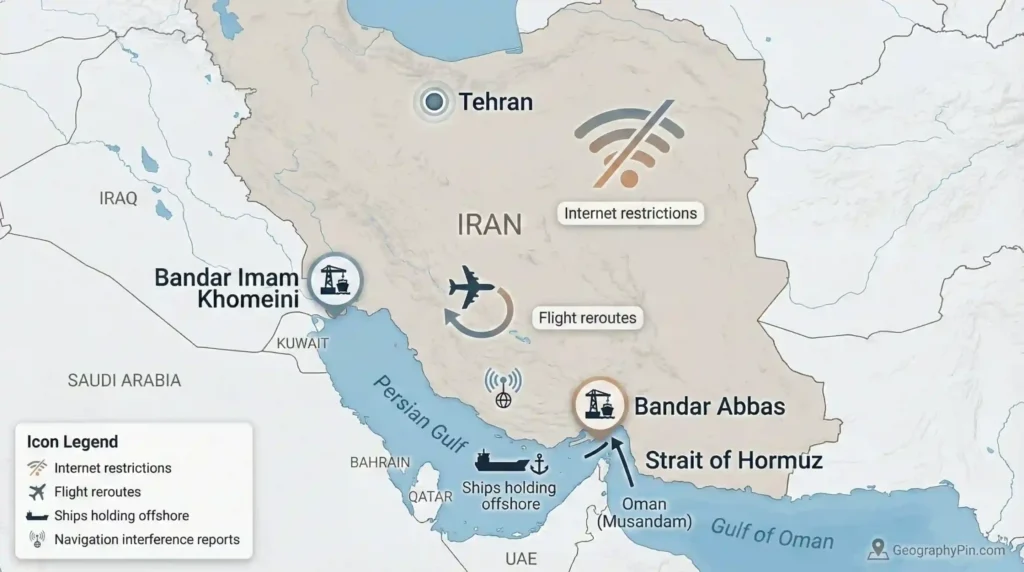
What changes on the map if this escalates? The first shifts are usually not new borders—they’re no-go skies (temporary airspace restrictions), slower port approaches (ships holding offshore), and risk corridors around Hormuz where navigation warnings and insurance caution spread faster than official announcements.
What to Watch Next
Over the next few days, these are the most meaningful “tells” to watch:
- Connectivity: any easing or tightening of the shutdown (a proxy for control and accountability).
- Legal moves: trials, sentencing signals, and any credible, document-backed execution reporting.
- External pressure: what follows the UN Security Council session and whether sanctions stack further.
- Operational disruption: repeat airspace restrictions, sustained shipping holds, or expanding navigation interference warnings.
If two or three of these intensify at once, the story usually shifts from “crackdown inside Iran” to “regional stability and trade risk.”
FAQ
Why do death toll numbers differ across reports?
Because access is restricted, monitors use different categories, and databases update at different times—especially during a nationwide blackout. Treat totals as estimates, show ranges, and prioritize verifiable actions and trends. Reuters has cited both an Iranian official’s lower figure and HRANA’s higher verified counts; AP cited a higher rights-group estimate in UN coverage (Reuters, Jan 13–15, 2026; AP, Jan 15, 2026).
Do U.S. sanctions mean a strike is imminent?
Not by itself. Sanctions are escalation, but still non-kinetic. Watch whether sanctions, base posture shifts, and air/sea disruption all intensify together—those combined signals matter more than any single headline (Reuters, Jan 11–15, 2026).
Why did airlines reroute—was there a specific attack?
Reroutes followed a short-notice airspace restriction and heightened risk perception. Operators often reroute on uncertainty alone when a region is tense and unpredictable (Reuters, Jan 14, 2026).
What’s the single best risk signal to watch?
Connectivity plus operational disruption. If the internet tightens while flights and shipping friction expand, the situation is usually worsening in both visibility and regional risk (OHCHR, Jan 10–13, 2026; Reuters, Jan 14, 2026).
What Did We Learn Today?
- Iran’s unrest is now tightly linked to international pressure—sanctions and UN scrutiny are moving alongside the crackdown.
- Verification is the core problem: the blackout turns totals into estimates and makes rumor filtering essential.
- Flights, ports, and chokepoints make Iran’s geography a force multiplier for global risk perception—especially around Hormuz and major Gulf ports.
Sources & verification notes
This update is built around outside-verifiable trails (sanctions lists, UN meeting timing, flight/ship behavior) plus high-trust human-rights statements about the blackout and repression. Where nationwide totals are involved (killed, detained), I present ranges and attribution because access restrictions prevent clean confirmation.
- Reuters (Jan 14, 2026): Iran airspace restriction reported via Flightradar24; ships anchoring outside Iranian ports; GNSS/GPS interference warnings in the Gulf/Hormuz area.
- Reuters (Jan 15, 2026): U.S. sanctions on five Iranian officials and Fardis Prison; 18 shadow-banking targets; UN Security Council session coverage; execution-related claims and Iran responses.
- Associated Press (Jan 15, 2026): sanctions coverage and UN Security Council emergency meeting reporting.
- U.S. Treasury / OFAC (Jan 15, 2026): official press release describing sanctions package and rationale.
- UN OHCHR (Jan 10–13, 2026): statements calling for restoration of internet access and warning about monitoring constraints.
- Human Rights Watch (Jan 12 and Jan 16, 2026): reports arguing the blackout is concealing abuses and escalating violence.