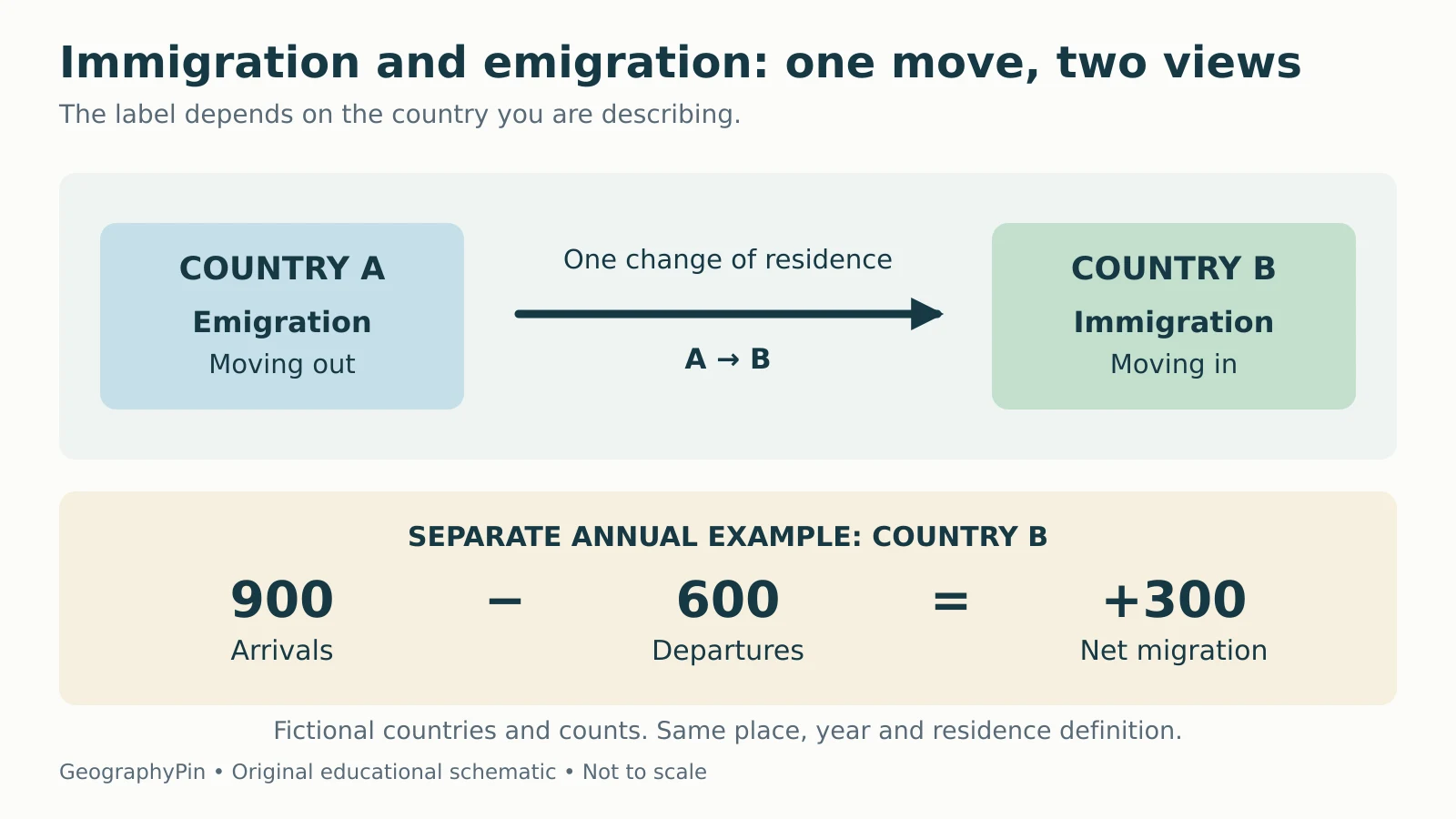
Someone who moves from one country to another can be an emigrant and an immigrant in the same move. The label depends on which country you are describing. That simple change of viewpoint also helps explain why arrival totals, net migration and the migrant population are different numbers.
Immigration is movement into a country to live there; emigration is movement out of a country to live elsewhere. A person moving from Country A to Country B emigrates from A and immigrates to B. Net migration subtracts departures from arrivals for the same place, period and statistical definition.
How to use this article: You can follow one move from both countries, check the net-migration calculation, separate stocks from flows, or read a migration statistic.
One Move Has an Origin and a Destination
The direction is relative to a place
Suppose someone changes their usual residence from fictional Country A to fictional Country B. From A’s perspective, the person is leaving: that is emigration. From B’s perspective, the person is arriving: that is immigration.
The U.S. Census Bureau’s migration overview uses this to/from distinction. Neither word by itself tells you the person’s citizenship, reason for moving or legal admission category.
| Viewpoint | Term | Meaning |
|---|---|---|
| Country A, the origin | Emigration | Moving out to live elsewhere |
| Country B, the destination | Immigration | Moving in to live there |
| Both places together | International migration | A change of residence across a national border |
A returning citizen can also appear in immigration statistics when the measure includes citizens who move back from abroad. Immigration is therefore not automatically a synonym for the arrival of noncitizens.
One person’s departure and arrival are not two different people. They are two perspectives on a movement. Published origin and destination totals may nevertheless differ because countries use different sources, reference periods or reporting methods.
Internal Migration Does Not Cross a National Border
Migration can also take place within a country. A move between states, provinces or regions is internal migration; datasets may distinguish those moves from shorter residential moves within one local area.
The statistical boundary matters more than distance alone. A long move within one country is still internal, while a short move across a national border can be international. For a local area, the terms in-migration and out-migration make the direction clear.
A daily commute or ordinary holiday normally does not change someone’s usual residence. Counting journeys through an airport therefore does not automatically count immigrants or emigrants.
For one specific statistical convention, the Eurostat migration methodology uses an actual or intended stay of at least 12 months for its usual-residence-based international immigration and emigration measures. That is a defined measurement rule, not a claim that all migration everywhere must be permanent.
Always read the dataset’s duration and residence criteria. Short-term movement, long-term migration, border crossings and changes of address can be recorded in different statistical series.
Net Migration Is Arrivals Minus Departures
Use the same place, period and definition
The UK Office for National Statistics distinguishes immigration, emigration and their difference. Net migration is positive when arrivals exceed departures and negative when departures exceed arrivals.
In a fictional one-year example, Country B records 900 arrivals and 600 departures that meet the same residence definition. Its net migration is 900 − 600 = +300. There were 1,500 qualifying movements across the two flow totals, not just 300.

| Arrivals | Departures | Net migration | Interpretation |
|---|---|---|---|
| 900 | 600 | +300 | Migration adds 300 to the population |
| 900 | 900 | 0 | Equal flows do not mean no movement |
| 500 | 700 | −200 | Migration subtracts 200 from the population |
Download the fictional migration examples as CSV.
These are three alternative scenarios, not three years in a real country. Net zero can hide substantial arrivals and departures, so it is not enough to describe the volume of movement.
Population Change Also Includes Births and Deaths
Net migration is only part of population change. The Census Bureau’s population-estimates glossary identifies births, deaths and net migration as demographic components.
In a simplified population account with unchanged boundaries:
Population change = births − deaths + arrivals − departures.
Continue the fictional Country B example. It starts with 100,000 residents, has 1,200 births and 1,000 deaths, and records net migration of +300. Natural increase is 200, total growth is 500, and the ending population is 100,500.
Conversely, positive net migration does not guarantee population growth if deaths exceed births by a larger amount. At regional scales, include both internal and international movements affecting the area. Real estimates may also contain reconciliation adjustments or boundary changes, which should be explained in their methodology.
A Migrant Stock Is Not an Annual Arrival Total
A period measures a flow; a date identifies a stock
A flow describes migration during a specified interval, such as a year. A stock describes a defined migrant population resident at a particular date. It can include people who arrived recently and people who have lived there for decades.
The World Bank metadata for international migrant stock, sourced from the UN Population Division, uses foreign-born residents where possible and citizenship information where birthplace data are unavailable. Those are different classification bases.
Birthplace and citizenship are not interchangeable. A person born abroad may later become a citizen without changing birthplace. A citizen returning to their birth country can count in an arrival flow while not belonging to a stock defined as people born outside that country.
Nor is the change in migrant stock necessarily equal to the latest net-migration total. Departures, deaths, the people included in the definition and statistical revisions can all affect the comparison. Match the populations and concepts before subtracting one table from another.
Read the Label Before Comparing the Number
Five checks prevent common mistakes
- Place and direction: into or out of which country or region?
- Time: a flow over a period or a stock on a date?
- Coverage: which residence durations, citizenship groups and movement types are included?
- Unit: people, movements, visas, border crossings or a rate per population?
- Method: observed records, survey estimates or modeled totals, and are they provisional?
A visa count is not automatically an arrival count, and a border-crossing count is not automatically a count of distinct migrants. Read the source definition before using either as a substitute.
These distinctions are part of human geography’s study of people and places. For practice applying population concepts, use the population geography quiz.
What Did We Learn Today?
Immigration and emigration describe the destination and origin sides of a residence change. Net migration is arrivals minus departures, while total population change also includes births and deaths. A migrant stock is a population at a date, not an annual movement total. Reliable comparisons keep the place, period, residence definition and population coverage consistent.
Sources & Data Notes
Country A, Country B and all numerical scenarios are fictional teaching examples. They are not estimates for a real country or forecasts. The Eurostat 12-month criterion is an attributed statistical convention, not a universal definition of every kind of movement. This article explains geography and statistics, not immigration-law eligibility or an individual’s legal status.
- U.S. Census Bureau: About Migration and Place of Birth
- Eurostat: International Migration and Citizenship Methodology
- UK Office for National Statistics: Understanding International Migration Statistics
- U.S. Census Bureau: National Terms and Definitions
- World Bank DataBank: International Migrant Stock Metadata