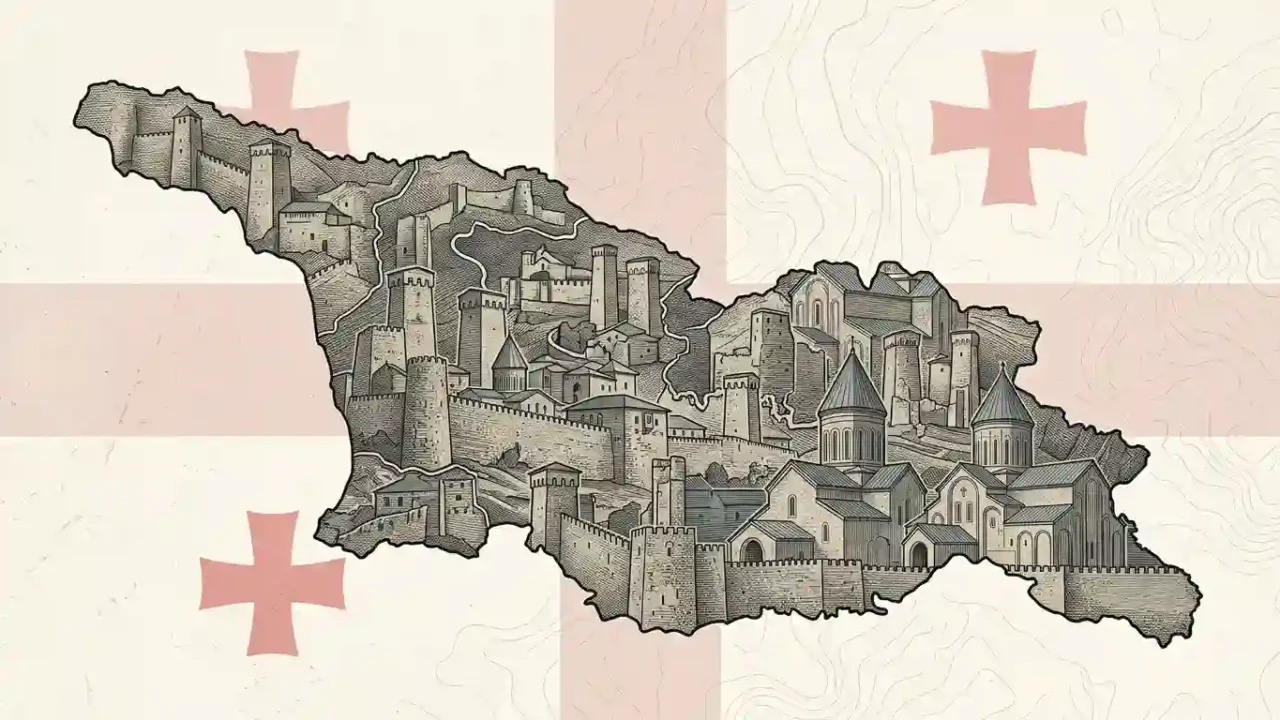
Georgia has more defensive sites than any single fixed total can capture. This page organizes 158 named castles, fortresses, fortified towns, and related complexes by present-day region, using broad source dates where available. It is an extensive working inventory, not an official claim that only these 158 sites exist.
How to use this article: First check what the inventory counts, then read how the dates work, compare the regional totals, or review the territorial context.
How This Regional Inventory Works
The tables are a corrected English rendering of the Georgian-language list of fortifications, checked against Georgia’s public cultural-heritage portal, National Library catalog records, and official site records. The portal catalogs both individual monuments and larger complexes, so it does not support one simple, permanent national total.
What counts as a castle or fortress here?
The inventory keeps the source’s broad approach. It includes castles, citadels, fortress walls, fortified towns, fortified residences, and some complexes whose defensive and religious functions overlap. That scope explains why entries such as Gremi, Batonis Tsikhe, and Samshvilde sit beside more conventional military fortresses.
This is not a complete register of every tower, wall, archaeological enclosure, or fortified village in Georgia. A different definition—or a newer heritage survey—will produce a different total.
How to read the construction dates
Many Georgian fortifications developed in several building phases. A date may refer to the earliest known occupation, the surviving walls, a major rebuilding, or the first written record rather than one moment of construction. Broad labels such as “Middle Ages” and “feudal period” are retained where the source does not support a narrower date; “Not stated” is used instead of guessing.
Regional totals in the cleaned inventory
The 158-entry total is a transparent count of the rows below. Kojori is placed under Tbilisi, Bochorma under Mtskheta-Mtianeti, and Jaqi Castle is not counted because its probable site lies in modern Turkey.
| Region or capital | Entries |
|---|---|
| Tbilisi | 4 |
| Autonomous Republic of Abkhazia | 4 |
| Autonomous Republic of Adjara | 12 |
| Guria | 4 |
| Imereti | 16 |
| Kakheti | 19 |
| Mtskheta-Mtianeti | 3 |
| Racha-Lechkhumi and Kvemo Svaneti | 3 |
| Samegrelo-Zemo Svaneti | 14 |
| Samtskhe-Javakheti | 20 |
| Kvemo Kartli | 16 |
| Shida Kartli | 43 |
| Total | 158 |
Territorial and access context
The list follows Georgia’s internationally recognized borders. Abkhazia and the Tskhinvali region/South Ossetia are outside the Georgian government’s de facto control, and international access remains restricted; several Shida Kartli entries are in or near the Tskhinvali region. Their inclusion is geographic and historical, not a statement that ordinary visitor access is available.
UNESCO status also requires care. Ananuri and the Vardzia-Khertvisi landscape appear on Georgia’s World Heritage Tentative List, but tentative-list placement is not the same as inscription on the World Heritage List.
Tbilisi
Tbilisi contains four entries in this inventory. Narikala preserves the capital’s best-known defensive site, Tabori survives mainly as foundations, and Kojori is placed here according to its present-day administrative location.
| No. | Name | Date or period |
|---|---|---|
| 1 | Tabori Castle | Feudal period |
| 2 | Tbilisi Castle (historical source name) | Feudal period |
| 3 | Narikala Fortress | First recorded in the late 4th century; later rebuilding |
| 4 | Kojori Fortress (Azeula or Koroghli Fortress) | 11th century; multilayered site |
Autonomous Republic of Abkhazia
Four sites are retained under the Autonomous Republic of Abkhazia. Their names and source locations are included for geographic completeness, but current access and on-site conditions should not be inferred from this historical table.
| No. | Name | Date or period | Source location |
|---|---|---|---|
| 1 | Anakopia Fortress | Feudal period | Gudauta Municipality |
| 2 | Satanjo Castle | 8th–10th centuries | Gali Municipality |
| 3 | Bzyb Fortress | 8th–10th centuries | Gagra Municipality |
| 4 | Trakei Castle | 6th century | Gudauta Municipality |
Autonomous Republic of Adjara
Adjara’s 12 entries include early Black Sea defenses such as Petra and Gonio-Apsaros Fortress, along with medieval mountain fortifications in Keda and Khulo. Gonio’s surviving complex has Roman, Byzantine, and Ottoman layers rather than a single construction date.
| No. | Name | Date or period | Location |
|---|---|---|---|
| 1 | Batumi Castle | 6th century | Batumi |
| 2 | Petra Fortress | 6th century | Kobuleti Municipality |
| 3 | Gonio-Apsaros Fortress | Roman-period fortification; associated with the 1st century BCE and later phases | Khelvachauri Municipality |
| 4 | Khikhani Fortress | 10th–11th centuries | Khulo Municipality |
| 5 | Gulebi Castle | 12th–13th centuries | Keda Municipality |
| 6 | Saghoreti Fortress | 14th–15th centuries | Keda Municipality |
| 7 | Tsivasula Castle | 16th–17th centuries | Keda Municipality |
| 8 | Elias Castle | Not stated | Kobuleti Municipality |
| 9 | Mamuka Castle | Not stated | Kobuleti Municipality |
| 10 | Gvara Castle | Not stated | Khelvachauri Municipality |
| 11 | Begoshvili Castle | 12th–13th centuries | Khulo Municipality |
| 12 | Tsikhiskeli Castle | 12th–13th centuries | Khulo Municipality |
Guria Region
Guria contributes four entries. The dating is uneven: Askana is assigned an early date in the source inventory, while Bukistsikhe and Likhauri are left undated rather than given unsupported construction centuries.
| No. | Name | Date or period | Location |
|---|---|---|---|
| 1 | Askana Castle | 4th century | Ozurgeti Municipality |
| 2 | Bukistsikhe Castle | Not stated | Chokhatauri Municipality |
| 3 | Likhauri Castle | Not stated | Ozurgeti Municipality |
| 4 | Ghomi Castle | Middle Ages | Chokhatauri Municipality |
Imereti Region
Imereti has 16 entries spanning antiquity, late antiquity, the medieval period, and the 18th century. The table retains broad source labels where a fortification’s exact construction history remains unclear.
| No. | Name | Date or period | Location |
|---|---|---|---|
| 1 | Uchimerion Fortress | 6th century | Kutaisi |
| 2 | Baghdati Fortress | 1703 | Baghdati Municipality |
| 3 | Mtskeri Castle | 8th century | Zestafoni Municipality |
| 4 | Shorapani Fortress | Antiquity | Zestafoni Municipality |
| 5 | Bertsikhe | Early feudal period | Terjola Municipality |
| 6 | Skande Castle | 4th century | Terjola Municipality |
| 7 | Modinakhe Fortress | 18th century | Sachkhere Municipality |
| 8 | Tsutskhvati Castle | Middle Ages | Tkibuli Municipality |
| 9 | Jvari Castle | Middle Ages | Tkibuli Municipality |
| 10 | Dghnori Castle | Middle Ages | Tskaltubo Municipality |
| 11 | Katskhi Castle | Feudal period | Chiatura Municipality |
| 12 | Navardzeti Castle | Feudal period | Chiatura Municipality |
| 13 | Sveri Castle | Middle Ages | Chiatura Municipality |
| 14 | Vakhani Castle | 10th–11th centuries | Kharagauli Municipality |
| 15 | Chkheri Castle | Not stated | Kharagauli Municipality |
| 16 | Didgvabuni Castle | Early feudal period | Khoni Municipality |
Kakheti Region
Kakheti has 19 entries in the corrected regional count. They range from early fortified centers such as Ujarma and Khornabuji to royal residences and 18th-century defensive walls. Bochorma is listed later under Mtskheta-Mtianeti because it stands in modern Tianeti Municipality.
| No. | Name | Date or period | Location |
|---|---|---|---|
| 1 | Ujarma Fortress | 3rd–4th centuries; later phases | Sagarejo Municipality |
| 2 | Khornabuji Fortress | 5th century | Dedoplistskaro Municipality |
| 3 | Psiti Castle | 5th–6th centuries | Telavi Municipality |
| 4 | Kveteri Fortress | 8th century | Akhmeta Municipality |
| 5 | Kachalauri Castle | 8th–9th centuries | Akhmeta Municipality |
| 6 | Machi Castle | 9th century | Lagodekhi Municipality |
| 7 | Manavi Fortress | 10th–11th centuries | Sagarejo Municipality |
| 8 | Gremi Fortified Complex | 15th–16th centuries; Church of the Archangels built and painted 1565–1577 | Kvareli Municipality |
| 9 | Batonis Tsikhe | 17th–18th centuries | Telavi |
| 10 | Kvareli Fortress | 16th–18th centuries | Kvareli |
| 11 | Sighnaghi Fortress and Wall | 1762 | Sighnaghi |
| 12 | Khashmi Castle | 17th century | Sagarejo Municipality |
| 13 | Niakhura Fortress | 17th–18th centuries | Sagarejo Municipality |
| 14 | Laliskuri Fortress | 17th–18th centuries | Telavi Municipality |
| 15 | Cholokashvili Fortified Residence | 1755–1756 | Akhmeta Municipality |
| 16 | Korchibashishvili Castle | 18th century | Telavi |
| 17 | Matani Castle | 18th century | Akhmeta Municipality |
| 18 | Shilda Fortress and Wall | 18th century | Kvareli Municipality |
| 19 | Second Makashvili Fortified Residence | 18th century | Telavi Municipality |
Mtskheta-Mtianeti Region
This table contains three entries, including Ananuri Fortress and Bochorma. It is plainly not an exhaustive inventory of the region’s defensive heritage; it preserves the established list while correcting Bochorma’s modern regional placement.
| No. | Name | Date or period | Location |
|---|---|---|---|
| 1 | Ananuri Fortified Castle Ensemble | 14th–18th centuries | Dusheti Municipality |
| 2 | Arsha Fortress | 16th century | Kazbegi Municipality |
| 3 | Bochorma Fortress | Exact construction date unknown; documented by the 10th century | Tianeti Municipality |
Racha-Lechkhumi and Kvemo Svaneti Region
Three entries are retained for Racha-Lechkhumi and Kvemo Svaneti, all placed in Ambrolauri Municipality. The source dates are broad and should not be read as single-phase construction histories.
| No. | Name | Date or period | Location |
|---|---|---|---|
| 1 | Kvari Fortress | Feudal period | Ambrolauri Municipality |
| 2 | Minda Fortress | Middle Ages | Ambrolauri Municipality |
| 3 | Khotevi Castle | 17th century | Ambrolauri Municipality |
Samegrelo-Zemo Svaneti Region
Samegrelo-Zemo Svaneti has 14 entries. The consulted regional inventory does not provide defensible construction dates for these rows, so the table preserves the names and municipalities without supplying invented centuries.
| No. | Name | Date or period | Location |
|---|---|---|---|
| 1 | Abedati Fortress | Not stated | Martvili Municipality |
| 2 | Anaklia Fortress | Not stated | Zugdidi Municipality |
| 3 | Eki Castle | Not stated | Senaki Municipality |
| 4 | Tamakoni Castle | Not stated | Martvili Municipality |
| 5 | Kotianeti Castle | Not stated | Senaki Municipality |
| 6 | Rukhi Castle | Not stated | Zugdidi Municipality |
| 7 | Sakalandarishvili Castle | Not stated | Senaki Municipality |
| 8 | Skuri Castle | Not stated | Senaki Municipality |
| 9 | Noga Fortress | Not stated | Martvili Municipality |
| 10 | Shkhepi Fortress | Not stated | Senaki Municipality |
| 11 | Tsikhegoji Fortress | Not stated | Senaki Municipality |
| 12 | Chakvinji Fortress | Not stated | Zugdidi Municipality |
| 13 | Khamiskuri Castle | Not stated | Khobi Municipality |
| 14 | Kheti Castle | Not stated | Khobi Municipality |
Samtskhe-Javakheti Region
Samtskhe-Javakheti contributes 20 entries within modern Georgia, including Rabati or Akhaltsikhe Castle, Tmogvi, and Khertvisi. The old source row for Jaqi Castle is excluded from the table because its probable location is now in Turkey, although it remains important to the history of the Jaqeli dynasty.
| No. | Name | Date or period | Location |
|---|---|---|---|
| 1 | Abuli Castle | Not stated | Akhalkalaki Municipality |
| 2 | Aspindza Castle | Not stated | Aspindza Municipality |
| 3 | Arkistsikhe Castle | Not stated | Akhaltsikhe Municipality |
| 4 | Rabati (Akhaltsikhe) Castle | 9th-century origins; later rebuilding | Akhaltsikhe Municipality |
| 5 | Atskuri Castle | 11th century | Akhaltsikhe Municipality |
| 6 | Demoti Castle | Not stated | Borjomi Municipality |
| 7 | Dviri Castle | 13th–14th centuries | Borjomi Municipality |
| 8 | Vardi Castle | Not stated | Akhalkalaki Municipality |
| 9 | Zanavi Castle | Middle Ages | Adigeni Municipality |
| 10 | Tiseli Castle | Not stated | Akhaltsikhe Municipality |
| 11 | Tmogvi Fortress | 10th century | Aspindza Municipality |
| 12 | Kokhtastavi Castle | Not stated | Aspindza Municipality |
| 13 | Okros Tsikhe | 13th century | Adigeni Municipality |
| 14 | Petre Castle | Not stated | Borjomi Municipality |
| 15 | Sakanape Fortress | 12th century | Akhaltsikhe Municipality |
| 16 | Slesa Castle | Middle Ages | Akhaltsikhe Municipality |
| 17 | Shaori Fortress | Not stated | Akhalkalaki Municipality |
| 18 | Tsikhisjvari Castle | Not stated | Borjomi Municipality |
| 19 | Khertvisi Fortress | 10th century; major work dated 1354–1356 | Aspindza Municipality |
| 20 | Kherkhemi Castle | Middle Ages | Adigeni Municipality |
Kvemo Kartli Region
Kvemo Kartli has 16 entries after Kojori is placed under Tbilisi. The region’s table includes natural strongholds such as Birtvisi, fortified urban sites such as Samshvilde, and later defensive complexes such as Kolagiri and Khuluti.
| No. | Name | Date or period | Location |
|---|---|---|---|
| 1 | Berdiki Castle | Not stated | Bolnisi Municipality |
| 2 | Kveshi Fortress | Middle Ages | Bolnisi Municipality |
| 3 | Kolagiri Fortress | 18th century | Bolnisi Municipality |
| 4 | Chapala Castle | 12th–13th centuries | Bolnisi Municipality |
| 5 | Birtvisi Fortress | Not stated | Tetritskaro Municipality |
| 6 | Kldekari Fortress | 9th–10th centuries | Tetritskaro Municipality |
| 7 | Lasti Fortress | 12th century | Tetritskaro Municipality |
| 8 | Orbeti Fortress | Middle Ages | Tetritskaro Municipality |
| 9 | Samshvilde Fortified City | Multiperiod site; date not reduced to one construction phase | Tetritskaro Municipality |
| 10 | Partskhisi Castle | Not stated | Tetritskaro Municipality |
| 11 | Santi Cyclopean Castle | Middle Ages in source inventory | Tsalka Municipality |
| 12 | Khuluti Castle | 18th century | Tetritskaro Municipality |
| 13 | Ofreti Castle | Early feudal period | Marneuli Municipality |
| 14 | Tsopi Castle | Middle Ages | Marneuli Municipality |
| 15 | Rustavi Fortress | 5th–8th centuries | Rustavi |
| 16 | Gagi Fortress | Earlier origins; rebuilt in or before the 10th century | Marneuli Municipality |
Shida Kartli Region
Shida Kartli has 43 entries, the largest table in this inventory. It includes major strongholds such as Gori and Surami, smaller family castles, and sites in areas now affected by the Tskhinvali region/South Ossetia conflict.
| No. | Name | Date or period | Source location |
|---|---|---|---|
| 1 | Abisi Castle | 18th century | Kareli Municipality |
| 2 | Ateni Fortress | 10th–11th centuries | Gori Municipality |
| 3 | Akhaltsikhe Fortress | 18th century | Kaspi Municipality |
| 4 | Bekhushe Castle | Late Middle Ages | Gori Municipality |
| 5 | Bulbuli Castle | Feudal period | Khashuri Municipality |
| 6 | Gori Fortress | Site evidence from the 1st millennium BCE; major rebuilding in 1774 | Gori Municipality |
| 7 | Dri Castle | High feudal period | Kaspi Municipality |
| 8 | Vere Castle | 9th–10th centuries | Gori Municipality |
| 9 | Kiknatberi Castle | Late feudal period | Gori Municipality |
| 10 | Kldemaghala Castle | 5th–6th centuries | Kaspi Municipality |
| 11 | Mtskhetijvari Castle | Feudal period | Khashuri Municipality |
| 12 | Osiauri Castle | 17th–18th centuries | Khashuri Municipality |
| 13 | Rkoni Fortress | 18th century | Kaspi Municipality |
| 14 | Surami Fortress | Middle Ages in source inventory; earlier origins are also proposed | Khashuri Municipality |
| 15 | Skhvilo Castle | 14th century | Kaspi Municipality |
| 16 | Tirdznisi Castle | Second half of the 18th century | Gori Municipality |
| 17 | Tskhireti Castle | 10th century | Kaspi Municipality |
| 18 | Dzama Castle | High feudal period | Kareli Municipality |
| 19 | Tsedisi Fortress | 10th century | Gori Municipality |
| 20 | Achabeti Fortress | Not stated | Gori Municipality in source inventory; Tskhinvali region/South Ossetia |
| 21 | Kekhvi Castle | Not stated | Gori Municipality in source inventory; Tskhinvali region/South Ossetia |
| 22 | Mirmanoz Eristavi Castle | 17th–18th centuries | Gori Municipality |
| 23 | Atotsi Castle | 18th century | Kareli Municipality |
| 24 | Gnolidze Family Castle | 17th–18th centuries | Gori Municipality |
| 25 | Khubashvili Family Castle | 17th–18th centuries | Gori Municipality |
| 26 | Chasarbeni Castle | 17th–18th centuries | Gori Municipality |
| 27 | Tkviavi Fortress | 18th century | Gori Municipality |
| 28 | Shindisi Fortress | 18th century | Gori Municipality |
| 29 | Aradeti Fortress | 17th century | Kareli Municipality |
| 30 | Mdzovreti Castle | 17th century | Kareli Municipality |
| 31 | Samtsevrisi Fortress | 15th–17th centuries | Kareli Municipality |
| 32 | Skhlebi Castle | Feudal period | Kareli Municipality |
| 33 | Atsriskhevi Fortress | 18th century | Gori Municipality |
| 34 | Pokhala Fortress | Late Middle Ages | Gori Municipality |
| 35 | Gozo Fortress | Middle feudal period | Gori Municipality |
| 36 | Vanati Fortress | High and Late Middle Ages | Gori Municipality |
| 37 | Vildi Castle | Late Middle Ages | Gori Municipality |
| 38 | Ikorti Fortress | Late Middle Ages | Gori Municipality |
| 39 | Inauri Castle | Late Middle Ages | Gori Municipality |
| 40 | Rekomi Castle | High Middle Ages | Gori Municipality |
| 41 | Satikhari Castle | 18th century | Gori Municipality |
| 42 | Sveri Castle | Late Middle Ages | Gori Municipality |
| 43 | Khaduriantubani Castle | 18th century | Gori Municipality |
Table downloads (13)
- Regional totals in this 158-entry working inventory (14 × 2)View tableDownload CSV
- Castles and fortresses listed for Tbilisi (5 × 3)View tableDownload CSV
- Castles and fortresses listed for the Autonomous Republic of Abkhazia (5 × 4)View tableDownload CSV
- Castles and fortresses listed for the Autonomous Republic of Adjara (13 × 4)View tableDownload CSV
- Castles and fortresses listed for Guria (5 × 4)View tableDownload CSV
- Castles and fortresses listed for Imereti (17 × 4)View tableDownload CSV
- Castles and fortresses listed for Kakheti (20 × 4)View tableDownload CSV
- Castles and fortresses listed for Mtskheta-Mtianeti (4 × 4)View tableDownload CSV
- Castles and fortresses listed for Racha-Lechkhumi and Kvemo Svaneti (4 × 4)View tableDownload CSV
- Castles and fortresses listed for Samegrelo-Zemo Svaneti (15 × 4)View tableDownload CSV
- Castles and fortresses listed for Samtskhe-Javakheti within modern Georgia (21 × 4)View tableDownload CSV
- Castles and fortresses listed for Kvemo Kartli (17 × 4)View tableDownload CSV
- Castles and fortresses listed for Shida Kartli (44 × 4)View tableDownload CSV
Frequently Asked Questions
How many castles and fortresses are there in Georgia?
No single authoritative number covers every possible castle, fortress, tower, fortified town, and archaeological enclosure. The tables on this page contain 158 entries within Georgia’s internationally recognized borders, but that is a transparent inventory count rather than an official national total.
Are all 158 sites open to visitors?
No. Some are maintained attractions, while others are ruins, remote archaeological sites, structurally unsafe, on private or restricted land, or in conflict-affected areas. Current access should be checked with the responsible local or heritage authority before a visit.
Are all of Georgia’s castles protected by UNESCO?
No. UNESCO recognition applies only to specifically identified properties. Ananuri and Vardzia-Khertvisi are on Georgia’s Tentative List, which is a preliminary national nomination list and not the same as inscription on the World Heritage List.
Why are some dates broad or missing?
Fortifications were often expanded, destroyed, and rebuilt over centuries, and surviving records may date different construction phases. When the consulted inventory supplied only a broad period—or no defensible date—the table preserves that uncertainty.
Why are Abkhazia and sites in the Tskhinvali region included?
The inventory follows Georgia’s internationally recognized borders. Inclusion records geographic and historical location; it does not imply Georgian government control, safe public access, or unchanged on-site conditions.
What Did We Learn Today?
Georgia’s fortifications form a larger and less tidy record than one headline number suggests. This cleaned regional inventory contains 158 entries within the country’s internationally recognized borders, but the total is a table count rather than an official ceiling, and its broad or missing dates should be read as catalog labels rather than precise construction years.
Sources & Data Notes
The regional inventory was checked against the National Agency for Cultural Heritage Preservation of Georgia’s Cultural Heritage GIS portal, Georgian Wikipedia’s List of Fortifications in Georgia, National Parliamentary Library of Georgia catalog records for the monument volumes cited by that list, Georgian National Tourism Administration site records, UNESCO World Heritage Centre entries, and 2026 Council of Europe and European Union material for territorial context. Dates are presented as source ranges or broad periods; “Not stated” means no defensible date was found in the consulted inventory, and 158 is a row count rather than an official national total. This article was prepared and editorially reviewed by Z.K. Atlas, who completed the final factual checks and publication approval. AI tools may have assisted during the editorial process, including with language refinement and the creation or editing of visual materials.