A water-cycle diagram often looks like a neat circle: water rises, forms clouds, falls, and returns to the sea. That is one useful route, but real water also moves through soil, plants, snow, lakes, and rock, sometimes returning to the air without reaching the ocean.
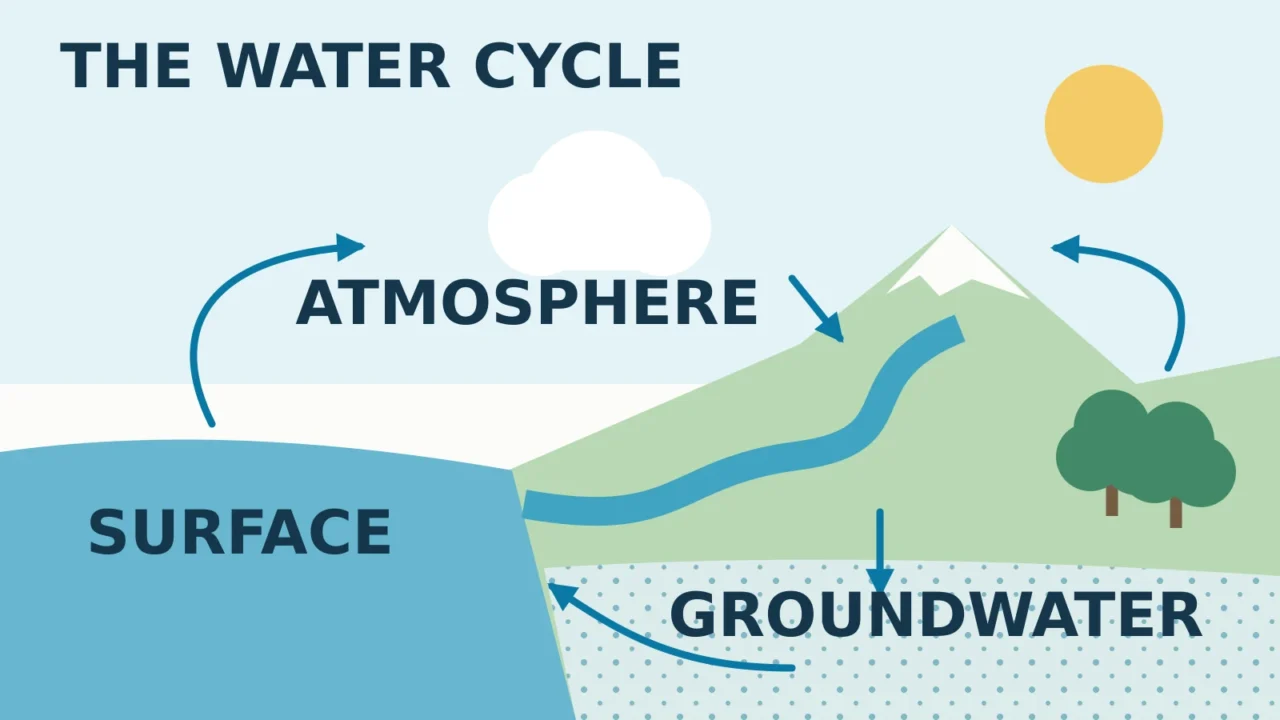
The water cycle, or hydrologic cycle, is the continuous movement of water among the atmosphere, Earth’s surface, underground stores, and living things. Solar energy and gravity help drive it. Evaporation, condensation, precipitation, runoff, and groundwater flow connect those stores, but water does not have to follow every process in a fixed order.
Follow the part you need: Separate evaporation from transpiration, trace water entering the ground, or compare three possible journeys.
1. Read the Water Cycle Diagram
Start by separating stores from flows. A store, also called a pool, is somewhere water is held: an ocean, a glacier, soil, a lake, an aquifer, or the atmosphere. A flow transfers water between stores. Some transfers also change its state between liquid, solid, and gas.
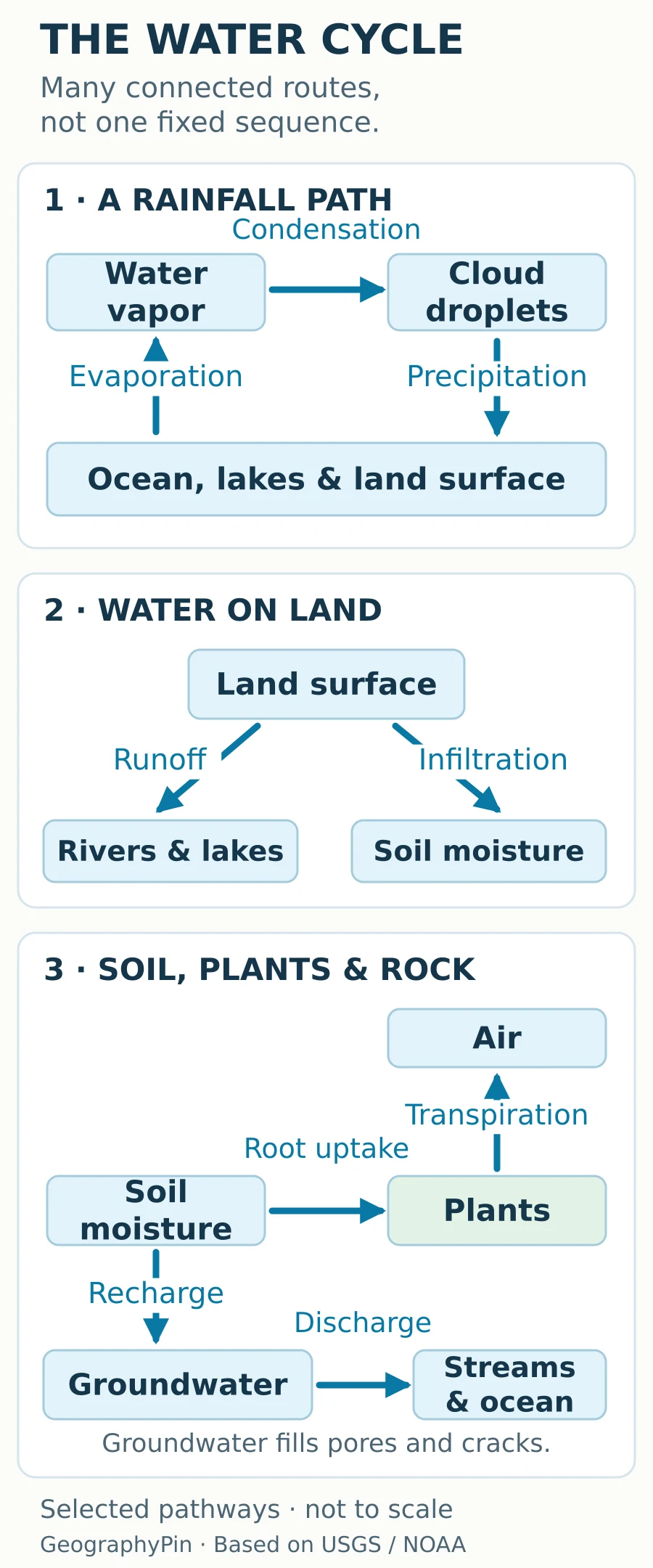
The USGS water-cycle overview uses this store-and-flow approach. It avoids treating “collection” as a final step: stored water can keep moving, and any store can be a starting point for an explanation.
Solar energy supplies heat that helps water evaporate. Gravity pulls precipitation toward the surface and drives downhill flow. Wind transports atmospheric moisture, while differences in elevation and pressure influence groundwater movement. These drivers work together rather than passing a single parcel of water around a conveyor belt.
2. How Water Moves Into and Out of the Air
Evaporation and transpiration return water to the atmosphere
Evaporation changes liquid water into water vapor, a gas. It happens at ocean and lake surfaces, on wet soil, and from puddles or rain-wet leaves. Water does not need to boil to evaporate, and evaporation does not stop simply because the sun has set.
Transpiration is the release of water vapor from plants, mainly through their leaves. Roots take up water, which travels through the plant before some returns to the air. Evaporation and transpiration together are called evapotranspiration. Water evaporating off a leaf’s wet exterior is different from water passing through the plant.
Condensation makes droplets; precipitation brings water down
Condensation changes water vapor into liquid droplets. Cooling air can reach saturation, allowing vapor to condense on tiny particles. Clouds contain droplets, ice crystals, or both; they are not simply visible water vapor. Water vapor itself is invisible.
Precipitation is water falling from clouds, including rain, snow, sleet, and hail. Cloud particles must grow large enough to fall out, and some falling water evaporates before reaching the ground. Condensation and precipitation are therefore different processes, not interchangeable names for rain.
Winds can carry moisture over land or ocean before precipitation occurs. Rain can fall straight back into the sea, or moisture released from vegetation can contribute to later rainfall over land. The clouds above a place do not have to come from the nearest water body.
3. What Happens When Water Reaches the Ground
Infiltration is not the same as groundwater recharge
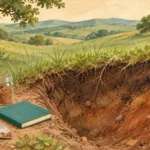
Infiltration is water entering the ground through the surface. Some remains as soil moisture and can later evaporate or be taken up by roots. Some percolates farther downward. When water reaches and replenishes the saturated underground zone, it becomes groundwater recharge. Not every drop that soaks into soil reaches an aquifer.
Groundwater occupies water-filled pores and cracks in sediment and rock. An aquifer is a permeable underground formation that stores and transmits usable quantities of water. Most groundwater is not an underground river, though flowing cave channels do exist in some geological settings.
Groundwater can discharge into springs, streams, lakes, wetlands, or the ocean. It helps sustain many streams between rainstorms. Exchange can also run the other way: a stream or lake may lose water into the ground. The direction depends on local water levels and geology, not on a universal one-way arrow.
Runoff and melting snow connect surface stores
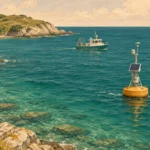
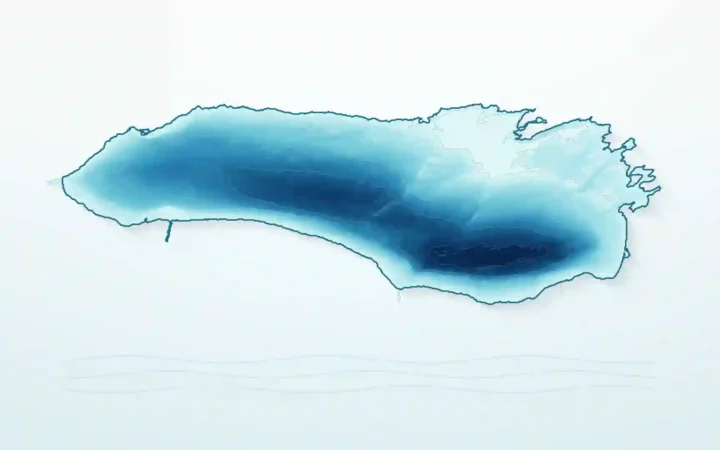
Surface runoff is water flowing over land. It can develop when rain arrives faster than the surface can absorb it, or when the ground is already saturated. Water collecting in channels becomes streamflow, which may enter a lake or reach the ocean. The water balance of a lake shows how precipitation, streams, evaporation, and groundwater connect in one place.
Snow and glaciers store frozen water. Melting turns it into liquid that may infiltrate or run off. Sublimation changes snow or ice directly into vapor without melting first; deposition changes vapor directly into ice. Freezing moves liquid water into a solid store. A diagram showing only rain and evaporation leaves these pathways out.
4. Why There Is No Single Route or Cycle Time
“Evaporation, condensation, precipitation, collection” is a memory aid, not a rule that every water molecule follows. There is no single scientifically required number of stages: a diagram can combine or separate processes depending on what it needs to teach.
Three possible journeys
- A short ocean route: surface water evaporates, contributes to a cloud, and returns as precipitation over the ocean without crossing land.
- A land-and-plant route: rain infiltrates soil, roots take up some water, and transpiration returns it to the atmosphere without a river journey.
- An underground route: rain or snowmelt infiltrates, recharges groundwater, and later discharges into a stream. That stream may feed a lake rather than immediately reach the sea.
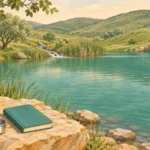
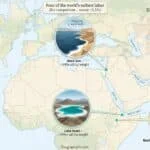
These are illustrative possibilities, not tracked droplets or a claim that each route takes the same time. A closed-basin lake, for example, has no surface outlet to the ocean; evaporation or underground exchange can still connect it to the wider cycle.
Residence time describes how long water remains in a store. It varies widely, including within the same aquifer or lake. USGS describes groundwater that can move significant distances in days and deep groundwater that may take thousands of years to return. Those are examples of different settings, not a timetable for all groundwater.
5. How People Change the Water Cycle
People are part of the modern cycle. We change where water is stored, the paths it follows, the timing of its movement, and its quality.
- Dams and diversions store water and alter downstream flows.
- Groundwater pumping removes stored water. Sustained withdrawals that exceed replenishment can reduce groundwater storage.
- Paving and vegetation changes alter infiltration, runoff, and evapotranspiration. More sealed ground commonly means less direct infiltration and more rapid runoff.
- Irrigation and water supply move water between rivers, aquifers, fields, and settlements. Some evaporates or is transpired; some returns to surface water or groundwater.
A changing climate also affects precipitation patterns, evaporation, snow and ice storage, and the timing of runoff. The effects differ by region. One storm is a weather event; shifts in long-term patterns belong to climate rather than daily weather.
Water cycling globally does not guarantee a reliable local supply. Water may be salty, polluted, frozen, difficult to reach, or replenished too slowly for current demand. As NOAA explains, a source can be depleted even while water continues circulating through the planet. Availability depends on location, timing, quantity, and quality.
What Did We Learn Today?
Read the water cycle as connected stores and flows, not a fixed circle. Evaporation and transpiration move water into the air; condensation forms droplets; precipitation returns water toward the surface. From there, water can run off, enter soil, recharge groundwater, freeze, or pass through plants. Different routes take different amounts of time, and human activities change both the movement and availability of water.
Sources & Data Notes
Process definitions and the distinction between stores and flows follow USGS, with atmospheric and human-impact context from NASA and NOAA. The original GeographyPin illustrations are explanatory schematics, not maps or measured water budgets. They show selected pathways, omit many exchanges, and do not scale arrow widths to flow volumes. The example journeys are hypothetical, and groundwater travel times depend on local conditions.