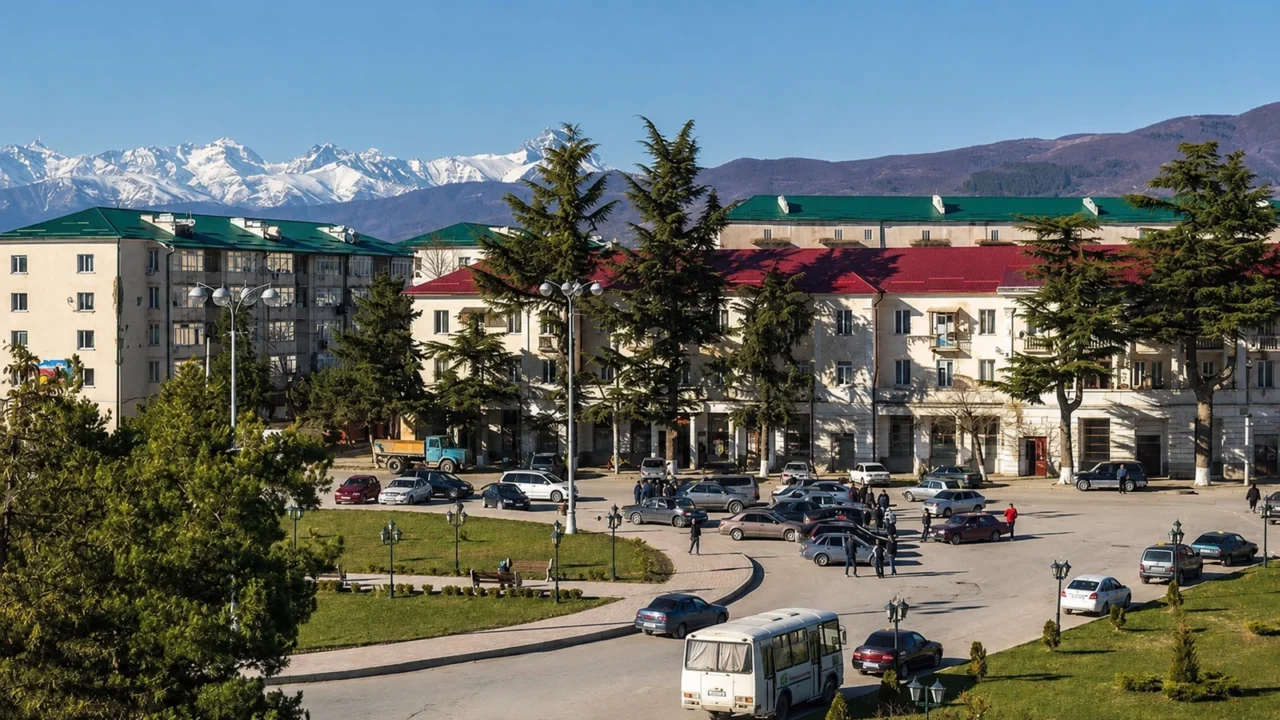
South Ossetia is a mountainous territory inside Georgia’s internationally recognized borders, but it is governed by a de facto administration backed by Russia and remains under Russian effective control. Georgians and Ossetians once lived in closely intermingled communities; wars in 1991–92 and 2008, displacement, and enforced separation broke much of that shared life.
How to use this article: Start with the legal-status check, see what the 1989 population pattern reveals, read the careful 2008 sequence, or go directly to the requirements for reconciliation.
Where South Ossetia Is and What Its Status Is
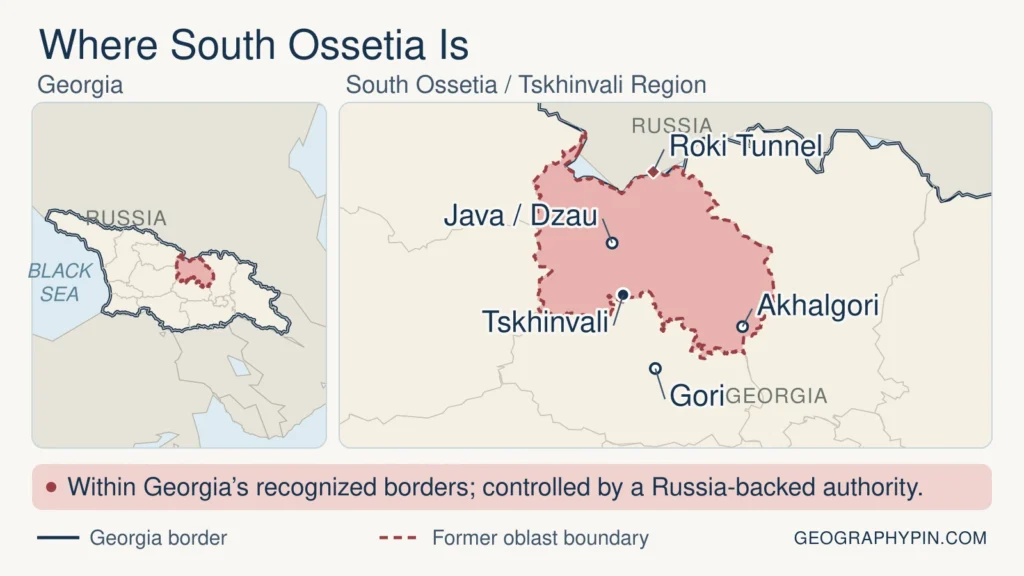
South Ossetia covers roughly 1,500 square miles (3,900 square kilometers) on the southern side of the Greater Caucasus mountain system. It lies north of Gori, the principal Georgian city immediately south of the conflict area, and reaches the Russian republic of North Ossetia–Alania across the main Caucasus ridge.
The legal-status check
South Ossetia lies within Georgia’s internationally recognized borders. In practice, Tbilisi has exercised no control anywhere inside the former autonomous oblast since the August 2008 war. A local de facto administration—which means an authority operating in practice without broad international recognition—governs the territory with extensive Russian military, political, and financial backing.
The European Court of Human Rights found that Russia exercised effective control over South Ossetia after the ceasefire of August 12, 2008, and that the combination of a strong Russian presence and the local authority’s dependence on Moscow demonstrated continuing effective control afterward.
Russia recognized South Ossetia as independent on August 26, 2008. In July 2026, the Pacific state now officially named Naoero withdrew its earlier recognition, leaving four United Nations member states—Russia, Nicaragua, Venezuela, and Syria—recognizing South Ossetian independence.
| Question | Careful answer |
|---|---|
| Where is it? | In the central South Caucasus, within Georgia’s internationally recognized borders. |
| What is the main city? | Tskhinvali, called Tskhinval in Ossetian and Russian usage. |
| Who administers it? | A de facto South Ossetian government closely integrated with and supported by Russia. |
| What does Georgia call it? | Usually the Tskhinvali Region; Georgia officially treats it as occupied territory. |
| Is the population known? | No independently verified current count exists. A census administered by the de facto authorities reported about 53,500 residents in 2015, but demographic estimates differ. |
Names carry political meaning. “South Ossetia” is the familiar English geographic name and the name used by the de facto authorities. “Tskhinvali Region” reflects Georgian official usage. International organizations often combine the forms as “Tskhinvali Region/South Ossetia.” Using the common name here does not endorse a sovereignty claim.
The Land and People Beyond the Dispute
The territory is a chain of mountain valleys rather than a broad, uniform plateau. The Greater and Little Liakhvi rivers drain south toward central Georgia, while the Ksani valley forms the eastern approach around Akhalgori. Forested slopes, alpine pasture, narrow agricultural land, and snowbound high ground shape where people can live and how they move.
Mountains, valleys, and the Roki connection
Tskhinvali sits in the more accessible southern part of the territory. Java, also called Dzau, lies farther north in the mountains; Akhalgori, called Leningor by the de facto authorities, anchors the eastern district. Small settlements follow roads, streams, and cultivable valley floors.
The Roki Tunnel carries the main road north through the Caucasus to North Ossetia–Alania. This physical link helps explain both the region’s cultural connection to northern Ossetians and Russia’s ability to supply and defend the territory. Southward roads historically connected the same valleys to Gori and the rest of Georgia. Geography therefore offered connections in both directions; politics hardened one and restricted the other.
Who are the Ossetians?
Ossetians are a distinct ethnic people, not a Georgian subgroup and not simply Russians living in Georgia. Their language, Ossetian, belongs to the eastern branch of the Iranian language family and preserves a historical connection with the languages of the Alans. It is unrelated to Georgian, which is a Kartvelian language.
Most Ossetians live in North Ossetia–Alania within the Russian Federation, but Ossetian communities have also lived south of the Caucasus crest and across several regions of Georgia. Religion did not create the modern conflict: most Georgians and Ossetians are historically associated with Eastern Orthodox Christianity, although religious practice and local traditions vary.
The region’s mountain scenery, villages, churches, family land, and shared food traditions belong to people’s lived geography. Reducing it to a military corridor erases what was worth protecting in the first place.
How Georgians and Ossetians Lived Together
The idea that Georgians and Ossetians always occupied two sealed ethnic territories is not supported by the demographic map. Before the wars, Georgian and Ossetian communities existed inside and outside the autonomous region, sometimes in neighboring villages and sometimes in the same families.
What the 1989 population pattern reveals
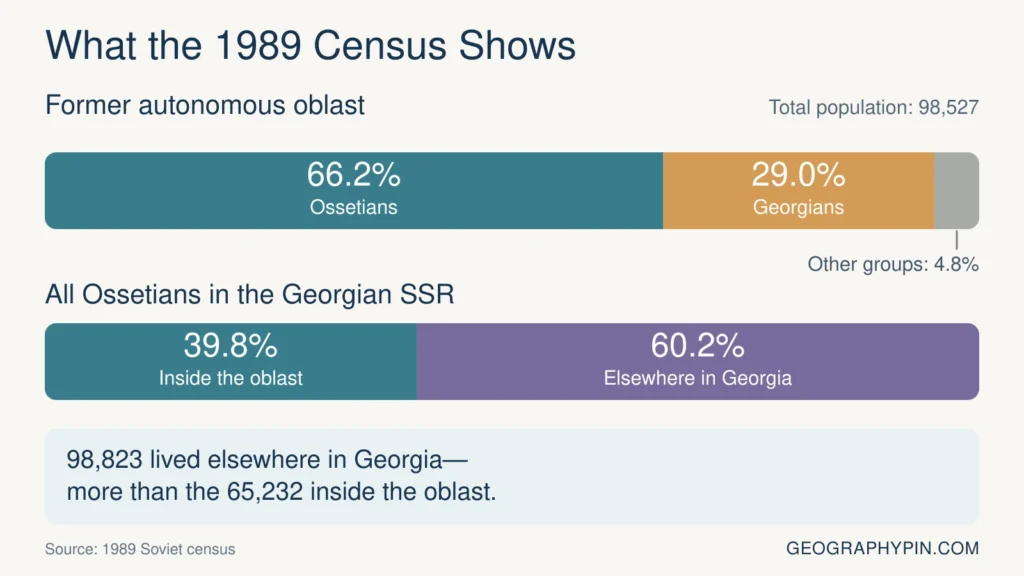
Analyses reproducing the 1989 Soviet census record 98,527 people in the South Ossetian Autonomous Oblast: 65,232 Ossetians and 28,544 Georgians. A separate republic-wide count recorded 164,055 Ossetians across the Georgian SSR. Subtracting the oblast figure shows that approximately 98,800 Ossetians lived elsewhere in Georgia—substantially more than lived inside the autonomous region.
| Population measure | Count | Meaning |
|---|---|---|
| Total population of the autonomous oblast | 98,527 | The prewar regional population within the Soviet administrative boundary. |
| Ossetians inside the autonomous oblast | 65,232, or about 66.2% | Ossetians formed the regional majority. |
| Georgians inside the autonomous oblast | 28,544, or about 29.0% | Georgians formed a large regional minority, not a marginal presence. |
| Ossetians throughout the Georgian SSR | 164,055 | The Ossetian population extended far beyond South Ossetia. |
| Ossetians elsewhere in Georgia | About 98,800 | This rounded calculation subtracts the oblast count from the republic-wide total. |
These numbers do not prove how anyone wanted to vote or which state arrangement they preferred. They prove something more basic: the human geography was not cleanly divisible. Any project to create an ethnically exclusive territory would inevitably displace people.
A checkerboard of villages, roads, and relationships
Even after the 1991–92 war, Georgian-administered and Ossetian-administered villages remained closely interwoven around Tskhinvali and along the Greater and Little Liakhvi valleys. International Crisis Group described lively exchanges and uncontrolled trade across the divided zone during the years without full-scale war.
The Ergneti market south of Tskhinvali captured the contradiction. It was a major smuggling hub that deprived Georgia of customs revenue and strengthened informal power networks. It was also a meeting place where Georgians and Ossetians bought goods, earned money, exchanged information, and maintained everyday contact.
Intermarriage was significant, although reliable totals do not exist. People shared workplaces, schools, markets, religious customs, and family ties. None of that means relations were free of discrimination, language disputes, crime, or political resentment. It means coexistence was a documented reality, not an imaginary future.
How the Conflict Developed
The conflict was not caused by one ancient hatred or one night of fighting. It developed through disputed historical memories, the collapse of two political systems, escalating nationalist programs, armed violence, outside intervention, and repeated failures to protect civilians.
Before 1922: one place, competing memories
The territory south of the Greater Caucasus formed part of historical Georgian political space, while Ossetian communities established long-standing settlements in its mountain valleys over centuries. Historians dispute the timing, scale, and political meaning of different migration periods. Those debates can explain identity, but they cannot by themselves settle modern sovereignty or remove either community’s rights.
Violence in 1918–1920 left one of the deepest disagreements in Georgian–Ossetian memory. Ossetian-led uprisings were connected to local land grievances, Bolshevik politics, and the wider Russian Civil War; forces of the Democratic Republic of Georgia suppressed them with severe violence, burning villages and driving many Ossetians north. South Ossetian institutions describe the events as genocide, while the Georgian narrative emphasizes a Soviet-backed rebellion against an independent state. Casualty totals and legal labels remain contested, but the mass suffering and displacement are not reasonably dismissible.
The Soviet autonomous region
After the Red Army took Georgia in 1921, Soviet authorities created the South Ossetian Autonomous Oblast within Soviet Georgia on April 20, 1922. Its outline was therefore a Soviet administrative boundary rather than an ancient international frontier. The arrangement recognized a territorial form of Ossetian autonomy while keeping the region economically and administratively tied to Georgia.
For most of the Soviet period, Georgians and Ossetians interacted extensively, but unresolved questions remained beneath the surface: language rights, access to institutions, economic opportunity, the region’s status, Georgian fears of Russian manipulation, and Ossetian fears of Georgian nationalism.
1988–1992: status claims become war
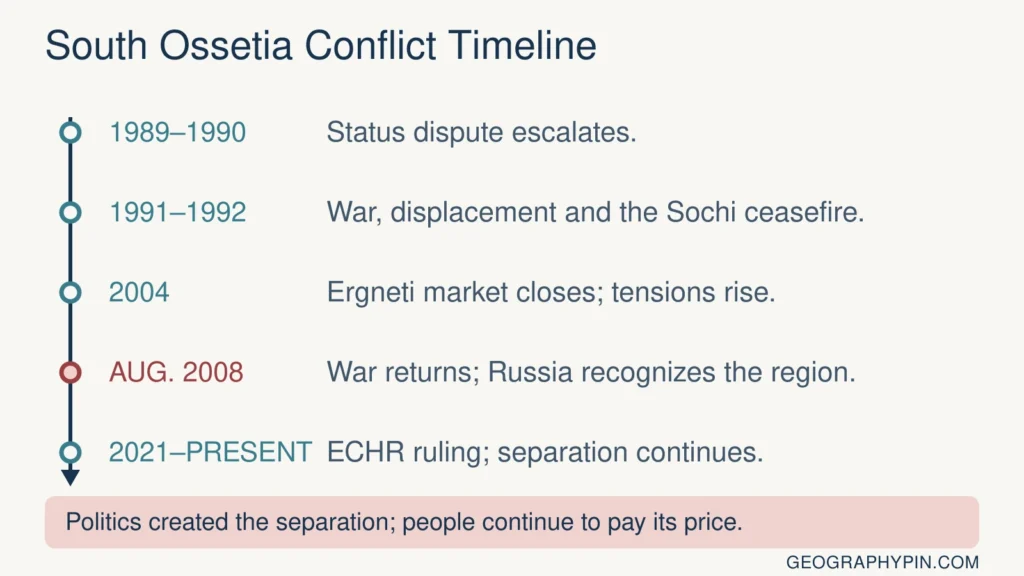
As the Soviet Union weakened, the Ossetian national movement Adamon Nykhas emerged in 1988. In November 1989, the regional council sought to raise South Ossetia from an autonomous oblast to an autonomous republic; Georgia’s Supreme Soviet rejected the move. A large Georgian march toward Tskhinvali later that month was blocked, and confrontation sharpened fear on both sides.
In September 1990, the regional authorities proclaimed a South Ossetian Soviet republic within the Soviet Union and later held separate elections. On December 11, Georgia abolished the autonomous oblast. The decision did not resolve separatism; it removed the region’s formal autonomous status at a moment when many Ossetians feared Georgian nationalism. In January 1991, Georgian forces entered Tskhinvali and the crisis became an armed conflict.
Human Rights Watch documented indiscriminate shelling, torture, summary executions, hostage-taking, looting, and forced evacuation by Georgian and Ossetian fighters. It also held the Georgian government responsible for failing to protect—and in some cases enabling abuses against—Ossetians elsewhere in Georgia. By early 1992, the organization reported at least 250 people killed, about 100,000 refugees reaching North Ossetia from the conflict area and other parts of Georgia, approximately 23,000 Georgian refugees from South Ossetia, and nearly 100 evacuated or destroyed villages.
Those figures were recorded before the final ceasefire and are not a complete final toll. Their value is that they establish the direction and scale of harm: both communities were attacked and uprooted, and state collapse gave armed groups room to turn political claims into collective punishment.
1992–2003: peace without settlement
The Sochi Agreement of June 24, 1992, established a ceasefire, a security zone, and joint peacekeeping forces. Control remained fragmented between Tbilisi and Tskhinvali. The political dispute froze, but daily society did not freeze completely: trade resumed, people crossed between communities, and Georgian and Ossetian villages continued to exist beside one another.
2004–2008: trust collapses again
After Mikheil Saakashvili became Georgia’s president, restoring territorial control became a central state goal. The government closed the Ergneti market during an anti-smuggling campaign in 2004 and increased its security presence. The market’s criminal economy was a legitimate state problem, but closing it without a durable replacement also removed livelihoods and one of the strongest channels of Georgian–Ossetian contact.
Fighting in 2004 killed dozens and strengthened hard-line politics in Tskhinvali. Georgia later supported an alternative Ossetian administration in Georgian-controlled villages, while Russian passport distribution, financial support, security involvement, and military links with the de facto authorities deepened. Negotiations continued, but the conflict zone became more armed and less trusting.
What Happened in August 2008
The shortest accurate explanation requires two different questions: what act began the open, large-scale war, and what chain of events produced it? Collapsing those questions into one is the main reason accounts of August 2008 sound mutually exclusive.
The careful sequence
- Before August 7: Years of political pressure and military preparation were followed by worsening shootings, shelling, attacks, and mutual accusations in and around the conflict zone.
- Night of August 7–8: Georgian forces launched a sustained artillery attack on Tskhinvali and a broader military operation in the surrounding area.
- August 8 onward: Additional Russian ground forces crossed from Russia through South Ossetia, supported by air power and other military elements. Russian operations extended beyond the region into undisputed Georgian territory.
- August 12: An EU-brokered six-point ceasefire was agreed, although implementation and withdrawal remained disputed.
- After the fighting: South Ossetian forces and irregulars looted and burned Georgian homes and villages, while Russian forces largely failed to prevent the campaign.
- August 26: Russia recognized South Ossetia and Abkhazia as independent states.
So who started the 2008 war?
The EU-sponsored Independent International Fact-Finding Mission concluded that the open, large-scale conflict began with Georgia’s operation against Tskhinvali on the night of August 7–8. It found that Georgia’s claim of a large-scale Russian incursion before the offensive was not sufficiently substantiated and that the attack, particularly the use of heavy artillery and multiple-launch rockets in and around a populated city, was not justified under international law.
That finding does not turn the preceding escalation into empty background or make Russia’s response lawful in full. The same mission documented years of provocations, Russian coercive policy, military support and passport distribution, an influx of fighters from Russia, and signs that some Russian forces were present beyond the authorized peacekeeping contingent. It concluded that much of Russia’s subsequent campaign went far beyond reasonable defense.
The distinction matters: Georgia initiated the open large-scale assault, but no serious explanation of the conflict can assign every cause or every later crime to Georgia. Russia’s advance deep into Georgia, indiscriminate attacks, and post-ceasefire conduct require separate judgment. So do South Ossetian attacks, forced displacement, and destruction of Georgian settlements.
The human cost
The EU fact-finding mission estimated that about 850 people were killed across the wider war, far more than 100,000 civilians fled their homes, and roughly 35,000 people had still not returned when its report was completed. The totals include Georgian, South Ossetian, and Russian military and civilian losses and should not be used as a measure of whose grief matters more.
Many Ossetian civilians fled north during the Georgian attack and feared destruction in Tskhinvali. Many Georgian civilians fled South Ossetia and the adjoining areas during Russian and South Ossetian advances; whole Georgian settlements north of Tskhinvali were subsequently emptied and destroyed. The war ended the remaining checkerboard of control and placed the former autonomous oblast under Tskhinvali and Russian control.
What Independent Investigations Established
A factual account cannot work as a scoreboard in which one established crime erases another. The clearest record comes from investigations that separated the conduct of Georgian forces, Russian forces, South Ossetian forces, and the authorities responsible after the ceasefire.
| Actor | Findings that must remain in the record |
|---|---|
| Georgian forces | The large-scale attack on Tskhinvali began the open war; the use of inaccurate heavy weapons in populated areas failed legal requirements concerning distinction and precautions, causing civilian harm. |
| Russian forces | Russian operations expanded deep into undisputed Georgian territory; Russian weapons also caused indiscriminate civilian harm, and Russian forces failed to stop widespread post-ceasefire abuses where they exercised control. |
| South Ossetian forces and irregulars | Investigators documented unlawful detention, hostage-taking, ill-treatment, looting, arson, forced displacement, and systematic destruction of predominantly Georgian settlements. |
| Authorities after the ceasefire | Russian and South Ossetian authorities failed to protect civilians and property adequately or create conditions for displaced Georgians to return safely. |
Table downloads (3)
- South Ossetia at a glance (6 × 2)View tableDownload CSV
- What the 1989 Soviet census shows (6 × 3)View tableDownload CSV
- Major findings concerning the 2008 war and its aftermath (5 × 2)View tableDownload CSV
Courts added legal responsibility
The European Court of Human Rights later found Russia responsible for a pattern of grave violations after the active fighting, including killings, torture and ill-treatment, arbitrary detention, looting and burning of homes, inhuman treatment directed at Georgians as an ethnic group, and denial of displaced people’s return. The judgment rested on Russia’s effective control; it did not declare every act during the chaotic active phase attributable to Russia under the European Convention.
In a separate case concerning continuing “borderization,” the Court found a system of violations involving life, liberty, family life, property, education, and freedom of movement. A 2025 compensation judgment covered more than 29,000 victims of that continuing pattern.
The International Criminal Court issued warrants in 2022 for three former South Ossetian officials, finding reasonable grounds concerning alleged war crimes that included unlawful confinement, torture or inhuman treatment, hostage-taking, and unlawful transfer. Arrest warrants are not convictions, and the suspects remain entitled to the presumption of innocence unless tried and found guilty.
Why balance does not mean equal blame
Balance means applying the same standard of evidence to every actor. It does not require assigning identical motives, identical legal responsibility, or an artificial fifty-fifty share of suffering. A Georgian attack can be unlawful while Georgia’s international border remains legally recognized. Ossetian civilians can be genuine victims while South Ossetian forces are responsible for crimes against Georgians. Russia can cite security concerns while still bearing responsibility for disproportionate force, effective control, and continuing violations.
What Separation Looks Like Today
The line around South Ossetia is not an internationally accepted state border. On the ground, however, fences, signs, surveillance devices, patrols, and controlled crossing points make it function like one for the people living beside it.
Fences turn political status into daily hardship
For farmers, the dispute can mean losing access to an orchard or field. For families, it can mean a long journey to reach a relative visible only a few miles away. Residents have faced detention and fines for crossing a line that may be poorly marked or that cuts through land they used before the war.
During the period from September 2025 through February 2026, the EU Monitoring Mission recorded 6,096 feet (1,858 meters) of new fencing along the South Ossetian line. The Council of Europe also reported 15 new detention cases from October 2025 through March 2026. Temporary pedestrian openings at Mosabruni/Odzisi and Kardzmani were generally limited to the twentieth through thirtieth days of each month during that reporting period.
The European Union Monitoring Mission patrols the Georgian-controlled side around the clock, but it has never received access to South Ossetia despite a mandate covering all of Georgia. Broader international humanitarian access inside the territory also remained blocked; the International Committee of the Red Cross was the only international humanitarian organization with regular access reported there.
Contact has not disappeared completely
The Ergneti Incident Prevention and Response Mechanism and its hotline help manage detentions, security incidents, irrigation, and other practical problems. The Geneva International Discussions remain the principal international format addressing the consequences of the 2008 war, although disputes regularly block progress on return and political status.
Small forms of cooperation also continue. In 2025, Georgia’s referral health program financed treatment for 116 patients from South Ossetia/Tskhinvali Region, and the Peace Fund for a Better Future reported support for more than 120 joint business projects since 2020. These programs do not solve sovereignty, but they show that useful contact can continue without requiring either side to abandon its position first.
The post-2008 order removed Georgian forces from the territory and answered a central South Ossetian security demand. It also deepened dependence on Russia and restricted southern access, international engagement, and economic options. Displaced Georgians remained unable to return to many homes. The present arrangement therefore protects a political separation while leaving much of the human loss unresolved.
Three Truths That Must Fit Together
Most partisan accounts become fragile because they preserve one community’s truth by deleting another’s. A stronger interpretation holds three propositions together without treating them as contradictions.
1. Georgia’s legal claim and Georgian suffering are real
South Ossetia lies within Georgia’s internationally recognized borders. Russian recognition and practical control did not receive broad international acceptance. Georgian civilians were killed, detained, dispossessed, and expelled; settlements were systematically destroyed, and the right of return remains obstructed. Acknowledging Georgian errors does not cancel those facts.
2. Ossetian identity, fear, and suffering are real
Ossetians are a distinct people with their own language, historical memory, and political agency. The violence of 1918–1920, anti-Ossetian nationalist rhetoric, abolition of autonomy, attacks and evictions in 1991, and the Georgian assault on Tskhinvali in 2008 created fears that cannot be dismissed as invented by Moscow. Russian exploitation of those fears does not make the fears false.
3. Russia’s role was decisive, but local choices still mattered
Russia supplied political, military, passport, and financial support and ultimately imposed the power balance that sustains separation. Yet blaming Russia alone would erase decisions made by Georgian and South Ossetian leaders and violence committed by local armed groups. Georgia abolished autonomy during an escalating crisis, failed to protect Ossetians, disrupted contact without an adequate replacement in 2004, and initiated the open 2008 assault. South Ossetian authorities and forces attacked Georgians, destroyed settlements, blocked return, and tied the territory’s future increasingly to Moscow.
These truths do not create collective guilt. A Georgian child did not shell Tskhinvali; an Ossetian child did not burn a Georgian village. Responsibility belongs to institutions and individuals whose conduct can be established—not to entire ethnic groups or their descendants.
What Reconciliation Would Require
Reconciliation does not require Georgians and Ossetians to call themselves one ethnic people. It requires two distinct peoples to accept that identity, security, property, dignity, and political voice cannot be protected by denying those same rights to the other community.
Practical principles before final status
- Acknowledge the full record: Georgian institutions should state specific Georgian errors and abuses without abandoning Georgia’s territorial claim. Ossetian representatives should acknowledge crimes, expulsions, and destruction committed against Georgian civilians.
- Guarantee non-use of force: Security must rest on credible commitments, functioning hotlines, and international monitoring rather than promises from one side alone.
- Restore normal movement: Crossing points should open regularly, arbitrary detention should end, and access to farms, healthcare, schools, cemeteries, and family members should not depend on political loyalty.
- Protect return and property rights: Return must be voluntary, safe, and dignified for displaced people of every ethnicity. Property claims need a documented, impartial process; return cannot require surrendering identity or citizenship claims.
- Protect Ossetian identity in any settlement: Language, education, culture, local government, and meaningful political representation need enforceable guarantees strong enough to survive a change of government in Tbilisi.
- Rebuild practical interdependence: Status-neutral trade, agricultural cooperation, scholarships, medical care, and joint businesses can make peace materially useful rather than ceremonial.
- Pursue individual accountability: Missing-person cases, unlawful killings, torture, and property destruction should be investigated without assigning inherited guilt to a nationality.
- Let people speak directly: Georgian-, Ossetian-, and Russian-language media, schools, researchers, families, and civil organizations need safe ways to communicate without being treated as traitors.
Why people must come before the final formula
Georgia cannot build durable unity by forcing people who fear Georgian rule to submit first and trust later. The South Ossetian claim to safety cannot be built ethically on the exclusion of Georgian residents and displaced families. Russia cannot credibly present permanent dependency and closed crossings as a complete solution for Ossetians.
A final political settlement would require difficult negotiations over security, political status, self-government, displaced people, property, and international guarantees. Human contact does not need to wait for agreement on every one of those questions. Reopening a road, treating a patient, locating a missing person, or returning a field does not decide sovereignty; it reduces the number of lives consumed by the dispute.
The future cannot be built by asking Georgians to forget lost homes or Ossetians to forget experienced fear. It can begin when neither community accepts that another generation must inherit isolation as proof of loyalty.
Frequently Asked Questions
Is there an active war in South Ossetia now?
No full-scale war is underway, but the conflict is unresolved. Russian forces and the de facto authorities control the territory, while detentions, new fencing, restricted crossings, and security incidents continue along the administrative boundary line (Council of Europe, 2026).
What does “borderization” mean?
The term describes the physical marking and enforcement of the administrative boundary line through fences, signs, trenches, surveillance, patrols, and detention practices. The line is not an internationally recognized border, but these measures can separate residents from homes, fields, roads, schools, cemeteries, and relatives.
Was South Ossetia an independent country before 1990?
Not as a broadly recognized modern state within today’s boundary. The Soviet Union created the South Ossetian Autonomous Oblast inside Soviet Georgia in 1922; the regional authorities proclaimed a separate Soviet republic in 1990 as the USSR was breaking apart. Older Georgian and Ossetian histories cannot be mapped automatically onto that Soviet outline.
Does South Ossetia want to join Russia?
Successive de facto leaders have advocated eventual union with Russia, and the territory is already closely integrated with Russia in security, finance, passports, and currency. Formal annexation has not occurred, and Georgia’s internationally recognized borders remain unchanged (Reuters, 2026).
Why do present-day population estimates differ?
The latest full count published by the de facto authorities dates to 2015, independent access is restricted, and migration between South Ossetia and Russia is difficult to measure. Estimates may also use different definitions of residence, so the reported census figure should not be treated as a verified current total.
What Did We Learn Today?
South Ossetia lies within Georgia’s internationally recognized borders but remains under a Russia-backed de facto administration and continuing Russian effective control. Georgians and Ossetians were not historically separated into clean ethnic territories: they lived across and beside one another, and both suffered violence and displacement as political disputes became wars. A credible path forward must protect Georgian return and property rights, Ossetian identity and security, direct human contact, and individual accountability at the same time.
Sources & Data Notes
The principal sources consulted were the EU-sponsored Independent International Fact-Finding Mission on the Conflict in Georgia, European Court of Human Rights judgments, International Criminal Court records, United Nations material, the Council of Europe’s 2026 consolidated report, the 1992 Human Rights Watch investigation, International Crisis Group reporting, the 1992 Sochi Agreement, the Government of Naoero’s recognition notice, Reuters reporting on recent integration policy, census-based work by OSW and the European Centre for Minority Issues, and Encyclopaedia Iranica for Ossetian language classification. Population and displacement figures are dated and attributed because coverage, boundaries, return movements, and access limitations differ; the 2015 de facto census total and the calculated number of Ossetians living elsewhere in Soviet Georgia are rounded. This article was prepared and editorially reviewed by Zurab Koniashvili (Z.K. Atlas), who completed the final factual checks and publication approval. AI tools may have assisted with language refinement and the creation or editing of visual materials.