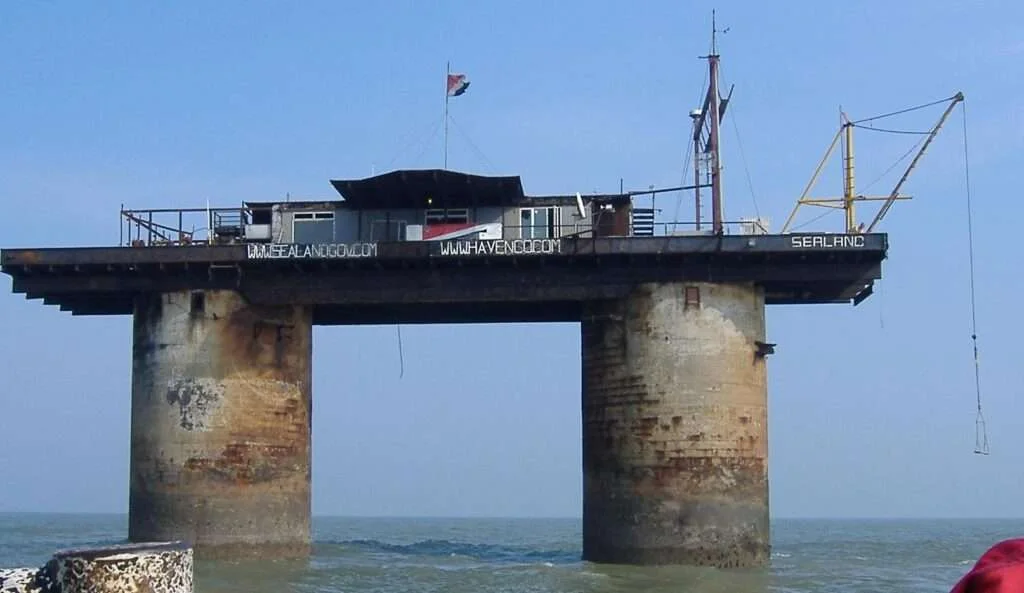
Two concrete towers and a steel deck in the North Sea make an unlikely setting for a royal family. Sealand’s fascination lies in that contrast: a former military fort has acquired the symbols of a country, but symbols and sovereign status are not the same thing.
Sealand is a self-proclaimed micronation on Roughs Tower, a former British sea fort off England’s east coast. It is not an internationally recognized sovereign state. Its claim to be the smallest country should therefore be distinguished from rankings of recognized states, rather than treated as a smaller rival to Vatican City.
1. From sea fort to micronation
Roughs Tower was built during World War II, not as an oil platform or a natural island settlement. Its concrete supports carry a deck above the North Sea. According to Sealand’s own history, Roy Bates declared it independent on September 2, 1967, adopting the name Principality of Sealand.
The Bates family’s project developed the familiar outward features of nationhood, including a flag, constitution, currency, and royal titles. These explain its identity and appeal; they do not independently establish recognition by other governments.
A 1968 firearms case is central to Sealand’s story. As legal scholar James Grimmelmann explains, the British court lacked jurisdiction over firearms charges concerning conduct on the fort, which then lay outside British territorial waters. A ruling about the reach of a court is not equivalent to diplomatic recognition of a new country.
2. Why the statehood claim is disputed
The 1933 Montevideo Convention sets out four familiar qualifications: a permanent population, a defined territory, a government, and the capacity to enter into relations with other states. It does not list “mutual recognition” as one of those four qualifications. Article 3 separately addresses the relationship between a state’s political existence and recognition.
That distinction matters, but it does not make declaring independence sufficient. The character of the claimed territory and the actual political community still require examination. Grimmelmann’s analysis discusses a 1978 Cologne court decision rejecting Sealand’s statehood, including the problem of treating a constructed platform as state territory.
The maritime setting also changed. A UK parliamentary answer confirms that British territorial waters were extended from 3 to 12 nautical miles in 1987. The fort’s position beyond the earlier limit should not be presented as proof that it remains outside British jurisdiction today.
Micronation is the useful descriptive term here: it identifies Sealand’s claim without endorsing it. It should not be confused with microstate, a term used for very small sovereign states.
3. What Sealand’s size and population figures mean
Guinness World Records lists Sealand under “Smallest area to lay claim to nation status” and gives about 14,000 square feet (1,300 square meters). The wording of that category is essential: it records a claim, not recognition as the world’s smallest sovereign state. The figure should be attributed to that record, not presented as a surveyed national land area.
Population requires similar care. Sealand’s website describes year-round residents but supplies no exact count. People on the fort and supporters elsewhere are different groups; its online community is not a resident census. The cited sources do not establish an exact current resident count.
For a comparison involving a recognized state, see our explanation of Vatican City and the world’s smallest national population.
4. E-citizenship is not a travel document
Sealand markets an e-citizenship membership, distinct from conventional nationality. Its website says the program does not change an existing passport or nationality and confers no right of residence or visa elsewhere. It also says a Sealand passport is not currently included.
An identity card, honorary title, online membership, and internationally accepted passport serve different purposes. Do not assume that buying one gives permission to cross a border or move to another country.
Frequently Asked Questions
Can tourists visit Sealand?
Access is limited. Sealand advertises selected member visits, not general public admission. Check current arrangements rather than assuming you can arrive uninvited.
Is a Sealand title part of the British peerage?
No. Sealand’s own website distinguishes its titles from the British Crown’s honours system. A title associated with the micronation is not a British peerage.
What Did We Learn Today?
Sealand shows why political geography is about more than size. A platform can have a flag and a compelling history without becoming a recognized sovereign state. Separate legal recognition from self-description, physical residents from online supporters, and membership products from travel rights.
Sources & Data Notes
Sealand’s pages are used for its own historical account and product descriptions, not as independent recognition of sovereignty. The area is an attributed Guinness figure, rounded in square feet; no current census count is asserted. Legal history is distinguished from present-day membership marketing.
- Sealand: its own historical account
- James Grimmelmann, Sealand, HavenCo, and the Rule of Law (2012), especially pp. 422–424 and 465–473
- Montevideo Convention (1933), Articles 1 and 3
- UK Parliament: territorial waters, answer of July 10, 2017
- Guinness World Records: Sealand’s claim category
- Sealand: e-citizenship and visitor information