
Rising above the Potskhovi River (also called Potskhovistskali) at about 1,000 meters (3,281 feet) in Georgia’s Samtskhe–Javakheti region, Rabati Castle—traditionally known as Akhaltsikhe Castle—layers Georgian, Ottoman, and Imperial Russian chapters into one fortified hilltop. Its core dates to the 9th century, but the complex you walk today was comprehensively restored in 2011–2012.
Rabati (Akhaltsikhe) Castle is a hilltop fortress in southern Georgia, founded in the 9th century and expanded under the Jakeli atabegs. It mixes a church, mosque, madrasa, minaret, palace, and museum within 7 hectares (17 acres). As of 2025, the complex operates daily around 09:00–20:00, with standard entry listed at 20 GEL.
What & Where
The fortress crowns the old Rabati district of Akhaltsikhe, a city split by the Potskhovi River. The site’s early name was Lomsia (“lion”), while Akhaltsikhe literally means “new fortress.” The restored complex covers roughly 70,000 m² (7 hectares / 17.3 acres) at approximately 41.6446° N, 42.9789° E. It is one of the region’s marquee sights alongside Vardzia.
| Metric | Value |
|---|---|
| Elevation | ~1,000 m (3,281 ft) above sea level |
| Area of complex | ~70,000 m² (7 ha / 17.3 acres) |
| Coordinates | 41.6446° N, 42.9789° E |
| From Tbilisi (road) | ~200 km (125 miles); ~3.5–4.5 hours |
Historical Epochs
Foundation & Early Period (9th–11th centuries). Chronicles attribute the initial fortress—then Lomsia—to Guaram Mampali in the 9th century, guarding trade routes across the Mtkvari (Kura) basin.
Jakeli Atabeg Era (12th–15th centuries). After warfare in the 11th century, Beshken II Jaqeli (often spelled Bashken) led rebuilding under King David IV “Agmashenebeli”. The seat of the Samtskhe–Saatabago atabegs, Akhaltsikhe endured Mongol and later Timurid (Tamerlane) pressures yet remained a regional center.
Ottoman Pashalik (16th–19th centuries). The Ottomans seized Akhaltsikhe in 1578/1579, establishing a pashalik headquarters. The period added the Haji Ahmed-Pasha Mosque, a madrasa, baths, and administrative buildings.
Russian Imperial Era (1828–1918). The fortress fell to Russian forces during the 1828–1829 Russo-Turkish War; Akhaltsikhe became a garrisoned border town and gradually lost front-line military relevance.
Modern Restoration (2011–2012). A state-funded program stabilized walls and towers, renewed the mosque/minaret, and re-organized the site for visitors, integrating the Samtskhe–Javakheti History Museum into the Jakeli Palace.
| Period | Dates | Key Events |
|---|---|---|
| Foundation & Early | 9th–11th c. | Fortress founded as Lomsia (trad.) by Guaram Mampali. |
| Jakeli Atabeg | 12th–15th c. | Rebuilt under David IV; capital of Samtskhe–Saatabago; survives invasions. |
| Ottoman Pashalik | 1578/79–1828 | Mosque, madrasa, baths added; Ottoman administrative seat. |
| Russian Imperial | 1828–1918 | Captured in Russo-Turkish War; fortified as frontier garrison. |
| Modern Restoration | 2011–2012 | Comprehensive conservation & visitor re-planning. |
Architecture & Inside the Walls
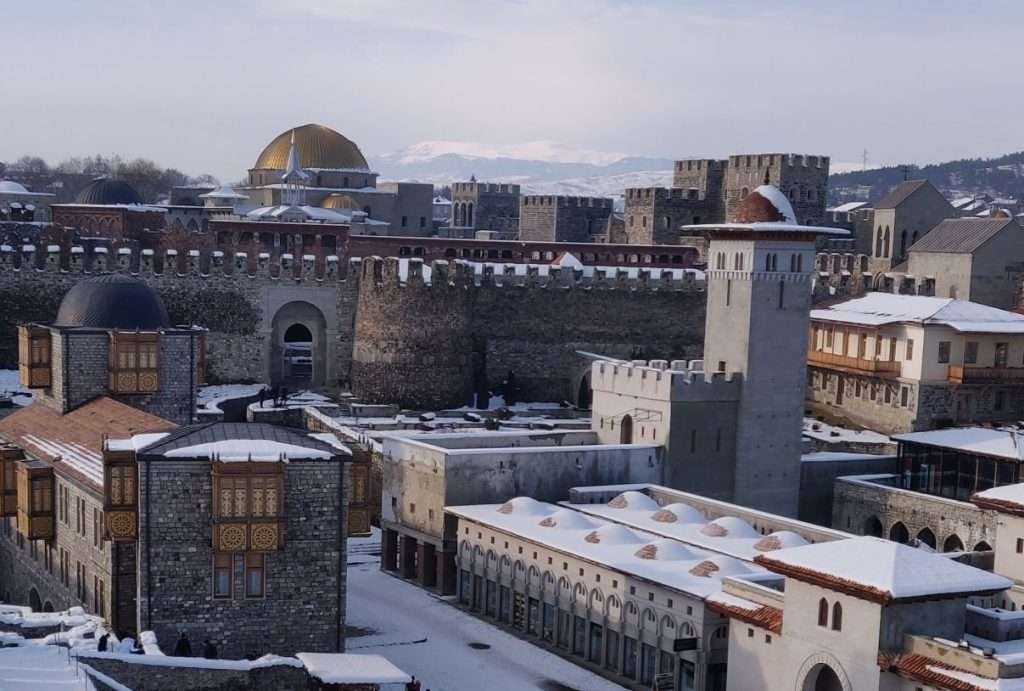
Church of the Assumption. Fresco fragments, a stone iconostasis, and pointed-arch windows reflect medieval Georgian ecclesiastical craft.
Haji Ahmed-Pasha Mosque (1752). Built by the local Ottoman-era governor, the mosque’s plan recalls Orthodox forms while adopting Ottoman décor; a madrasa and minaret stand adjacent.
Jakeli Palace & Museum. Vaulted palace halls host the Samtskhe–Javakheti History Museum, part of the Georgian National Museum network, with 25,000+ objects spanning prehistory to modern times (coins, manuscripts, ethnography).
Visiting Today (Hours, Tickets, What to Expect)
Site hours (complex): listed as daily 09:00–20:00 (as of 2025). Museum hours: typically Tue–Sun 10:00–17:30 (closed Mon); check locally for seasonal changes. Standard entry: 20 GEL for foreign visitors, with reduced categories for residents/students/pensioners.
On-site amenities. The lower precinct includes cafés, shops, a hotel, and a wine cellar; the upper precinct concentrates the historic monuments and viewpoints. Plan 1.5–2.5 hours to tour at an easy pace; add time for the museum.
| Practical Snapshot (as of 2025) | Details |
|---|---|
| Complex Hours | ~09:00–20:00 daily |
| Museum Hours | ~10:00–17:30 Tue–Sun; closed Mon |
| Foreign Visitor Ticket | 20 GEL |
| Phone / Email | +995 365 200 500 • info@rabati.ge |
| Allowable Visit Time | ~1.5–2.5 hrs (add 45–60 min for museum) |
Getting There & Map
From Tbilisi: roughly 200 km (125 miles) by road; count on 3.5–4.5 hours depending on route and traffic. Marshrutka minibuses run from Didube station to Akhaltsikhe several times daily; self-drivers can combine Rabati with nearby Sapara Monastery or Vardzia.
From Kutaisi: about 175 km (109 miles); allow 3.5–4 hours. Streets around the lower gate offer pay parking. The upper precinct involves stairs; accessible paths exist in lower areas.
Map: Rabati Castle location (41.6446° N, 42.9789° E)
FAQ
Where exactly is Rabati Castle?
On the hill above the Rabati district of Akhaltsikhe, Samtskhe–Javakheti, Georgia—over the Potskhovi River—at ~1,000 m (3,281 ft) elevation.
Is “Rabati” the same as Akhaltsikhe Castle?
Yes. “Rabati” is the historical quarter name that became attached to the fortress; “Akhaltsikhe Castle” is the formal/older designation.
When was the mosque built?
In 1752 under Haji Ahmed-Pasha Jaqeli; a madrasa and minaret were added nearby.
How busy does it get?
Attendance exceeded 100,000 in 2023 and has continued to grow through 2025, so arrive early or late in the day for quieter ramparts.
Can I visit the museum inside the palace?
Yes—the Samtskhe–Javakheti History Museum (a Georgian National Museum branch) sits in the Jakeli Palace; allow 45–60 minutes.
What Did We Learn Today?
- Rabati/ Akhaltsikhe Castle began as Lomsia in the 9th century and grew under the Jakeli atabegs.
- It fuses church, mosque, madrasa, minaret, palace and museum inside 7 hectares (17+ acres).
- Ottoman control (from 1578/79) left major architectural imprints; Russia took the site in 1828–1829.
- The 2011–2012 restoration reshaped the complex for visitors while stabilizing heritage fabric.
- As of 2025, hours list roughly 09:00–20:00; foreign entry is 20 GEL.