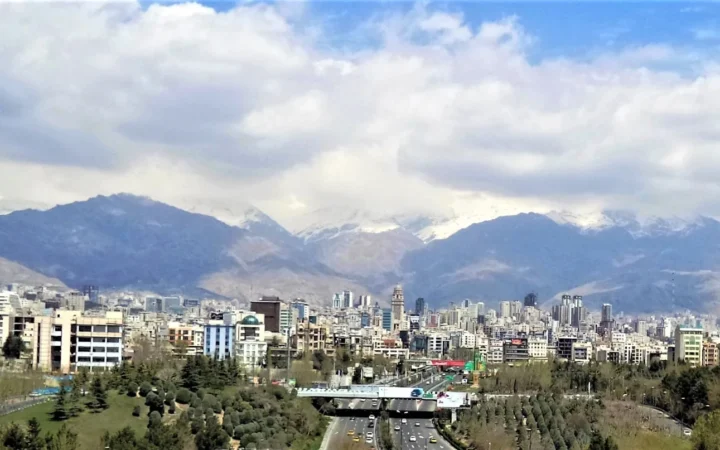
A historical atlas may label a vast empire “Persia,” while a modern map shows the country Iran. A museum might describe an object as Persian even when it was made outside today’s Iranian borders. These usages are connected, but the name alone does not tell you which place, period, or kind of identity is meant.
Persia was a longstanding external name for Iran in many European-language contexts. Iran is the modern country’s name and has much older local roots. Persian can also describe a language or cultural tradition, while a Persian empire had boundaries tied to a particular historical period, not those of present-day Iran.
1. Start by separating the names and their scales
For a present-day political map, use Iran. For a historical document, read “Persia” in the context of its author and date. For a language, artwork, or literary tradition, “Persian” may be the appropriate term without implying that the subject belongs exclusively inside the modern state.
That is why a simple statement that Persia “became” Iran can mislead. It may refer to a change in foreign official terminology, but it should not imply that a new country appeared overnight or that an older name disappeared from every cultural setting.
Which kind of place or identity does the term describe?
| Term | Useful meaning | Important distinction |
|---|---|---|
| Iran | The present-day country; also a name with a long history. | A modern state is not identical to every earlier realm using a related name. |
| Persia | A historical external name for the country in many European-language sources. | Check the period and context rather than assuming an ancient empire is always intended. |
| Persian | A language and a term used for people and cultural traditions. | Language, ethnicity, cultural practice, and citizenship are different categories. |
| Iranian languages | A linguistic group that includes Persian and other languages. | It does not mean only languages spoken by citizens of Iran. |
| A Persian empire | A historical state identified by dynasty and date. | Its territorial reach changed and could extend beyond modern Iran. |
| Greater Iran / Persianate world | Related historical-cultural frameworks whose usage needs context. | Neither is a modern sovereign state; the two terms are not automatic synonyms. |
2. Persia connects a regional name with a wider history
Pārsa and Fars are part of the name’s geography
The name Persia is connected with Pārsa, the Persian homeland associated with the region now called Fars in southwestern Iran. Encyclopaedia Iranica explains how the Greeks used a name associated with the Persians for the wider empire. A regional name thus acquired a much broader external use.
Keep the scales separate: Fars is not all of Iran, and Iran is not the full territory reached by every Persian empire. Nor should the boundaries of a historical region be assumed to match those of the modern province exactly. A name can remain recognizable while the administrative geography around it changes.
In European-language accounts, Persia also referred to the country in periods long after the ancient Achaemenid dynasty. Finding “Persia” on an old map therefore does not, by itself, date the map to antiquity. The legend, publication date, and named ruler or dynasty help identify what the author intended.
3. What changed in foreign official usage in 1935?
A contemporary diplomatic record gives the precise context
On February 20, 1935, the British Foreign Secretary reported to Parliament that a memorandum sent to foreign diplomatic missions in Tehran on December 25, 1934, requested the use of Iran and Iranian in official correspondence and conversation from March 21, 1935. Britain’s minister in Tehran had been instructed to accept that request.
This contemporary record supports a specific claim about foreign official usage. It does not show that the word Iran was invented in 1935, that a new state was founded that day, or that every use of “Persia” in every language was prohibited. Those are larger claims than the document makes.
Iran was not a newly created name
The name Iran has older linguistic and historical roots. Specialist scholarship traces New Persian Irān through Middle Persian Ērān. Gherardo Gnoli’s discussion in Encyclopaedia Iranica examines the political use of the term in the Sasanian period, many centuries before the twentieth-century diplomatic request.
A name’s age does not prove that a single unchanged political system or border existed throughout its history. The important point here is narrower: foreign adoption of a familiar local name and the original emergence of that name are different events.
4. Modern Iran and a historical empire need different maps
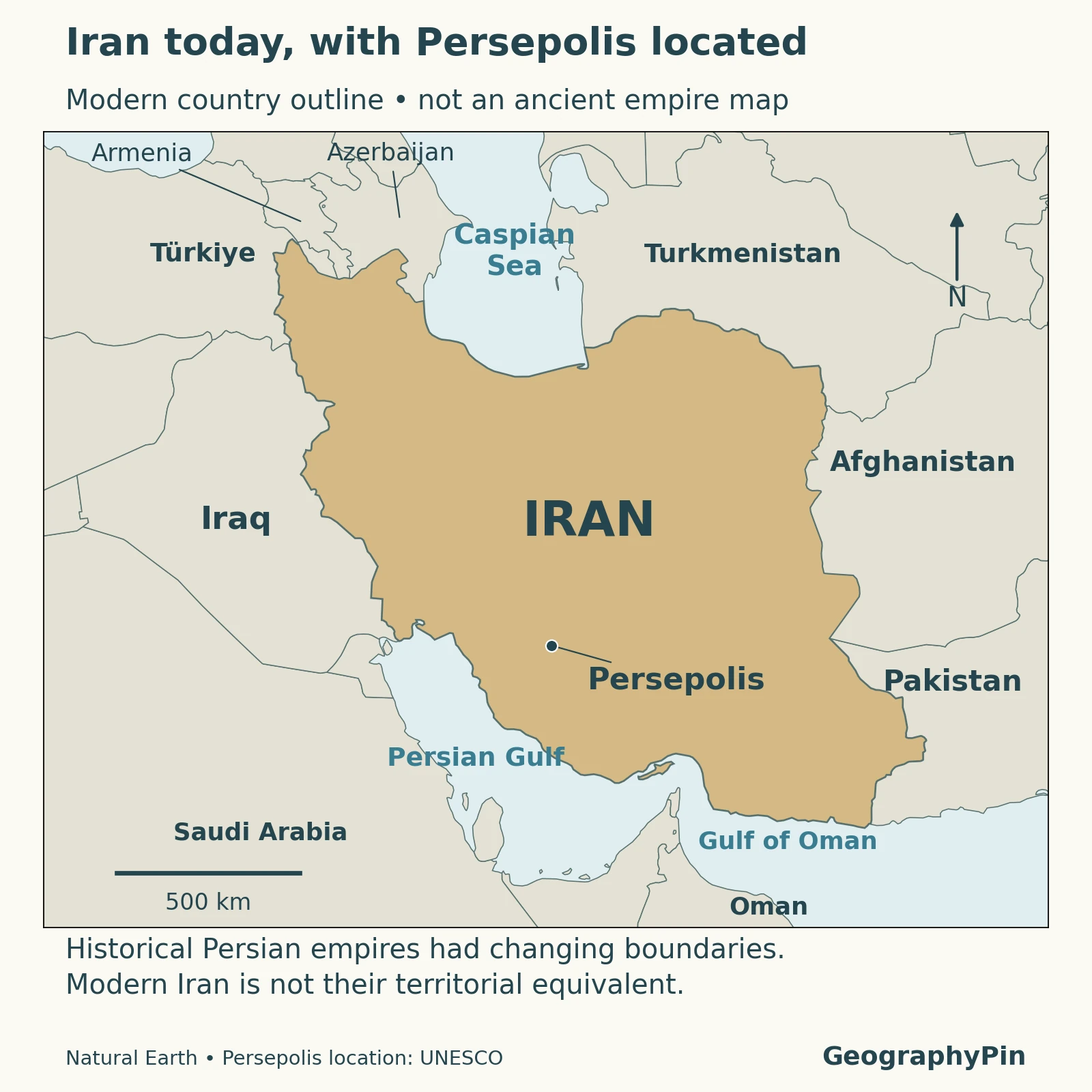
The locator shows present-day Iran and selected geographic reference points. It does not show the maximum extent of an ancient empire or claim that neighboring countries belong to modern Iran. For the country’s current physical setting, continue to our Iran profile and geography of Iran.
The Achaemenid period is a useful dated example
The Metropolitan Museum of Art dates the Achaemenid Persian Empire to 550–330 BCE. Its reach extended across areas including Anatolia, Egypt, western Asia, Central Asia, and parts of the northwestern Indian subcontinent. That was a much wider and differently shaped political geography than modern Iran.
However, an empire’s full lifespan is not one map date. Conquests, losses, and reconquests changed what it controlled. A map labeled only “550–330 BCE” could combine territories from different moments unless its author explains the convention. A carefully dated snapshot and a maximum-extent reconstruction answer different questions.
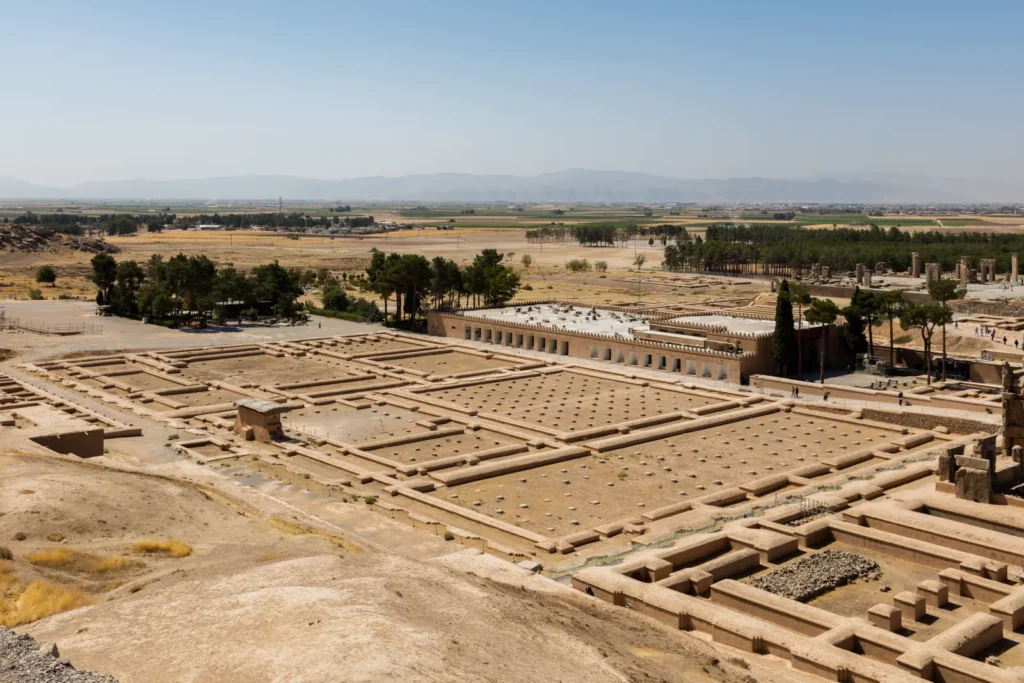
Persepolis offers a concrete connection between the ancient history and the modern map. UNESCO identifies it as the Achaemenid ceremonial capital founded by Darius I in 518 BCE. Today its archaeological remains lie within Iran. The site can be located precisely without drawing an unsupported imperial boundary around it.
5. Persian language and Iranian identity are not the same category
Persian is one Iranian language
In linguistics, Iranian names a group of related languages, not a passport category. Persian belongs to that group, as do languages such as Kurdish and Pashto. Calling a language Iranian does not mean its speakers live only in the modern country Iran, or that it is merely a dialect of Persian.
Persian itself has major contemporary varieties associated with Iran, Afghanistan, and Tajikistan, commonly discussed as Farsi, Dari, and Tajik. Specialist descriptions recognize differences between these varieties and diversity within them. They should not be presented as identical in pronunciation, vocabulary, or writing practices.
The same care applies to people. Iranian citizenship does not automatically establish Persian ethnic identity, and speaking Persian does not automatically establish Iranian citizenship. In a country profile, use the term that answers the actual question rather than substituting one identity for another.
Cultural connections do not create a single political boundary
The Persianate world is a scholarly way of discussing cultural and literary connections that crossed political and linguistic borders. Research describes a plural, multilingual field of exchange rather than a single nation-state. Persian cultural influence could matter in places where not everyone spoke Persian as a first language.
Greater Iran is also used as a historical-cultural framework, but its scope depends on the author and period. Do not assume it is identical to every use of “Persianate,” or look for one universally agreed official border. In either case, cultural connection should not be mistaken for modern sovereignty over another country.
6. Choosing the right term when reading or writing
A useful first question is whether the subject is a country, historical state, language, or cultural network. Then look for the date. “Iran today,” “Achaemenid Persia,” and “Persian literature” point to different kinds of information even though their histories overlap.
On a modern political map, Iran is the country to locate. When discussing a historical source, preserve its terminology while explaining the period. For a language or cultural tradition, Persian may remain entirely natural. Accuracy comes from making the intended meaning clear, not from mechanically replacing every occurrence of one word with the other.
What Did We Learn Today?
Persia and Iran have connected histories, but names operate at different scales. The 1935 diplomatic request concerned foreign official usage, not the invention of Iran. Modern borders, historical imperial territories, languages, and cultural networks should be identified separately so that a familiar name does not conceal a different geographic meaning.
Sources & Data Notes
The locator uses a generalized modern country outline, not reconstructed ancient boundaries. Historical dates refer to the named period or document; they are not dates for the modern map. Cultural frameworks are discussed without assigning them a supposedly official territorial border.
- UK Parliament, Hansard, February 20, 1935. Contemporary report of the diplomatic naming request.
- Encyclopaedia Iranica: Iran. Names and political, geographic, linguistic and cultural meanings.
- Xavier de Planhol, Encyclopaedia Iranica: Fars, geography. Regional and broader uses of the Persian name.
- Gherardo Gnoli, Encyclopaedia Iranica: Pre-Islamic Iranian identity. Earlier historical use of Iran.
- The Metropolitan Museum of Art: Achaemenid Persian Empire. Dated imperial context.
- Bahriddin Aliev and Aya Okawa, Encyclopaedia Iranica: Tajiki and Persian. Varieties and linguistic distinctions.
- University of Chicago: Persian language program. Persian within the Iranian language group.
- Persianate Words and Worlds (2024), PMLA. Transregional cultural and literary connections.
- UNESCO: Persepolis. Archaeological context and site location.
- Natural Earth. Public-domain geographic basemap.
Featured photograph: Diego Delso, Wikimedia Commons, CC BY-SA 4.0. Resized and converted to WebP; the adapted photograph remains under the same license.