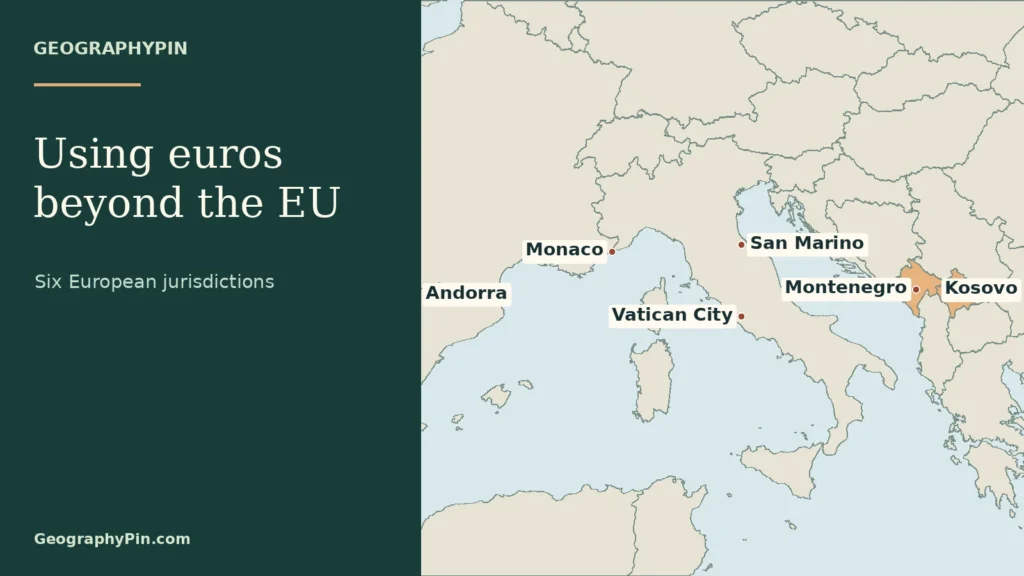
A euro coin minted in Monaco can circulate in an EU member state. Montenegro also uses euros, but has no comparable minting right. Spending the same currency tells you little about the legal route by which it arrived.
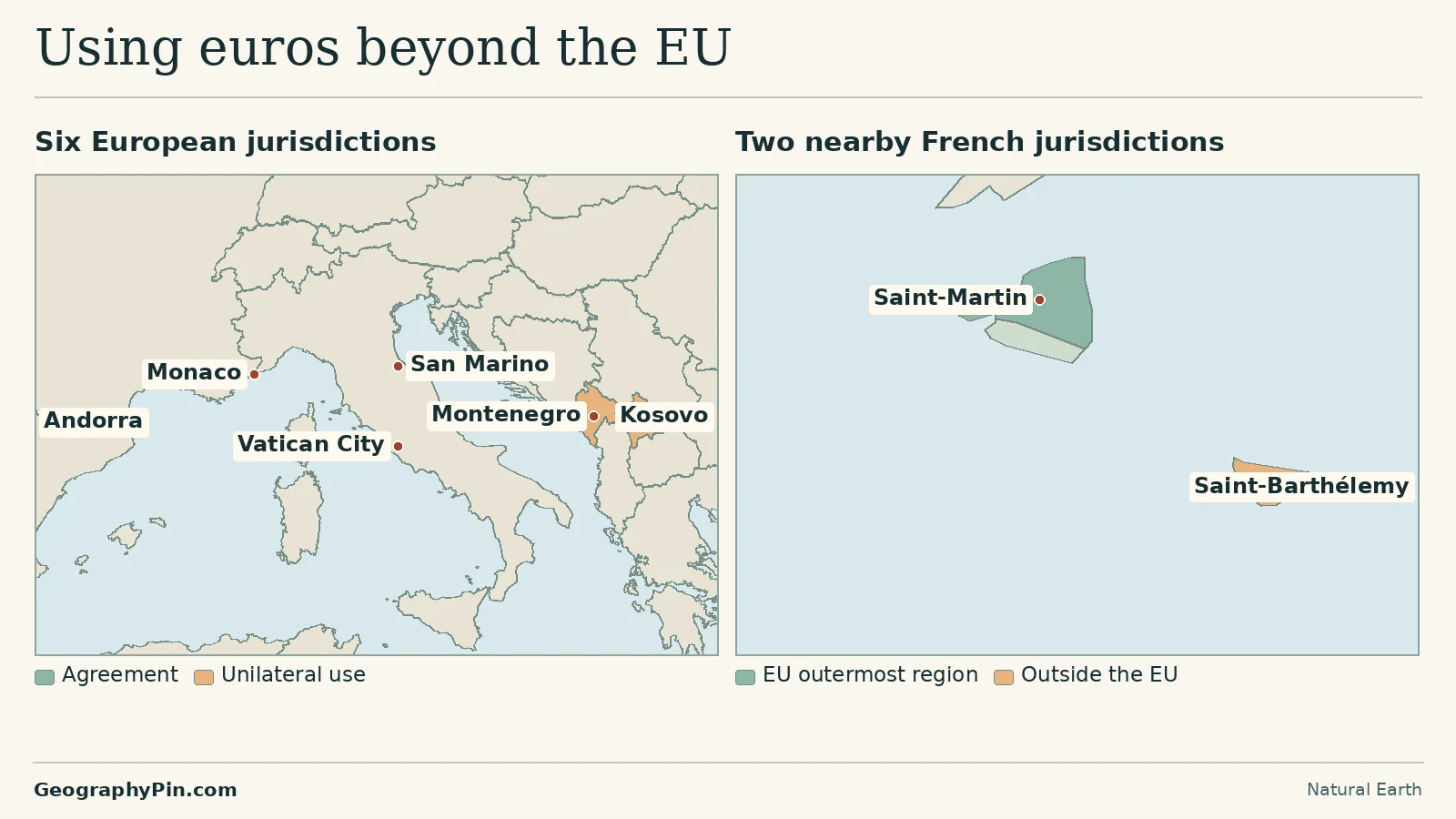
Four non-EU European microstates use the euro under monetary agreements with the EU: Andorra, Monaco, San Marino and Vatican City. Montenegro and Kosovo use it unilaterally. None of the six is a euro-area member state. Outside Europe, some territories also use the euro, with different relationships to the EU and its monetary rules.
See how Montenegro uses the euro, what a coin can tell you, or how two nearby French jurisdictions differ.
Agreement, unilateral adoption or membership?
| Place | Basis and timing | Right to issue an agreed quantity of euro coins | Euro-area member? |
|---|---|---|---|
| Andorra | Used euro cash from 2002. Monetary agreement entered into force in 2012. | Yes | No |
| Monaco | Monetary agreement continuing its French-franc connection. Euro cash from 2002. | Yes | No |
| San Marino | Monetary agreement continuing its Italian-lira connection. Euro cash from 2002. | Yes | No |
| Vatican City | Monetary agreement continuing its Italian-lira connection. Euro cash from 2002. | Yes | No |
| Montenegro | Unilateral use, following use of the German mark. Euro cash from 2002. | No national issue under an EU agreement | No |
| Kosovo | Unilateral use, following use of the German mark. Euro cash from 2002. | No national issue under an EU agreement | No |

The European Commission distinguishes the four signatories from the two unilateral users. The convention includes Kosovo as a separately administered monetary jurisdiction. Its inclusion describes the currency in use and takes no position on recognition. This distinction also matters when comparing the EU, Schengen and the euro area, which have different memberships and different tasks.
What an agreement adds
A formal monetary agreement sets responsibilities and limited issuing rights. The microstates can issue approved euro coins within agreed ceilings. A collector might recognize a national design on one of those coins, but the right to issue coins does not give the government a seat as a euro-area national central bank in monetary-policy decisions.
Why Montenegro gives a different answer
A country can use banknotes and coins issued elsewhere. It then needs to acquire the currency through ordinary flows such as payments, tourism, investment and banks. It does not gain an independent ability to create euro banknotes or a vote on euro-area interest rates. “Uses the euro” is therefore a broader category than “helped set its monetary policy.”
What a coin can tell you about an agreement
Look at the national face of a euro coin issued by the Vatican. Its existence is consistent with a monetary agreement that permits a limited issue. Finding that coin in a shop in Montenegro establishes only that it circulated there. The place where a particular coin changes hands cannot establish the shop’s country of issue, EU membership or power to mint coins.
The overseas cases that change the count
Saint-Pierre and Miquelon, off Canada, and Saint-Barthélemy in the Caribbean are French overseas territories outside the EU that use the euro by arrangement. French Guiana and Réunion also use the euro, but are outermost regions inside the EU. Geographic distance from Brussels is not a test of legal membership. The British Sovereign Base Areas on Cyprus furnish another territorial case where the euro is used in line with the surrounding Cypriot economy.
A peg is a different monetary relationship
A country may keep its own money and fix its exchange rate against the euro. The currency printed on the local banknote remains the domestic currency. Retailers may also accept euros as a convenience in places where euros are not legal tender. Neither practice adds a country to the list above. A count of currency users needs an explicit test for what qualifies.
A short journey between two euro-using jurisdictions
Fly to the French Caribbean and the political map provides a revealing pair. Saint-Martin, the French part of the island shared with Sint Maarten, is an EU outermost region. Saint-Barthélemy has had the EU status of an overseas country and territory since 2012 and retained the euro through specific arrangements. The islands are close enough to share a map inset, but a map shading the territorial extent of the EU needs to distinguish them.
Now compare two cash payments back in Europe. A shop in Monaco and a shop in Montenegro may both accept a euro note as ordinary money. Monaco has a monetary agreement with the EU; Montenegro adopted the currency without such an agreement. A banknote migrating from one shop to the other does not carry a record of the legal foundation under which the second country uses it.
Finally distinguish official currency from a peg. A peg sets a relationship between one currency and another. Prices, wages and change can still be denominated in the local unit. An overseas exchange counter offering euros is weaker evidence still. The European Commission and ECB lists identify the jurisdictions that actually use the euro and the arrangements supporting that use. A travel diary that reports just one successful transaction cannot supply the same classification.
Reading a euro map at the scale of a microstate
On a map of the Italian peninsula, Vatican City and San Marino are tiny polygons surrounded by a much larger euro-area member. A color that means “euro normally used” can cover both sides of each border. A color that means “EU member participating in the euro area” must stop at those national borders. The reason for the different colors can be explained without changing any of the international boundary geometry.
Andorra supplies a useful timeline for the same distinction. Euro banknotes and coins circulated before the monetary agreement was in force. The agreement later established a formal relationship that included limited coin-issuing rights. A map of where someone could ordinarily pay with euro cash can therefore change at a different date from a map of which states had concluded monetary agreements. The two kinds of map may converge on some dates and diverge on others.
One more test is representation. A microstate issuing national-sided euro coins under agreement and a euro-area member government participating in the EU institutions have different legal roles. The coin alone identifies a recognized issuer and a design. It does not show who participates in euro-area decision-making. The four-column table at the beginning separates everyday use, the basis for it, issuing rights and membership for precisely this reason.
Frequently Asked Questions
Does a euro coin always identify the country where you received it?
No. National designs refer to the issuing authority. Coins circulate across borders, so one received in France or Italy could have originated in a microstate.
Did euro-area expansion change the status of these six?
EU members joining the euro area and nonmembers using euros are different categories. When an EU member adopts the currency it changes euro-area membership, not the basis under which Monaco or Montenegro uses it.
What Did We Learn Today?
Monetary agreements, unilateral use and EU euro-area membership each confer different rights. For overseas places there is one more question to ask: whether the territory itself lies inside the EU’s legal scope.
Sources & Data Notes
Evidence checked November 23, 2026. The six-place table follows the European Commission’s European convention. Overseas examples are classified by EU territorial status. Dates distinguish the arrival of cash from the start of a later agreement.