Buying an apartment in a government-built estate sounds like a contradiction only if “public” must describe the land, building, financing and household’s rights all at once. In Singapore those rights can sit with different institutions.
Singapore has a market economy with extensive public landownership, subsidized housing and state investment. Private businesses compete and households buy and resell homes. Government agencies also allocate land and shape housing supply. Public housing figures measure people or homes under particular definitions. They cannot measure the state’s share of Singapore’s entire economy.
How to use this article: Jump to the discussion you need: Two percentages with different denominators, One estate, two household arrangements or Read the accounts at the right level.
Three decisions, three kinds of ownership
| Activity | Institution or owner | How decisions are made |
|---|---|---|
| New public flats | Housing & Development Board and eligible households | HDB supplies homes under eligibility and pricing rules. |
| Flat resales | Eligible buyers and sellers | Prices are negotiated within HDB restrictions. |
| A portfolio company | Shareholders, potentially including Temasek | The board and management make business decisions. |
| An independent private firm | Its individual or corporate owners | Owners raise capital and compete for customers. |

A firm that buys a lease on state land can own its equipment, hire staff and sell products at market prices. Singapore’s land area is small enough to make coordinated planning especially consequential. A map of Singapore helps explain why transport links, housing estates and industrial sites compete for the same scarce space. It cannot identify the owner of a company operating on that space.
What a household buys from HDB
Most new HDB flats are sold on long leases, commonly 99 years. A buyer acquires rights in the flat for the remaining term, subject to eligibility, occupation and resale rules. A resale buyer normally acquires the balance of that lease. Paying a market resale price does not convert the property into freehold land.
Two percentages with different denominators
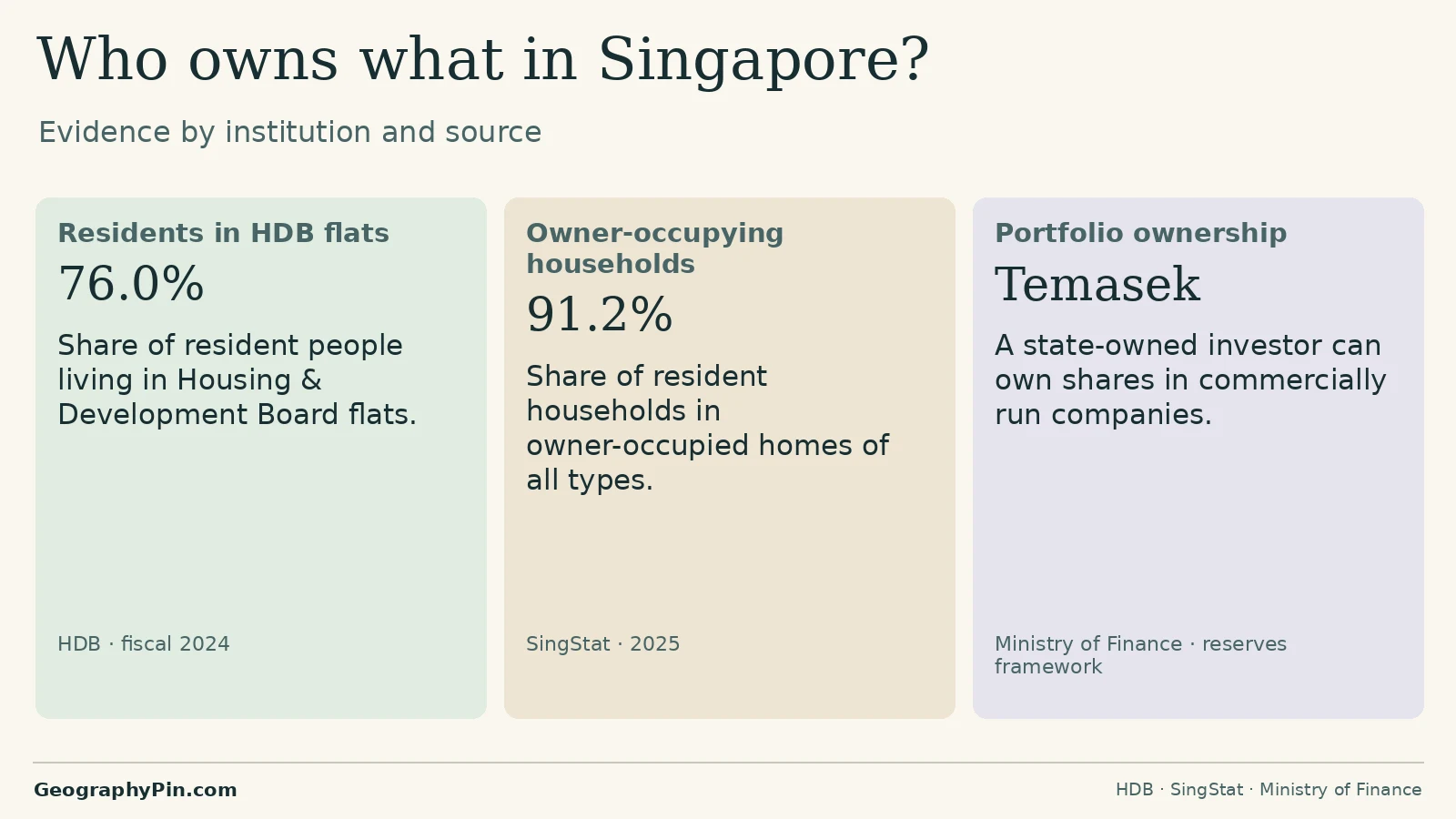
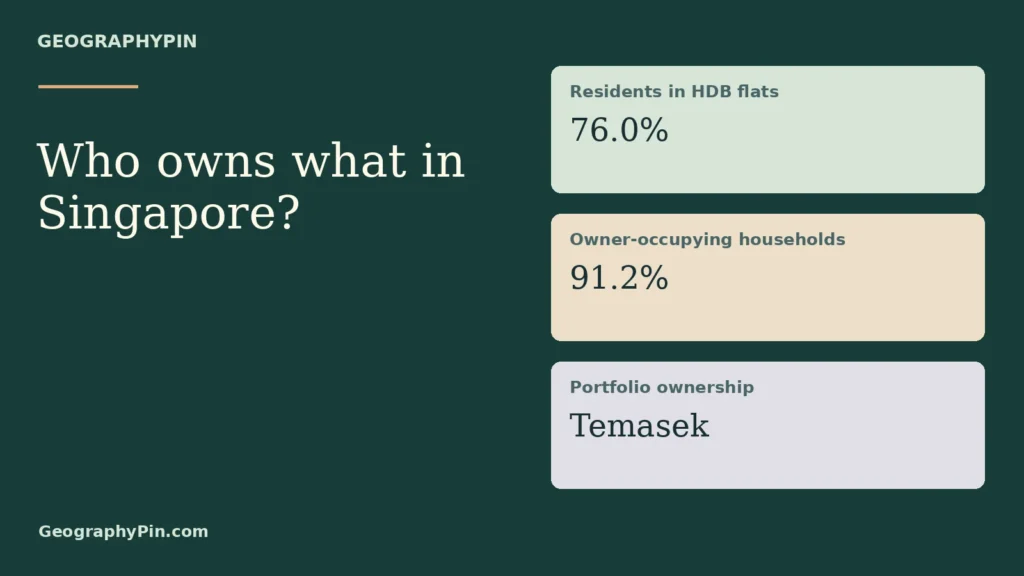
HDB’s FY2024 figures use all residents as the denominator. Of those residents, 76.0% lived in HDB flats and 73.0% lived in sold HDB flats. The 3.0-percentage-point difference measures residents in other HDB flats.
SingStat’s 2025 figure of 91.2% uses a different denominator: resident households across all housing types. It measures the share of households occupying a home they own. A household can contain several residents, so subtracting one series from the other would give a misleading result.
The finance also has layers. A household may use eligible Central Provident Fund savings toward a purchase and may qualify for a housing grant. A public savings framework helps finance a household interest in a home. It does not turn the family into a tenant renting month by month from the government.
One estate, two household arrangements
On the same estate, one family can own the remaining term of its flat’s lease while a neighbor rents through the public rental scheme. Both families live in HDB flats. Only the first occupies a flat sold on a lease.
Where a state investment company fits
Temasek is owned by Singapore’s Minister for Finance and holds a portfolio of investments. An equity stake gives it shareholder rights in a company. It does not automatically give the government ownership of all the assets, revenues or shares of every business in that portfolio. A minority stake and full ownership are plainly different interests.
Read the accounts at the right level
A portfolio value is measured at a point in time. Gross domestic product measures the value added by economic activity over a period. Dividing one by the other does not tell a reader what percentage of business is state owned. Nor is a portfolio company’s sales revenue the government’s budget revenue. To compare Singapore with other economic systems, begin by choosing a comparable measure, such as household tenure, land title or enterprise equity.
Follow the money when an HDB flat is built
Consider the site before anyone receives a key. Singapore’s Ministry of Finance explains that transfers of state land to HDB are accounted for at fair market value. The state is converting a land asset into a financial asset in the reserves. HDB, meanwhile, records a real land cost as it develops housing. The two entries can refer to the same transaction while telling different stories about the finances of the state and the housing board.
Then consider the first buyer. The sale price, any grant for which the household qualifies and the way it finances the balance are three separate numbers. A household using its own CPF savings is drawing on an accumulated balance. A grant reduces the household’s burden. Neither number on its own establishes the market value of the plot beneath the block. At resale, the existing lease and the remaining term also matter to what a new buyer is willing to pay.
The geography makes those distinctions visible. An HDB estate can contain owner-occupied flats alongside homes rented by other households, with transport and public facilities serving both. Land planning explains why the buildings are there. Household tenure explains who holds the rights to a particular flat. The board’s audited financial statements describe a third unit: the institution that develops and manages the program. The five Nordic economies offer a different comparison of private ownership, public services and household outcomes.
Frequently Asked Questions
Can an owner-occupier live in public housing?
Yes. HDB describes the type of housing and its development system. Owner-occupation describes how a particular household holds and uses its home. Both can describe the same flat.
Does a long lease reset when somebody buys a resale flat?
Ordinarily the buyer takes the unexpired portion. That difference matters when comparing the price of two otherwise similar flats built in different years.
What Did We Learn Today?
Land, a leasehold home and shares in a business are separate assets. Singapore’s institutions distribute rights at all three levels, which is why a housing statistic cannot settle the wider economic question.
Sources & Data Notes
HDB fiscal-year statistics count residents. SingStat’s 2025 owner-occupation measure counts resident households across housing types. The two percentages are included to illustrate their denominators.
- Housing & Development Board, FY2024 key statistics
- Singapore Department of Statistics, resident household indicators
- Ministry of Finance, management of Singapore’s reserves
- Housing & Development Board, financial statements to March 31, 2026
- Housing & Development Board, resale statistics
- Ministry of Finance, accounting for state land used in public housing