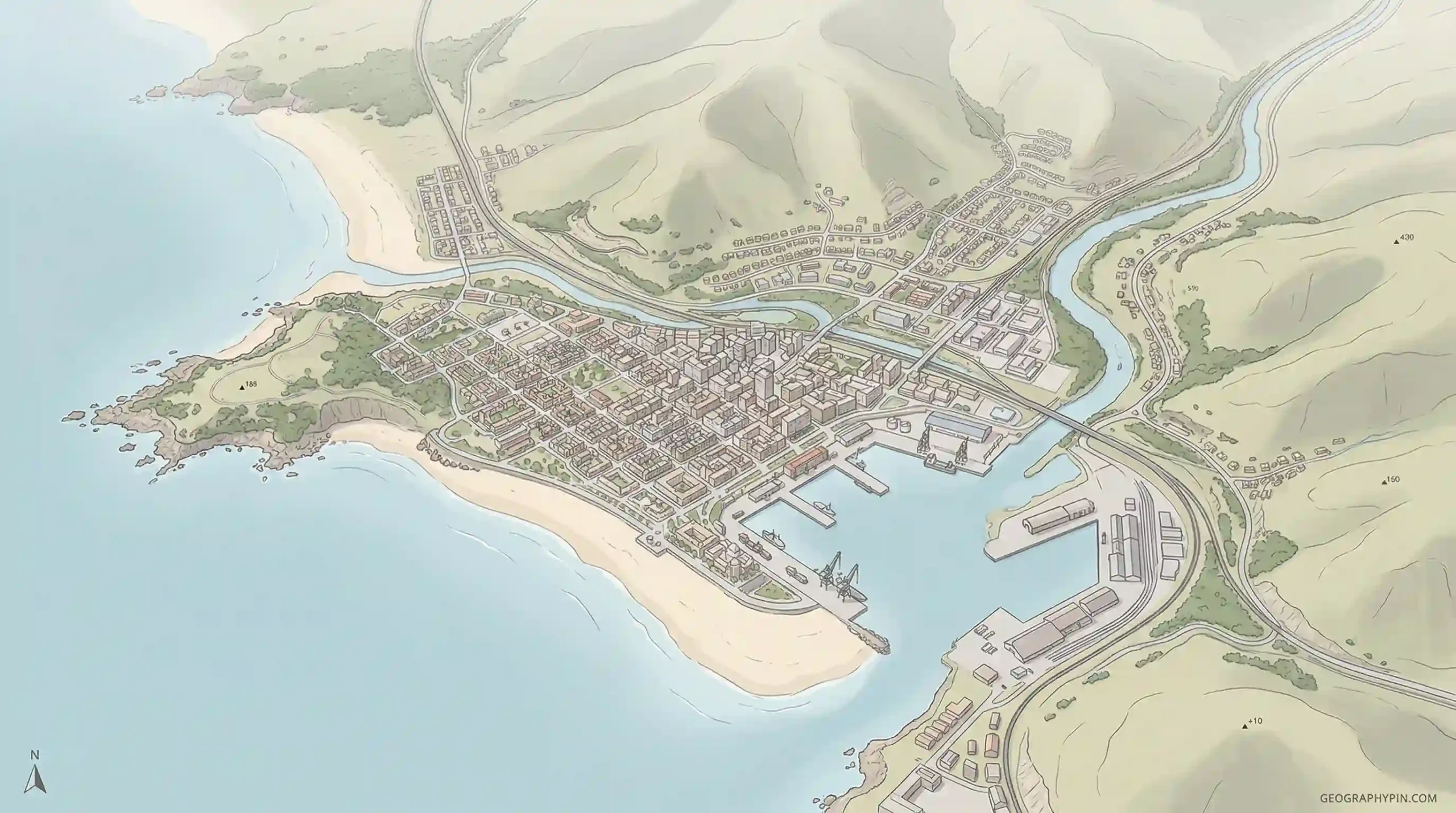
This comparison comes down to one common confusion: both are branches of geography, but they begin with different questions. The distinction is useful rather than absolute, because urban flooding, drought and farming, or coastal erosion and tourism all connect environmental processes with human decisions.
Human geography and physical geography differ mainly in primary focus. Human geography studies people, culture, population, settlement, politics, and economic activity across space; physical geography studies landforms, climate, water, soils, ecosystems, and Earth processes. Many geographic questions need both because human decisions and physical environments continually affect one another.
How to use this article: Start with the quick distinction, see how both branches examine one place, compare them in the side-by-side table, or use the topic-classification test.
What is the core difference?
National Geographic Education describes geography through places, physical features, human societies, and the relationships among them. Geography therefore examines not only where something is located, but also why it is there, how it changes, and how it connects with other places. GeographyPin’s overview of what geography studies explains this wider framework.
Human and physical geography are the two branches most often compared, but they are not the only way the discipline can be organized. Educational frameworks may also distinguish environmental geography and geographic techniques, while the National Geography Standards separately identify physical systems, human systems, and environment-and-society connections.
Quick distinction
If the main question concerns population distribution, migration, culture, cities, political space, economic activity, or land use, it is usually human geography. If it concerns rivers, coasts, mountains, weather, climate, soils, ecosystems, or erosion, it is usually physical geography.
The easiest way to remember the difference is that human geography asks how people organize space and how places affect human life. Physical geography asks how natural systems work and how they shape places. The division becomes less tidy when a real question involves both environmental conditions and human choices.
What human geography studies
Human geography focuses on the spatial side of human life: where people and activities are located, how they move and connect, and why social, cultural, political, and economic patterns differ from place to place. GeographyPin’s human geography overview examines these ideas in greater depth.
This branch asks questions such as: Why do cities grow where they do? Why do migration routes follow certain corridors? Why do languages, religious landscapes, or voting patterns cluster differently across regions? Why does one neighborhood become industrial while another becomes residential or commercially valuable? These are spatial questions about how human activity is organized.
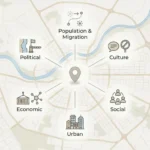
Typical subfields include urban, population, cultural, political, social, economic, and historical geography. GeographyPin’s guide to the main types of human geography explains how these subfields differ and connect.
Human geographers may use census data, interviews, surveys, field observation, archival material, policy documents, GIS, and quantitative spatial analysis. The chosen evidence depends on the question, and many studies combine numerical data with information about people’s experiences and decisions.
Human geography should not be reduced to showing that “people live here.” Its real strength is explaining pattern, movement, power, identity, difference, and decision-making across space. It asks not only where people and activities are located, but why those patterns developed and what they mean.
What physical geography studies
Physical geography focuses on natural environments and the processes that form and change them. Its subjects include climate, the atmosphere, soils, rivers, landforms, oceans, ecosystems, and environmental change.
This branch tackles questions such as: Why does a river meander in one area but cut a steep valley elsewhere? Why do some slopes erode faster than others? Why does one side of a mountain range lie in a rain shadow? Why are some coasts more exposed to flooding or shoreline retreat? These are process-based questions about natural systems and landscape change.
Major areas commonly include geomorphology, hydrology, climatology, biogeography, glaciology, oceanography, and soil geography. Physical geographers may use field measurements, maps, remote sensing, laboratory analysis, environmental observations, and process-based models. Its questions and methods therefore overlap strongly with Earth and environmental sciences.
Physical geography is not limited to environments untouched by people. It also examines how human actions alter natural systems, including changes to drainage, soils, vegetation, rivers, and coastlines. This creates frequent connections with environmental geography and hazard research.
One place, two kinds of geography
Definitions are useful, but the difference becomes clearer when both branches examine the same place. A location can be studied through two compatible lenses because it has both human and physical characteristics.
Three quick real-world examples
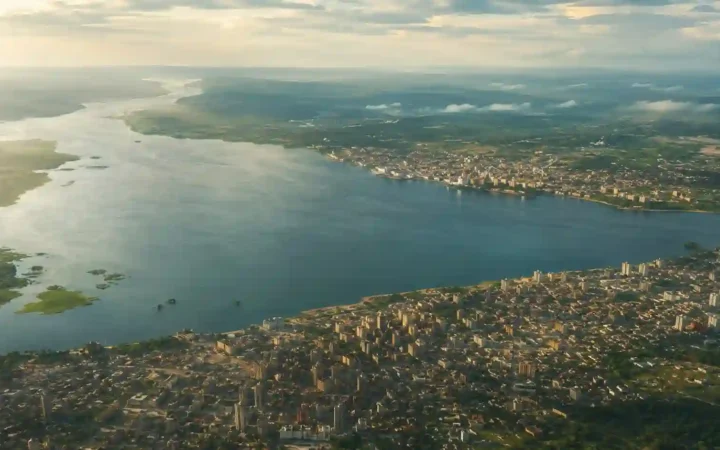
A river city on a floodplain. A physical geographer asks about drainage, flood frequency, channel behavior, soils, and low-lying terrain. A human geographer asks why the city expanded there, who lives in the most exposed districts, how transport and land values shaped growth, and how planning decisions increased or reduced risk. The strongest explanation combines both.
A farming region under drought. A physical geographer looks at rainfall, evaporation, soils, water storage, and climate variability. A human geographer looks at land use, irrigation choices, market pressures, crop selection, labor systems, and who can adapt fastest when water becomes scarce. The complete explanation sits at the intersection.
A tourist coast under erosion. A physical geographer studies waves, sediment movement, sea-level effects, storms, and shoreline change. A human geographer studies hotel development, zoning, seasonal population pressure, infrastructure placement, insurance, and who bears the cost when beaches shrink or flooding rises. It is the same place viewed through different first questions.
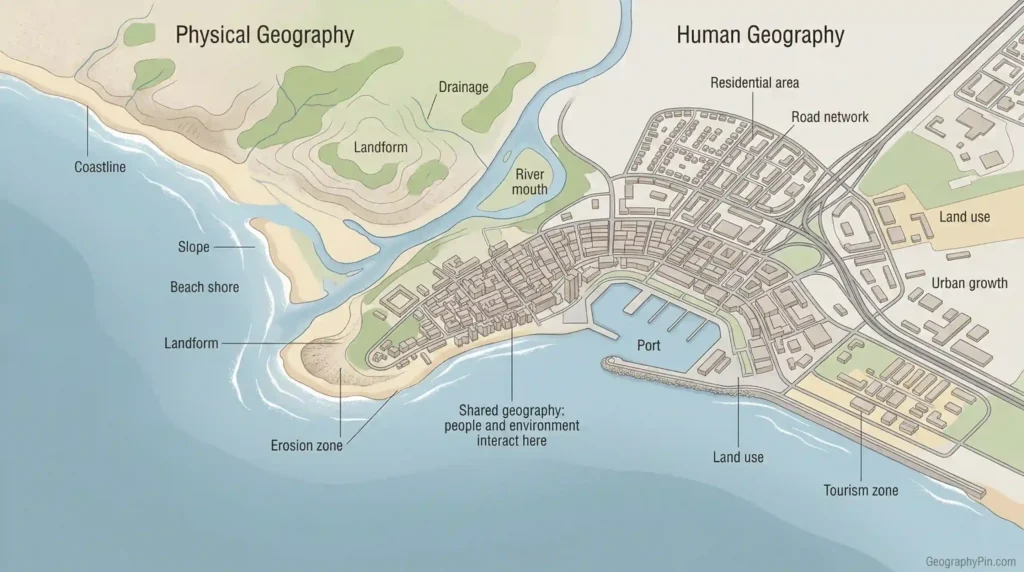
The key point is that human geography and physical geography are not competing explanations of a place. They are different ways of asking questions that often work best together.
Side-by-side comparison
The clearest comparison considers the questions, evidence, and explanations each branch usually produces. These are typical differences rather than rigid boundaries, because geographers in both branches may share methods and study the same problems.
At a glance
| Comparison point | Human geography | Physical geography |
|---|---|---|
| Primary focus | People, societies, culture, economies, politics, settlement, and land use | Landforms, climate, water, soils, ecosystems, and environmental processes |
| Typical first question | Why are people or activities arranged this way across space? | How does this natural system work, and why does it take this form here? |
| Common subjects | Migration, cities, borders, trade, culture, population, and inequality | Rivers, weather, erosion, coasts, glaciers, soils, and biomes |
| Common evidence | Census data, interviews, surveys, maps, archives, and policy documents | Field measurements, satellite imagery, terrain data, and climate or water observations |
| Example classroom question | Why did this city grow around a port? | Why is this coastline eroding? |
| Contribution to shared topics | Explains settlement, policy, behavior, economic choices, and differences in vulnerability | Explains environmental processes, physical exposure, landscape change, and natural constraints |
Another distinction helps: human geography often explains how people and institutions produce spatial patterns, while physical geography often explains how environmental systems produce spatial patterns. Both remain geographic because both ask why a pattern exists in one place rather than another.
How to tell which one your question needs
When a topic is difficult to classify, the problem is usually the angle rather than the subject itself. Climate, agriculture, cities, rivers, tourism, and hazards can appear in either branch depending on what the question is trying to explain. A useful test is to ask what kind of evidence would settle it.
A practical classification test
If the answer mainly needs evidence about people, institutions, behavior, policy, identity, or economic organization, begin with human geography. If it mainly needs evidence about topography, water, climate, soils, landform change, or ecological processes, begin with physical geography. If both sets of evidence are necessary, frame the topic as an overlap from the start.
This test is especially useful for school assignments. “Why do migrants concentrate in this city?” is mainly human geography. “Why does this valley flood so often?” is mainly physical geography. “Why do poorer districts in this city flood more often?” requires both because the answer involves physical exposure and human settlement patterns.
Common mix-ups
- Human geography is not limited to population counts. It also covers culture, politics, economies, identity, settlement, movement, and spatial inequality.
- Physical geography is not another name for geology. It is broader in some directions, covering climate, hydrology, soils, ecosystems, and land-surface processes, while geology has its own focus on Earth materials, structures, and processes.
- GIS analyzes and displays geographically referenced information. It is a system and analytical tool used with both human and physical data rather than belonging exclusively to either branch.
- A place does not have to be classified as human or physical. Places contain both kinds of characteristics, and many geographic questions examine their interaction.
Frequently Asked Questions
Is climate change human geography or physical geography?
As a geography topic, it belongs to both. Physical geography examines climate systems, temperature, precipitation, ice, drought, sea-level change, and hazards. Human geography examines human causes, exposure, adaptation, migration, planning, policy, and unequal effects.
Is urban geography part of human geography?
Yes. Urban geography is generally treated as a major human-geography subfield because it studies settlement, land use, city structure, mobility, economies, and social organization across urban space.
Is GIS human geography or physical geography?
GIS does not belong exclusively to either branch. It can analyze physical data such as elevation, rivers, and floodplains or human data such as population, transport, income, and land use.
Can one assignment use both branches?
Yes. Questions involving hazards, land use, water stress, environmental change, climate adaptation, or the influence of physical settings on human decisions often require evidence from both branches.
What is the fastest way to tell them apart in an exam?
Ask which evidence the answer needs first. People-centered evidence usually indicates human geography, while environment-centered evidence usually indicates physical geography. If both are essential, identify the topic as an overlap instead of forcing it into one category.
What Did We Learn Today?
Human geography mainly explains spatial patterns involving people, cultures, cities, politics, and economies, while physical geography explains natural systems such as landforms, climate, water, soils, and ecosystems. The most reliable way to classify a question is by the evidence and explanation it requires, although many real places and environmental problems need both branches together.
Sources & Data Notes
The definitions and branch boundaries were checked against National Geographic Education’s geography overview and National Geography Standards, while the GIS explanation was checked against the U.S. Geological Survey. This conceptual comparison uses no changing statistical dataset. Z.K. Atlas completed the final factual checks, editorial review, and publication approval and accepts responsibility for the published article. AI tools may have assisted with language refinement and the creation or editing of visual materials.