Gudauri is a ski resort in Georgia’s Greater Caucasus, reached by road from Tbilisi. Its main appeal is time on the mountain: skiing and snowboarding in winter, and selected sightseeing or outdoor activities when summer services operate. The most useful booking decision is choosing accommodation that works with your actual lift, lesson, and transport plans.
Gudauri suits a ski-focused stay better than a packed sightseeing itinerary. For a short first visit, allow several nights if you want lessons or multiple ski days, confirm the connection between your lodging and the slopes, and check the operator’s latest lift status. A season announcement does not guarantee that every lift or run will operate on your dates.
Before making a reservation: Read the opening-date distinction, check questions for your accommodation, and compare a beginner’s first day with a non-skier’s visit.
1. Is Gudauri the Right Mountain Base?
Gudauri lies in Mtskheta-Mtianeti on the Georgian Military Road corridor, roughly 75 miles (120 kilometers) from Tbilisi according to the tourism board and Mountain Trails Agency. Think of it as a mountain resort spread across slopes and roads, rather than a compact historic town where every attraction is a short walk away.
Choose Gudauri for lift-served winter sports. Ski schools and rental services make it possible to plan a learning trip, while more experienced visitors can organize their days around the terrain actually open. Groups with mixed abilities should choose a convenient meeting area before booking separate activities.
Choose Stepantsminda for Gergeti Trinity Church and the Kazbegi valleys. A Gudauri stay can be combined with that area, but onward road or gondola access needs its own check. For Svan architecture alongside mountain activities, compare Mestia and the Hatsvali–Tetnuldi area. Those are separate journeys, not interchangeable neighborhoods of one resort.
A skier’s ideal location may be inconvenient for a companion who wants cafés, level walking, or indoor activities. Discuss the whole group’s plans, especially if only some people will use the lifts.
2. Ski Season, Opening Announcements, and Daily Conditions
Gudauri’s winter season broadly falls between December and spring, but fixed opening and closing dates cannot be carried forward from an old guide. Snow cover, wind, maintenance, and safety decisions affect individual lifts and runs.
What is announced for the coming winter?
In its October 28, 2026 announcement, the Mountain Trails Agency says the winter season is scheduled to open on December 20, 2026, including Gudauri. Treat that as the announced seasonal opening, not confirmation that the full ski area will be available. Before paying for a trip that depends on a particular lift, check the operator’s Gudauri lift and trail information and confirm any unclear status directly.
MTA has also announced new infrastructure and snowmaking work for the 2026–27 season. Planned improvements should not be counted as available until the operator confirms their completion and operation. A resort-wide trail total tells you less about your skiing day than which suitable runs are actually accessible.
For dates near the beginning or end of a season, be particularly careful with nonrefundable bookings. Later snowfalls do not necessarily extend the published operating season, and a webcam showing snow does not establish that a lift is carrying passengers. Check the timestamp on every status report and forecast.
Holiday periods can make lodging and lessons harder to arrange at short notice. Book the parts that matter to your group in advance, but read the cancellation conditions for weather disruption. No month can guarantee powder, visibility, or a full week of uninterrupted skiing.
3. Where to Stay: Choose the Lift Connection, Not Just the View
New Gudauri, accommodation around the lower lifts, and properties farther along the road can produce very different daily routines. Use the current resort map and the property’s exact location, then ask how you reach your lesson or chosen lift in winter boots with equipment.
| Your priority | Look for | Verify before paying |
|---|---|---|
| First ski lessons | Easy access to the instructor’s meeting point | The actual teaching area and daily pickup needs |
| Ski-in/ski-out | A direct usable route to and from the building | Required ability, snow cover, and connecting lift operation |
| Family convenience | Meals, warm storage, and short transfers | Age rules, stairs, and equipment-carrying distance |
| Quiet evenings | A property away from late-night venues | Food access and transport after the lifts close |
| Self-catering value | A usable kitchen and convenient grocery access | Final price, heating, cleaning fees, and check-in arrangements |
Five questions worth sending to your host
- Which lift and ski-school meeting point are closest by the actual winter walking route?
- Does reaching them involve a road crossing, steep slope, stairs, or a shuttle?
- If a shuttle is offered, when does it run and is it included?
- Where can we dry boots and store skis or snowboards?
- What happens to our booking if the access road closes?
For mobility needs, ask for measurements and photographs of entrances and bathrooms rather than relying on a generic accessibility label. Confirm restaurant and spa availability with the property too; an amenity in a listing is not proof that it operates during every stay.
4. Getting to Gudauri from Tbilisi
Road transport is the practical connection from Tbilisi. Georgia Travel gives an approximate two- to two-and-a-half-hour drive in ordinary conditions, but that is unsuitable as a tight connection allowance. Airport pickup, city traffic, roadside stops, snow, and restrictions can add time.
A prearranged transfer is often the simplest option with ski equipment or a group. Specify the airport or city pickup, luggage and equipment quantity, exact accommodation, waiting policy, and winter-road arrangements. The driver should know which entrance or access road serves your building.
A minibus can suit travelers with flexible timing and light luggage. Confirm the service, fare, drop-off, equipment space, and onward connection before relying on it. A stop on the main highway is not necessarily convenient for a particular apartment complex.
Driving yourself requires a suitable vehicle, preparation for winter conditions, and compliance with any current equipment restrictions. Check the rental contract and the Roads Department’s latest road restrictions. Do not assume four-wheel drive exempts you from closures or other requirements.
Read the exact section named in a notice. Access to Gudauri from Tbilisi and travel onward over the Gudauri–Kobi corridor are different questions. Road restrictions can also distinguish trucks from passenger vehicles. Leave a buffer before your flight home; a final night in the capital can be useful, with the Tbilisi guide helping you make that stop worthwhile.
5. Passes, Lessons, Rentals, and the Real Trip Cost
Compare the total trip rather than accommodation alone. Budget separately for the transfer, lodging, meals, lift access, equipment, lessons, and insurance. Ask for prices in Georgian lari and check exactly what a package includes. This avoids treating an old daily-pass price as the cost of an entire ski day.
The operator’s pass guidance says passes are available at operating ticket offices and that access requires a physical Multicard. A reused card and the product loaded onto it are different things. Check the pass’s date validity, resort coverage, night-skiing terms, eligibility documents, and refund conditions before purchase. Do not assume every multi-day product covers every resort.
A beginner’s first day
Choose an instructor and agree on the teaching language, group size, meeting point, and suitable learning area. Ask which lift product you actually need for that lesson before buying a broader pass. Leave time for boot fitting and equipment adjustment; a hurried arrival can consume much of a short session.
Confirm whether the quote includes skis or a snowboard, boots, poles where relevant, a helmet, and lift access. Ask about damage terms and the return deadline. Your instructor should help select terrain appropriate to your ability and that day’s conditions; a color on a map does not account for ice, visibility, or congestion.
Experienced skiers should also check which terrain is open before buying several days of access. Read cancellation and refund rules for lessons, rentals, and passes separately. The hotel’s cancellation terms do not automatically cover the rest of the trip.
6. Non-Skiers, Summer Visits, and Kazbegi Excursions
Can you enjoy Gudauri without skiing?
Yes, if you want mountain scenery and a relaxed stay rather than a long list of urban attractions. Sightseeing gondola rides may be possible when the relevant service operates. Confirm pedestrian access, the correct ticket, the return journey, and the final descent before going up. Do not assume every chairlift or ski connection carries foot passengers.
Build a poor-weather alternative around facilities you have actually confirmed at your accommodation. Walking beside an icy road or across a working piste is not a substitute for a maintained pedestrian route. With non-skiers in the group, the convenience of meals and indoor space can matter more than the advertised distance to a lift.
Summer is a separate operating season
In warmer months, Gudauri can work as a mountain stop, with sightseeing, selected walks, and activities offered by local operators. Summer lift operations have their own announcements. A winter pass page, an old summer schedule, or a photograph of a running gondola is not enough to plan a ride.
For paragliding or another specialist activity, use a qualified operator, ask about weather cancellation, and check insurance coverage for that activity. A guidebook cannot establish conditions on the day, and no activity should be treated as guaranteed simply because you reserved it.
The Kobi gondola does not deliver you to Stepantsminda
The lift connection runs between the Gudauri system and Kobi. Stepantsminda is a separate onward road journey. If you plan to combine a ride with Gergeti or the Kazbegi valleys, arrange that road transport and a workable return plan. Do not depend on a sightseeing lift as an emergency substitute for a closed road.
A full ski day, a Kazbegi excursion, and a return to Tbilisi are competing uses of a short visit. For a mixed winter itinerary, give Gudauri and Stepantsminda their own time rather than using the connection as a reason to overload one day.
7. A Practical Short-Stay Plan
For a first ski break, three nights create room for two potential full mountain days without making arrival-day skiing essential. This is a planning suggestion, not a guarantee of two operating days.
- Arrival: reach your accommodation, check the next day’s status, find your lesson meeting point, and arrange equipment fitting.
- First full day: take your lesson or begin on suitable open runs. Keep the afternoon flexible rather than prebooking a distant excursion.
- Second full day: continue skiing if conditions allow, take another lesson, or use your confirmed alternative. Do not compensate for a closure by entering closed terrain.
- Departure: allow enough time for equipment returns and the road journey. Avoid making a last-minute run the deciding factor in a flight connection.
A longer stay gives more flexibility and can suit a learning trip, while a single-day visit is better approached as a limited introduction. If arriving from Tbilisi for just one day, arrange equipment and lessons in advance but confirm their cancellation terms and operating conditions before departure.
8. Slope Safety, Off-Piste Terrain, and Packing
Stay within open terrain appropriate to your ability, follow signs and staff instructions, and stop where you are visible without obstructing a run. Wear a properly fitted helmet and keep your speed within your control. Wind, flat light, and changing snow can make familiar slopes more demanding.
Off-piste skiing is a separate undertaking. Nearby tracks do not prove that a slope is safe. Avalanche assessment, route selection, rescue skills, and suitable equipment require proper preparation; use a qualified mountain guide for unfamiliar backcountry terrain. Ski-touring and heli-skiing advertisements are not a substitute for that assessment.
The UK government’s Georgia safety guidance warns that emergency response for mountain activities may be limited and accurate avalanche information can be difficult to obtain. Under Georgia’s entry-insurance rules effective January 1, 2026, tourists need health and accident cover of at least GEL 30,000 for the entire stay, including arrival and departure dates, unless a listed exemption applies. Verify winter-sports, off-piste, altitude, rescue, and evacuation coverage with your insurer. Entry-compliant insurance does not automatically cover skiing or every activity sold at the resort.
Pack warm layers, waterproof outerwear, gloves, eye protection, sunscreen, and footwear suitable for icy walking surfaces. Carry emergency contact information and keep your phone charged. Georgia’s emergency number is 112; ask your instructor or accommodation how to contact local ski patrol as well. Do not rely on a phone connection as your only safety plan.
What Did We Learn Today?
Gudauri works best when accommodation, lessons, lift access, and road transport form one practical plan. Choose a property for the daily route you will actually use, distinguish an announced season from confirmed operations, and leave time for weather disruption. Sightseeing rides and Kazbegi excursions need separate checks, while off-piste activities require preparation beyond an ordinary resort ski day.
Sources & Data Notes
The December 20 date is MTA’s announced 2026–27 seasonal opening, not evidence of individual lift operation. No current pass price, full-terrain availability, or guaranteed drive time is asserted. Exact infrastructure totals are omitted because published catalogs and planned upgrades differ. Accommodation choices and the short-stay plan are editorial recommendations; recheck operator notices, roads, booking terms, and insurance for your dates.
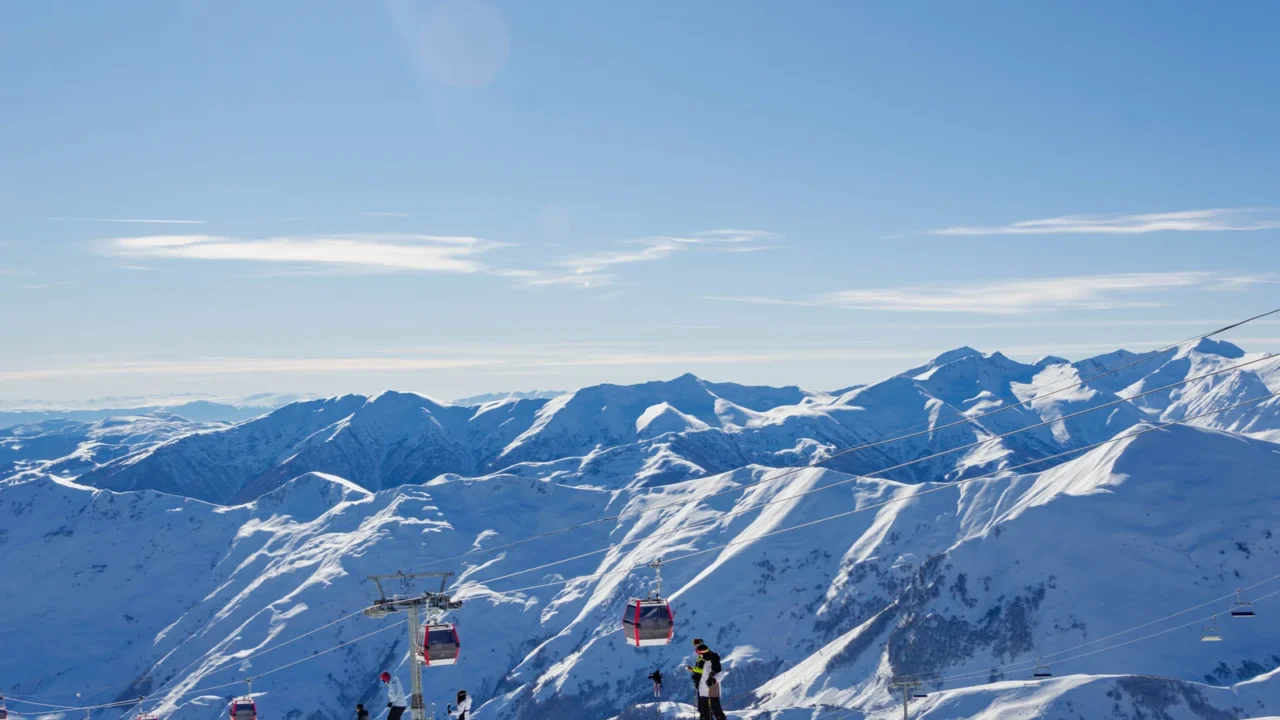
Featured photograph: Snow-covered peaks, gondolas and ski slopes at Gudauri. Photo date unverified. Photo: Alexander Fadeev / Pexels. Pexels License. Resized and converted to WebP.
- Mountain Trails Agency: October 28, 2026 winter-opening announcement.
- Mountain Trails Agency: Gudauri resort and lift-status page.
- Mountain Trails Agency: planned 2026–27 Gudauri infrastructure upgrades.
- Mountain Trails Agency: passes, cards, and operating-status guidance.
- Georgia Travel: Gudauri, for destination geography and the Kobi connection.
- Georgia Travel: visiting Gudauri in winter, for transport and general visitor context.
- Roads Department: dated Gudauri–Kobi avalanche restriction notice, an example of section-specific restrictions rather than today’s road status.
- UK FCDO: Georgia safety and security, including mountain activities.