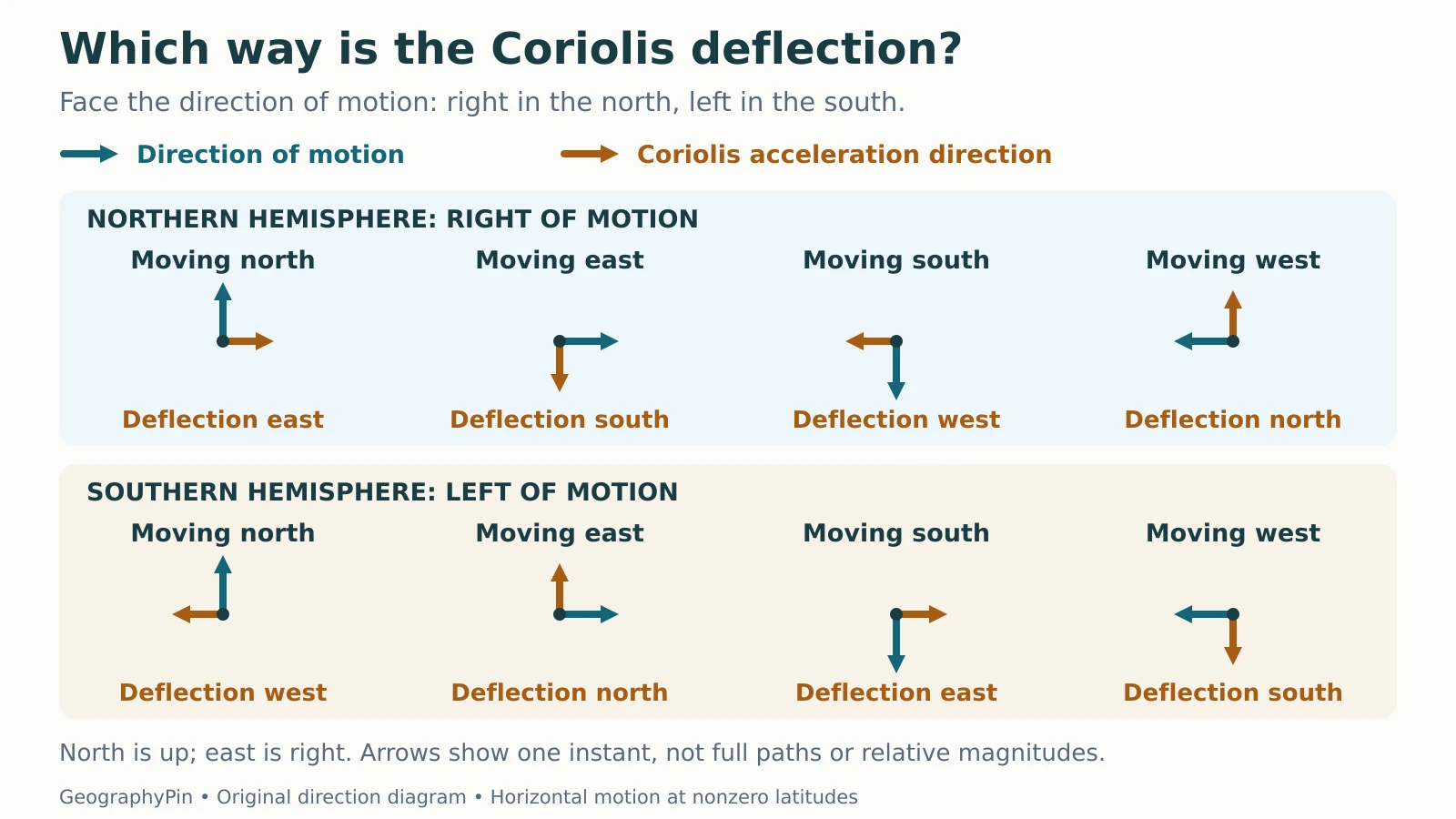
Air is deflected to the right in the Northern Hemisphere, yet winds around a northern low-pressure system circulate counterclockwise. That apparent contradiction disappears when you separate right of the moving air from clockwise around a center. Start with the direction of motion, then ask what the Coriolis contribution changes.
For horizontal motion, the Coriolis contribution acts to the right of travel in the Northern Hemisphere and to the left in the Southern Hemisphere. Right and left follow the moving object, not the page. This is an instantaneous acceleration direction, not a completed turn or a prediction of the whole path.
How to use this article: You can apply right and left correctly, compare all eight compass cases, resolve the low-pressure puzzle, or check a diagram step by step.
Face the Motion Before Choosing Right or Left
Use the traveler’s perspective
The NOAA Coriolis tutorial gives the familiar hemisphere rule. To apply it, imagine facing the same way as the moving air. Northward motion has east on its right; southward motion has west on its right. “Right” therefore cannot mean “east” in every example.
In the Southern Hemisphere, choose the other side. Air moving north has west on its left, while air moving south has east on its left. Use latitude to identify the hemisphere, not longitude or the position of the arrow on a page. The latitude and longitude guide explains those coordinate labels.
Also distinguish a motion arrow from a wind name. As NOAA’s wind lesson notes, meteorological winds are named for where they come from. A northerly wind moves toward the south. Apply the rule to that southward motion, not to the word “north.”
Eight Compass Cases Make the Rule Visible
Compare motion with its perpendicular contribution
The diagram separates two different quantities. Blue shows the instantaneous direction of motion; orange shows the horizontal Coriolis acceleration contribution. Acceleration means a change in velocity, so an orange arrow is not a second wind blowing independently.

| Motion toward | Northern Hemisphere | Southern Hemisphere |
|---|---|---|
| North | East, to the right | West, to the left |
| East | South, to the right | North, to the left |
| South | West, to the right | East, to the left |
| West | North, to the right | South, to the left |
The orange contribution is perpendicular to the current motion. If the motion changes direction, its right or left side changes too. The diagram does not instruct an air parcel to make an immediate 90-degree corner, nor does it show the net acceleration from every influence.
Why a Northern Low Can Circulate Counterclockwise
Separate the local right turn from circulation around a center
Picture air north of a Northern Hemisphere low, initially moving south toward the center. Right of south is west, so its Coriolis contribution points west. At the north side of a circle, westward motion is the counterclockwise direction. The two descriptions are consistent.
Try the same reasoning west of the low: initially inward motion is eastward, whose right side is south. Southward motion on the west side again fits counterclockwise circulation. These are direction checks, not a simulation of how a real storm develops.
The Met Office’s overview describes the opposite circulation senses around highs and lows in each hemisphere. Northern lows generally circulate counterclockwise and northern highs clockwise; the Southern Hemisphere pattern reverses.
Other forces are essential. The pressure-gradient force points toward lower pressure, while surface friction changes wind speed and the balance of influences. Penn State’s force-balance lesson explains why surface winds can cross pressure contours toward a low while also circulating around it.
A curved path requires a net acceleration, so do not describe an entire curved cyclone circulation as an exact balance between the pressure-gradient and Coriolis forces alone. Most importantly, Coriolis alone does not determine the storm’s wind field or its travel direction.
The Rule Comes from a Rotating Viewpoint
We describe weather from Earth’s rotating surface. A coordinate system attached to that surface is itself turning, so its description of motion needs rotation-related terms. The Coriolis term depends on velocity relative to that rotating system.
Penn State’s treatment of apparent forces derives this relationship. Calling Coriolis an apparent force does not mean that the observed deflection is an illusion to ignore. It means the term arises from the reference frame rather than a separate physical agent pushing sideways.
An ideal freely moving ball viewed from above a rotating platform can travel straight in the nonrotating view but appear curved to someone riding the platform. This illustrates the viewpoint change. Real wind is also acted on by pressure gradients, gravity and friction, so the demonstration is not a claim that actual air always travels straight when viewed from space.
Coriolis does not start motion from rest relative to Earth. For the horizontal contribution shown here, it changes direction without directly supplying the energy that drives the flow.
Speed and Latitude Change the Contribution
The NOAA motion worksheet relates horizontal Coriolis acceleration to speed and latitude. For horizontal speed U, its magnitude is 2ΩU × |sin φ|, where Ω is Earth’s rotation rate and φ is latitude. The absolute-value bars keep a magnitude nonnegative; hemisphere determines the side.
At the same latitude, doubling speed doubles this acceleration contribution. At the same speed, its magnitude increases toward the poles. Because sin 30° is 0.5 and sin 60° is about 0.866, the contribution at 60° has about 1.73 times the magnitude at 30°. Equal northern and southern latitudes give equal magnitudes but opposite sides of deflection.
At the equator, this usual horizontal deflection of horizontal motion is zero. That carefully limited statement does not say every component of the full three-dimensional Coriolis effect vanishes there.
Acceleration is not force: multiplying acceleration by mass gives force. A larger air mass does not, by that fact alone, receive a larger Coriolis acceleration. Longer duration can allow deflection to accumulate, but time is not an extra factor increasing the instantaneous acceleration.
Check the Scale and the Question Being Asked
Use a four-step direction check
- Identify the hemisphere from latitude.
- Find the actual direction of motion, translating wind names if necessary.
- Choose the perpendicular right or left direction from the moving object’s perspective.
- State that this is the Coriolis contribution, then consider other forces before describing the full path.
For example, air moving west in the Southern Hemisphere has south on its left. If a diagram places its horizontal Coriolis arrow north, it has reversed the rule. That conclusion still does not tell you the air’s speed or where it will be an hour later.
The importance of Earth’s rotation also depends on the scale and duration of motion compared with other influences. Penn State’s small-scale discussion explains why ordinary sinks are dominated by basin geometry and preexisting motion, rather than offering a reliable hemisphere test. The existing Geographic Myths guide covers that misconception in detail.
To practice atmospheric direction and pressure questions, use the Climatology and Meteorology Quiz. Keep the diagram’s arrows as a reasoning aid, not a substitute for an observed or forecast wind map.
What Did We Learn Today?
Right and left in the Coriolis rule are relative to motion, not fixed compass directions. The eight cases identify an instantaneous horizontal acceleration contribution. Counterclockwise flow around a northern low is consistent with that local rule, but its full circulation also involves pressure gradients, friction and path curvature. Speed, latitude and scale determine how useful the simplified picture is.
Sources & Data Notes
The diagram and compass exercises are original schematic teaching material, not measurements or a weather simulation. Direction checks use east–north components: for velocity (u, v), the horizontal Coriolis contribution is (fv, −fu), with f = 2Ω sin φ. The table and labels were checked against this relationship. Arrow lengths do not represent comparable physical magnitudes.