A school atlas can put a capital symbol beside Bern, while Switzerland’s own authorities call it the federal city. The two descriptions grew out of the way a federation chose a seat for its institutions.
Bern functions as Switzerland’s capital. The Federal Assembly chose it as the seat of the federal authorities in 1848, and Swiss authorities call it the federal city. The federal constitution does not designate an official national capital. Several federal courts sit elsewhere, so Bern’s role is clearest when described institution by institution.
How to use this article: Jump to the discussion you need: A French or German label for the same place, What was actually being selected or Using a world map or a government directory.
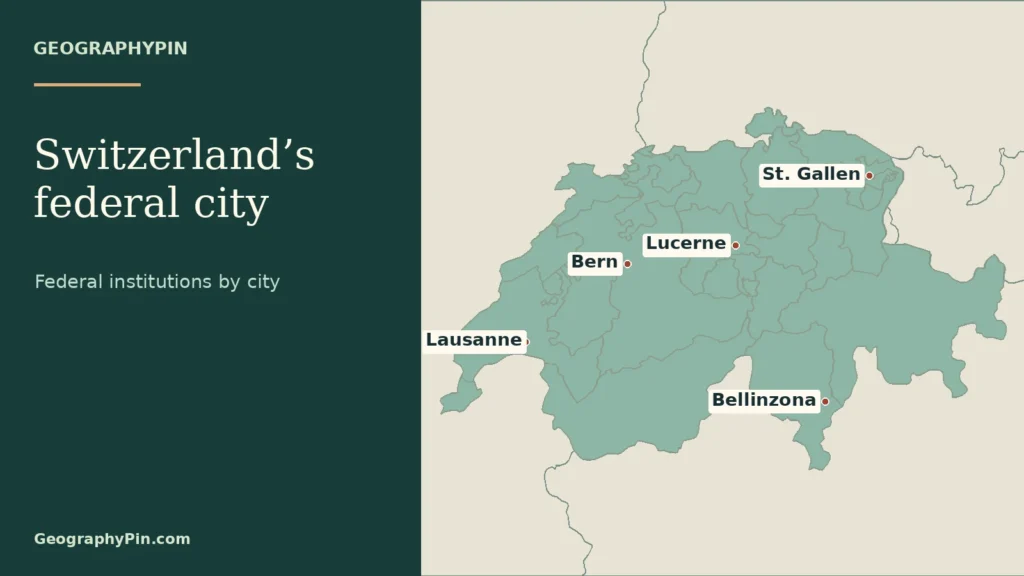
Where Switzerland’s federal business takes place
| City | Institution or function | How to read the location |
|---|---|---|
| Bern | Parliament and Federal Council | The main center of federal political decisions. |
| Lausanne | Federal Supreme Court | Principal seat of the highest court. |
| Lucerne | Divisions of the Federal Supreme Court | Some Supreme Court work takes place here. |
| Bellinzona | Federal Criminal Court | A distinct federal court in Ticino. |
| St. Gallen | Federal Administrative Court and Federal Patent Court | Federal judicial institutions in eastern Switzerland. |

A federal institution can sit far from the city in which legislators appointed its members. This is especially visible in Switzerland, where the national political center, the largest city and major judicial seats are different places. The table identifies institutions, rather than sorting cities by population or international prominence.
A French or German label for the same place
Federal information appears in several national languages. Berne is the French spelling and Bern is the German spelling familiar on many English-language maps. Bundesstadt and ville fédérale both describe the federal city. Changing the language of a directory changes the labels, while the Federal Assembly continues to meet in the same place.
The decision the Assembly made in 1848
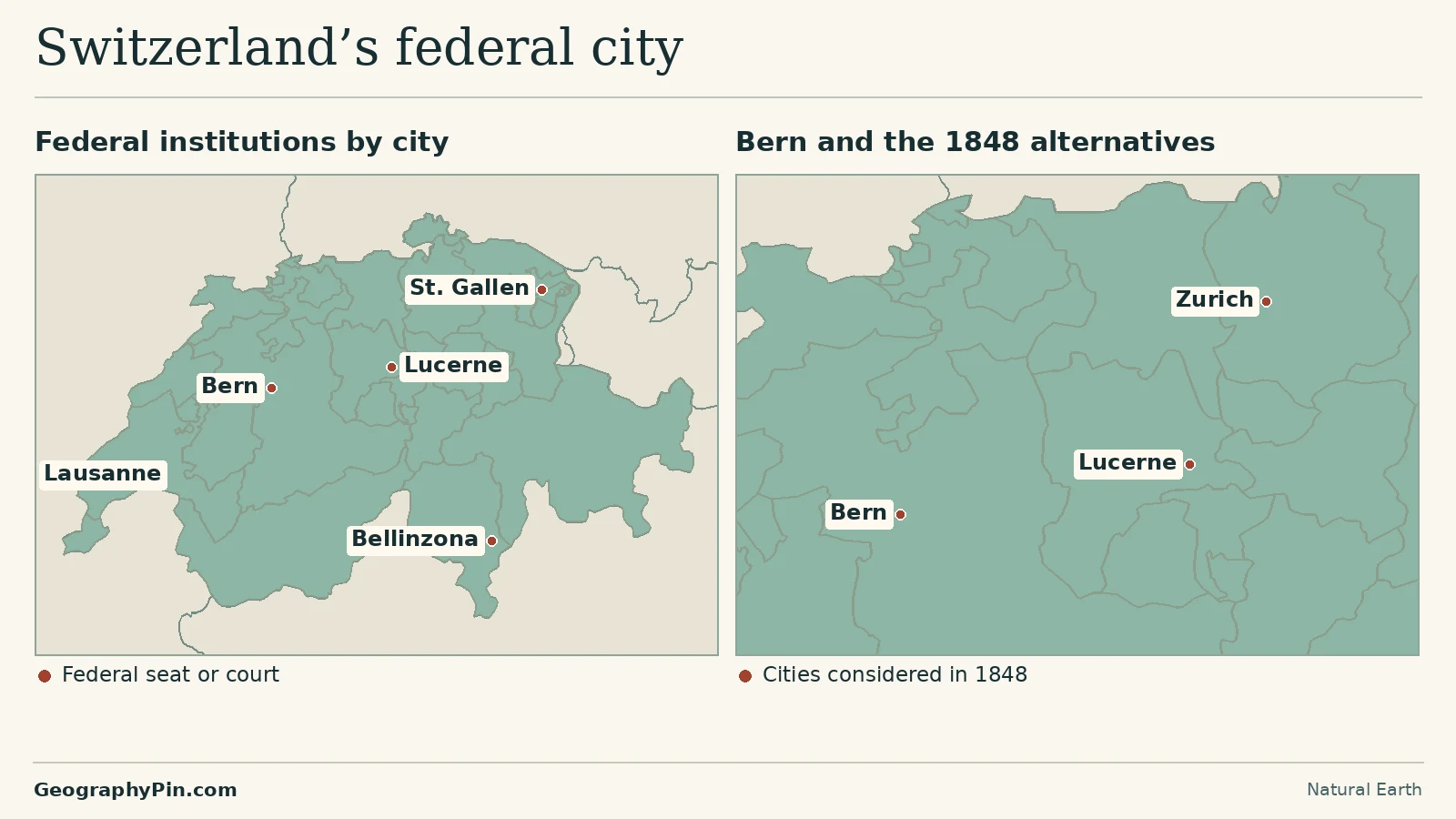
The new federal state needed a regular meeting place. Previously, the confederation had conducted important business in different cantonal centers. When the Federal Assembly voted, Bern prevailed over Zurich and Lucerne. Bern’s location and its political acceptability mattered in a federation balancing language regions and cantonal interests.
What was actually being selected?
The decision provided a workable home for parliament and the executive. It did not turn municipal Bern into a national district outside the cantonal system. Bern remains a city within the canton of Bern and serves as that canton’s capital as well. Calling it a federal city describes a function, rather than a special territory like Washington, D.C. Compare that choice with Nigeria’s relocation of its federal seat from Lagos to Abuja, which involved moving institutions into a newly planned capital.
Why Geneva and Zurich appear in the same conversation
Geneva hosts major international institutions. These are global or intergovernmental bodies with their own legal identities. Their presence does not place the Swiss parliament in Geneva. Zurich is a large economic and transport center, but a railway timetable or banking map answers a different question from the federal directory.
Using a world map or a government directory
For a world capitals reference, Bern is the useful answer. For a question about filing a case or locating a particular court, use the institution’s name and official seat. For a constitutional comparison, note the absence of an explicit capital designation. The same country can supply all three answers without changing its geography.
Why Switzerland’s federal institutions are in several cities
Bern, Lucerne and Zurich are all plausible dots on a small map of Switzerland. What the Federal Assembly needed in 1848 was a working location for federal political institutions under the new constitution. Selecting Bern directed officials, legislative sessions and a growing administrative presence there. It did not require every part of the federal system to share the same address.
The table of federal institutions and their seats locates the Federal Supreme Court in Lausanne and the Federal Criminal Court in Bellinzona. A court’s address tells a litigant where that institution sits; the federal legislature still meets in Bern.
Frequently Asked Questions
Is the whole federal administration in Bern?
No. The main political authorities meet there, but federal offices and courts are distributed. Even the Federal Supreme Court has work in more than one city.
Why do English-language maps sometimes spell the name Berne?
Berne is the French spelling, also found in English usage. Bern is the German form commonly used on English-language maps. Both refer to the same federal city.
What Did We Learn Today?
The 1848 choice gave parliament and the executive a home. The rest of the institutional map explains why a capital star is adequate for a quiz and insufficient for locating a federal court.
Sources & Data Notes
The vote date and terminology follow Swiss federal and national museum accounts. Court seats follow the Federal Chancellery’s 2026 institutional guide.