Athens is a university city, a music center and a community shaped by rivers and local institutions. Understanding its place in northeast Georgia means looking beyond the campus and recognizing the modern Athens–Clarke County government that surrounds the historic town.
A university city with a wider story
Athens is a city in northeast Georgia, United States, known for the University of Georgia and its influential music scene. It lies in the Piedmont, along the North and Middle Oconee rivers. Modern Athens–Clarke County has a unified government; Census figures distinguish its balance area from separately incorporated municipalities.
Find your starting point: Explore the river landscape, understand Athens–Clarke County, or discover the city’s music and working life.
1. A university city in northeast Georgia
Athens lies in the northeastern part of the U.S. state of Georgia, in the rolling Piedmont landscape. This is Athens in the United States, not the Greek capital. Its name nevertheless makes a deliberate connection: John Milledge named the town after the ancient center of learning as a community developed around the University of Georgia.
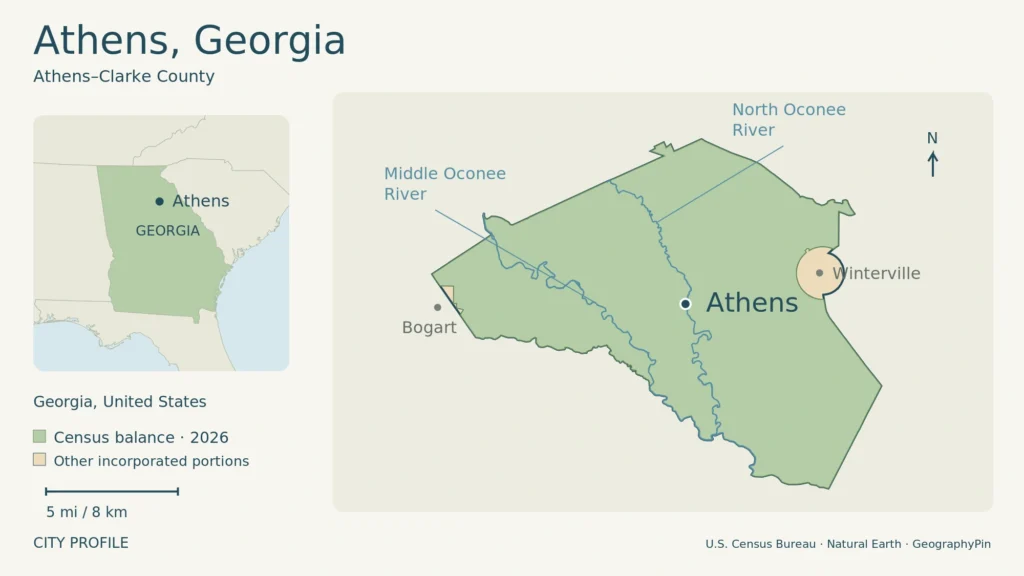
Green shows the Census balance used for the statistics. Tan marks separately incorporated portions inside the full Athens–Clarke unified area; Bogart also extends beyond it. Dots are representative geographic points, not downtown landmarks. Enlarge map.
Two rivers shape the local landscape
The North Oconee and Middle Oconee rivers flow through Athens–Clarke County. They meet south of Athens at the university’s Whitehall Forest, forming the Oconee River. The county’s Greenway Network Plan describes wide, relatively shallow river channels interrupted by shoals, with streams and floodplains forming an important part of the local landscape.
Those waterways connect the city’s built environment with its natural setting. The greenway follows river and tributary corridors, protecting natural resources while providing places for public recreation. Springs influenced the choice of the university site, and early settlement included a mill beside the river. Water was part of Athens’s development long before it became a feature of today’s park network.
2. Understanding Athens–Clarke County
A unified government, with separate municipalities
The former Athens city and Clarke County governments combined following a referendum approved in August 1990. Officials of the new unified government took their oaths on January 14, 1991. That change expanded the meaning of Athens as a local-government area beyond the older city.
Winterville and Bogart retain separate municipal roles. The distinction has practical effects: Athens–Clarke County’s business-registration guidance directs businesses inside those cities to register with their own municipalities. The unified area is therefore not simply one undifferentiated city jurisdiction.
For population and land area, this profile uses the Census Bureau’s Athens–Clarke County unified government (balance). “Balance” means the portion outside separately incorporated places. It excludes Winterville and the part of Bogart within the consolidated area. It is also different from the wider Athens metropolitan region.
The Census Bureau estimated 128,612 residents on July 1, 2025 for this balance area. Its April 1, 2020 census count was 127,315. These figures describe the modern Census geography, not the footprint of the old city or the wider metropolitan region.
3. The university and the town’s beginnings
The University of Georgia received its state charter in 1785, but the Athens site was selected in 1801. These are different stages in the institution’s history: a legal charter did not immediately create a functioning campus at this location.
John Milledge acquired 633 acres beside the Oconee for the university. Its first graduating class completed its studies in 1804. Athens was incorporated in 1806, so the university’s establishment and the town’s early development were closely connected rather than separate stories.
The institution’s modern role extends beyond undergraduate teaching. Research, professional education and public service all form part of its work. This gives Athens connections to agricultural, scientific and professional communities across Georgia and beyond, while keeping a university at the center of the city’s identity.
Education is a strong thread through Athens’s history, but it is not the whole fabric. The city also developed commercial and cultural institutions serving residents outside the university. The Morton Theatre is an especially useful example of that broader civic life.
4. Black community life and integration
Monroe Bowers “Pink” Morton’s building brought entertainment and professional services together in downtown Athens. Completed in 1910, the Morton Theatre opened on May 18 with a piano concert by Alice Carter Simmons. Black and white patrons attended that opening performance.
The building also housed Black doctors, dentists, pharmacists and other businesses. Its importance therefore reaches beyond the stage: it was a place where cultural life and the work of a Black business community shared an address. Reading the building only as a historic performance venue misses that everyday economic role.
The University of Georgia’s integration in 1961 marked a different struggle over access to civic institutions. After a federal court ordered their admission, Charlayne Hunter and Hamilton Holmes began classes on January 9, becoming the university’s first Black students. UGA Libraries’ archival account records the hostility and violence that accompanied their arrival.
These histories belong together without being interchangeable. The Morton building shows community institution-building under segregation; the integration story concerns the challenge to exclusion at a public university. Both are essential to understanding Athens beyond its college-town image.
5. Music, research and the working city
A music scene with local roots
Athens became widely associated with alternative rock and new wave through bands including R.E.M. and the B-52s. University students and college radio helped sustain the setting in which that music circulated. The city’s musical identity grew through local relationships as well as through the later fame of individual performers.
UGA Special Collections preserves evidence of that creative work in its Underground Sound Collection. Recordings made at Robbie Collins’s studio between 1987 and 1992 include R.E.M., Love Tractor and other local musicians. Such collections show the practical infrastructure behind a scene: recording spaces, musicians, radio and audiences all mattered.
Athens’s economy is broader than education and entertainment. The local economic-development department identifies advanced manufacturing, biotechnology and pharmaceuticals, healthcare and the creative economy among its target sectors. Its industry examples include hospitals, pharmaceutical businesses and manufacturers, alongside creative enterprises.
These activities connect different kinds of work. Universities conduct research and train specialists; healthcare providers serve the surrounding region; factories and laboratories produce goods and develop technologies. Music and other creative work add another strand. Together they explain why Athens is both a university center and a working regional city, rather than simply a campus with shops around it.
6. Athens facts at a glance
| Fact | Value |
|---|---|
| Location | Northeast Georgia, United States; Piedmont region |
| Government unification | Referendum in 1990; new officials sworn in during 1991 |
| 2020 census population | 127,315 on April 1, 2020 |
| Population estimate | 128,612 on July 1, 2025; Vintage 2025 |
| Land area | 116.33 square miles (301.29 square kilometers), 2020 Census geography |
| Principal rivers | North Oconee and Middle Oconee |
For campus walks, music evenings, garden visits and arrival choices, use the Athens travel guide.
What Did We Learn Today?
Athens grew around the University of Georgia, but its identity also includes Black business institutions, the struggle for integration and an influential music scene. Its rivers connect the built city to the Piedmont landscape. Modern population figures refer to Athens–Clarke County’s balance area, not simply the historic town or the wider metropolitan region.
Sources & Data Notes
Open sources and data notes
Population and land area use the Census Bureau’s Athens–Clarke County unified government (balance), excluding separately incorporated places. The 2025 population estimate and 2020 census count are separate releases; land area refers to 2020 geography. Metric area is rounded. The older municipal community brochure is used only for historical and geographic background, not its outdated population or university enrollment. Economic target sectors describe local development priorities, not a ranking by employment.
Original GeographyPin map using U.S. Census Bureau 2026 TIGER/Line consolidated-city, balance and water geography, with boundaries dated January 1, 2026, and Natural Earth v5.1.1 state context. Map vintage is separate from the 2020 land-area figure.
- U.S. Census Bureau: Athens–Clarke County unified government (balance), QuickFacts
- U.S. Census Bureau: consolidated-city balance definition
- Athens–Clarke County: unification anniversary and timeline
- Athens–Clarke County: business registration jurisdictions
- Athens–Clarke County: Greenway Network Plan, 2025 update, pp. 13–16
- Athens–Clarke County: community background
- University of Georgia Bulletin: university history and mission
- Athens–Clarke County: history and the city name
- Morton Theatre: building and community history
- UGA Libraries: university integration archival guide
- UGA Special Collections: Underground Sound Collection
- Athens–Clarke County Economic Development: target sectors